

Apple lost its two-year bid on Wednesday morning in Luxembourg to narrow the EU Digital Markets Act’s reach over the App Store and iOS, as the General Court dismissed every Apple action and confirmed its gatekeeper designation. The ruling is not just another Europe-versus-Big-Tech skirmish. It is the first serious judicial stress test of the DMA’s gatekeeper machinery, and Apple did not merely lose on the margins. The court left the Commission’s core architecture intact and, just as importantly, told Apple and the other gatekeepers that they cannot litigate DMA obligations in the abstract before a specific enforcement decision lands.
That is the real story. Apple wanted to fight the DMA at the level of principle: what counts as a platform, how far interoperability can go, whether a closed ecosystem can be treated as one integrated choke point rather than a set of separate products. The General Court instead forced the fight down into the enforcement pipeline, where Apple will have to contest specific Commission orders one by one. For EU iPhone users, developers, rival services, and enterprise IT teams managing Apple fleets, the message is blunt: the DMA framework survives, the designation stands, and the compliance arguments now move from courtroom theory to operational reality.
Apple’s central pitch was familiar because it is the company’s central product philosophy: the iPhone, iPad, Mac, Apple Watch, and Apple TV are distinct experiences, each with its own hardware context, user expectations, and software surface. In court, that became a legal argument. Apple maintained that its App Stores for iPhone, iPad, Mac, Apple Watch, and Apple TV should be treated as separate services rather than consolidated into a single designated core platform service.
The General Court did not buy it. The judges treated the stores functionally: each connects developers with end users so software can be distributed. Whether the storefront is reached through a phone, tablet, watch, TV box, or computer did not change the basic intermediary role Apple plays between software makers and users.
That matters because the DMA is built around gatekeeping power, not branding segmentation. Apple’s argument, if accepted, would have given large platforms a template for slicing integrated ecosystems into narrower legal units. A company could then say that obligations applied to this store but not that one, this device class but not that one, this user pathway but not the broader business model that makes the pathway valuable.
The court’s answer was narrower but more damaging to Apple: if the function is unified, the legal treatment can be unified. That is a major win for the Commission because the DMA depends on a regulator’s ability to identify bottlenecks at ecosystem scale. A law aimed at gatekeepers would become much weaker if the gatekeeper could redraw the gate after designation.
The Luxembourg-based court, sitting in its Eighth Chamber with five judges, said it plainly: “The General Court dismisses all the actions brought by Apple.” It also confirmed “the designation of Apple as a gatekeeper in relation to the App Store and iOS.” For a company that has spent years arguing that regulatory intervention risks degrading user trust, privacy, and security, the court’s terse formulation had a different emphasis: Apple is big enough, central enough, and structurally important enough to remain inside the DMA’s hardest obligations.
The iMessage point is easy to misunderstand. Apple did not lose because the court said iMessage must be regulated as a gatekeeper service. It lost because the court found the challenge inadmissible: iMessage had not been listed in a designation decision as an important gateway, so no DMA obligations attached to it. In the court’s words, “None of the obligations laid down by the DMA applies to iMessage since that service has not been listed in a designation decision as an important gateway.”
That is procedurally clean but strategically significant. Apple wanted to erase or narrow a classification before it became operationally dangerous. The court said there was not yet a reviewable legal injury. That same logic becomes the spine of the broader judgment: designated companies cannot pre-litigate the entire DMA before Brussels has converted general obligations into specific enforcement acts.
The table looks procedural, but the practical consequence is direct. Apple’s effort to narrow the DMA at the designation stage failed. Its attempt to challenge potential downstream obligations before those obligations were enforced also failed. That combination leaves the Commission with room to keep developing its DMA enforcement program without having the entire regime frozen by pre-emptive litigation from every designated platform.
That distinction will frustrate both sides. Apple can plausibly say that its deepest objections remain unresolved. The Commission can plausibly say that the gatekeeper designation has survived and that enforcement can continue. The practical result is that Apple’s substantive arguments about security, privacy, proportionality, and technical feasibility are not gone; they have been pushed into later cases.
Assimakis Komninos, a Brussels competition-law partner at White & Case, captured the judgment’s procedural message in two words: “It’s premature.” In his reading, Apple tried to contest interoperability requirements before the Commission had issued a specific enforcement decision. The court’s response was not to decide every future technical question, but to refuse the attempt to litigate them early.
Pierre Larouche, Chair of Law and Innovation at the Université de Montréal, made the same point from another angle. The refusal to entertain Apple’s arguments against the DMA’s interoperability obligations means those arguments will come back in another case. That is not a small caveat. It means the judgment strengthens the DMA as a process, while leaving room for fights over particular Commission demands.
Alba Ribera Martínez, an assistant professor in law and technology at VU Amsterdam, warned that this procedural approach may carry risks of its own. If some Commission decisions closing market investigations cannot be appealed before the courts, the limitation could become, in her words, “quite dangerous.” That is the harder institutional question behind the Apple headline: a fast-moving digital regulator needs discretion, but too much procedural insulation can make the regulator’s negative decisions unusually hard to test.
For now, however, the operational message is unmistakable. The gatekeeper cannot stop the machine at the front door. It must wait until the machine produces an order.
The interoperability record is even more combustible. According to FSFE interoperability research by the Free Software Foundation Europe, as of March 22, 2026, not one of the 56 formal interoperability requests Apple received under DMA Article 6(7) had resulted in a working solution. Examples of denied feature access included Just-in-Time compilation, NFC protocols, and Bluetooth Low Energy Audio. Apple’s recurring position has been that many requested features fall outside the scope of the law.
That is where the court’s sequencing rule becomes more than a lawyer’s abstraction. If a platform can reject requests, narrow the scope of compliance, and then challenge the whole obligation before enforcement, delay becomes a strategy. The General Court’s judgment blocks that route. It does not prove Apple’s denials were unlawful, but it makes clear that the fight over those denials belongs in specific enforcement proceedings, not in a broad attack on the designation architecture.
The Commission has already opened two specification proceedings on iOS connectivity and interoperability transparency in 2024 and 2025. It also issued preliminary findings in a separate Article 6(4) investigation on April 23, 2025. That same day, it levied the first DMA fine ever: €500 million against Apple for restricting App Store developers from steering users toward cheaper purchasing options outside the App Store.
That fine is not resolved by Wednesday’s ruling. Apple is separately contesting it. But the proximity of these events tells the larger story: Brussels is no longer debating whether Apple’s ecosystem power is theoretically significant. It is testing whether Apple’s actual implementation gives rivals and developers meaningful access or merely formal access.
Apple’s response after the ruling stayed on message. “We firmly believe the DMA’s mandate goes beyond what is lawful and proportionate, threatening to erode decades of privacy and security protections we’ve built and leaving our users vulnerable to new risks,” an Apple spokesperson said. The company added: “We will continue advocating for the innovation and privacy our European customers deserve.”
That argument will continue to resonate with some users and administrators. Apple’s security model is not imaginary. The company’s tight control over app distribution, hardware access, background services, payments, and inter-app behavior has real security benefits. But the DMA dispute is not about whether closed systems can be safer in some respects. It is about whether a company with Apple’s market position can use that safety argument to preserve every commercial bottleneck indefinitely.
At the time, the DMA still had the feel of a constitutional experiment. Europe had written a law aimed not merely at punishing past anticompetitive conduct, but at restructuring the default rules for large digital platforms. Gatekeepers would face upfront obligations: allow certain forms of interoperability, stop self-preferencing, permit business users to steer customers, and reduce the ability of dominant platforms to lock in users and developers.
Apple’s court challenge was the first serious attempt to see how much of that framework would survive contact with judicial review. The answer, at least at the General Court level, is: enough to matter. The law’s designation mechanism remains standing. Apple’s attempt to split its App Stores into device-specific services failed. Its iMessage challenge failed because no obligations attached. Its broader attempt to contest obligations before enforcement failed as premature.
That does not make the Commission omnipotent. Each specification proceeding, non-compliance decision, and fine can still produce its own legal fight. Apple can appeal Wednesday’s ruling to the Court of Justice of the European Union, but only on points of law, not on a fresh review of the facts. That is a narrower path than relitigating whether the App Store ecosystem is functionally unified.
The effect is to move the DMA out of the “will this survive?” phase and into the “how hard will Brussels enforce?” phase. For developers, rival browser makers, payment providers, cloud services, accessory makers, and AI assistant providers, that is a material change. The legal backdrop against which they negotiate with Apple has shifted. Apple can still resist specific demands, but the baseline designation is no longer hanging by the same thread.
The common lesson is procedural. A gatekeeper cannot ask the court to invalidate the practical bite of the DMA before the Commission has put that bite into a specific decision. For large platforms, that removes a powerful delay tactic. For the Commission, it preserves the ability to build the law through enforcement rather than having its entire theory frozen at the threshold.
That is especially relevant for Microsoft watchers. WindowsForum readers tend to see the DMA through the lens of Windows choice screens, Edge, Bing, cloud infrastructure, identity services, and enterprise integration rather than through iOS app distribution alone. The Apple ruling does not decide any Microsoft-specific obligation. But it does suggest that, if the Commission designates or specifies obligations against a platform, the company’s best legal challenge will likely come after the concrete decision, not before.
The same logic applies to cloud. If Brussels treats cloud infrastructure as a gatekeeping layer, the platforms under investigation will want to argue that enterprise buyers are sophisticated, markets are contestable, and interoperability obligations are technically or commercially overbroad. Wednesday’s judgment suggests those arguments may need to wait for a final designation or enforcement act rather than being used to derail the inquiry in advance.
This is why the ruling is bigger than Apple’s European App Store terms. It strengthens a regulatory sequencing model that favors administrative momentum. The Commission investigates, designates, specifies, and enforces; the platform challenges when a concrete legal effect arrives. That model may be efficient. It may also create pressure points where companies feel compelled to redesign products before courts have tested the outer limits of the Commission’s interpretation.
September 2023 — The Commission designated iOS, the App Store, and Safari as Apple core platform services subject to gatekeeper obligations.
2024 and 2025 — The Commission opened two specification proceedings on iOS connectivity and interoperability transparency.
April 23, 2025 — The Commission issued preliminary findings in a separate Article 6(4) investigation and imposed the first DMA fine ever, €500 million against Apple over App Store steering restrictions.
October 2025 — Apple lost at tribunal level in the UK Kent App Store case, with claims valued at up to £1.5 billion and the matter now at the Court of Appeal.
March 22, 2026 — FSFE interoperability research recorded 56 formal Apple interoperability requests under DMA Article 6(7), with no working solution resulting from them as of that date.
June 2026 — Italy’s AGCM opened an investigation into Apple’s iCloud interoperability, and a separate Which? iCloud class action was certified in the UK.
Wednesday morning — The General Court, sitting in its Eighth Chamber with five judges, dismissed all Apple actions and confirmed Apple’s gatekeeper designation for the App Store and iOS.
July 27, 2026 — Binding decisions are due in Alphabet’s two pending EU Commission specification proceedings.
The Commission has framed the issue differently. In its telling, Apple chose not to launch rather than offering a compliant solution that would provide equal opportunity to rival AI assistants. That disagreement is not resolved by Wednesday’s ruling. But the sequencing rule tells us how the legal fight is likely to unfold if the dispute matures: Apple will need a specific enforcement decision before it can fully contest the demanded interoperability path in court.
For EU users, the result is maddeningly practical. The same law that preserves alternative app stores, browser choice, and external purchasing rights may also be cited by Apple as the reason certain new integrated features arrive late or not at all. The DMA’s defenders will say that is Apple weaponizing product delay to protect a closed ecosystem. Apple will say it is refusing to compromise privacy and security under an overbroad regulatory mandate.
Both claims can contain some truth. The DMA does force Apple to treat certain privileged system functions as contestable infrastructure. That is the point of the law. At the same time, AI assistants create harder risk questions than app store links or browser prompts because they may act across apps, infer context, and touch sensitive user data. Regulators and platforms are now fighting not over whether interoperability matters, but over who defines safe interoperability when the feature is an agent rather than a static API.
This is where the General Court’s ruling may have its largest future effect. It does not answer the Siri AI question, but it makes clear that Apple cannot use the general designation challenge to avoid the next round. If Brussels issues a specific order, the fight will be about the details of that order. Apple’s broad claim that the DMA mandate goes beyond what is lawful and proportionate will have to be translated into concrete objections about particular access rights, safeguards, timelines, and technical designs.
The UK is also becoming a serious litigation venue. Apple lost a class action at tribunal level in October 2025 in the Kent App Store case, with potential exposure of up to £1.5 billion, and that matter is now at the Court of Appeal. A separate Which? iCloud class action certified in June 2026 covers up to 39.7 million UK consumers and values potential damages at up to £3 billion.
None of those proceedings is decided by the General Court’s DMA ruling. But together they show why Apple’s European strategy is becoming harder to sustain. The company is no longer facing one regulator on one theory. It is facing a layered contest over app distribution, payment steering, cloud interoperability, operating-system access, and consumer damages.
That layered pressure changes incentives. A company can treat one fine as a cost of doing business. It can treat one market investigation as a negotiation. But when court rulings, Commission proceedings, national competition probes, and class actions all point toward the same basic complaint — that Apple gives its own services structural advantages inside a closed ecosystem — the legal risk compounds.
The Commission’s response to Wednesday’s ruling was measured. It called the decision an important step for DMA enforcement and for the pursuit of more contestability and fairness in digital markets. Consumer advocates were sharper. Agustín Reyna, director general of the European Consumer Organisation, said it was good news that the EU court confirmed Apple is a gatekeeper, arguing that anything less would have jeopardized the DMA’s positive impact in creating more online choice for consumers. He added that Apple’s energy would be better spent complying with the DMA “in full and without delay.”
Apple’s answer is that compliance without limits can harm the very users regulators claim to protect. That argument will not disappear. But after Wednesday, it is no longer an argument against being a gatekeeper. It is an argument Apple must attach to specific enforcement fights.
Before the ruling, Apple still had a live argument that the Commission had overreached in treating its App Store and iOS as gatekeeper services. After the ruling, those rights are much less likely to be unwound by a successful Apple challenge at the designation stage. Apple can still appeal to the Court of Justice of the European Union on points of law, but it cannot use that appeal to demand a fresh factual review.
The unresolved issue is quality. A right that exists on paper can be made unattractive in practice through friction, fees, warning screens, contractual complexity, limited APIs, or slow approval processes. Developers have said Apple’s EU changes often preserve the economics and control of the old model even while technically complying with the letter of the DMA. The Commission’s open investigations are where that claim will be tested.
Users should therefore expect a long, uneven transition. The DMA will not instantly turn iOS into Android, nor was that ever the goal. The more realistic outcome is a European version of iOS with more mandated seams: more choices at setup, more ways for developers to direct users outside Apple’s payment system, more pressure for interoperability with hardware and software features, and more regulatory scrutiny when Apple says no.
For Windows users and IT pros, the lesson is broader. Platform regulation is becoming a deployment variable. Just as privacy law changed cookie banners, consent flows, telemetry settings, and data-processing agreements, competition law is now changing operating-system behavior, app distribution, browser defaults, cloud interoperability, and AI feature rollout. Geography is no longer just a language or currency setting. It can determine which platform features exist.
The timing is hard to ignore. In one week, Europe’s courts locked in a massive legacy antitrust penalty against Google and preserved the DMA’s gatekeeper designation framework against Apple. Those are different laws, different courts, and different procedural postures. But together they show that Brussels’ digital competition project is not a press-release exercise.
There was a more nuanced Meta result before Apple’s defeat. The same General Court freed Facebook Marketplace from DMA designation after finding the Commission had not adequately justified that classification, while Facebook Messenger remained inside the rules. That nuance matters because it undercuts the simplistic argument that EU courts are merely rubber-stamping every Commission theory.
Apple’s loss stands out because it was total across the fronts it opened. The App Store argument failed. The iOS designation survived. The iMessage action was inadmissible. The premature challenge to obligations was blocked. If Meta showed that a gatekeeper can win when the Commission’s justification is weak, Apple showed that the court is not eager to dismantle the DMA’s foundation when the platform’s gatekeeping role is functionally obvious.
For Brussels, that is the best possible combination: judicial review with enough teeth to preserve legitimacy, but not so much skepticism that the DMA becomes unenforceable before it matures. For platforms, it is a warning that the strongest challenges will need to be specific, factual, and tied to concrete Commission errors. Grand arguments about ecosystem integrity may not be enough.
What it has done is more structural:
The result is a DMA that looks less like an experiment and more like a standing operating system for European platform regulation. Apple can still resist, appeal, redesign, delay, and argue that Brussels is endangering user security in the name of competition. But after Wednesday morning in Luxembourg, the company is doing all of that from inside the gatekeeper box, not outside it. For users, developers, and IT departments, the next phase will be less about whether the DMA applies and more about whether Europe can make its promised choices work in the real products people carry, manage, and depend on every day.
That is the real story. Apple wanted to fight the DMA at the level of principle: what counts as a platform, how far interoperability can go, whether a closed ecosystem can be treated as one integrated choke point rather than a set of separate products. The General Court instead forced the fight down into the enforcement pipeline, where Apple will have to contest specific Commission orders one by one. For EU iPhone users, developers, rival services, and enterprise IT teams managing Apple fleets, the message is blunt: the DMA framework survives, the designation stands, and the compliance arguments now move from courtroom theory to operational reality.
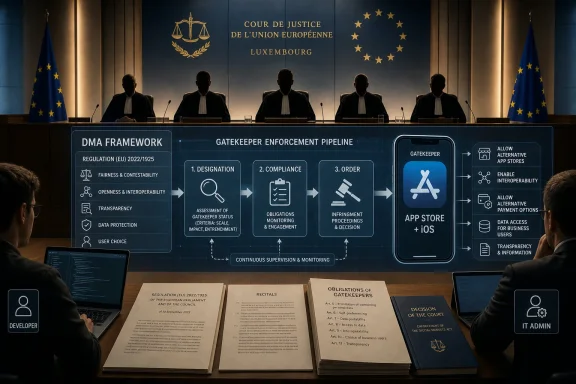 Luxembourg Turns Apple’s Ecosystem Argument Against It
Apple’s central pitch was familiar because it is the company’s central product philosophy: the iPhone, iPad, Mac, Apple Watch, and Apple TV are distinct experiences, each with its own hardware context, user expectations, and software surface. In court, that became a legal argument. Apple maintained that its App Stores for iPhone, iPad, Mac, Apple Watch, and Apple TV should be treated as separate services rather than consolidated into a single designated core platform service.The General Court did not buy it. The judges treated the stores functionally: each connects developers with end users so software can be distributed. Whether the storefront is reached through a phone, tablet, watch, TV box, or computer did not change the basic intermediary role Apple plays between software makers and users.
That matters because the DMA is built around gatekeeping power, not branding segmentation. Apple’s argument, if accepted, would have given large platforms a template for slicing integrated ecosystems into narrower legal units. A company could then say that obligations applied to this store but not that one, this device class but not that one, this user pathway but not the broader business model that makes the pathway valuable.
The court’s answer was narrower but more damaging to Apple: if the function is unified, the legal treatment can be unified. That is a major win for the Commission because the DMA depends on a regulator’s ability to identify bottlenecks at ecosystem scale. A law aimed at gatekeepers would become much weaker if the gatekeeper could redraw the gate after designation.
The Luxembourg-based court, sitting in its Eighth Chamber with five judges, said it plainly: “The General Court dismisses all the actions brought by Apple.” It also confirmed “the designation of Apple as a gatekeeper in relation to the App Store and iOS.” For a company that has spent years arguing that regulatory intervention risks degrading user trust, privacy, and security, the court’s terse formulation had a different emphasis: Apple is big enough, central enough, and structurally important enough to remain inside the DMA’s hardest obligations.
The Cases Were Separate, but the Loss Was Comprehensive
The ruling covered three separate cases: T-1079/23, T-1080/23, and T-214/24. Apple and Apple Distribution International sought relief from the Commission’s September 2023 decision designating iOS, the App Store, and Safari as core platform services subject to gatekeeper obligations. Apple also tried to attack the Commission’s treatment of iMessage as a number-independent interpersonal communications service, or NIICS.The iMessage point is easy to misunderstand. Apple did not lose because the court said iMessage must be regulated as a gatekeeper service. It lost because the court found the challenge inadmissible: iMessage had not been listed in a designation decision as an important gateway, so no DMA obligations attached to it. In the court’s words, “None of the obligations laid down by the DMA applies to iMessage since that service has not been listed in a designation decision as an important gateway.”
That is procedurally clean but strategically significant. Apple wanted to erase or narrow a classification before it became operationally dangerous. The court said there was not yet a reviewable legal injury. That same logic becomes the spine of the broader judgment: designated companies cannot pre-litigate the entire DMA before Brussels has converted general obligations into specific enforcement acts.
| Case | Apple’s target | Main service issue | Court result | Practical effect |
|---|---|---|---|---|
| T-1079/23 | Commission action tied to iMessage scrutiny | iMessage as a NIICS | Challenge rejected as inadmissible | No DMA obligations applied because iMessage was not listed in a designation decision |
| T-1080/23 | September 2023 gatekeeper designation | App Store, iOS, Safari | Apple’s action dismissed | App Store and iOS gatekeeper designation confirmed |
| T-214/24 | Commission handling of the iMessage market investigation | iMessage classification and closure | Challenge rejected as inadmissible | Apple could not contest a classification that produced no binding DMA obligations |
The Court Did Not Bless Every DMA Obligation; It Delayed the Fight
The most important part of the judgment is not a sweeping endorsement of every interoperability demand Brussels may eventually make. It is a sequencing rule. The court concluded that Apple was trying to challenge obligations that flow from designation before the Commission had issued specific enforcement decisions telling Apple exactly what to do.That distinction will frustrate both sides. Apple can plausibly say that its deepest objections remain unresolved. The Commission can plausibly say that the gatekeeper designation has survived and that enforcement can continue. The practical result is that Apple’s substantive arguments about security, privacy, proportionality, and technical feasibility are not gone; they have been pushed into later cases.
Assimakis Komninos, a Brussels competition-law partner at White & Case, captured the judgment’s procedural message in two words: “It’s premature.” In his reading, Apple tried to contest interoperability requirements before the Commission had issued a specific enforcement decision. The court’s response was not to decide every future technical question, but to refuse the attempt to litigate them early.
Pierre Larouche, Chair of Law and Innovation at the Université de Montréal, made the same point from another angle. The refusal to entertain Apple’s arguments against the DMA’s interoperability obligations means those arguments will come back in another case. That is not a small caveat. It means the judgment strengthens the DMA as a process, while leaving room for fights over particular Commission demands.
Alba Ribera Martínez, an assistant professor in law and technology at VU Amsterdam, warned that this procedural approach may carry risks of its own. If some Commission decisions closing market investigations cannot be appealed before the courts, the limitation could become, in her words, “quite dangerous.” That is the harder institutional question behind the Apple headline: a fast-moving digital regulator needs discretion, but too much procedural insulation can make the regulator’s negative decisions unusually hard to test.
For now, however, the operational message is unmistakable. The gatekeeper cannot stop the machine at the front door. It must wait until the machine produces an order.
Apple’s Compliance Record Made the Loss Bite Harder
Apple’s legal defeat lands against a compliance record that has already angered developers, consumer groups, and Brussels. The company has made visible DMA changes in Europe, including alternative app marketplaces and outside payment links beginning with iOS 17.5 and iPadOS 18. But Apple has also wrapped those changes in business terms, fees, notices, and implementation choices that critics say preserve much of the old control structure under a new regulatory label.The interoperability record is even more combustible. According to FSFE interoperability research by the Free Software Foundation Europe, as of March 22, 2026, not one of the 56 formal interoperability requests Apple received under DMA Article 6(7) had resulted in a working solution. Examples of denied feature access included Just-in-Time compilation, NFC protocols, and Bluetooth Low Energy Audio. Apple’s recurring position has been that many requested features fall outside the scope of the law.
That is where the court’s sequencing rule becomes more than a lawyer’s abstraction. If a platform can reject requests, narrow the scope of compliance, and then challenge the whole obligation before enforcement, delay becomes a strategy. The General Court’s judgment blocks that route. It does not prove Apple’s denials were unlawful, but it makes clear that the fight over those denials belongs in specific enforcement proceedings, not in a broad attack on the designation architecture.
The Commission has already opened two specification proceedings on iOS connectivity and interoperability transparency in 2024 and 2025. It also issued preliminary findings in a separate Article 6(4) investigation on April 23, 2025. That same day, it levied the first DMA fine ever: €500 million against Apple for restricting App Store developers from steering users toward cheaper purchasing options outside the App Store.
That fine is not resolved by Wednesday’s ruling. Apple is separately contesting it. But the proximity of these events tells the larger story: Brussels is no longer debating whether Apple’s ecosystem power is theoretically significant. It is testing whether Apple’s actual implementation gives rivals and developers meaningful access or merely formal access.
Apple’s response after the ruling stayed on message. “We firmly believe the DMA’s mandate goes beyond what is lawful and proportionate, threatening to erode decades of privacy and security protections we’ve built and leaving our users vulnerable to new risks,” an Apple spokesperson said. The company added: “We will continue advocating for the innovation and privacy our European customers deserve.”
That argument will continue to resonate with some users and administrators. Apple’s security model is not imaginary. The company’s tight control over app distribution, hardware access, background services, payments, and inter-app behavior has real security benefits. But the DMA dispute is not about whether closed systems can be safer in some respects. It is about whether a company with Apple’s market position can use that safety argument to preserve every commercial bottleneck indefinitely.
The DMA Is Now an Enforcement Regime, Not a Policy Debate
The DMA took effect in May 2023, and the Commission’s first gatekeeper designations followed in September 2023. Alphabet, Amazon, Apple, ByteDance, Meta, and Microsoft were the original six designated gatekeepers. That first designation decision put Apple’s iOS, App Store, and Safari inside the framework.At the time, the DMA still had the feel of a constitutional experiment. Europe had written a law aimed not merely at punishing past anticompetitive conduct, but at restructuring the default rules for large digital platforms. Gatekeepers would face upfront obligations: allow certain forms of interoperability, stop self-preferencing, permit business users to steer customers, and reduce the ability of dominant platforms to lock in users and developers.
Apple’s court challenge was the first serious attempt to see how much of that framework would survive contact with judicial review. The answer, at least at the General Court level, is: enough to matter. The law’s designation mechanism remains standing. Apple’s attempt to split its App Stores into device-specific services failed. Its iMessage challenge failed because no obligations attached. Its broader attempt to contest obligations before enforcement failed as premature.
That does not make the Commission omnipotent. Each specification proceeding, non-compliance decision, and fine can still produce its own legal fight. Apple can appeal Wednesday’s ruling to the Court of Justice of the European Union, but only on points of law, not on a fresh review of the facts. That is a narrower path than relitigating whether the App Store ecosystem is functionally unified.
The effect is to move the DMA out of the “will this survive?” phase and into the “how hard will Brussels enforce?” phase. For developers, rival browser makers, payment providers, cloud services, accessory makers, and AI assistant providers, that is a material change. The legal backdrop against which they negotiate with Apple has shifted. Apple can still resist specific demands, but the baseline designation is no longer hanging by the same thread.
The Ruling Reaches Beyond Cupertino
Apple is the named loser, but the court’s sequencing rule matters to every designated gatekeeper. Alphabet faces two pending EU Commission specification proceedings with binding decisions due by July 27, 2026. Meta is appealing a €200 million DMA fine while navigating separate consent-architecture enforcement proceedings. Amazon and Microsoft are under active EU cloud gatekeeper proceedings for potential cloud infrastructure gatekeeper designation. ByteDance continues to face DMA compliance scrutiny around TikTok.The common lesson is procedural. A gatekeeper cannot ask the court to invalidate the practical bite of the DMA before the Commission has put that bite into a specific decision. For large platforms, that removes a powerful delay tactic. For the Commission, it preserves the ability to build the law through enforcement rather than having its entire theory frozen at the threshold.
That is especially relevant for Microsoft watchers. WindowsForum readers tend to see the DMA through the lens of Windows choice screens, Edge, Bing, cloud infrastructure, identity services, and enterprise integration rather than through iOS app distribution alone. The Apple ruling does not decide any Microsoft-specific obligation. But it does suggest that, if the Commission designates or specifies obligations against a platform, the company’s best legal challenge will likely come after the concrete decision, not before.
The same logic applies to cloud. If Brussels treats cloud infrastructure as a gatekeeping layer, the platforms under investigation will want to argue that enterprise buyers are sophisticated, markets are contestable, and interoperability obligations are technically or commercially overbroad. Wednesday’s judgment suggests those arguments may need to wait for a final designation or enforcement act rather than being used to derail the inquiry in advance.
This is why the ruling is bigger than Apple’s European App Store terms. It strengthens a regulatory sequencing model that favors administrative momentum. The Commission investigates, designates, specifies, and enforces; the platform challenges when a concrete legal effect arrives. That model may be efficient. It may also create pressure points where companies feel compelled to redesign products before courts have tested the outer limits of the Commission’s interpretation.
Timeline
May 2023 — The Digital Markets Act took effect, giving the Commission a new ex ante competition tool for large digital platforms.September 2023 — The Commission designated iOS, the App Store, and Safari as Apple core platform services subject to gatekeeper obligations.
2024 and 2025 — The Commission opened two specification proceedings on iOS connectivity and interoperability transparency.
April 23, 2025 — The Commission issued preliminary findings in a separate Article 6(4) investigation and imposed the first DMA fine ever, €500 million against Apple over App Store steering restrictions.
October 2025 — Apple lost at tribunal level in the UK Kent App Store case, with claims valued at up to £1.5 billion and the matter now at the Court of Appeal.
March 22, 2026 — FSFE interoperability research recorded 56 formal Apple interoperability requests under DMA Article 6(7), with no working solution resulting from them as of that date.
June 2026 — Italy’s AGCM opened an investigation into Apple’s iCloud interoperability, and a separate Which? iCloud class action was certified in the UK.
Wednesday morning — The General Court, sitting in its Eighth Chamber with five judges, dismissed all Apple actions and confirmed Apple’s gatekeeper designation for the App Store and iOS.
July 27, 2026 — Binding decisions are due in Alphabet’s two pending EU Commission specification proceedings.
Siri AI Shows the Cost of Compliance Brinkmanship
The ruling also lands in the middle of a separate but politically potent fight over Siri AI. Apple has said Siri AI remains blocked from EU iPhones and iPads for the forthcoming iOS 27 launch, after the Commission refused to grant an 18-month blanket DMA exemption. Apple’s newsroom position is that the EU’s interpretation of the DMA would require it to give rival virtual assistants deep access to private user data and the ability to control other installed apps without the protections Apple considers necessary.The Commission has framed the issue differently. In its telling, Apple chose not to launch rather than offering a compliant solution that would provide equal opportunity to rival AI assistants. That disagreement is not resolved by Wednesday’s ruling. But the sequencing rule tells us how the legal fight is likely to unfold if the dispute matures: Apple will need a specific enforcement decision before it can fully contest the demanded interoperability path in court.
For EU users, the result is maddeningly practical. The same law that preserves alternative app stores, browser choice, and external purchasing rights may also be cited by Apple as the reason certain new integrated features arrive late or not at all. The DMA’s defenders will say that is Apple weaponizing product delay to protect a closed ecosystem. Apple will say it is refusing to compromise privacy and security under an overbroad regulatory mandate.
Both claims can contain some truth. The DMA does force Apple to treat certain privileged system functions as contestable infrastructure. That is the point of the law. At the same time, AI assistants create harder risk questions than app store links or browser prompts because they may act across apps, infer context, and touch sensitive user data. Regulators and platforms are now fighting not over whether interoperability matters, but over who defines safe interoperability when the feature is an agent rather than a static API.
This is where the General Court’s ruling may have its largest future effect. It does not answer the Siri AI question, but it makes clear that Apple cannot use the general designation challenge to avoid the next round. If Brussels issues a specific order, the fight will be about the details of that order. Apple’s broad claim that the DMA mandate goes beyond what is lawful and proportionate will have to be translated into concrete objections about particular access rights, safeguards, timelines, and technical designs.
Europe’s Apple Problem Is Now Bigger Than the DMA
Wednesday’s decision is one front in a wider European squeeze on Apple. The company is separately fighting the €500 million DMA fine imposed in April 2025 over App Store steering restrictions. Italy’s AGCM opened an investigation in June 2026 into Apple’s iCloud interoperability, examining whether competing cloud services receive the same platform access that iCloud enjoys under DMA Article 6(7).The UK is also becoming a serious litigation venue. Apple lost a class action at tribunal level in October 2025 in the Kent App Store case, with potential exposure of up to £1.5 billion, and that matter is now at the Court of Appeal. A separate Which? iCloud class action certified in June 2026 covers up to 39.7 million UK consumers and values potential damages at up to £3 billion.
None of those proceedings is decided by the General Court’s DMA ruling. But together they show why Apple’s European strategy is becoming harder to sustain. The company is no longer facing one regulator on one theory. It is facing a layered contest over app distribution, payment steering, cloud interoperability, operating-system access, and consumer damages.
That layered pressure changes incentives. A company can treat one fine as a cost of doing business. It can treat one market investigation as a negotiation. But when court rulings, Commission proceedings, national competition probes, and class actions all point toward the same basic complaint — that Apple gives its own services structural advantages inside a closed ecosystem — the legal risk compounds.
The Commission’s response to Wednesday’s ruling was measured. It called the decision an important step for DMA enforcement and for the pursuit of more contestability and fairness in digital markets. Consumer advocates were sharper. Agustín Reyna, director general of the European Consumer Organisation, said it was good news that the EU court confirmed Apple is a gatekeeper, arguing that anything less would have jeopardized the DMA’s positive impact in creating more online choice for consumers. He added that Apple’s energy would be better spent complying with the DMA “in full and without delay.”
Apple’s answer is that compliance without limits can harm the very users regulators claim to protect. That argument will not disappear. But after Wednesday, it is no longer an argument against being a gatekeeper. It is an argument Apple must attach to specific enforcement fights.
Action checklist for admins
- Inventory EU-managed iPhones and iPads separately from non-EU fleets, because DMA-driven app distribution, browser choice, payment-link, and marketplace behavior may differ by region.
- Review MDM and acceptable-use policies for alternative app marketplaces, external purchasing links, browser defaults, and third-party payment flows.
- Document whether your organization permits alternative marketplaces on corporate devices, especially in regulated environments where app provenance and supportability matter.
- Track Apple’s DMA compliance updates for iOS 17.5, iPadOS 18, and later releases rather than assuming global Apple behavior applies uniformly in the EU.
- For internal app teams, reassess whether EU distribution should rely only on the App Store or also consider DMA-enabled channels once business, security, and support risks are understood.
- Monitor Commission specification proceedings and Apple appeals, because concrete enforcement decisions may change what interoperability features vendors can request and what Apple must expose.
What Changes for EU iPhone Users Now
For approximately 150 million iPhone users in the EU, the immediate effect is continuity rather than a sudden new menu of rights. Alternative app marketplaces, outside payment links, and browser choice screens are not new as of Wednesday. What changed is the litigation risk around the framework that required them.Before the ruling, Apple still had a live argument that the Commission had overreached in treating its App Store and iOS as gatekeeper services. After the ruling, those rights are much less likely to be unwound by a successful Apple challenge at the designation stage. Apple can still appeal to the Court of Justice of the European Union on points of law, but it cannot use that appeal to demand a fresh factual review.
The unresolved issue is quality. A right that exists on paper can be made unattractive in practice through friction, fees, warning screens, contractual complexity, limited APIs, or slow approval processes. Developers have said Apple’s EU changes often preserve the economics and control of the old model even while technically complying with the letter of the DMA. The Commission’s open investigations are where that claim will be tested.
Users should therefore expect a long, uneven transition. The DMA will not instantly turn iOS into Android, nor was that ever the goal. The more realistic outcome is a European version of iOS with more mandated seams: more choices at setup, more ways for developers to direct users outside Apple’s payment system, more pressure for interoperability with hardware and software features, and more regulatory scrutiny when Apple says no.
For Windows users and IT pros, the lesson is broader. Platform regulation is becoming a deployment variable. Just as privacy law changed cookie banners, consent flows, telemetry settings, and data-processing agreements, competition law is now changing operating-system behavior, app distribution, browser defaults, cloud interoperability, and AI feature rollout. Geography is no longer just a language or currency setting. It can determine which platform features exist.
The Android Fine Shows Brussels Is Playing a Long Game
The Apple ruling came six days after another major EU courtroom loss for an American technology giant. On July 2, the Court of Justice of the European Union dismissed Google and Alphabet’s final appeal in Case C-738/22 P, making permanent a €4.1 billion antitrust fine over anticompetitive Android practices. That fine was originally levied in 2018 and is now legally binding with no further appeal available.The timing is hard to ignore. In one week, Europe’s courts locked in a massive legacy antitrust penalty against Google and preserved the DMA’s gatekeeper designation framework against Apple. Those are different laws, different courts, and different procedural postures. But together they show that Brussels’ digital competition project is not a press-release exercise.
There was a more nuanced Meta result before Apple’s defeat. The same General Court freed Facebook Marketplace from DMA designation after finding the Commission had not adequately justified that classification, while Facebook Messenger remained inside the rules. That nuance matters because it undercuts the simplistic argument that EU courts are merely rubber-stamping every Commission theory.
Apple’s loss stands out because it was total across the fronts it opened. The App Store argument failed. The iOS designation survived. The iMessage action was inadmissible. The premature challenge to obligations was blocked. If Meta showed that a gatekeeper can win when the Commission’s justification is weak, Apple showed that the court is not eager to dismantle the DMA’s foundation when the platform’s gatekeeping role is functionally obvious.
For Brussels, that is the best possible combination: judicial review with enough teeth to preserve legitimacy, but not so much skepticism that the DMA becomes unenforceable before it matures. For platforms, it is a warning that the strongest challenges will need to be specific, factual, and tied to concrete Commission errors. Grand arguments about ecosystem integrity may not be enough.
The New Rule of Platform Power in Europe
The practical lessons from the ruling are not subtle, but they are easy to overstate. Apple has not been ordered by this judgment to open every private API, approve every interoperability request, or ship Siri AI in Europe. The General Court has not decided that every Commission theory under the DMA is lawful.What it has done is more structural:
- Apple remains a DMA gatekeeper for the App Store and iOS.
- The App Store cannot be fragmented into five device-specific services to shrink the law’s reach.
- iMessage was not reviewable in this posture because no DMA obligations attached to it through a designation decision.
- Gatekeepers must generally wait for specific enforcement decisions before challenging the substance of DMA obligations.
- The Commission’s enforcement pipeline now has more room to move against Apple and other designated platforms.
- Users and admins should plan for a Europe-specific Apple ecosystem, not a single global iOS rulebook.
The result is a DMA that looks less like an experiment and more like a standing operating system for European platform regulation. Apple can still resist, appeal, redesign, delay, and argue that Brussels is endangering user security in the name of competition. But after Wednesday morning in Luxembourg, the company is doing all of that from inside the gatekeeper box, not outside it. For users, developers, and IT departments, the next phase will be less about whether the DMA applies and more about whether Europe can make its promised choices work in the real products people carry, manage, and depend on every day.
References
- Primary source: Tech Times
Published: 2026-07-09T02:50:14.275611
Apple Loses DMA Gatekeeper Fight: EU Court Closes Interoperability Challenge Window
Apple DMA ruling: the EU General Court dismissed all three of Apple’s gatekeeper designation challenges on July 8, 2026, confirming App Store and iOS obligations and establishing a rule that bars allwww.techtimes.com - Official source: developer.apple.com
Requesting interoperability with iOS and iPadOS in the European Union - Support - Apple Developer
Apple has designed a process for developers to request effective interoperability for iOS apps in the European Union under Article 6(7) of the EU Digital Markets Act.developer.apple.com
- Related coverage: digital-strategy.ec.europa.eu
Commission finds Apple and Meta in breach of the Digital Markets Act
The European Commission found that Apple breached its anti-steering obligation under the Digital Markets Act (DMA), and that Meta breached the DMA obligation to give consumers the choice of a service that uses less of their personal data.digital-strategy.ec.europa.eu
- Related coverage: investing.com
EU court rejects Apple’s challenge against EU rules reining in Big Tech By Reuters
EU court rejects Apple’s challenge against EU rules reining in Big Techwww.investing.com - Related coverage: elpais.com
- Related coverage: lemonde.fr
Bruxelles sanctionne Apple et Meta dans le cadre de sa nouvelle régulation numérique, tout en s’efforçant de ne pas politiser son geste
Les deux géants américains se voient infliger des amendes de 500 millions et 200 millions d’euros au titre du Digital Markets Act. Mais pour éviter de fâcher Washington, dans le contexte de la guerre commerciale de Donald Trump, la Commission avance prudemment.www.lemonde.fr
- Official source: apple.com
Due to DMA, Siri AI delayed in EU for iOS 27 and iPadOS 27 - Apple
Due to the Digital Markets Act, Apple will not be able to ship Siri AI in the European Union with the release of iOS 27 and iPadOS 27.www.apple.com - Related coverage: aa.com.tr
Italian antitrust authority opens probe into Apple over cloud interoperability
Investigation focuses on whether 3rd-party cloud services are granted fair access on iOS and iPadOS | Anadoluwww.aa.com.tr - Related coverage: multiplayer.it
Apple finisce sotto la lente dell’Antitrust italiana: verifiche in corso sul servizio iCloud - Multiplayer.it
L'AGCM ha aperto un'indagine su Apple per verificare il rispetto del Digital Markets Act riguardo ai servizi cloud su iOS e iPadOS.multiplayer.it
- Related coverage: corrierecomunicazioni.it
Servizi cloud, Apple sotto indagine
Servizi cloud, Agcm indaga Apple sul Dma: focus su interoperabilità, backup integrale e accesso dei concorrenti a iOs e iPadOs.www.corrierecomunicazioni.it - Related coverage: ciplawyer.com
Italian Competition Authority Launches Investigation into Apple Under the Digital Markets Act-Unfair Competition|EU|IP Express|China Intellectual Property Lawyers Network
On 16 June 2026, Italy’s AGCM opened a DMA probe into Apple over iOS interoperability, alleging unequal third‑party cloud access versus iCloud.|China Intellectual Property Lawyers Networkwww.ciplawyer.com
- Official source: images.apple.com
Apple introduces Siri AI, a profoundly more capable and personal assistant - Apple (UK)
Apple introduces Siri AI, a profoundly more capable and personal assistant powered by Apple Intelligence, with personal context, world knowledge, and on-screen awareness.images.apple.com - Related coverage: hwupgrade.it
Servizi cloud su iOS, l'Antitrust italiana indaga Apple per il DMA | Hardware Upgrade
L'Autorità italiana contesta ad Apple l'accesso diseguale alle componenti di iOS e iPadOS tra iCloud e i servizi cloud concorrenti. È la prima volta che l'AGCM usa i poteri di indagine previsti dal DMA a supporto della Commissione europeawww.hwupgrade.it - Related coverage: citynext.it
Apple nel mirino dell’AGCM: avviata indagine DMA sull’interoperabilità dei servizi cloud - CityNext
Indagine AGCM su Apple per presunte limitazioni all’interoperabilità dei servizi cloud con iOS e iPadOS, in possibile violazione del Digital Markets Actcitynext.it - Related coverage: techradar.com
17 things we learned at WWDC 2026 — Siri's getting a big AI makeover, Golden Gate is the next macOS, Liquid Glass is changing, and more | TechRadar
All the big stories from Apple's annual developer conferencewww.techradar.com - Related coverage: creativebloq.com
Apple has finally caught up on AI with the new Siri for iPhone, iPad and Mac – but there's one problem | Creative Bloq
Every Apple WWDC 2026 update live as it happened.www.creativebloq.com