

Apple is testing four smart-glasses frame designs for a possible 2027 launch, according to Bloomberg reporting amplified by Mashable, while its newly unveiled iOS 27 Siri overhaul shows how Apple is preparing the software layer those glasses would need. The hardware rumor and the Siri reboot are not separate stories. They are two halves of the same Apple problem: the company wants the next interface, but it still has to prove it can make artificial intelligence feel reliable enough to wear on your face.
That is the real significance of the latest Apple glasses chatter. Meta has already turned camera-equipped Ray-Bans into a culturally plausible gadget, and Google is circling the same territory with Android XR. Apple, meanwhile, is trying to enter the category without repeating the Vision Pro mistake: technically impressive, strategically ambitious, and far too detached from everyday computing.
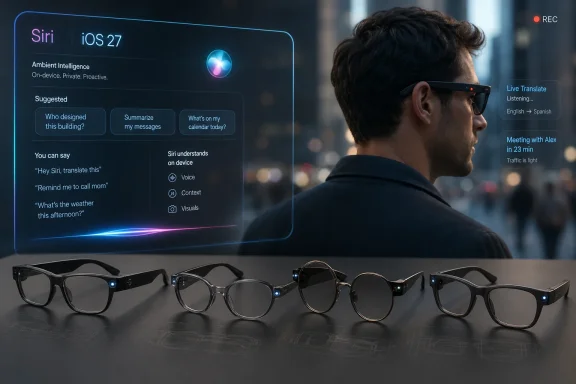
The most important thing about Bloomberg’s smart-glasses report is not the number four. It is the fact that Apple is reportedly testing consumer eyewear at all, after years of letting “Apple Glasses” live in the same rumor warehouse as the Apple car. Mashable summarized Mark Gurman’s reporting as a late-2026 reveal possibility ahead of a 2027 launch, with Apple experimenting across rectangular, oval, and circular frames, multiple colors, vertically oriented oval camera lenses, lights, speakers, and a design language meant to compete with Meta’s Ray-Ban line.
That description sounds mundane only if you miss the strategic pivot. Apple is not described as building another Vision Pro-class headset. It is reportedly working on glasses that look like glasses, behave like accessories, and sit closer to AirPods than to a Mac strapped to your head.
That matters because the headset era has already taught the industry a lesson it should have learned from decades of failed wearables: people do not want to enter computing every time they need a notification, a photo, a translation, or a map cue. They want computing to leak into the world in small, useful, socially tolerable ways.
Meta understood this before Apple did. The Ray-Ban Meta glasses are not full augmented-reality devices in the science-fiction sense, but they have normalized something Apple long treated with extreme caution: a camera, microphone, speaker, and AI assistant sitting on the user’s face in public. That is the beachhead.
The old Siri could not have powered smart glasses. It could set timers, mishear names, launch apps, and occasionally answer simple questions, but it was never a trustworthy ambient assistant. Glasses demand a different standard because the user has less patience and less screen space. If the assistant hesitates, hallucinates, routes badly, or requires a handoff back to the phone too often, the product collapses into an expensive pair of Bluetooth camera frames.
That is why Apple’s reported Google Gemini partnership for a more conversational Siri is more than a concession that Cupertino fell behind OpenAI, Google, Anthropic, and Meta. It is an admission that Apple cannot ship a new form factor on old assistant foundations. The voice layer has to become flexible, contextual, and fast enough to replace many small phone interactions.
The challenge is especially acute for Apple because its brand promise is not experimentation. Meta can ship weird, learn in public, and iterate through social awkwardness. Google can tolerate product churn. Apple sells the idea that the product is already coherent when it reaches the customer.
That coherence is what Siri has lacked. If Apple wants glasses to be a mainstream product rather than a developer curiosity, Siri cannot merely become “better.” It has to become invisible infrastructure.
The Vision Pro asked users to accept isolation, weight, cost, app scarcity, and a new interaction model all at once. That is a lot of friction for a product whose best early demos often looked more like private theater than daily computing. Even enthusiasts who admired the engineering struggled to explain why ordinary users needed one.
Smart glasses invert that equation. Instead of asking the user to step into a computer, they ask the computer to accompany the user. That sounds less futuristic, but it is far more commercially plausible.
Apple’s reported design testing suggests the company understands the category is as much fashion as technology. Rectangular, oval, and circular frames are not just aesthetic variants; they are an acknowledgment that glasses live on faces, not desks. A phone can be hidden in a case. A headset can be used in private. Glasses become part of a person’s appearance.
That is where Apple may have a better chance than it did with Vision Pro. It knows how to make personal technology feel desirable. The iPod, iPhone, Apple Watch, and AirPods each succeeded not because they introduced wholly unprecedented concepts, but because Apple found the version regular people could imagine using every day.
Mashable noted Reuters reporting that Meta Ray-Ban smart-glasses sales tripled in 2025. The important number is not just the growth; it is what grew. Meta did not need a transparent display, a spatial app ecosystem, or a perfect mixed-reality platform to generate demand. It needed a familiar frame, a famous eyewear partner, and enough utility to make the device feel less like a costume.
That is a dangerous precedent for Apple. The company has often waited for categories to mature before entering with a more polished product. But in AI wearables, waiting carries a new kind of risk because user behavior itself is being trained elsewhere.
If millions of people become comfortable saying commands to Meta AI through their glasses, taking hands-free photos, and treating eyewear as an always-on interface, Apple will not simply be entering a hardware market. It will be trying to redirect an emerging social habit.
This is why the Siri reboot and glasses rumor belong together. Apple cannot beat Meta’s eyewear with better hinges alone. It needs a superior assistant experience, tighter iPhone integration, a credible privacy story, and enough third-party developer gravity to make the product feel like part of the Apple ecosystem rather than a late answer to Ray-Ban Meta.
Apple’s reported oval camera lenses and lights suggest the company knows the social contract will matter. A visible recording indicator is not a small design choice; it is part of the permission structure for the product. If people around the wearer cannot tell whether they are being recorded, smart glasses become less like AirPods and more like Google Glass — a product remembered as much for social rejection as for technological ambition.
Apple has long marketed privacy as a competitive advantage, and glasses would test that message in a highly visible way. A privacy promise buried in settings will not be enough. The device has to communicate its behavior physically, instantly, and legibly.
That is harder than it sounds. If the camera is too subtle, bystanders distrust it. If the indicator is too prominent, wearers feel self-conscious. If the device relies heavily on cloud AI, privacy advocates will ask where images and context are going. If it keeps too much processing local, battery life and capability may suffer.
For WindowsForum readers, this is not just a consumer concern. Enterprises will eventually have to decide whether these devices are allowed in offices, hospitals, labs, schools, factories, and government spaces. The same features that make glasses useful for field work, accessibility, remote assistance, and documentation also make them a governance headache.
The iOS 27 cycle is therefore best understood as groundwork. A better Siri, expanded Apple Intelligence hooks, improved Dynamic Island behavior, cross-platform AI features, and deeper app intents all point toward a future where apps can be acted upon without always being opened. That is exactly the model glasses need.
A screen-light device cannot rely on the old app grid. It needs actions. Start a route. Summarize this message. Capture this receipt. Identify this plant. Translate that sign. Send this clip. Remind me about this when I get home. The assistant becomes the launcher, the interpreter, and the interface.
That model also puts pressure on developers to structure apps around intent, permissions, and context. Microsoft has been moving in a similar direction with Copilot across Windows and Microsoft 365: the interface becomes less about launching discrete applications and more about asking a system to perform work across them. Apple’s version will be more tightly controlled, but the endpoint is similar.
The question is whether Apple can make that control feel like quality rather than constraint. Developers will tolerate rules if the market is large and the user experience is strong. They will not rush to build for a category that looks like Vision Pro volume with App Store review friction attached.
Windows users already live in a multi-device reality. They use iPhones with Windows laptops, Android phones with Microsoft 365, Meta headsets with gaming PCs, and browser-based AI tools across all of it. Smart glasses would add another input-and-output layer, one that could capture context from the physical world and pass it into the services people use at work.
That creates opportunities and headaches for Microsoft. Copilot on Windows is strongest when it has context: files, apps, meetings, messages, screenshots, and user intent. Glasses could provide a richer stream of real-world context, but Apple is unlikely to expose that stream generously to Windows. Meta and Google may be more open, or at least more motivated to make cross-platform deals.
For IT departments, the important issue is not which company wins the consumer fashion contest. It is whether AI wearables become endpoints that need identity, policy, logging, data-loss prevention, app controls, and procurement rules. A pair of glasses that can record video, hear meetings, summarize conversations, and query corporate data is not just an accessory. It is a security boundary with temples.
That is why Apple’s privacy posture will matter beyond marketing. If Apple can persuade enterprises that its glasses process sensitive context safely, it may enter corporate environments through the same side door as the iPhone and Apple Watch. If not, the devices may be banned from many workplaces before they ever reach scale.
Cook’s Apple mastered operational scale, services growth, wearables, custom silicon, and supply-chain discipline. It did not produce a post-iPhone platform on the level of the iPhone itself. The Apple Watch became a major business, and AirPods became a cultural object, but neither displaced the phone as the center of Apple life.
Ternus inherits a company that must now make a harder transition. The next era is not just about thinner hardware, faster chips, or better cameras. It is about whether Apple can turn AI into a system-wide interface while preserving the trust, polish, and integration that define its products.
That is a tall order for a hardware executive, but it may also be the right framing. The AI era will not be won by chatbots alone. It will be won by companies that can package models, sensors, silicon, displays, batteries, identity, payments, app ecosystems, and social acceptability into devices people actually use.
Smart glasses sit at the center of that puzzle. They are a hardware product whose success depends on software intelligence, developer support, privacy architecture, fashion sense, and ecosystem leverage. In other words, they are exactly the kind of product that will reveal what post-Cook Apple is good at — and what it is not.
That may be wise. Full AR glasses remain constrained by battery life, heat, display brightness, optics, prescription support, weight, and price. A product that tries to solve all of that in generation one risks becoming Vision Pro again: impressive, expensive, and uncommon.
A camera-and-audio-first device with AI assistance is less glamorous but more shippable. It gives Apple a way to establish the form factor, train user habits, gather developer interest, and improve Siri in a real-world context. Displays can come later if the foundation works.
The danger is that Apple’s brand invites expectations it may not want to meet immediately. If the company unveils glasses without a display, critics will call them late Meta clones. If it includes a display too soon, it may ship a compromised product. Apple’s usual move is to wait until the tradeoffs feel invisible, but Meta’s head start may compress that timetable.
This is the strategic squeeze: Apple needs to be patient enough not to ship a science project, but fast enough not to let Meta define the category.
On the phone, that means Siri, Dynamic Island, Photos, Messages, Mail, Wallet, Camera, and third-party app actions. On the watch, it means health, notifications, quick replies, and glanceable context. On the Mac and iPad, it means productivity and creation. On glasses, it would mean the world itself becomes the prompt.
That is powerful, but it is also where Apple’s cautious culture may collide with AI’s probabilistic nature. A phone assistant can be wrong and still be corrected with a tap. Glasses will often be used while walking, driving, working, traveling, or interacting with other people. Mistakes become more consequential.
Apple’s answer will likely be a hybrid model: on-device processing where possible, private cloud infrastructure where necessary, and outside model partnerships where Apple’s own systems lag. That is not as ideologically pure as Apple might prefer, but it reflects reality. No single company currently owns the entire AI stack from model quality to consumer trust to wearable hardware.
The success of this approach will depend less on benchmark charts than on latency, permissions, memory, and restraint. Users do not need glasses that answer every question. They need glasses that know when to help, when to stay quiet, and when to get out of the way.
That is the real significance of the latest Apple glasses chatter. Meta has already turned camera-equipped Ray-Bans into a culturally plausible gadget, and Google is circling the same territory with Android XR. Apple, meanwhile, is trying to enter the category without repeating the Vision Pro mistake: technically impressive, strategically ambitious, and far too detached from everyday computing.
 Apple Is No Longer Pretending the Phone Is the Final Interface
The most important thing about Bloomberg’s smart-glasses report is not the number four. It is the fact that Apple is reportedly testing consumer eyewear at all, after years of letting “Apple Glasses” live in the same rumor warehouse as the Apple car. Mashable summarized Mark Gurman’s reporting as a late-2026 reveal possibility ahead of a 2027 launch, with Apple experimenting across rectangular, oval, and circular frames, multiple colors, vertically oriented oval camera lenses, lights, speakers, and a design language meant to compete with Meta’s Ray-Ban line.That description sounds mundane only if you miss the strategic pivot. Apple is not described as building another Vision Pro-class headset. It is reportedly working on glasses that look like glasses, behave like accessories, and sit closer to AirPods than to a Mac strapped to your head.
That matters because the headset era has already taught the industry a lesson it should have learned from decades of failed wearables: people do not want to enter computing every time they need a notification, a photo, a translation, or a map cue. They want computing to leak into the world in small, useful, socially tolerable ways.
Meta understood this before Apple did. The Ray-Ban Meta glasses are not full augmented-reality devices in the science-fiction sense, but they have normalized something Apple long treated with extreme caution: a camera, microphone, speaker, and AI assistant sitting on the user’s face in public. That is the beachhead.
Siri Has to Become an Interface, Not a Punchline
The Siri thread running through Mashable’s WWDC coverage is just as important as the glasses rumor. Before the event, Mashable pointed to Gurman’s reading of Apple’s WWDC 2026 artwork — glowing neon text, “All systems glow,” and a possible Dynamic Island visual cue — as a hint toward the new Siri interface. After years of delay, Apple did use WWDC 2026 to make Siri central again, with iOS 27, macOS 27, iPadOS 27, watchOS 27, and visionOS 27 all positioned around a more capable Apple Intelligence layer.The old Siri could not have powered smart glasses. It could set timers, mishear names, launch apps, and occasionally answer simple questions, but it was never a trustworthy ambient assistant. Glasses demand a different standard because the user has less patience and less screen space. If the assistant hesitates, hallucinates, routes badly, or requires a handoff back to the phone too often, the product collapses into an expensive pair of Bluetooth camera frames.
That is why Apple’s reported Google Gemini partnership for a more conversational Siri is more than a concession that Cupertino fell behind OpenAI, Google, Anthropic, and Meta. It is an admission that Apple cannot ship a new form factor on old assistant foundations. The voice layer has to become flexible, contextual, and fast enough to replace many small phone interactions.
The challenge is especially acute for Apple because its brand promise is not experimentation. Meta can ship weird, learn in public, and iterate through social awkwardness. Google can tolerate product churn. Apple sells the idea that the product is already coherent when it reaches the customer.
That coherence is what Siri has lacked. If Apple wants glasses to be a mainstream product rather than a developer curiosity, Siri cannot merely become “better.” It has to become invisible infrastructure.
The Vision Pro Lesson Is That Wonder Does Not Equal Habit
The Apple Vision Pro remains the shadow over every Apple wearable rumor. It proved that Apple can build a stunning spatial-computing device. It also proved that stunning is not the same as sticky.The Vision Pro asked users to accept isolation, weight, cost, app scarcity, and a new interaction model all at once. That is a lot of friction for a product whose best early demos often looked more like private theater than daily computing. Even enthusiasts who admired the engineering struggled to explain why ordinary users needed one.
Smart glasses invert that equation. Instead of asking the user to step into a computer, they ask the computer to accompany the user. That sounds less futuristic, but it is far more commercially plausible.
Apple’s reported design testing suggests the company understands the category is as much fashion as technology. Rectangular, oval, and circular frames are not just aesthetic variants; they are an acknowledgment that glasses live on faces, not desks. A phone can be hidden in a case. A headset can be used in private. Glasses become part of a person’s appearance.
That is where Apple may have a better chance than it did with Vision Pro. It knows how to make personal technology feel desirable. The iPod, iPhone, Apple Watch, and AirPods each succeeded not because they introduced wholly unprecedented concepts, but because Apple found the version regular people could imagine using every day.
Meta Has the Lead Because It Lowered the Ambition
The uncomfortable truth for Apple is that Meta’s current advantage comes from restraint. Ray-Ban Meta glasses do not try to be full AR spectacles. They take photos, record video, play audio, handle calls, and increasingly lean on AI as a voice-first companion. That is not the dream demo, but it is enough to create a habit.Mashable noted Reuters reporting that Meta Ray-Ban smart-glasses sales tripled in 2025. The important number is not just the growth; it is what grew. Meta did not need a transparent display, a spatial app ecosystem, or a perfect mixed-reality platform to generate demand. It needed a familiar frame, a famous eyewear partner, and enough utility to make the device feel less like a costume.
That is a dangerous precedent for Apple. The company has often waited for categories to mature before entering with a more polished product. But in AI wearables, waiting carries a new kind of risk because user behavior itself is being trained elsewhere.
If millions of people become comfortable saying commands to Meta AI through their glasses, taking hands-free photos, and treating eyewear as an always-on interface, Apple will not simply be entering a hardware market. It will be trying to redirect an emerging social habit.
This is why the Siri reboot and glasses rumor belong together. Apple cannot beat Meta’s eyewear with better hinges alone. It needs a superior assistant experience, tighter iPhone integration, a credible privacy story, and enough third-party developer gravity to make the product feel like part of the Apple ecosystem rather than a late answer to Ray-Ban Meta.
The Camera Is the Feature and the Liability
Camera-equipped glasses are useful because they see what the user sees. They are controversial for exactly the same reason.Apple’s reported oval camera lenses and lights suggest the company knows the social contract will matter. A visible recording indicator is not a small design choice; it is part of the permission structure for the product. If people around the wearer cannot tell whether they are being recorded, smart glasses become less like AirPods and more like Google Glass — a product remembered as much for social rejection as for technological ambition.
Apple has long marketed privacy as a competitive advantage, and glasses would test that message in a highly visible way. A privacy promise buried in settings will not be enough. The device has to communicate its behavior physically, instantly, and legibly.
That is harder than it sounds. If the camera is too subtle, bystanders distrust it. If the indicator is too prominent, wearers feel self-conscious. If the device relies heavily on cloud AI, privacy advocates will ask where images and context are going. If it keeps too much processing local, battery life and capability may suffer.
For WindowsForum readers, this is not just a consumer concern. Enterprises will eventually have to decide whether these devices are allowed in offices, hospitals, labs, schools, factories, and government spaces. The same features that make glasses useful for field work, accessibility, remote assistance, and documentation also make them a governance headache.
Developers Will Decide Whether This Is an Accessory or a Platform
WWDC is nominally a developer conference, and that context matters. Apple does not need smart glasses to launch with a sprawling app store on day one, but it does need developers to believe there is a platform coming. Otherwise the glasses risk becoming a closed Apple accessory: useful, polished, and limited.The iOS 27 cycle is therefore best understood as groundwork. A better Siri, expanded Apple Intelligence hooks, improved Dynamic Island behavior, cross-platform AI features, and deeper app intents all point toward a future where apps can be acted upon without always being opened. That is exactly the model glasses need.
A screen-light device cannot rely on the old app grid. It needs actions. Start a route. Summarize this message. Capture this receipt. Identify this plant. Translate that sign. Send this clip. Remind me about this when I get home. The assistant becomes the launcher, the interpreter, and the interface.
That model also puts pressure on developers to structure apps around intent, permissions, and context. Microsoft has been moving in a similar direction with Copilot across Windows and Microsoft 365: the interface becomes less about launching discrete applications and more about asking a system to perform work across them. Apple’s version will be more tightly controlled, but the endpoint is similar.
The question is whether Apple can make that control feel like quality rather than constraint. Developers will tolerate rules if the market is large and the user experience is strong. They will not rush to build for a category that looks like Vision Pro volume with App Store review friction attached.
The Windows Angle Is Not as Distant as It Looks
At first glance, Apple smart glasses may look like a story for iPhone users, not Windows enthusiasts. That reading is too narrow. If Apple, Meta, Google, and others normalize AI eyewear, the PC becomes one node in a broader personal-computing mesh.Windows users already live in a multi-device reality. They use iPhones with Windows laptops, Android phones with Microsoft 365, Meta headsets with gaming PCs, and browser-based AI tools across all of it. Smart glasses would add another input-and-output layer, one that could capture context from the physical world and pass it into the services people use at work.
That creates opportunities and headaches for Microsoft. Copilot on Windows is strongest when it has context: files, apps, meetings, messages, screenshots, and user intent. Glasses could provide a richer stream of real-world context, but Apple is unlikely to expose that stream generously to Windows. Meta and Google may be more open, or at least more motivated to make cross-platform deals.
For IT departments, the important issue is not which company wins the consumer fashion contest. It is whether AI wearables become endpoints that need identity, policy, logging, data-loss prevention, app controls, and procurement rules. A pair of glasses that can record video, hear meetings, summarize conversations, and query corporate data is not just an accessory. It is a security boundary with temples.
That is why Apple’s privacy posture will matter beyond marketing. If Apple can persuade enterprises that its glasses process sensitive context safely, it may enter corporate environments through the same side door as the iPhone and Apple Watch. If not, the devices may be banned from many workplaces before they ever reach scale.
Tim Cook’s Last WWDC Framed the Succession Problem
Mashable’s WWDC preview also leaned into the leadership drama: 2026 is Tim Cook’s final WWDC as Apple CEO, with John Ternus set to take over. That matters because the smart-glasses question is also a succession question.Cook’s Apple mastered operational scale, services growth, wearables, custom silicon, and supply-chain discipline. It did not produce a post-iPhone platform on the level of the iPhone itself. The Apple Watch became a major business, and AirPods became a cultural object, but neither displaced the phone as the center of Apple life.
Ternus inherits a company that must now make a harder transition. The next era is not just about thinner hardware, faster chips, or better cameras. It is about whether Apple can turn AI into a system-wide interface while preserving the trust, polish, and integration that define its products.
That is a tall order for a hardware executive, but it may also be the right framing. The AI era will not be won by chatbots alone. It will be won by companies that can package models, sensors, silicon, displays, batteries, identity, payments, app ecosystems, and social acceptability into devices people actually use.
Smart glasses sit at the center of that puzzle. They are a hardware product whose success depends on software intelligence, developer support, privacy architecture, fashion sense, and ecosystem leverage. In other words, they are exactly the kind of product that will reveal what post-Cook Apple is good at — and what it is not.
The First Apple Glasses May Be Less AR Than Everyone Wants
One of the traps in covering Apple glasses is assuming the first product must match the fantasy. People hear “Apple Glasses” and imagine floating windows, persistent overlays, perfect navigation arrows, live captions, object recognition, and a seamless visual layer on top of reality. The reported feature set sounds more modest.That may be wise. Full AR glasses remain constrained by battery life, heat, display brightness, optics, prescription support, weight, and price. A product that tries to solve all of that in generation one risks becoming Vision Pro again: impressive, expensive, and uncommon.
A camera-and-audio-first device with AI assistance is less glamorous but more shippable. It gives Apple a way to establish the form factor, train user habits, gather developer interest, and improve Siri in a real-world context. Displays can come later if the foundation works.
The danger is that Apple’s brand invites expectations it may not want to meet immediately. If the company unveils glasses without a display, critics will call them late Meta clones. If it includes a display too soon, it may ship a compromised product. Apple’s usual move is to wait until the tradeoffs feel invisible, but Meta’s head start may compress that timetable.
This is the strategic squeeze: Apple needs to be patient enough not to ship a science project, but fast enough not to let Meta define the category.
The Real Product Is Ambient Apple Intelligence
The phrase “Apple Intelligence” sounded defensive when Apple introduced it, a branded answer to a market that had already moved. With glasses in view, the branding makes more sense. Apple is not trying to sell a chatbot; it is trying to make intelligence ambient across the devices it controls.On the phone, that means Siri, Dynamic Island, Photos, Messages, Mail, Wallet, Camera, and third-party app actions. On the watch, it means health, notifications, quick replies, and glanceable context. On the Mac and iPad, it means productivity and creation. On glasses, it would mean the world itself becomes the prompt.
That is powerful, but it is also where Apple’s cautious culture may collide with AI’s probabilistic nature. A phone assistant can be wrong and still be corrected with a tap. Glasses will often be used while walking, driving, working, traveling, or interacting with other people. Mistakes become more consequential.
Apple’s answer will likely be a hybrid model: on-device processing where possible, private cloud infrastructure where necessary, and outside model partnerships where Apple’s own systems lag. That is not as ideologically pure as Apple might prefer, but it reflects reality. No single company currently owns the entire AI stack from model quality to consumer trust to wearable hardware.
The success of this approach will depend less on benchmark charts than on latency, permissions, memory, and restraint. Users do not need glasses that answer every question. They need glasses that know when to help, when to stay quiet, and when to get out of the way.
Cupertino’s Glasses Bet Comes Down to Five Hard Tests
Apple’s rumored glasses are still far enough away that every detail could change, but the direction is now clear enough to judge the stakes. The company is moving toward a world where AI is not a destination app but a layer across personal hardware, and eyewear is the most intimate version of that bet.- Apple’s reported smart-glasses testing suggests a 2027 product aimed first at everyday wearability, not necessarily full science-fiction augmented reality.
- The iOS 27 Siri overhaul is a prerequisite for glasses because voice and context will matter more than traditional app launching.
- Meta’s Ray-Ban success gives Apple proof of demand, but it also gives Meta time to define user habits before Apple arrives.
- Privacy, recording indicators, and enterprise controls will determine whether smart glasses are socially accepted or restricted by default.
- Developers will need app-intent and AI-action hooks more than conventional screen-first interfaces if Apple wants glasses to become a platform.
- John Ternus will inherit a product challenge that blends Apple’s hardware discipline with an AI software race Apple can no longer afford to trail.
References
- Primary source: Mashable
Published: 2026-07-04T09:20:18.749771
Apple is testing four smart glasses designs to compete with Meta | Mashable
Apple wants to compete with Meta when it comes to smart glasses.mashable.com - Related coverage: tomsguide.com
Apple is 'rethinking its future product roadmap' after losing smart glasses chief to OpenAI, analysts say | Tom's Guide
A look at what recent Apple losses might mean for Apple Glasses and the Vision Pro moving forward.www.tomsguide.com - Related coverage: macrumors.com
Everything Apple Announced at WWDC 2026 in 10 Minutes
Apple held its WWDC 2026 keynote today, introducing iOS 27, macOS 27, iPadOS 27, watchOS 27, visionOS 27, and tvOS 27. It took Apple an hour and a half to walk through the major new features in the updates, but we have a quicker 10 minute recap for those who want the highlights. Subscribe to the...www.macrumors.com - Official source: apple.com
Apple kicks off Worldwide Developers Conference on June 8 - Apple
Apple today unveiled an exciting lineup for its annual Worldwide Developers Conference (WWDC), taking place June 8-12.www.apple.com - Related coverage: techcrunch.com
Apple reportedly testing four designs for upcoming smart glasses | TechCrunch
These glasses are a step back from an ambitious plan that once called for Apple to launch a variety of mixed and augmented reality devices.techcrunch.com - Related coverage: theguardian.com
Apple debuts revamped ‘Siri AI’ and new child safety features for iPhones and iPads | Apple | The Guardian
At his final WWDC keynote, Tim Cook highlights AI-forward upgrade to the voice assistant to be widely released in fallwww.theguardian.com
- Related coverage: techspot.com
Apple is testing four smart glasses designs as it prepares to challenge Meta Ray-Bans | TechSpot
While Meta partnered with Ray-Ban to position its smart glasses as more lifestyle-oriented than experimental, Apple's design philosophy remains distinctly in-house. In his Power On newsletter, Gurman...www.techspot.com - Related coverage: apple.gadgethacks.com
Tim Cook’s Final WWDC as Apple CEO Puts Siri and John Ternus in Focus << Apple :: Gadget Hacks
WWDC 2026 opened June 8, marking Tim Cook's final Worldwide Developers Conference as Apple CEO before John Ternus takes over on September 1. The timing... apple.gadgethacks.com
- Related coverage: republicworld.com
Apple WWDC 2026 Set for June 8: iOS 27, macOS 27, a Siri Overhaul, and Tim Cook's Final Keynote as CEO | Republic World
The biggest spotlight falls on iOS 27, which is expected to define Apple&#39;s software direction for the next generation of iPhones.www.republicworld.com - Related coverage: notebookcheck.net
Apple tests four smart glasses designs – AI wearable instead of AR eyewear - Notebookcheck News
Apple is apparently working on a new device category: smart glasses that are meant to function as an AI wearable rather than true AR glasses. The concept does not include image overlays, but is said to be closely linked to the iPhone. Four different designs are currently being tested. www.notebookcheck.net
- Related coverage: livemint.com
From iOS 27 to a glowing Siri makeover: Biggest reveals expected at Tim Cook's final WWDC as CEO | Mint
iOS 27 will likely debut at WWDC 2026 along with other Apple operating sytems. The tech giant is also expected to reveal a brand new Siri, an Extensions system and upgrades to visual intelligence. www.livemint.com
- Related coverage: tomshardware.com
Apple demonstrates cross-platform Siri upgrades in macOS 27 Golden Gate at WWDC — update brings Liquid Glass improvements and unifies AI strategy | Tom's Hardware
macOS 27 brings new AI features and, finally, matching corner radii.www.tomshardware.com - Related coverage: elpais.com
WWDC 2026: Apple presenta una Siri renovada con IA generativa que no podrán usar los iPhone y iPads en Europa
El popular asistente de voz inteligente tendrá este otoño, solo en inglés, las funciones de inteligencia artificial ya prometidas hace dos años por la empresa tecnológica, que no ha aclarado si llegarán a ser compatibles con la normativa europeaelpais.com
- Related coverage: t3.com
Apple WWDC 2026 recap: Siri AI, iOS 27, EU exclusions and Cook's farewell | T3
CEO Tim Cook's final keynote was a pivotal moment for Applewww.t3.com - Related coverage: omni.se
Golden Gate, ”liquid glass” och Siri – det här visade Apple upp på årets WWDC
Apple presenterade en rad nyheter när den årliga utvecklarkonferensen WWDC inleddes på måndagskvällen.omni.se - Related coverage: digitalcameraworld.com
Apple plans to out-cool Ray-Ban and out-tech Meta with new camera glasses with four new designs | Digital Camera World
Apple has four smart glasses designs on the way (and a folding phone). Is it cool enough to unseat the Meta Ray-Bans?www.digitalcameraworld.com - Related coverage: los40.com
Apple prepara la última WWDC de Tim Cook | Tecnología | LOS40
El material promocional da una pista importante, pero sin confirmar sus secretos.los40.com - Related coverage: techxplore.com