

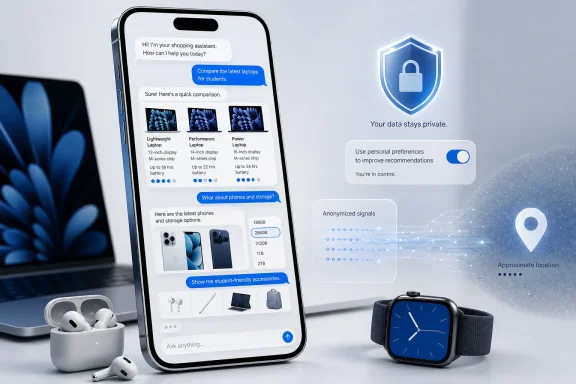
Apple appears to be laying the privacy groundwork for an AI-powered shopping assistant inside the Apple Store app, a move that could turn the company’s mobile storefront from a catalog and checkout tool into a conversational product advisor. The feature has not been formally announced or released, but newly published privacy language refers to a “Virtual Shopping Assistant” that can personalize answers using account, device, carrier, chat, and optionally location information.
That wording matters because privacy disclosures usually describe systems that are either already operating in limited form or close enough to launch that their data practices must be documented. If Apple follows through, the Apple Store app could gain a chatbot designed to help buyers compare devices, choose configurations, understand services, and navigate increasingly complicated purchase decisions.
For Windows users, the development is worth watching even if it lives squarely in Apple’s ecosystem. It reflects a broader shift in consumer technology: retailers are using generative AI not merely to answer support questions, but to guide the high-value decisions that once required a knowledgeable salesperson, a comparison spreadsheet, or a long afternoon of browser tabs.
The modern online store has a familiar problem: a vast selection does not automatically produce a simple buying experience. Apple may sell a comparatively narrow hardware lineup versus a traditional PC retailer, but selecting the right Mac, iPad, iPhone, Watch, storage tier, connectivity option, accessory, warranty coverage, trade-in route, and subscription service can still become surprisingly complex.
A virtual shopping assistant has the potential to reduce that friction. Rather than forcing a customer to navigate filters, product pages, technical-specification tables, support articles, and comparison tools separately, a conversational interface could consolidate the process into a single exchange.
In its strongest form, the assistant could respond to questions such as:
Apple already has plenty of structured information available to support such a service. Its store can recognize the devices linked to an Apple Account, surface compatible accessories, identify subscriptions, present trade-in options, and show regional purchasing availability. The practical challenge is not collecting product data; it is making that data useful without allowing a chatbot to oversimplify technical trade-offs or turn every recommendation into an upsell.
The stated categories are significant:
Device identifiers can help establish which products are in use and which accessories, software versions, or replacement paths make sense. That could be particularly useful when a customer asks whether an older iPhone, iPad, Mac, or Watch is compatible with a product they are considering.
Carrier information suggests the assistant may help address mobile connectivity questions. Choosing between storage options is relatively straightforward; choosing a handset around eSIM availability, network support, regional plans, or activation choices is much more complicated.
Location information introduces another layer of practical personalization. It may be relevant for nearby retail availability, delivery options, store appointments, local trade-in handling, regulatory differences, and the availability of particular features or services.
Chat history is perhaps the most consequential category. Retaining transcripts could make a multistage purchase process coherent. A customer could discuss a Mac configuration one day, return later to ask about monitors or financing, and continue where the previous discussion ended.
That continuity can be convenient, but it also means the shopping assistant may become a repository for personal preferences, budget conversations, product frustrations, upgrade plans, and other information users would not necessarily share in a conventional product filter.
This opt-in approach is a positive sign. It separates the act of using the assistant from the separate decision to let conversation data contribute to improvement efforts. Customers who want a personalized shopping experience but do not want their chats used for model improvement should have a meaningful choice.
However, the distinction needs to be understood clearly. Turning off Chat Improvements does not necessarily mean Apple will stop storing the conversation or using it to provide the service. The privacy language indicates that transcripts may still be retained so users can revisit conversations and for Apple’s business analytics.
In practical terms, there are at least three different questions users should consider:
Personalization means using information about a specific person, device, account, location, or previous interaction to make the current answer more relevant. If a customer owns an older MacBook, for example, a shopping assistant could suggest a migration-appropriate replacement rather than presenting every laptop equally.
Improvement means using interactions more broadly to refine the assistant’s quality, likely by identifying poor answers, improving retrieval systems, tuning instructions, evaluating model performance, or contributing to training and quality-assurance workflows. That process may involve more people and systems than an individual real-time conversation.
The strongest privacy design would make those boundaries explicit in the app itself, not just in legal text. Users should be able to understand what is saved, what is used for analytics, what is used for quality improvement, how long it is retained, and how to delete previous chats.
That statement confirms a critical point: at least some portion of the virtual shopping assistant’s conversational capabilities may rely on external technology or service providers. It does not identify a specific model provider, cloud provider, or company, and any claim naming a particular partner would be speculative unless Apple discloses it directly.
The company’s approach raises a familiar but difficult privacy question. Removing direct identifiers such as names, account IDs, email addresses, and phone numbers is valuable, but de-identification does not automatically make text harmless or impossible to connect back to an individual.
Shopping conversations can contain indirect identifiers. A user might mention a rare profession, a specific accessibility need, a local store issue, a product serial number, a family member’s device, a unique travel plan, or a highly specific purchase timeline. In aggregate, those details can be sensitive even when a message has been scrubbed of obvious personal information.
Apple’s wording indicates that partners may use the information solely to help provide a conversational response. That is materially different from allowing a third party to independently train its own public model on Apple customer chats. Still, customers deserve clarity on where the processing occurs, how it is protected, and whether transferred text is retained beyond the immediate response workflow.
This does not make the feature inherently untrustworthy. A well-designed assistant can save customers money by steering them away from overpowered hardware, unnecessary accessories, incompatible configurations, or redundant subscriptions. It can also help less technical shoppers avoid costly mistakes.
Yet the incentive to increase basket value will always exist. The assistant could recommend more storage “for peace of mind,” add service plans as a default, favor newer models when a lower-cost option would suffice, or frame feature comparisons in ways that nudge a buyer toward premium hardware.
For example, a high-quality answer might say:
The virtual assistant should also be able to acknowledge uncertainty. Retail AI needs a reliable way to say, “I cannot verify that,” “Please confirm this with a specialist,” or “Availability and trade-in valuation may change.” Confidently wrong answers are especially damaging when they lead to a purchase that costs hundreds or thousands of dollars.
Traditional e-commerce analytics can show that someone viewed a laptop, compared specifications, and abandoned a cart. A conversational assistant can reveal much more: the user may be concerned about battery longevity, uncertain about software compatibility, worried about an upcoming trip, or trying to remain within a set budget.
That richer context can improve customer service and product matching. It can also create more powerful behavioral data, which is why privacy controls and clear explanations matter so much.
First, its hardware and services are tightly integrated. Compatibility questions can often be answered through a relatively controlled product matrix rather than an open market filled with thousands of vendors and inconsistent specifications.
Second, Apple operates both digital and physical retail channels. A future version of the assistant could potentially bridge online research with a store appointment, pickup option, trade-in transaction, or guided setup session.
Third, Apple has direct knowledge of the devices associated with a customer account, subject to the company’s policies and user permissions. That can make recommendations much more relevant than an anonymous online quiz.
The risk is that the same ecosystem advantage can feel intrusive if customers are not given clear, granular control. Personalized help becomes less appealing if users suspect the assistant is silently assembling a detailed profile from every available signal.
A Windows buyer may need help evaluating processor generations, graphics performance, RAM capacity, SSD upgrades, display characteristics, ports, docking compatibility, warranty terms, repairability, battery claims, vendor software, ARM compatibility, gaming requirements, and Windows edition differences. The same buyer may be choosing among dozens of manufacturers and hundreds of models.
That complexity makes an AI shopping assistant genuinely attractive. A good system could translate a vague need—such as “a laptop for college, light gaming, and Adobe work”—into useful, transparent trade-offs without forcing users to decipher benchmark charts and confusing retailer filters.
The best AI shopping tools for PCs should offer:
The wording that refers to availability suggests a phased rollout is plausible. That could mean selected countries, a limited set of languages, specific hardware categories, or a test period before broader expansion.
It is also unclear whether the assistant will be text-only or eventually support voice, images, product-camera scanning, document uploads, or proactive recommendations. Each added capability would improve convenience while creating additional data-handling and accuracy considerations.
Another unresolved issue is escalation. An AI assistant will need a reliable handoff to human support when questions involve complicated financing, accessibility accommodations, data migration, enterprise purchasing, carrier disputes, repair history, or conflicting technical requirements.
The privacy disclosure also shows that this convenience will depend on a substantial amount of contextual data, including chat history and optional location information. Apple’s promised Chat Improvements control and its stated removal of personal identifiers before sharing chats with response-generation partners are constructive measures, but they are not substitutes for detailed, understandable controls over transcript retention, analytics, data sharing, and deletion.
Ultimately, the assistant’s success will depend less on whether it can sound conversational and more on whether it can be accurate, transparent, privacy-conscious, and genuinely user-first. The most valuable AI shopping assistant is not the one that sells the most expensive configuration; it is the one that clearly explains the trade-offs and helps customers buy only what they actually need.
That wording matters because privacy disclosures usually describe systems that are either already operating in limited form or close enough to launch that their data practices must be documented. If Apple follows through, the Apple Store app could gain a chatbot designed to help buyers compare devices, choose configurations, understand services, and navigate increasingly complicated purchase decisions.
For Windows users, the development is worth watching even if it lives squarely in Apple’s ecosystem. It reflects a broader shift in consumer technology: retailers are using generative AI not merely to answer support questions, but to guide the high-value decisions that once required a knowledgeable salesperson, a comparison spreadsheet, or a long afternoon of browser tabs.
 A Storefront Becoming a Conversation
The modern online store has a familiar problem: a vast selection does not automatically produce a simple buying experience. Apple may sell a comparatively narrow hardware lineup versus a traditional PC retailer, but selecting the right Mac, iPad, iPhone, Watch, storage tier, connectivity option, accessory, warranty coverage, trade-in route, and subscription service can still become surprisingly complex.A virtual shopping assistant has the potential to reduce that friction. Rather than forcing a customer to navigate filters, product pages, technical-specification tables, support articles, and comparison tools separately, a conversational interface could consolidate the process into a single exchange.
In its strongest form, the assistant could respond to questions such as:
- “Which laptop is best for photo editing and occasional video work?”
- “Can this tablet replace my old notebook for university?”
- “Which iPhone works best with my carrier plan?”
- “Do I need more storage if I use cloud photo backup?”
- “Will this accessory work with the devices I already own?”
- “What is the practical difference between two similarly priced configurations?”
- “Can I trade in my current device, and what will the new monthly payment look like?”
Apple already has plenty of structured information available to support such a service. Its store can recognize the devices linked to an Apple Account, surface compatible accessories, identify subscriptions, present trade-in options, and show regional purchasing availability. The practical challenge is not collecting product data; it is making that data useful without allowing a chatbot to oversimplify technical trade-offs or turn every recommendation into an upsell.
What the Privacy Policy Reveals
The most concrete evidence for the feature is Apple’s revised Apple Store app privacy wording. It describes a virtual shopping assistant that may collect and store a mix of customer and device-related information in order to personalize the conversation, provide relevant answers, and—if the user agrees—improve the assistant.The stated categories are significant:
- Apple Account information
- Device identifiers
- Carrier information
- Chat information and transcripts
- Location data, where enabled
Why Each Data Category Matters
Account information could allow the assistant to recognize products already owned, past purchases, active subscriptions, trade-in eligibility, and perhaps household-related purchasing context where Apple’s systems permit it. In theory, that enables much better recommendations than a generic web chatbot can deliver.Device identifiers can help establish which products are in use and which accessories, software versions, or replacement paths make sense. That could be particularly useful when a customer asks whether an older iPhone, iPad, Mac, or Watch is compatible with a product they are considering.
Carrier information suggests the assistant may help address mobile connectivity questions. Choosing between storage options is relatively straightforward; choosing a handset around eSIM availability, network support, regional plans, or activation choices is much more complicated.
Location information introduces another layer of practical personalization. It may be relevant for nearby retail availability, delivery options, store appointments, local trade-in handling, regulatory differences, and the availability of particular features or services.
Chat history is perhaps the most consequential category. Retaining transcripts could make a multistage purchase process coherent. A customer could discuss a Mac configuration one day, return later to ask about monitors or financing, and continue where the previous discussion ended.
That continuity can be convenient, but it also means the shopping assistant may become a repository for personal preferences, budget conversations, product frustrations, upgrade plans, and other information users would not necessarily share in a conventional product filter.
Chat Improvements Is an Important—but Limited—Control
Apple says users will be able to choose whether their interactions can be used to improve the virtual shopping assistant through a Chat Improvements control in the Apple Store app. The setting is expected to appear under the account settings area.This opt-in approach is a positive sign. It separates the act of using the assistant from the separate decision to let conversation data contribute to improvement efforts. Customers who want a personalized shopping experience but do not want their chats used for model improvement should have a meaningful choice.
However, the distinction needs to be understood clearly. Turning off Chat Improvements does not necessarily mean Apple will stop storing the conversation or using it to provide the service. The privacy language indicates that transcripts may still be retained so users can revisit conversations and for Apple’s business analytics.
In practical terms, there are at least three different questions users should consider:
- Can the assistant use context to answer my question now?
- Will the transcript remain available when I return later?
- May my interaction be used to improve the assistant over time?
The Difference Between Personalization and Training
The language around AI privacy can be confusing because “improvement” and “personalization” are often discussed as though they were the same thing. They are not.Personalization means using information about a specific person, device, account, location, or previous interaction to make the current answer more relevant. If a customer owns an older MacBook, for example, a shopping assistant could suggest a migration-appropriate replacement rather than presenting every laptop equally.
Improvement means using interactions more broadly to refine the assistant’s quality, likely by identifying poor answers, improving retrieval systems, tuning instructions, evaluating model performance, or contributing to training and quality-assurance workflows. That process may involve more people and systems than an individual real-time conversation.
The strongest privacy design would make those boundaries explicit in the app itself, not just in legal text. Users should be able to understand what is saved, what is used for analytics, what is used for quality improvement, how long it is retained, and how to delete previous chats.
Third-Party AI Partners Add a New Layer of Risk
Apple’s disclosure says personal identifiers are removed before chat content is shared with partners that help generate conversational responses. Those partners are unnamed.That statement confirms a critical point: at least some portion of the virtual shopping assistant’s conversational capabilities may rely on external technology or service providers. It does not identify a specific model provider, cloud provider, or company, and any claim naming a particular partner would be speculative unless Apple discloses it directly.
The company’s approach raises a familiar but difficult privacy question. Removing direct identifiers such as names, account IDs, email addresses, and phone numbers is valuable, but de-identification does not automatically make text harmless or impossible to connect back to an individual.
Shopping conversations can contain indirect identifiers. A user might mention a rare profession, a specific accessibility need, a local store issue, a product serial number, a family member’s device, a unique travel plan, or a highly specific purchase timeline. In aggregate, those details can be sensitive even when a message has been scrubbed of obvious personal information.
What “Scrubbed” Should Mean in Practice
For Apple’s assurance to carry real weight, the system needs more than a basic removal of names and account numbers. A robust privacy process should account for:- Addresses and precise locations embedded in free-form text
- Telephone numbers, email addresses, and payment references
- Product serial numbers and device IDs
- Health, accessibility, education, employment, or family details
- Conversation context that can reveal identity over multiple messages
- Information retrieved from an account but echoed back into the chat
- Accidental disclosures made by the assistant itself
Apple’s wording indicates that partners may use the information solely to help provide a conversational response. That is materially different from allowing a third party to independently train its own public model on Apple customer chats. Still, customers deserve clarity on where the processing occurs, how it is protected, and whether transferred text is retained beyond the immediate response workflow.
The Sales Assistant Problem: Helpful Advice or Algorithmic Upselling?
A shopping assistant is inherently different from a general-purpose productivity tool because its goals are mixed. It can help users, but it operates inside a store whose purpose is to sell products and services.This does not make the feature inherently untrustworthy. A well-designed assistant can save customers money by steering them away from overpowered hardware, unnecessary accessories, incompatible configurations, or redundant subscriptions. It can also help less technical shoppers avoid costly mistakes.
Yet the incentive to increase basket value will always exist. The assistant could recommend more storage “for peace of mind,” add service plans as a default, favor newer models when a lower-cost option would suffice, or frame feature comparisons in ways that nudge a buyer toward premium hardware.
Recommendations Need Explanations
The key safeguard is explainability. A credible AI shopping assistant should not merely say, “Buy this model.” It should state why a particular device suits the expressed needs and what compromises come with choosing it.For example, a high-quality answer might say:
- A lower-cost configuration meets the stated workload.
- The upgrade is useful only if the customer expects heavier local media editing or longer device ownership.
- More storage matters because of local files, while cloud-based workflows may reduce the need.
- A more expensive display or processor is beneficial in specific professional scenarios, not for ordinary productivity tasks.
- A current accessory may already work, making a new purchase unnecessary.
The virtual assistant should also be able to acknowledge uncertainty. Retail AI needs a reliable way to say, “I cannot verify that,” “Please confirm this with a specialist,” or “Availability and trade-in valuation may change.” Confidently wrong answers are especially damaging when they lead to a purchase that costs hundreds or thousands of dollars.
Why Apple Is Pursuing AI Commerce Now
Apple’s reported shopping assistant fits into the industry-wide race to make AI a primary interface for information, support, and transactions. Retailers want customers to ask questions in natural language because the conversation exposes intent more directly than clicks through a product catalog.Traditional e-commerce analytics can show that someone viewed a laptop, compared specifications, and abandoned a cart. A conversational assistant can reveal much more: the user may be concerned about battery longevity, uncertain about software compatibility, worried about an upcoming trip, or trying to remain within a set budget.
That richer context can improve customer service and product matching. It can also create more powerful behavioral data, which is why privacy controls and clear explanations matter so much.
Apple Has a Distinctive Advantage
Apple has several advantages that could make its shopping assistant more useful than a generic retailer chatbot.First, its hardware and services are tightly integrated. Compatibility questions can often be answered through a relatively controlled product matrix rather than an open market filled with thousands of vendors and inconsistent specifications.
Second, Apple operates both digital and physical retail channels. A future version of the assistant could potentially bridge online research with a store appointment, pickup option, trade-in transaction, or guided setup session.
Third, Apple has direct knowledge of the devices associated with a customer account, subject to the company’s policies and user permissions. That can make recommendations much more relevant than an anonymous online quiz.
The risk is that the same ecosystem advantage can feel intrusive if customers are not given clear, granular control. Personalized help becomes less appealing if users suspect the assistant is silently assembling a detailed profile from every available signal.
Implications for Windows PCs and Microsoft’s Ecosystem
The Apple Store app may be Apple-focused, but the concept should resonate with Windows users and Microsoft ecosystem watchers. PC shopping is arguably a more difficult AI assistance problem than Apple hardware shopping because the Windows market is broader, messier, and more configuration-heavy.A Windows buyer may need help evaluating processor generations, graphics performance, RAM capacity, SSD upgrades, display characteristics, ports, docking compatibility, warranty terms, repairability, battery claims, vendor software, ARM compatibility, gaming requirements, and Windows edition differences. The same buyer may be choosing among dozens of manufacturers and hundreds of models.
That complexity makes an AI shopping assistant genuinely attractive. A good system could translate a vague need—such as “a laptop for college, light gaming, and Adobe work”—into useful, transparent trade-offs without forcing users to decipher benchmark charts and confusing retailer filters.
The Standards Should Be Higher in the PC Market
At the same time, AI recommendations in the Windows hardware market must be held to a high standard. A chatbot should never hide whether a product is sponsored, whether inventory pressure influences recommendations, whether it has access to current pricing, or whether it is comparing equivalent configurations.The best AI shopping tools for PCs should offer:
- Clear comparisons of performance, portability, battery life, repairability, and price
- Up-front warnings about compromises, including soldered memory or limited ports
- Separate recommendations for local AI workloads, gaming, office productivity, and creative work
- Honest compatibility guidance for Windows on ARM, legacy software, peripherals, and drivers
- Accessible links to technical specifications and support documentation
- Strong privacy controls around conversation history and profile-based recommendations
- A straightforward way to disable personalization entirely
What Remains Unknown
The privacy disclosure provides meaningful clues, but it does not answer several important questions. Apple has not publicly detailed the assistant’s launch date, supported regions, languages, device requirements, model architecture, partner identity, or whether it will be available to every Apple Store app user at release.The wording that refers to availability suggests a phased rollout is plausible. That could mean selected countries, a limited set of languages, specific hardware categories, or a test period before broader expansion.
It is also unclear whether the assistant will be text-only or eventually support voice, images, product-camera scanning, document uploads, or proactive recommendations. Each added capability would improve convenience while creating additional data-handling and accuracy considerations.
Another unresolved issue is escalation. An AI assistant will need a reliable handoff to human support when questions involve complicated financing, accessibility accommodations, data migration, enterprise purchasing, carrier disputes, repair history, or conflicting technical requirements.
The Bottom Line
Apple’s reported Virtual Shopping Assistant could make the Apple Store app more useful by replacing static product browsing with tailored, context-aware buying guidance. The idea has real merit: many customers do not need more product pages; they need plain-language help deciding what fits their work, budget, existing devices, and long-term plans.The privacy disclosure also shows that this convenience will depend on a substantial amount of contextual data, including chat history and optional location information. Apple’s promised Chat Improvements control and its stated removal of personal identifiers before sharing chats with response-generation partners are constructive measures, but they are not substitutes for detailed, understandable controls over transcript retention, analytics, data sharing, and deletion.
Ultimately, the assistant’s success will depend less on whether it can sound conversational and more on whether it can be accurate, transparent, privacy-conscious, and genuinely user-first. The most valuable AI shopping assistant is not the one that sells the most expensive configuration; it is the one that clearly explains the trade-offs and helps customers buy only what they actually need.
References
- Primary source: Neowin
Published: 2026-07-23T04:54:02+00:00
Loading…
www.neowin.net - Independent coverage: The Apple Post
Published: 2026-07-22T23:50:37+00:00
Loading…
www.theapplepost.com - Independent coverage: AppleInsider
Published: 2026-07-22T21:50:29+00:00
Loading…
appleinsider.com - Independent coverage: 9to5Mac
Published: 2026-07-22T20:56:34+00:00
Loading…
9to5mac.com - Independent coverage: MacRumors
Published: 2026-07-22T20:25:42+00:00
Loading…
www.macrumors.com - Official source: apple.com
Loading…
www.apple.com