

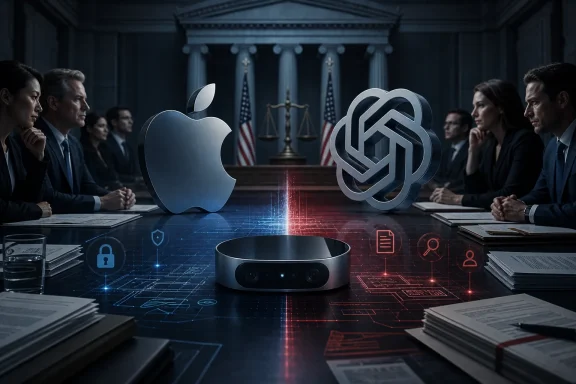
Apple sued OpenAI, io Products, Tang Yew Tan, and Chang Liu in federal court in San Jose, California. Apple seeks damages and an order blocking the defendants from possessing or using alleged trade secrets. The immediate forward-looking question is whether Apple can obtain an injunction capable of disrupting OpenAI’s hardware work before a product launch.
Those are the verified facts at the center of the dispute. The rest remains contested. Apple alleges that former employees took confidential information for OpenAI’s benefit, while OpenAI has publicly denied having any interest in other companies’ trade secrets. No court has determined that the defendants misappropriated or used Apple’s protected information, and the evidence needed to resolve those claims has not yet been tested through the litigation process.
Apple’s complaint describes OpenAI’s emerging hardware business as resting on “the shakiest of foundations, rotten to its core by its illegal reliance on misappropriated trade secrets.” That is Apple’s characterization, not a judicial finding, but it identifies the company’s central theory: the alleged problem is not merely possession of isolated information but possible contamination of a developing hardware program.
Apple states its theory in similarly direct language: “This case is about Apple’s former employees stealing Apple’s trade secrets for the benefit of OpenAI.” It then summarizes the purpose of the lawsuit: “Apple brings this suit to put a stop to it.”
The requested injunction is therefore at least as important as the demand for damages. Compensation would address harm Apple says has already occurred. An injunction could impose prospective restrictions on possession, disclosure, or use of information that the court determines is likely to qualify as a trade secret.
The practical effect of any order would depend entirely on its wording. A narrowly drawn order might require specified materials to be returned, deleted, preserved, or placed beyond the reach of particular employees. A broader order could affect work that Apple persuades the court was developed through the use of protected information. The filing of a complaint alone does not impose either result.
Apple must identify the information it claims to own, explain why it is legally protected, and connect each defendant to acquisition, disclosure, use, or threatened use. It must also satisfy the additional requirements for preliminary relief if it seeks an order before trial. OpenAI and the other defendants will have opportunities to dispute Apple’s definitions, evidence, inferences, and requested remedies.
By bringing the case while OpenAI is developing consumer hardware, Apple is trying to resolve those questions before the relevant work becomes a finished product. Whether the lawsuit can actually alter a launch schedule will depend less on the complaint’s forceful language than on the evidence Apple can present early in the case.
Tang’s long Apple career makes the legal boundary especially important. Experienced employees are generally free to change jobs and apply their abilities elsewhere, subject to enforceable contractual and legal obligations. Trade-secret law does not ordinarily give a former employer ownership over a person’s general skill, judgment, professional experience, or knowledge commonly understood within an industry.
Apple must therefore do more than show that Tang knew how Apple develops hardware or that OpenAI valued his experience. It must identify information that is sufficiently specific, secret, economically valuable because of its secrecy, and subject to reasonable protective measures. It must then connect that information to conduct covered by the applicable law.
The same discipline applies to the allegations against Liu. His move from Apple to OpenAI may establish opportunity, but opportunity is not proof of acquisition or use. Apple will need reliable evidence concerning the information at issue and the actions it attributes to him. Liu may contest the alleged conduct, the status of the information, causation, or all three.
The institutional claim requires another step. Even if Apple proves that an individual acted improperly, it must establish the legal and factual basis for holding OpenAI or io Products responsible. Questions may include what the organizations knew, when they knew it, how they responded, whether anyone authorized the conduct, and whether disputed information entered or influenced their work.
Those are questions for pleadings, evidence, and judicial rulings. They should not be treated as resolved merely because Apple has placed multiple defendants in the same complaint.
Interviews for technical positions often require candidates to discuss difficult projects, design decisions, operational failures, manufacturing constraints, and the methods they used to solve problems. Those discussions help an employer evaluate competence, but they also create pressure to reveal more than a candidate is entitled to share.
The distinction should be explicit. A candidate can discuss personal expertise and publicly known work without disclosing restricted documents, nonpublic specifications, source code, internal financial data, confidential product plans, proprietary test results, or physical property belonging to another organization.
Hiring managers need boundaries as well. They should not ask candidates to prove their value by supplying another company’s confidential materials. Interviewers who receive an unsolicited offer of proprietary information should stop the discussion, avoid reviewing the material, and notify the appropriate legal or compliance personnel.
These safeguards protect both sides. They reduce the risk that a candidate will violate an obligation to a current or former employer, and they help the hiring organization demonstrate that its work was developed independently.
OpenAI spokesperson Drew Pusateri has said the company has “no interest in other companies’ trade secrets” and remains focused on building technology that empowers people. That public statement is a denial of Apple’s broader premise, not a point-by-point litigation response. The defendants’ formal court filings will provide a clearer account of which allegations they admit, deny, or contend are legally insufficient.
OpenAI may argue that the information Apple identifies is too general, already known, independently developed, or never received or used. It may also distinguish unauthorized individual conduct from organizational policy. Apple, in turn, will need to support its theory with more than the fact that former Apple employees work on OpenAI hardware.
Modern access rarely depends on one directory account. It can be distributed across identity providers, managed devices, cloud storage, source repositories, engineering portals, virtual private networks, messaging systems, application tokens, synchronization clients, security keys, and locally stored data.
As a result, disabling a primary account may not terminate every session or recover every copy of corporate information. A reliable departure process should reconcile human-resources records, identity revocation, asset management, data preservation, and legal obligations.
Risk can increase during the notice period, when an employee may still require broad access to complete legitimate work. Monitoring should therefore be based on established policies, proportionality, applicable law, and clearly defined security signals rather than an assumption that every departing employee is acting improperly.
That timing gives Apple a reason to seek relief before the product reaches the market. It also gives the court a reason to demand precision. An order entered during active development could impose substantial costs even before the underlying claims are resolved, so Apple will need to connect its requested restrictions to identifiable information and a legally cognizable risk of harm.
Hardware development can make provenance questions particularly complicated. Product decisions frequently combine employee experience, public knowledge, supplier capabilities, original experimentation, standard engineering practice, and company-specific research. A design may pass through many iterations before it becomes commercially viable.
OpenAI may try to demonstrate that its work arose from independent design processes, public or licensed information, and the lawful expertise of its employees. Documentation created before particular hires or before the alleged receipt of disputed information could be important to that defense.
Apple may attempt to show that protected information entered the development process and influenced decisions in ways that cannot be remedied by deleting a file. But that conclusion cannot be assumed. It must be established through evidence linking specific protected information to specific conduct and, where relevant, specific work.
A successful OpenAI device could have competitive implications for Apple if it creates a new way for consumers to interact with AI outside conventional phone and computer interfaces. It could also remain complementary to existing devices or occupy a narrower category. Without a fully revealed product and market evidence, claims that it will displace the iPhone or transfer control of customer relationships to OpenAI are speculative.
The narrower and more immediate question is whether OpenAI can show that its hardware program has a lawful, independently documented origin. That is the point on which legal risk and product execution may intersect.
The hardware initiative introduces a different possibility. OpenAI may eventually create a device that complements Apple products, competes with some of them, or opens a category that does not map neatly onto existing phones, tablets, and computers. The available facts do not establish which outcome is most likely.
The lawsuit nevertheless shows how quickly a partnership can become more complicated when one party expands into another’s core market. Apple’s hardware advantage depends not only on visible industrial design but also on accumulated engineering practices, integration decisions, production experience, and disciplined protection of genuinely confidential information.
OpenAI is entitled to hire experienced employees and compete in hardware. It is not entitled to acquire or use Apple trade secrets. Apple, conversely, is entitled to protect information that meets the legal definition of a trade secret, but it cannot use that label to prevent former employees from applying their general abilities or to block lawful competition.
The litigation will test where that boundary lies in this case.
Possession and use are related but distinct questions. Evidence that a defendant received a confidential document could support one part of Apple’s case, but it would not automatically prove that the information shaped a product. Conversely, evidence that protected information appeared in a requirement, design decision, or technical discussion could be significant even if the original document was no longer present.
Timing may be important. If OpenAI can show that a challenged idea or requirement was documented before the person associated with the alleged disclosure joined the project, that could weaken Apple’s account. If Apple can show that a distinctive piece of protected information appeared shortly after an alleged transfer, with no credible independent explanation, that could strengthen it.
The legal distinction between a former employee’s memory and an employer’s protected information will also be central. Tang’s experience may be exceptionally valuable, but value alone does not make it Apple’s property. The court will need to distinguish general professional knowledge from information that is specific enough to be identified and legally protected.
Apple will therefore need to identify the alleged trade secrets with enough precision to allow the defendants to understand the claims and prepare a defense, while avoiding unnecessary public disclosure of the very information it says is secret. Courts commonly manage that tension through sealed filings, protective orders, limited disclosure, and staged identification procedures, but the exact approach remains for the judge to determine.
OpenAI will then have opportunities to challenge whether the identified information was actually secret, whether Apple took reasonable measures to protect it, whether it had independent economic value, and whether any defendant improperly acquired or used it. General descriptions such as “hardware expertise,” “design knowledge,” or “manufacturing experience” may not be sufficient without more particularized proof.
Causation will be equally important. Even if Apple proves improper acquisition, the scope of relief may depend on whether the information was shared, retained, incorporated, or likely to be used. An injunction must be connected to a demonstrated or sufficiently imminent legal harm; it is not supposed to operate as a general prohibition on competition.
That makes documentation valuable to both sides. Contemporaneous records can support an independent-development defense, establish when an idea originated, show who had access to information, or reveal how an organization responded after learning of a potential problem. The absence of records may create disputes, but it does not automatically prove either side’s theory.
A motion to dismiss would generally test whether Apple has pleaded legally sufficient claims, not resolve every factual conflict. An answer would formally admit, deny, or state insufficient knowledge concerning the complaint’s allegations. Counterclaims are also possible, although none should be assumed.
The defendants could argue that Apple’s proposed restrictions are unsupported, vague, unnecessarily broad, or harmful to lawful competition. The court could grant relief, deny it, narrow it, defer a ruling, or encourage temporary safeguards while the parties develop a more complete record.
Because both sides may possess commercially sensitive information, a protective order could become an important early milestone. Any discovery request or dispute would still have to comply with the court’s rules and requirements of relevance and proportionality. The filing of the lawsuit does not give either side unlimited access to the other’s operations.
OpenAI’s strongest response will not be a broad assurance that it respects intellectual property. It will be evidence showing how its hardware work originated, what controls it applied to competitive hiring, and whether disputed information ever entered or influenced the program.
Apple’s strongest case will likewise require more than descriptions of former employees’ value or OpenAI’s competitive ambition. It must identify protectable information, prove improper conduct, connect individuals to the organizations it sued, and justify a remedy targeted to the harm it can establish.
The concise forward-looking verdict is therefore procedural rather than predictive: Apple has filed a potentially disruptive challenge to OpenAI’s hardware program, but the complaint itself does not establish contamination or justify a product blockade. The next meaningful signals will come from OpenAI’s formal response, any early injunction record, and the evidence each side can produce about provenance.
Those are the verified facts at the center of the dispute. The rest remains contested. Apple alleges that former employees took confidential information for OpenAI’s benefit, while OpenAI has publicly denied having any interest in other companies’ trade secrets. No court has determined that the defendants misappropriated or used Apple’s protected information, and the evidence needed to resolve those claims has not yet been tested through the litigation process.
 Apple Is Attacking the Foundation, Not Just the Product
Apple’s complaint describes OpenAI’s emerging hardware business as resting on “the shakiest of foundations, rotten to its core by its illegal reliance on misappropriated trade secrets.” That is Apple’s characterization, not a judicial finding, but it identifies the company’s central theory: the alleged problem is not merely possession of isolated information but possible contamination of a developing hardware program.Apple states its theory in similarly direct language: “This case is about Apple’s former employees stealing Apple’s trade secrets for the benefit of OpenAI.” It then summarizes the purpose of the lawsuit: “Apple brings this suit to put a stop to it.”
The requested injunction is therefore at least as important as the demand for damages. Compensation would address harm Apple says has already occurred. An injunction could impose prospective restrictions on possession, disclosure, or use of information that the court determines is likely to qualify as a trade secret.
The practical effect of any order would depend entirely on its wording. A narrowly drawn order might require specified materials to be returned, deleted, preserved, or placed beyond the reach of particular employees. A broader order could affect work that Apple persuades the court was developed through the use of protected information. The filing of a complaint alone does not impose either result.
Apple must identify the information it claims to own, explain why it is legally protected, and connect each defendant to acquisition, disclosure, use, or threatened use. It must also satisfy the additional requirements for preliminary relief if it seeks an order before trial. OpenAI and the other defendants will have opportunities to dispute Apple’s definitions, evidence, inferences, and requested remedies.
By bringing the case while OpenAI is developing consumer hardware, Apple is trying to resolve those questions before the relevant work becomes a finished product. Whether the lawsuit can actually alter a launch schedule will depend less on the complaint’s forceful language than on the evidence Apple can present early in the case.
Two Employees Anchor a Larger Institutional Claim
The individual defendants connect Apple’s allegations to OpenAI and io Products, but their inclusion does not by itself establish institutional liability.| Defendant | Apple connection | Current connection alleged in the case | Central issue |
|---|---|---|---|
| OpenAI | Apple’s partner at the software and AI-service layer | Developing consumer hardware | Whether it received, possessed, encouraged, or used protected Apple information |
| io Products | Associated with former Apple design leadership and employees | Part of OpenAI’s hardware operation | Whether its work benefited from information Apple legally owns |
| Tang Yew Tan | Former senior Apple product-design executive | OpenAI hardware executive | Whether his conduct crossed the line between transferable expertise and Apple trade secrets |
| Chang Liu | Former Apple engineer | Joined OpenAI | Whether he improperly acquired, retained, disclosed, or used protected Apple information |
Apple must therefore do more than show that Tang knew how Apple develops hardware or that OpenAI valued his experience. It must identify information that is sufficiently specific, secret, economically valuable because of its secrecy, and subject to reasonable protective measures. It must then connect that information to conduct covered by the applicable law.
The same discipline applies to the allegations against Liu. His move from Apple to OpenAI may establish opportunity, but opportunity is not proof of acquisition or use. Apple will need reliable evidence concerning the information at issue and the actions it attributes to him. Liu may contest the alleged conduct, the status of the information, causation, or all three.
The institutional claim requires another step. Even if Apple proves that an individual acted improperly, it must establish the legal and factual basis for holding OpenAI or io Products responsible. Questions may include what the organizations knew, when they knew it, how they responded, whether anyone authorized the conduct, and whether disputed information entered or influenced their work.
Those are questions for pleadings, evidence, and judicial rulings. They should not be treated as resolved merely because Apple has placed multiple defendants in the same complaint.
Recruitment Is a Security Boundary
Regardless of whether Apple proves its allegations, the dispute highlights a recurring risk for technology companies: recruitment can become an uncontrolled channel for confidential information.Interviews for technical positions often require candidates to discuss difficult projects, design decisions, operational failures, manufacturing constraints, and the methods they used to solve problems. Those discussions help an employer evaluate competence, but they also create pressure to reveal more than a candidate is entitled to share.
The distinction should be explicit. A candidate can discuss personal expertise and publicly known work without disclosing restricted documents, nonpublic specifications, source code, internal financial data, confidential product plans, proprietary test results, or physical property belonging to another organization.
Hiring managers need boundaries as well. They should not ask candidates to prove their value by supplying another company’s confidential materials. Interviewers who receive an unsolicited offer of proprietary information should stop the discussion, avoid reviewing the material, and notify the appropriate legal or compliance personnel.
These safeguards protect both sides. They reduce the risk that a candidate will violate an obligation to a current or former employer, and they help the hiring organization demonstrate that its work was developed independently.
OpenAI spokesperson Drew Pusateri has said the company has “no interest in other companies’ trade secrets” and remains focused on building technology that empowers people. That public statement is a denial of Apple’s broader premise, not a point-by-point litigation response. The defendants’ formal court filings will provide a clearer account of which allegations they admit, deny, or contend are legally insufficient.
OpenAI may argue that the information Apple identifies is too general, already known, independently developed, or never received or used. It may also distinguish unauthorized individual conduct from organizational policy. Apple, in turn, will need to support its theory with more than the fact that former Apple employees work on OpenAI hardware.
Offboarding Controls Matter Regardless of the Case’s Merits
The lawsuit also provides a useful occasion to review identity, data, and device controls without assuming that any particular control failed at Apple.Modern access rarely depends on one directory account. It can be distributed across identity providers, managed devices, cloud storage, source repositories, engineering portals, virtual private networks, messaging systems, application tokens, synchronization clients, security keys, and locally stored data.
As a result, disabling a primary account may not terminate every session or recover every copy of corporate information. A reliable departure process should reconcile human-resources records, identity revocation, asset management, data preservation, and legal obligations.
Risk can increase during the notice period, when an employee may still require broad access to complete legitimate work. Monitoring should therefore be based on established policies, proportionality, applicable law, and clearly defined security signals rather than an assumption that every departing employee is acting improperly.
Action checklist for admins
Regardless of the case’s merits, organizations should:- Revoke active sessions, application tokens, device certificates, remote-access credentials, and cloud permissions at the appropriate time instead of relying only on the primary directory account.
- Inventory managed laptops, phones, removable media, security keys, prototypes, test equipment, and other corporate property, then confirm return or approved containment.
- Review unusual downloads, synchronization activity, external transfers, privilege changes, printing, and repository access under a documented and legally reviewed monitoring policy.
- Preserve relevant logs and communications promptly when a credible concern arises, while respecting retention rules, privacy obligations, and litigation-hold requirements.
- Establish interview rules that prohibit candidates from presenting confidential documents, code, components, screenshots, internal metrics, or unreleased information belonging to another organization.
- Train recruiters, managers, and technical interviewers to stop and escalate a conversation when proprietary information is offered.
- Segregate questionable material rather than forwarding it through ordinary engineering or collaboration channels.
- Require new hires to confirm that they will not bring or use property or confidential information belonging to a former employer.
- Maintain records showing the independent origin of important product requirements, designs, and technical decisions.
- Coordinate legal, security, human-resources, compliance, and engineering teams instead of treating offboarding and competitive hiring as separate administrative processes.
OpenAI’s Hardware Ambition Raises the Commercial Pressure
The case is commercially significant because OpenAI is developing consumer hardware through an operation associated with prominent former Apple personnel, including Jony Ive and Tang. OpenAI has publicly indicated that consumer hardware is expected, although the precise product, feature set, and launch details have not been fully disclosed.That timing gives Apple a reason to seek relief before the product reaches the market. It also gives the court a reason to demand precision. An order entered during active development could impose substantial costs even before the underlying claims are resolved, so Apple will need to connect its requested restrictions to identifiable information and a legally cognizable risk of harm.
Hardware development can make provenance questions particularly complicated. Product decisions frequently combine employee experience, public knowledge, supplier capabilities, original experimentation, standard engineering practice, and company-specific research. A design may pass through many iterations before it becomes commercially viable.
OpenAI may try to demonstrate that its work arose from independent design processes, public or licensed information, and the lawful expertise of its employees. Documentation created before particular hires or before the alleged receipt of disputed information could be important to that defense.
Apple may attempt to show that protected information entered the development process and influenced decisions in ways that cannot be remedied by deleting a file. But that conclusion cannot be assumed. It must be established through evidence linking specific protected information to specific conduct and, where relevant, specific work.
A successful OpenAI device could have competitive implications for Apple if it creates a new way for consumers to interact with AI outside conventional phone and computer interfaces. It could also remain complementary to existing devices or occupy a narrower category. Without a fully revealed product and market evidence, claims that it will displace the iPhone or transfer control of customer relationships to OpenAI are speculative.
The narrower and more immediate question is whether OpenAI can show that its hardware program has a lawful, independently documented origin. That is the point on which legal risk and product execution may intersect.
Apple and OpenAI Are Partners at One Layer and Potential Rivals at Another
Apple and OpenAI partnered to make ChatGPT available through Apple’s software ecosystem. That arrangement reflects complementary interests: Apple can offer access to an external generative-AI service, while OpenAI can reach users through widely adopted consumer devices.The hardware initiative introduces a different possibility. OpenAI may eventually create a device that complements Apple products, competes with some of them, or opens a category that does not map neatly onto existing phones, tablets, and computers. The available facts do not establish which outcome is most likely.
The lawsuit nevertheless shows how quickly a partnership can become more complicated when one party expands into another’s core market. Apple’s hardware advantage depends not only on visible industrial design but also on accumulated engineering practices, integration decisions, production experience, and disciplined protection of genuinely confidential information.
OpenAI is entitled to hire experienced employees and compete in hardware. It is not entitled to acquire or use Apple trade secrets. Apple, conversely, is entitled to protect information that meets the legal definition of a trade secret, but it cannot use that label to prevent former employees from applying their general abilities or to block lawful competition.
The litigation will test where that boundary lies in this case.
The Case Will Turn on Provenance, Not Corporate Rhetoric
Apple’s language is forceful, but rhetoric will not decide the dispute. The central issue is provenance: whether particular OpenAI hardware work came from lawful independent development and employee expertise or from information that Apple can prove was protected and improperly acquired, disclosed, or used.Possession and use are related but distinct questions. Evidence that a defendant received a confidential document could support one part of Apple’s case, but it would not automatically prove that the information shaped a product. Conversely, evidence that protected information appeared in a requirement, design decision, or technical discussion could be significant even if the original document was no longer present.
Timing may be important. If OpenAI can show that a challenged idea or requirement was documented before the person associated with the alleged disclosure joined the project, that could weaken Apple’s account. If Apple can show that a distinctive piece of protected information appeared shortly after an alleged transfer, with no credible independent explanation, that could strengthen it.
The legal distinction between a former employee’s memory and an employer’s protected information will also be central. Tang’s experience may be exceptionally valuable, but value alone does not make it Apple’s property. The court will need to distinguish general professional knowledge from information that is specific enough to be identified and legally protected.
Apple will therefore need to identify the alleged trade secrets with enough precision to allow the defendants to understand the claims and prepare a defense, while avoiding unnecessary public disclosure of the very information it says is secret. Courts commonly manage that tension through sealed filings, protective orders, limited disclosure, and staged identification procedures, but the exact approach remains for the judge to determine.
OpenAI will then have opportunities to challenge whether the identified information was actually secret, whether Apple took reasonable measures to protect it, whether it had independent economic value, and whether any defendant improperly acquired or used it. General descriptions such as “hardware expertise,” “design knowledge,” or “manufacturing experience” may not be sufficient without more particularized proof.
Causation will be equally important. Even if Apple proves improper acquisition, the scope of relief may depend on whether the information was shared, retained, incorporated, or likely to be used. An injunction must be connected to a demonstrated or sufficiently imminent legal harm; it is not supposed to operate as a general prohibition on competition.
That makes documentation valuable to both sides. Contemporaneous records can support an independent-development defense, establish when an idea originated, show who had access to information, or reveal how an organization responded after learning of a potential problem. The absence of records may create disputes, but it does not automatically prove either side’s theory.
What Happens Next
The following are procedural possibilities, not predicted outcomes. The sequence and timing will depend on the defendants’ responses, Apple’s requests, the assigned judge, and any negotiated agreements among the parties.OpenAI and the other defendants respond
The defendants may answer the complaint, move to dismiss some or all claims, challenge the sufficiency of Apple’s trade-secret identification, or combine several procedural responses. Their filings should clarify which factual allegations are disputed and which legal defenses they intend to emphasize.A motion to dismiss would generally test whether Apple has pleaded legally sufficient claims, not resolve every factual conflict. An answer would formally admit, deny, or state insufficient knowledge concerning the complaint’s allegations. Counterclaims are also possible, although none should be assumed.
Early injunction proceedings may begin
If Apple seeks a temporary restraining order or preliminary injunction, the court may consider an accelerated schedule for evidence and briefing. Apple would need to satisfy the legal standards for early relief, including a sufficient showing on the merits and the risk of harm without an injunction.The defendants could argue that Apple’s proposed restrictions are unsupported, vague, unnecessarily broad, or harmful to lawful competition. The court could grant relief, deny it, narrow it, defer a ruling, or encourage temporary safeguards while the parties develop a more complete record.
Preservation and discovery disputes may emerge
The parties may negotiate or litigate the preservation of potentially relevant data. They may also disagree over the scope of discovery, confidentiality protections, access to sensitive technical material, and how Apple must identify the secrets it claims were misappropriated.Because both sides may possess commercially sensitive information, a protective order could become an important early milestone. Any discovery request or dispute would still have to comply with the court’s rules and requirements of relevance and proportionality. The filing of the lawsuit does not give either side unlimited access to the other’s operations.
Evidence that could materially strengthen Apple’s case
Apple’s position could become stronger if admissible evidence shows that:- It identified specific information qualifying for trade-secret protection.
- It used reasonable measures to keep that information secret.
- A defendant improperly acquired, disclosed, possessed, or used the identified information.
- OpenAI or io personnel knew, encouraged, accepted, or failed to contain an improper transfer under circumstances creating legal responsibility.
- Protected information can be traced to identifiable decisions or work in the hardware program.
- The risk of continued possession or use is concrete enough to support prospective relief.
Evidence that could materially weaken Apple’s case
Apple’s position could become weaker if evidence shows that:- Its descriptions remain too general to distinguish protected information from employee skill or industry knowledge.
- The information was public, widely known, independently derived, or not subject to reasonable secrecy measures.
- The disputed material never reached OpenAI or io Products.
- OpenAI’s relevant work predates the alleged transfer or has a documented independent origin.
- Individuals acted without organizational authorization and the companies promptly contained any questionable material.
- Apple cannot connect the alleged conduct to use, threatened use, compensable harm, or a properly tailored injunction.
A Lawsuit With Consequences, but No Verdict Yet
Apple has chosen an aggressive moment to sue: OpenAI is developing hardware, the product remains largely unrevealed, and an injunction could matter more before launch than after it. That timing gives the case commercial urgency, but it does not relieve Apple of the burden to prove each element of its claims.OpenAI’s strongest response will not be a broad assurance that it respects intellectual property. It will be evidence showing how its hardware work originated, what controls it applied to competitive hiring, and whether disputed information ever entered or influenced the program.
Apple’s strongest case will likewise require more than descriptions of former employees’ value or OpenAI’s competitive ambition. It must identify protectable information, prove improper conduct, connect individuals to the organizations it sued, and justify a remedy targeted to the harm it can establish.
The concise forward-looking verdict is therefore procedural rather than predictive: Apple has filed a potentially disruptive challenge to OpenAI’s hardware program, but the complaint itself does not establish contamination or justify a product blockade. The next meaningful signals will come from OpenAI’s formal response, any early injunction record, and the evidence each side can produce about provenance.
References
- Primary source: Taipei Times
Published: Sat, 11 Jul 2026 16:00:00 GMT
Loading…
www.taipeitimes.com - Independent coverage: Computerworld
Published: Sat, 11 Jul 2026 13:14:28 GMT
Loading…
www.computerworld.com - Independent coverage: Euronews
Published: Sat, 11 Jul 2026 11:34:10 GMT
Loading…
www.euronews.com - Independent coverage: CNA
Published: Sat, 11 Jul 2026 01:06:32 GMT
Apple sues OpenAI for stealing trade secrets
The lawsuit paints a picture of an aggressive effort by OpenAI to poach Apple employees and extract confidential information to build its own device.www.channelnewsasia.com - Independent coverage: AP News
Published: Sat, 11 Jul 2026 00:22:00 GMT
Apple files lawsuit accusing ChatGPT maker OpenAI of stealing trade secrets
Apple on Friday accused OpenAI of stealing trade secrets as it seeks to build its own hardware for ChatGPT.apnews.com - Independent coverage: Business Insider
Published: Fri, 10 Jul 2026 23:24:00 GMT
The Biggest Bombshells in Apple's Trade Secrets Lawsuit Versus OpenAI - Business Insider
In a filing, Apple says former employees working for OpenAI retained access to the iPhone maker's systems after leaving.www.businessinsider.com
- Independent coverage: The Guardian
Published: Fri, 10 Jul 2026 22:33:00 GMT
Apple sues OpenAI, alleging artificial intelligence company stole trade secrets | Apple | The Guardian
Suit claims OpenAI poached Apple workers, coaxing them to share confidential material in bid to create hardwarewww.theguardian.com - Related coverage: axios.com
Apple sues OpenAI for trade secret theft
Apple has lost significant talent to OpenAI as the frontier lab prepares to unveil its first hardware device.www.axios.com
- Related coverage: 9to5mac.com
OpenAI responds to Apple’s trade secret theft lawsuit - 9to5Mac
OpenAI has issued a formal statement in response to Apple’s lawsuit accusing the company of trade secret theft. Read it below.9to5mac.com - Related coverage: macrumors.com
- Related coverage: news.bloomberglaw.com
Apple Sues OpenAI for Trade Secret Theft in Pivotal Case (2)
Apple Inc. sued OpenAI for trade secret theft, accusing the artificial intelligence startup and its hardware chief of engaging in a coordinated campaign to steal information about upcoming products.news.bloomberglaw.com
- Related coverage: uol.com.br
- Related coverage: corriere.it
Apple denuncia OpenAI: il suo business dell'hardware è «marcio fino al midollo, rubati nostri segreti industriali» | Corriere.it
Causa presentata in California: secondo Cupertino, due ex dipendenti avrebbero trasferito informazioni su prodotti, processi industriali e fornitori. OpenAI respinge le accusewww.corriere.it - Related coverage: cand.uscourts.gov
- Related coverage: theweek.in
Apple sues OpenAI as battle for AI hardware heats up - The Week
Apple sued OpenAI, alleging intellectual property theft involving former employees. The tech giant claims two ex-employees, Tang Tan and Chang Liu, shared confidential hardware design information. This legal action follows reports of OpenAI's ambition to create a distinct AI hardware product.www.theweek.in - Related coverage: boursorama.com
Apple porte plainte contre OpenAI pour vol de secrets commerciaux - 10/07/2026 à 22:56 - Boursorama
Apple AAPL.O a intenté une action en justice vendredi contre OpenAI et deux de ses anciens employés, les accusant d'avoir volé des secrets commerciaux du fabricant de l'iPhone afin de favoriser l'entr... - 10/07/2026 à 22:56 - Boursorama www.boursorama.com
- Related coverage: prnewswire.com
Federal Court Issues Preliminary Injunction Against OpenAI, Sam Altman, and Sir Jony Ive; iyO Alleges Trade Secret Theft by Altman's Hardware Chief
/PRNewswire/ -- On Thursday, April 23, 2026, the U.S. District Court for the Northern District of California granted iyO Inc. a preliminary injunction against... www.prnewswire.com
- Related coverage: courthousenews.com
Apple sues OpenAI over trade secret theft | Courthouse News Service
Apple accuses OpenAI of taking "unlawful shortcuts" by encouraging job candidates from Apple to bring "actual parts" to their interviews. www.courthousenews.com
- Related coverage: thanhnien.vn
Apple kiện OpenAI đánh cắp bí mật thương mại
Apple kiện OpenAI thâu tóm 400 cựu nhân viên để hiện thực hóa tham vọng phần cứng.thanhnien.vn - Related coverage: gizmodo.com
- Official source: cdn.openai.com
- Official source: apple.com
- Related coverage: elpais.com
Apple demanda a Open AI ante un Tribunal de EE UU por robo de información confidencial | Economía | EL PAÍS
El gigante estadounidense de la tecnología acusa a antiguos empleados de sustraer datos sobre diseños de productos o procesos de fabricaciónelpais.com