

Apple briefly overtook Nvidia as the world’s most valuable publicly traded company on July 17, but the result says more about investors reassessing AI valuations than about Apple Intelligence suddenly becoming a proven revenue engine.
Reuters reported that Apple’s market capitalization reached roughly $4.9 trillion during Friday trading, edging past Nvidia after the chipmaker’s shares fell. By the close, the companies remained closely matched, making the ranking inherently temporary: market-cap crowns can change several times in a trading day.
Brussels Morning Newspaper framed the move as confidence in Apple Intelligence. That is directionally plausible, but it overstates the immediate evidence. Reuters characterized Apple’s renewed appeal as confidence in the durability of its earnings rather than a speculative bet on AI. Apple still has its hardware installed base, services revenue and cash generation; those fundamentals make it a different investment proposition from Nvidia’s exposure to data-center AI spending.
Nvidia remains the central supplier of high-end accelerators used to train and run large AI models in cloud data centers. Its valuation has been driven by spending from hyperscalers and enterprises building AI infrastructure, a market that can deliver enormous growth but is also susceptible to questions about whether customer capital expenditure will hold up.
Apple’s strategy is consumer-facing. Apple Intelligence uses a mixture of on-device processing and Apple’s Private Cloud Compute system, with features designed to sit inside iPhones, iPads and Macs rather than sell compute capacity to cloud operators. That approach could strengthen device upgrades, ecosystem retention and services demand, but Apple has not yet demonstrated that its AI features will create a distinct revenue line comparable with Nvidia’s data-center business.
The distinction matters for Windows users and IT buyers. Apple’s success does not mean Nvidia has lost its position in the AI PC and workstation market. Nvidia hardware remains important for local model development, engineering workloads, creative applications and enterprise AI deployments on Windows. Apple, meanwhile, is attempting to make AI capabilities an expected part of premium personal devices.
That does not establish Apple Intelligence as the decisive factor, nor does it suggest Apple can displace Nvidia in AI infrastructure. It shows that investors are placing a premium on Apple’s established business while waiting for clearer evidence of which AI products will generate lasting demand.
For now, the practical consequence is a closer race at the top of the market, not a change in the hardware and software choices available to Windows users or enterprise administrators.
The report also links the semiconductor selloff to market concern following Moonshot’s release of the open-weight Kimi K3 model, which renewed debate over whether increasingly efficient AI models could curb demand for ever-larger GPU deployments. Nvidia also continues to face pressure from U.S. export restrictions affecting China, alongside growing interest in domestic Chinese alternatives.

Reuters reported that Apple’s market capitalization reached roughly $4.9 trillion during Friday trading, edging past Nvidia after the chipmaker’s shares fell. By the close, the companies remained closely matched, making the ranking inherently temporary: market-cap crowns can change several times in a trading day.
Brussels Morning Newspaper framed the move as confidence in Apple Intelligence. That is directionally plausible, but it overstates the immediate evidence. Reuters characterized Apple’s renewed appeal as confidence in the durability of its earnings rather than a speculative bet on AI. Apple still has its hardware installed base, services revenue and cash generation; those fundamentals make it a different investment proposition from Nvidia’s exposure to data-center AI spending.
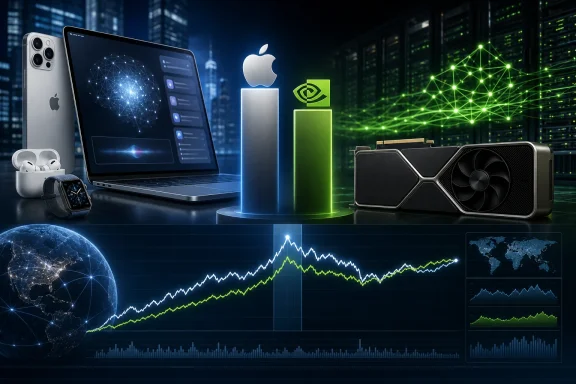 Apple and Nvidia are not chasing the same AI market
Nvidia remains the central supplier of high-end accelerators used to train and run large AI models in cloud data centers. Its valuation has been driven by spending from hyperscalers and enterprises building AI infrastructure, a market that can deliver enormous growth but is also susceptible to questions about whether customer capital expenditure will hold up.Apple’s strategy is consumer-facing. Apple Intelligence uses a mixture of on-device processing and Apple’s Private Cloud Compute system, with features designed to sit inside iPhones, iPads and Macs rather than sell compute capacity to cloud operators. That approach could strengthen device upgrades, ecosystem retention and services demand, but Apple has not yet demonstrated that its AI features will create a distinct revenue line comparable with Nvidia’s data-center business.
The distinction matters for Windows users and IT buyers. Apple’s success does not mean Nvidia has lost its position in the AI PC and workstation market. Nvidia hardware remains important for local model development, engineering workloads, creative applications and enterprise AI deployments on Windows. Apple, meanwhile, is attempting to make AI capabilities an expected part of premium personal devices.
A valuation crossover is not an AI verdict
The July 17 move followed a pullback in AI-linked semiconductor shares, according to Reuters, as investors reconsidered the sustainability of the broader AI trade. Apple benefited from that rotation, while Nvidia’s slide reduced the gap.That does not establish Apple Intelligence as the decisive factor, nor does it suggest Apple can displace Nvidia in AI infrastructure. It shows that investors are placing a premium on Apple’s established business while waiting for clearer evidence of which AI products will generate lasting demand.
For now, the practical consequence is a closer race at the top of the market, not a change in the hardware and software choices available to Windows users or enterprise administrators.
Update: Apple reportedly finished the session ahead of Nvidia (July 19, 2026)
Startup Fortune reports that Apple did not merely lead Nvidia briefly during July 17 trading; Reuters said Apple finished the session with the higher market value after Nvidia’s decline. That clarifies the intraday crossover described in earlier coverage, although the margin remained narrow.The report also links the semiconductor selloff to market concern following Moonshot’s release of the open-weight Kimi K3 model, which renewed debate over whether increasingly efficient AI models could curb demand for ever-larger GPU deployments. Nvidia also continues to face pressure from U.S. export restrictions affecting China, alongside growing interest in domestic Chinese alternatives.
Apple Beats Nvidia to Become the World's Most Valuable Company Again - Startup Fortune
Apple's $4.88 trillion close beat Nvidia's $4.86 trillion on July 17, 2026, as chip stocks slid and investors rotated into iPhone and Services growth.
startupfortune.com
References
- Primary source: Brussels Morning Newspaper
Published: 2026-07-17T13:12:48+00:00
Apple Intelligence: Can Apple Overtake Nvidia?
Apple Intelligence helps drive investor optimism as Apple narrows the gap with Nvidia in the race to become the world's most valuable company.brusselsmorning.com - Related coverage: investing.com
Apple closes in on Nvidia in race for world’s most valuable company By Reuters
Apple closes in on Nvidia in race for world’s most valuable companywww.investing.com - Related coverage: macrumors.com
Apple Passed Nvidia to Become World's Most Valuable Company Again
Apple momentarily became the world's most valuable publicly traded company again today after its market valuation surpassed that of Nvidia, according to CNBC. However, the two companies have since traded places during today's session. However, the two companies have since traded places...www.macrumors.com - Related coverage: theguardian.com
Apple dethrones Nvidia to regain title of world’s most valuable company | Apple | The Guardian
Shift in pecking order illustrates that investors are reassessing outlook for artificial intelligencewww.theguardian.com - Related coverage: fr.euronews.com
Apple dépasse Nvidia comme entreprise la plus valorisée au monde | Euronews
Apple, sans modèle de langage maison, rassure les marchés grâce à sa prudence en IA et aux solides ventes d’iPhonefr.euronews.com - Related coverage: live.euronext.com
Last edited:
