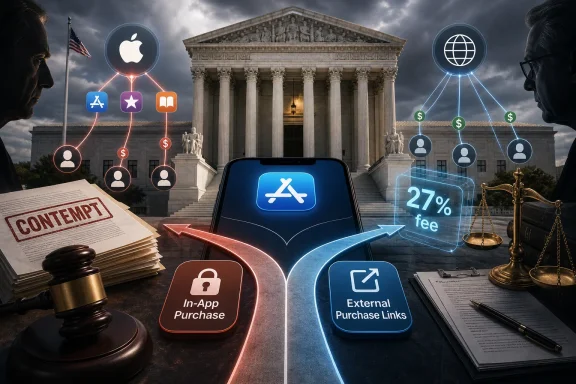
The Supreme Court agreed on June 30, 2026, to hear Apple’s appeal of a contempt ruling in its long-running Epic Games App Store case, putting the justices in position to decide how far courts can go when enforcing injunctions against platform owners. The headline is about Fortnite, iPhone payments, and Apple’s familiar 30 percent commission. The real case is about whether a dominant platform can obey an order on paper while rebuilding the same economic wall a few feet away. That makes it a mobile story, a developer story, and, uncomfortably for every ecosystem operator from Cupertino to Redmond, a governance story.
Apple’s Supreme Court appeal is carefully framed as a narrow legal dispute. The company is not asking the justices to relitigate every antitrust claim Epic brought in 2020, nor is it asking them to endorse the App Store model from first principles. Apple wants the Court to decide whether a company can be held in civil contempt for violating what a lower court describes as the spirit of an injunction when the conduct at issue was not spelled out with surgical precision.
That framing is not accidental. Apple has spent years trying to move this fight away from the intuitive question most developers ask — why should Apple collect a near-App Store-sized fee when payment happens outside Apple’s payment system? — and toward a procedural question the Supreme Court is more likely to care about. If injunctions can be enforced by judicial inference rather than explicit text, Apple argues, corporate defendants everywhere face uncertain compliance obligations.
Epic, predictably, sees the maneuver differently. Its argument is that Apple was ordered to stop blocking developers from steering users to outside payment options, then built a compliance regime that made steering economically pointless. The 27 percent fee Apple imposed on many external purchases was only slightly lower than the standard 30 percent App Store commission, and once payment processing and operational costs were added back in, developers could wind up with little or no practical benefit.
That is why the case has survived long after the original antitrust battlefield cooled. Epic lost most of its monopoly claims against Apple. Apple won the broad defense of its integrated App Store model. But the one remedy Epic did win — the right for developers to tell users there were cheaper ways to pay — has become the fulcrum of a much bigger fight over whether platform rules can be changed without platform economics changing at all.
For developers, that injunction looked like a crack in the wall. If a user could tap a link in an app and buy a subscription or digital item through the developer’s website, the developer might avoid Apple’s commission and keep materially more revenue. That was the theory, and it was the reason the injunction mattered even though Epic had failed to blow up the App Store model outright.
Apple’s response was to allow the links but attach a commission to transactions that followed them. In the United States, Apple’s external purchase fee generally sat three percentage points below its standard in-app purchase commission. A developer that would have paid 30 percent through Apple’s payment system could still owe Apple 27 percent after sending the user to the web.
That was the moment the dispute shifted from antitrust to enforcement. Apple could say it had complied: the links existed, the buttons existed, the rules had changed. Epic could say the remedy had been hollowed out: Apple had preserved the same economic deterrent through a new contractual mechanism.
The contempt ruling sided with Epic’s view. The district court concluded that Apple’s implementation frustrated the purpose of the injunction and, in effect, made the court-ordered relief unusable. The Ninth Circuit allowed that finding to stand, and Apple has now persuaded the Supreme Court to review the contempt standard.
But nobody in the app economy will experience the ruling as narrow. If Apple wins, it will be read by platform operators as confirmation that compliance can be engineered tightly around the literal text of an order. If Apple loses, it will tell courts and regulators that they can look past formal compliance and ask whether the remedy actually works.
That distinction matters well beyond iOS. Modern software platforms are governed less by outright bans than by fee schedules, review policies, APIs, telemetry requirements, identity systems, store rules, and contractual definitions. A platform rarely needs to say “no” when it can say “yes, subject to conditions that make the choice unattractive.”
The result is a kind of regulatory trench warfare. Courts and lawmakers order a gate to open. The platform opens it, then charges a toll, narrows the lane, adds warning screens, imposes reporting requirements, or limits eligibility. The question becomes whether the gate is legally open or practically open.
Apple is hardly alone in that instinct. Every large platform has learned to translate control into procedural language. Microsoft does it with licensing and bundling rules, Google with defaults and data access, Amazon with marketplace terms, and game console makers with certification and revenue-share structures. Apple’s case is simply the cleanest version because the numbers are so stark.
That is why Apple’s 27 percent external fee drew such fury. It offered the appearance of choice without the economics of choice. Developers could take on the friction of sending users to the web, operate their own checkout, absorb payment risk, handle customer service, and still owe Apple nearly the full commission.
For large companies with existing billing relationships — Spotify, Netflix, Kindle-style content businesses, fitness services, dating apps, cloud gaming providers — the ability to steer users outside Apple’s payment system can be meaningful. These companies already know how to bill customers directly. They can test pricing, bundles, and promotions across web and mobile with real sophistication.
For smaller developers, the benefit is less automatic. Checkout is not free. Fraud prevention is not free. Tax compliance is not free. Customer support, refund handling, subscription cancellation flows, and payment localization are not free. A startup escaping a 30 percent commission may still discover that it has recreated part of Apple’s payment stack at smaller scale and worse leverage.
That does not make Apple’s fee harmless. It makes the policy fight more complex than the slogan. The most powerful relief for developers is not merely permission to link out; it is permission to link out under conditions where doing so is economically rational and operationally tolerable.
In practice, the European experiment has been messier. Apple introduced a new fee architecture that includes install-based charges and tiered commissions. The numbers differ from the old App Store model, and in some cases they are lower, but the structure is complicated enough to make many developers hesitate. A developer weighing alternative distribution in Europe must model not only payment fees but install volume, eligibility thresholds, user trust, support burden, and the risk that a successful app triggers new costs.
That is the broader lesson. Platform power does not disappear when one fee is reduced. It migrates. If the commission is capped, the platform can introduce a technology fee. If payments are opened, the platform can regulate links. If third-party stores are allowed, the platform can shape security prompts, notarization requirements, or installation friction.
Apple defends this as the cost of maintaining a safe and trusted ecosystem. There is truth in that defense. iOS users do benefit from a tightly controlled distribution model, and the App Store has reduced certain categories of malware and fraud compared with more open software environments. The uncomfortable part is that the same control surface used for security is also used for commerce.
That dual-use nature is why regulators struggle. A warning screen can protect users, but it can also scare them away from a rival payment system. A review process can block scams, but it can also delay competitors. A fee can fund platform maintenance, but it can also neutralize a court-ordered alternative.
But that difference is narrowing at the edges. Microsoft has spent the last decade trying to make Windows more store-like where it can and more managed where it must. Windows 11 leans harder on account integration, cloud services, Smart App Control, Defender reputation systems, driver signing, Microsoft Store distribution, and enterprise policy layers. The PC remains vastly more open than the iPhone, but the direction of travel is toward managed trust.
That is not inherently bad. Sysadmins know the cost of openness because they pay it every Patch Tuesday, every phishing cleanup, every unsigned driver incident, and every line-of-business app that still needs an ancient runtime. A curated software path has obvious appeal in schools, government, healthcare, and locked-down enterprise fleets.
The Apple-Epic case matters to WindowsForum readers because it asks where curation ends and rent extraction begins. Microsoft’s own history with antitrust turned on similar questions: when does a platform owner improve the user experience, and when does it use platform control to disadvantage rivals? The vocabulary has changed from browsers and middleware to app stores and payment links, but the structure is familiar.
The Windows world has usually resolved the tension through multiplicity. If the Microsoft Store is unattractive, developers can ship an MSI, an EXE, a winget package, a Steam build, an enterprise deployment, or a direct download. That messy abundance is one reason Windows remains resilient. It is also why Microsoft has never had Apple’s clean ability to tax a massive slice of consumer software revenue at the point of transaction.
There is a real product achievement there. Many users prefer a system where apps are reviewed, payments are centralized, refunds are familiar, and malicious software has fewer paths onto the device. Parents, schools, and less technical users have rational reasons to value that model.
The problem is that Apple often treats the existence of security benefits as though it settles every commercial question downstream. It does not. A platform can be safer than the alternative and still overcharge. A review process can be useful and still discriminatory. A payment system can be convenient and still tied to anticompetitive steering rules.
The contempt fight exposes that distinction. The court did not order Apple to abandon app review or remove all protections around external payment links. It ordered Apple to stop preventing developers from communicating alternatives. Apple’s answer was not simply a security warning or a technical requirement; it was a commission structure that preserved Apple’s revenue claim over purchases it did not process.
That is why the “safety” argument only carries Apple so far. If the fee is truly about recouping platform costs, Apple has to explain why it tracks transaction value so closely. If a $100 annual subscription and a $10 annual subscription impose similar review and platform burdens, a percentage fee starts to look less like cost recovery and more like rent.
That is why the Supreme Court took the case. The justices are not an App Store rate board. They are more likely to care about whether the lower courts applied a contempt standard that gives enough notice to the party being punished. If Apple can show that the original injunction did not clearly prohibit commissions on external purchases, it has a plausible path to victory.
But the hard part is that injunctions are often written to prevent evasive conduct. Courts do not issue remedial orders as drafting exercises for companies to route around. If a defendant can preserve the prohibited effect by changing the mechanism, judicial remedies become performative. The order says one thing, the platform does another, and the market sees no difference.
That tension will define the case. Apple wants a rule that contempt must be tied to clear, unambiguous, precise prohibitions. Epic wants courts to retain enough power to stop deliberate workarounds. Both positions have institutional logic, and both can be abused.
For IT pros, this is not an abstract concern. Compliance often lives in the same gray zone. Whether the issue is software licensing, privacy controls, security attestations, procurement rules, or cloud residency commitments, organizations constantly ask whether they are satisfying the words of a requirement or its operational purpose. The Apple case is a high-dollar version of a familiar enterprise problem.
That does not mean the App Store commission vanishes. Apple still has enormous leverage: control over iOS distribution, user trust, developer tooling, review infrastructure, and access to one of the most lucrative customer bases in the world. Many developers will continue paying because the App Store remains the shortest path to revenue.
But the moral authority of the fee has weakened. Apple’s strongest version of the argument is that it created the marketplace, maintains the tools, protects users, and deserves compensation. Its weakest version is that it deserves a large percentage of transactions even when the developer acquires the customer, handles the payment, hosts the service, manages support, and merely tells the user where to pay.
That gap is where future regulation will live. Courts may focus on contempt doctrine, but lawmakers will ask simpler questions. How much control should a mobile operating system owner have over commerce that happens outside its payment system? When does a platform fee become a tax on access to users? What disclosures, warnings, and technical requirements are legitimate security measures rather than friction by design?
Those questions will not stop at Apple. Google’s Play Store, console storefronts, game distribution platforms, browser engines, AI model marketplaces, cloud app exchanges, and enterprise SaaS marketplaces all operate on variations of the same theme. The more software distribution consolidates into managed ecosystems, the more every fee schedule becomes a policy document.
Startups are different. A consumer app trying to build a subscription business lives and dies on small changes in conversion, churn, acquisition cost, and gross margin. A 30 percent platform fee can turn a workable model into a fundraising story with bad math. A 27 percent fee on external purchases does not fix that.
This is where the Supreme Court case becomes economically significant even if the legal question sounds narrow. If Apple can charge near-standard commissions on external transactions, the “choice” to use outside payments remains mostly theoretical for early-stage companies. If Apple cannot, developers with direct user relationships gain a new margin lever.
That lever will not help everyone equally. Games that depend heavily on App Store discovery may still prefer Apple’s payment system. Apps serving less technical audiences may avoid external checkout because the drop-off is too high. Subscription services with strong web brands may benefit more than casual utility apps.
Still, optionality matters. A startup does not need every user to pay outside the App Store for the economics to change. It may only need power users, annual subscribers, or enterprise-adjacent customers to shift. Even partial migration can fund development, support lower prices, or reduce dependence on venture capital.
Apple understands this, which is why it fights so hard over the fee. The battle is not merely about today’s lost commission. It is about preventing developers from training users that the App Store is not the only place where the commercial relationship can happen.
That delay matters because platform policy is iterative. Apple does not need one perfect answer; it needs a series of defensible answers that preserve the business model while each legal challenge works its way through the system. By the time one fee is struck down, another structure may be ready. By the time one warning screen is softened, another compliance pathway may be introduced.
This is the asymmetry between platforms and challengers. Developers need predictable rules to build products. Platforms can treat uncertainty as a moat. Every month of ambiguity favors the incumbent because most developers will not redesign billing, pricing, and user flows around a remedy that may disappear.
That is why the contempt ruling was so threatening to Apple. It did not merely reject a fee; it questioned the company’s pattern of compliance. A court willing to look at practical effect rather than formal structure is harder for a platform to route around. Apple wants the Supreme Court to narrow that enforcement power before it becomes a template.
Even if Apple wins, the victory may be incomplete. A ruling about contempt clarity would not necessarily bless every App Store fee forever. It could send the case back for further proceedings, invite a more specific injunction, or shift the fight to legislatures and regulators. The Supreme Court can decide the legal standard without settling the future of mobile software economics.
The change is partly cultural. Consumers understand subscriptions better than they once did. Developers talk publicly about platform taxes. Regulators have become more fluent in interface design, steering rules, and default effects. The old claim that app store policy is just private contracting no longer persuades as easily when one private contract governs access to hundreds of millions of devices.
It is also partly economic. Software margins are under pressure from cloud costs, AI infrastructure spending, privacy changes that make ads less predictable, and user fatigue with subscription pricing. A mandatory 30 percent cut looks different in a world where growth is harder and capital is less forgiving. Developers that once treated Apple’s fee as the cost of doing business now see it as one more platform dependency they cannot control.
The irony is that Apple’s App Store succeeded because it solved a real problem. Before app stores, software distribution was fragmented, risky, and often hostile to ordinary users. Apple made mobile software trusted and easy. The company’s difficulty now is that the solution became infrastructure, and infrastructure eventually attracts public obligations.
That is the stage this case has reached. It is no longer just Epic’s grievance, or Apple’s commission, or Fortnite’s banishment from iOS. It is a test of how much freedom a platform owner has to define compliance in ways that preserve the commercial status quo.
Apple’s Supreme Court fight is ultimately about who gets to define meaningful choice inside a controlled computing ecosystem. If Apple’s view prevails, the next decade of platform regulation will be a drafting contest in which every remedy must anticipate every workaround. If Epic’s view prevails, courts will have more room to ask whether users and developers actually received the freedom an order promised. Either way, the age of the unquestioned app store toll is over; what comes next is a more legalistic, more fragmented, and more politically contested software economy where every button, fee, and warning screen carries the weight of platform power.
 Apple Wants a Legal Fight About Contempt, Not a Business Fight About Rent
Apple’s Supreme Court appeal is carefully framed as a narrow legal dispute. The company is not asking the justices to relitigate every antitrust claim Epic brought in 2020, nor is it asking them to endorse the App Store model from first principles. Apple wants the Court to decide whether a company can be held in civil contempt for violating what a lower court describes as the spirit of an injunction when the conduct at issue was not spelled out with surgical precision.That framing is not accidental. Apple has spent years trying to move this fight away from the intuitive question most developers ask — why should Apple collect a near-App Store-sized fee when payment happens outside Apple’s payment system? — and toward a procedural question the Supreme Court is more likely to care about. If injunctions can be enforced by judicial inference rather than explicit text, Apple argues, corporate defendants everywhere face uncertain compliance obligations.
Epic, predictably, sees the maneuver differently. Its argument is that Apple was ordered to stop blocking developers from steering users to outside payment options, then built a compliance regime that made steering economically pointless. The 27 percent fee Apple imposed on many external purchases was only slightly lower than the standard 30 percent App Store commission, and once payment processing and operational costs were added back in, developers could wind up with little or no practical benefit.
That is why the case has survived long after the original antitrust battlefield cooled. Epic lost most of its monopoly claims against Apple. Apple won the broad defense of its integrated App Store model. But the one remedy Epic did win — the right for developers to tell users there were cheaper ways to pay — has become the fulcrum of a much bigger fight over whether platform rules can be changed without platform economics changing at all.
The 27 Percent Fee Was Apple’s Compliance Philosophy in Miniature
The first Epic trial ended in 2021 with an awkward split decision. Apple avoided the worst-case scenario: it was not ordered to open iOS to rival app stores in the United States, and the court did not declare the App Store an illegal monopoly under federal antitrust law. But Judge Yvonne Gonzalez Rogers did order Apple to relax its anti-steering rules, which had prevented developers from directing users inside apps to alternative purchasing mechanisms.For developers, that injunction looked like a crack in the wall. If a user could tap a link in an app and buy a subscription or digital item through the developer’s website, the developer might avoid Apple’s commission and keep materially more revenue. That was the theory, and it was the reason the injunction mattered even though Epic had failed to blow up the App Store model outright.
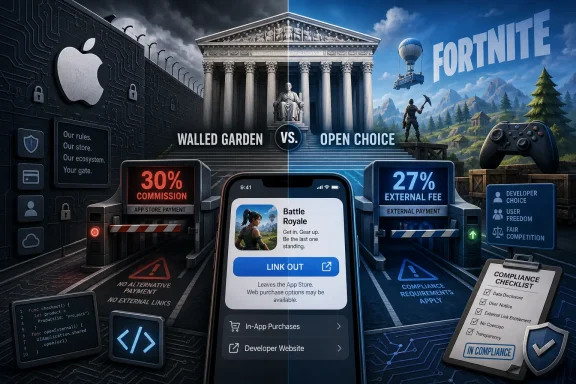
Apple’s response was to allow the links but attach a commission to transactions that followed them. In the United States, Apple’s external purchase fee generally sat three percentage points below its standard in-app purchase commission. A developer that would have paid 30 percent through Apple’s payment system could still owe Apple 27 percent after sending the user to the web.
That was the moment the dispute shifted from antitrust to enforcement. Apple could say it had complied: the links existed, the buttons existed, the rules had changed. Epic could say the remedy had been hollowed out: Apple had preserved the same economic deterrent through a new contractual mechanism.
The contempt ruling sided with Epic’s view. The district court concluded that Apple’s implementation frustrated the purpose of the injunction and, in effect, made the court-ordered relief unusable. The Ninth Circuit allowed that finding to stand, and Apple has now persuaded the Supreme Court to review the contempt standard.
The Supreme Court Took the Narrow Door, but the Market Is Watching the Whole House
The Supreme Court’s grant is narrower than the business stakes. The justices are focused on whether the contempt finding can rest on an injunction that did not explicitly prohibit the precise fee Apple later created. That is a classic Supreme Court move: take the doctrinal seam, leave the commercial explosion sitting just outside the frame.But nobody in the app economy will experience the ruling as narrow. If Apple wins, it will be read by platform operators as confirmation that compliance can be engineered tightly around the literal text of an order. If Apple loses, it will tell courts and regulators that they can look past formal compliance and ask whether the remedy actually works.
That distinction matters well beyond iOS. Modern software platforms are governed less by outright bans than by fee schedules, review policies, APIs, telemetry requirements, identity systems, store rules, and contractual definitions. A platform rarely needs to say “no” when it can say “yes, subject to conditions that make the choice unattractive.”
The result is a kind of regulatory trench warfare. Courts and lawmakers order a gate to open. The platform opens it, then charges a toll, narrows the lane, adds warning screens, imposes reporting requirements, or limits eligibility. The question becomes whether the gate is legally open or practically open.
Apple is hardly alone in that instinct. Every large platform has learned to translate control into procedural language. Microsoft does it with licensing and bundling rules, Google with defaults and data access, Amazon with marketplace terms, and game console makers with certification and revenue-share structures. Apple’s case is simply the cleanest version because the numbers are so stark.
Developers Care Less About Legal Doctrine Than About Unit Economics
The Supreme Court may spend oral argument parsing contempt doctrine, but developers will be doing arithmetic. A 30 percent commission is not a rounding error in consumer software. It is the difference between profitable and unprofitable user acquisition, between a sustainable subscription and a price increase, between a game studio reinvesting in content and watching the platform capture most of the upside.That is why Apple’s 27 percent external fee drew such fury. It offered the appearance of choice without the economics of choice. Developers could take on the friction of sending users to the web, operate their own checkout, absorb payment risk, handle customer service, and still owe Apple nearly the full commission.
For large companies with existing billing relationships — Spotify, Netflix, Kindle-style content businesses, fitness services, dating apps, cloud gaming providers — the ability to steer users outside Apple’s payment system can be meaningful. These companies already know how to bill customers directly. They can test pricing, bundles, and promotions across web and mobile with real sophistication.
For smaller developers, the benefit is less automatic. Checkout is not free. Fraud prevention is not free. Tax compliance is not free. Customer support, refund handling, subscription cancellation flows, and payment localization are not free. A startup escaping a 30 percent commission may still discover that it has recreated part of Apple’s payment stack at smaller scale and worse leverage.
That does not make Apple’s fee harmless. It makes the policy fight more complex than the slogan. The most powerful relief for developers is not merely permission to link out; it is permission to link out under conditions where doing so is economically rational and operationally tolerable.
The EU Has Already Shown How a Platform Can Lose and Still Preserve the Game
Europe’s Digital Markets Act gives the United States a preview of what happens when lawmakers force Apple to loosen its grip. In the EU, Apple has had to allow alternative app distribution and alternative payment options under a regulatory structure designed specifically for digital gatekeepers. That sounds like the kind of remedy Epic wanted from the beginning.In practice, the European experiment has been messier. Apple introduced a new fee architecture that includes install-based charges and tiered commissions. The numbers differ from the old App Store model, and in some cases they are lower, but the structure is complicated enough to make many developers hesitate. A developer weighing alternative distribution in Europe must model not only payment fees but install volume, eligibility thresholds, user trust, support burden, and the risk that a successful app triggers new costs.
That is the broader lesson. Platform power does not disappear when one fee is reduced. It migrates. If the commission is capped, the platform can introduce a technology fee. If payments are opened, the platform can regulate links. If third-party stores are allowed, the platform can shape security prompts, notarization requirements, or installation friction.
Apple defends this as the cost of maintaining a safe and trusted ecosystem. There is truth in that defense. iOS users do benefit from a tightly controlled distribution model, and the App Store has reduced certain categories of malware and fraud compared with more open software environments. The uncomfortable part is that the same control surface used for security is also used for commerce.
That dual-use nature is why regulators struggle. A warning screen can protect users, but it can also scare them away from a rival payment system. A review process can block scams, but it can also delay competitors. A fee can fund platform maintenance, but it can also neutralize a court-ordered alternative.
This Is the Same Platform Argument Windows Has Been Having for Decades
Windows users may be tempted to treat this as an Apple-only drama. After all, Windows grew up as the anti-iOS: open distribution, sideloaded applications, Win32 installers, third-party stores, direct billing, and a long history of users downloading whatever questionable executable a search engine served up. Microsoft never had a single App Store choke point for the PC ecosystem.But that difference is narrowing at the edges. Microsoft has spent the last decade trying to make Windows more store-like where it can and more managed where it must. Windows 11 leans harder on account integration, cloud services, Smart App Control, Defender reputation systems, driver signing, Microsoft Store distribution, and enterprise policy layers. The PC remains vastly more open than the iPhone, but the direction of travel is toward managed trust.
That is not inherently bad. Sysadmins know the cost of openness because they pay it every Patch Tuesday, every phishing cleanup, every unsigned driver incident, and every line-of-business app that still needs an ancient runtime. A curated software path has obvious appeal in schools, government, healthcare, and locked-down enterprise fleets.
The Apple-Epic case matters to WindowsForum readers because it asks where curation ends and rent extraction begins. Microsoft’s own history with antitrust turned on similar questions: when does a platform owner improve the user experience, and when does it use platform control to disadvantage rivals? The vocabulary has changed from browsers and middleware to app stores and payment links, but the structure is familiar.
The Windows world has usually resolved the tension through multiplicity. If the Microsoft Store is unattractive, developers can ship an MSI, an EXE, a winget package, a Steam build, an enterprise deployment, or a direct download. That messy abundance is one reason Windows remains resilient. It is also why Microsoft has never had Apple’s clean ability to tax a massive slice of consumer software revenue at the point of transaction.
Security Is Apple’s Strongest Argument and Its Most Convenient Shield
Apple’s best defense has always been user trust. The company built the iPhone into a mass-market computing platform partly by hiding the chaos that defined the old PC software world. Users generally do not think about payment processors, malware signatures, unsigned binaries, or fraudulent subscription traps when buying something through an iOS app. Apple made that invisible, then charged for the privilege.There is a real product achievement there. Many users prefer a system where apps are reviewed, payments are centralized, refunds are familiar, and malicious software has fewer paths onto the device. Parents, schools, and less technical users have rational reasons to value that model.
The problem is that Apple often treats the existence of security benefits as though it settles every commercial question downstream. It does not. A platform can be safer than the alternative and still overcharge. A review process can be useful and still discriminatory. A payment system can be convenient and still tied to anticompetitive steering rules.
The contempt fight exposes that distinction. The court did not order Apple to abandon app review or remove all protections around external payment links. It ordered Apple to stop preventing developers from communicating alternatives. Apple’s answer was not simply a security warning or a technical requirement; it was a commission structure that preserved Apple’s revenue claim over purchases it did not process.
That is why the “safety” argument only carries Apple so far. If the fee is truly about recouping platform costs, Apple has to explain why it tracks transaction value so closely. If a $100 annual subscription and a $10 annual subscription impose similar review and platform burdens, a percentage fee starts to look less like cost recovery and more like rent.
The Contempt Question Could Reshape Corporate Compliance
Apple’s legal argument should not be dismissed as mere gamesmanship. Injunctions need clarity. Companies subject to court orders must know what is forbidden, and contempt is a serious remedy. A legal system that punishes defendants for failing to anticipate a judge’s unstated expectations would create obvious due process problems.That is why the Supreme Court took the case. The justices are not an App Store rate board. They are more likely to care about whether the lower courts applied a contempt standard that gives enough notice to the party being punished. If Apple can show that the original injunction did not clearly prohibit commissions on external purchases, it has a plausible path to victory.
But the hard part is that injunctions are often written to prevent evasive conduct. Courts do not issue remedial orders as drafting exercises for companies to route around. If a defendant can preserve the prohibited effect by changing the mechanism, judicial remedies become performative. The order says one thing, the platform does another, and the market sees no difference.
That tension will define the case. Apple wants a rule that contempt must be tied to clear, unambiguous, precise prohibitions. Epic wants courts to retain enough power to stop deliberate workarounds. Both positions have institutional logic, and both can be abused.
For IT pros, this is not an abstract concern. Compliance often lives in the same gray zone. Whether the issue is software licensing, privacy controls, security attestations, procurement rules, or cloud residency commitments, organizations constantly ask whether they are satisfying the words of a requirement or its operational purpose. The Apple case is a high-dollar version of a familiar enterprise problem.
The App Store Model Is No Longer Just Apple’s Problem
Whatever the Court decides, the App Store model is under pressure from too many directions to return to its old simplicity. Regulators in Europe have already moved. Developers have become more sophisticated about margin leakage. Consumers are more accustomed to subscribing on the web and using services across devices. The idea that every digital transaction inside a mobile app naturally owes the platform 30 percent no longer feels as inevitable as it did in 2010.That does not mean the App Store commission vanishes. Apple still has enormous leverage: control over iOS distribution, user trust, developer tooling, review infrastructure, and access to one of the most lucrative customer bases in the world. Many developers will continue paying because the App Store remains the shortest path to revenue.
But the moral authority of the fee has weakened. Apple’s strongest version of the argument is that it created the marketplace, maintains the tools, protects users, and deserves compensation. Its weakest version is that it deserves a large percentage of transactions even when the developer acquires the customer, handles the payment, hosts the service, manages support, and merely tells the user where to pay.
That gap is where future regulation will live. Courts may focus on contempt doctrine, but lawmakers will ask simpler questions. How much control should a mobile operating system owner have over commerce that happens outside its payment system? When does a platform fee become a tax on access to users? What disclosures, warnings, and technical requirements are legitimate security measures rather than friction by design?
Those questions will not stop at Apple. Google’s Play Store, console storefronts, game distribution platforms, browser engines, AI model marketplaces, cloud app exchanges, and enterprise SaaS marketplaces all operate on variations of the same theme. The more software distribution consolidates into managed ecosystems, the more every fee schedule becomes a policy document.
Startups Are the Test Case Apple Would Rather Not Talk About
The biggest companies can survive almost any outcome. Spotify, Netflix, Meta, Microsoft, and Epic have lawyers, lobbyists, payment infrastructure, and enough brand power to push users through awkward checkout flows. If external links become more valuable, they can exploit them. If Apple wins, they can keep fighting elsewhere.Startups are different. A consumer app trying to build a subscription business lives and dies on small changes in conversion, churn, acquisition cost, and gross margin. A 30 percent platform fee can turn a workable model into a fundraising story with bad math. A 27 percent fee on external purchases does not fix that.
This is where the Supreme Court case becomes economically significant even if the legal question sounds narrow. If Apple can charge near-standard commissions on external transactions, the “choice” to use outside payments remains mostly theoretical for early-stage companies. If Apple cannot, developers with direct user relationships gain a new margin lever.
That lever will not help everyone equally. Games that depend heavily on App Store discovery may still prefer Apple’s payment system. Apps serving less technical audiences may avoid external checkout because the drop-off is too high. Subscription services with strong web brands may benefit more than casual utility apps.
Still, optionality matters. A startup does not need every user to pay outside the App Store for the economics to change. It may only need power users, annual subscribers, or enterprise-adjacent customers to shift. Even partial migration can fund development, support lower prices, or reduce dependence on venture capital.
Apple understands this, which is why it fights so hard over the fee. The battle is not merely about today’s lost commission. It is about preventing developers from training users that the App Store is not the only place where the commercial relationship can happen.
The Court’s Ruling May Arrive After the Market Has Already Moved
Supreme Court timing is slow by platform standards. The case will unfold across briefing, argument, and a decision that may not arrive until 2027. During that window, Apple will continue adjusting its rules, regulators will continue probing, and developers will continue testing user behavior under whatever payment-link regime is available at the time.That delay matters because platform policy is iterative. Apple does not need one perfect answer; it needs a series of defensible answers that preserve the business model while each legal challenge works its way through the system. By the time one fee is struck down, another structure may be ready. By the time one warning screen is softened, another compliance pathway may be introduced.
This is the asymmetry between platforms and challengers. Developers need predictable rules to build products. Platforms can treat uncertainty as a moat. Every month of ambiguity favors the incumbent because most developers will not redesign billing, pricing, and user flows around a remedy that may disappear.
That is why the contempt ruling was so threatening to Apple. It did not merely reject a fee; it questioned the company’s pattern of compliance. A court willing to look at practical effect rather than formal structure is harder for a platform to route around. Apple wants the Supreme Court to narrow that enforcement power before it becomes a template.
Even if Apple wins, the victory may be incomplete. A ruling about contempt clarity would not necessarily bless every App Store fee forever. It could send the case back for further proceedings, invite a more specific injunction, or shift the fight to legislatures and regulators. The Supreme Court can decide the legal standard without settling the future of mobile software economics.
The Platform Tax Is Now a Political Object
For years, Apple’s commission was treated as a business term. Developers complained, Apple defended it, users mostly ignored it, and the market absorbed the cost. That era is ending. Platform fees are now political objects because they shape who can build, who can compete, and who captures the surplus from digital markets.The change is partly cultural. Consumers understand subscriptions better than they once did. Developers talk publicly about platform taxes. Regulators have become more fluent in interface design, steering rules, and default effects. The old claim that app store policy is just private contracting no longer persuades as easily when one private contract governs access to hundreds of millions of devices.
It is also partly economic. Software margins are under pressure from cloud costs, AI infrastructure spending, privacy changes that make ads less predictable, and user fatigue with subscription pricing. A mandatory 30 percent cut looks different in a world where growth is harder and capital is less forgiving. Developers that once treated Apple’s fee as the cost of doing business now see it as one more platform dependency they cannot control.
The irony is that Apple’s App Store succeeded because it solved a real problem. Before app stores, software distribution was fragmented, risky, and often hostile to ordinary users. Apple made mobile software trusted and easy. The company’s difficulty now is that the solution became infrastructure, and infrastructure eventually attracts public obligations.
That is the stage this case has reached. It is no longer just Epic’s grievance, or Apple’s commission, or Fortnite’s banishment from iOS. It is a test of how much freedom a platform owner has to define compliance in ways that preserve the commercial status quo.
The Lesson for Every Walled Garden Is Written in Apple’s 27 Percent
The Supreme Court will not write a business plan for developers, but its decision will change the bargaining environment around mobile payments. The concrete stakes are easier to see than the legal language suggests.- The Supreme Court is reviewing Apple’s contempt fight, not reopening the entire original Epic antitrust case from scratch.
- Apple’s 27 percent external purchase fee is central because it made outside payment links only marginally cheaper than Apple’s own in-app purchase system.
- A ruling for Apple could make it easier for platform owners to comply narrowly with injunctions while preserving the economic effects courts tried to change.
- A ruling against Apple could strengthen judicial power to police workarounds that obey an order’s text while defeating its purpose.
- Developers should not assume that link-out rights automatically create savings, because checkout costs, user friction, and platform countermeasures still matter.
- Windows and enterprise administrators should watch the case because the same security-versus-control argument is spreading across managed software ecosystems.
Apple’s Supreme Court fight is ultimately about who gets to define meaningful choice inside a controlled computing ecosystem. If Apple’s view prevails, the next decade of platform regulation will be a drafting contest in which every remedy must anticipate every workaround. If Epic’s view prevails, courts will have more room to ask whether users and developers actually received the freedom an order promised. Either way, the age of the unquestioned app store toll is over; what comes next is a more legalistic, more fragmented, and more politically contested software economy where every button, fee, and warning screen carries the weight of platform power.
References
- Primary source: Ars Technica
Published: Tue, 30 Jun 2026 20:20:29 GMT
Apple takes Epic fight over app store fees to the Supreme Court - Ars Technica
Supreme Court will weigh if Apple contempt finding in Epic case is “erroneous.”...arstechnica.com - Independent coverage: Startup Fortune
Published: 2026-07-01T02:00:27.682547
The Supreme Court's Apple ruling could reset the economics of every mobile startup - Startup Fortune
The Supreme Court agreed on June 30 to hear Apple's appeal in the Epic Games App Store contempt case, setting up an October term argument over whetherstartupfortune.com - Independent coverage: pymnts.com
Published: Tue, 30 Jun 2026 22:41:37 GMT
PYMNTS | Supreme Court Takes Up Apple Appeal in Epic Games Fight
The Supreme Court will hear Apple’s appeal of a lower court ruling that found the company in contempt in its legal fight with Epic Games. www.pymnts.com
- Independent coverage: Courthouse News
Published: Tue, 30 Jun 2026 21:16:11 GMT
Supreme Court takes Apple contempt fight over App Store fees on third-party payments | Courthouse News Service
A federal judge said Apple "willfully" failed to comply with court orders following an antitrust suit filed by Fortnite developer Epic Games. www.courthousenews.com
- Independent coverage: Gizmodo
Published: Tue, 30 Jun 2026 21:15:21 GMT
Apple’s Beef With Fortnite Maker Epic Games Is Heading to the Supreme Court
The U.S. Supreme Court agreed to hear Apple’s appeal in a case dealing with App Store fees. gizmodo.com
- Independent coverage: Engadget
Published: Tue, 30 Jun 2026 21:14:24 GMT
The Supreme Court Will Hear An Appeal In The Long-Running Case Between Apple And Epic Games
Apple filed an appeal after being found in contempt of an order related to App Store fees.www.engadget.com
- Independent coverage: Reuters
Published: Tue, 30 Jun 2026 18:01:20 GMT
- Related coverage: macrumors.com
Supreme Court Will Hear Apple's Appeal in Epic Games App Store Fight
The United States Supreme Court has agreed to hear Apple's appeal against the contempt ruling that forced it to change its App Store linking rules, reports Reuters. In a statement to MacRumors, Apple said the court's decision was welcome news. This is an important question of law and...www.macrumors.com - Related coverage: techcrunch.com
Apple moves to take its App Store fight back to the Supreme Court | TechCrunch
Apple plans to ask the Supreme Court to review its App Store fight with Epic Games, as it challenges a ruling limiting its ability to charge fees on external payments.techcrunch.com - Related coverage: 9to5mac.com
Supreme Court agrees to hear Apple appeal over Epic Games ruling - 9to5Mac
The US Supreme Court has agreed to hear Apple’s appeal over a ruling that held the company in contempt related to its Epic Games case.9to5mac.com - Related coverage: supremecourt.gov
- Related coverage: apple.gadgethacks.com
Apple Supreme Court Review Epic Games Case: Two Key Legal Questions << Apple :: Gadget Hacks
Apple just filed a certiorari petition with the Supreme Court, asking the justices to take up two questions arising from the company's contempt finding in... apple.gadgethacks.com
- Related coverage: iclarified.com
Apple Fires Back at Epic in Supreme Court App Store Appeal - iClarified
Apple has filed a new Supreme Court brief in its legal battle with Epic Games, arguing that lower courts improperly held the company in contempt over its 27 percent commission on out-of-app purchases.www.iclarified.com - Related coverage: mlex.com
US Supreme Court to review Epic Games-Apple injunction compliance dispute | MLex | Specialist news and analysis on legal risk and regulation
MLex Summary: The US Supreme Court has granted certiorari to review a decision in Epic Games' injunction compliance dispute with Apple from the US Court of Appeals for the Ninth Circuit. The justices said Apple's petition for a writ of certiorari is granted limited to &quot;Question...www.mlex.com - Related coverage: techtimes.com
App Store Antitrust: Supreme Court Weighs Apple Bid to Kill Contempt Finding
App Store antitrust reaches its highest-stakes moment as all nine Supreme Court justices privately vote today on whether to hear Apple’s bid to erase a contempt finding, a decision that will setwww.techtimes.com