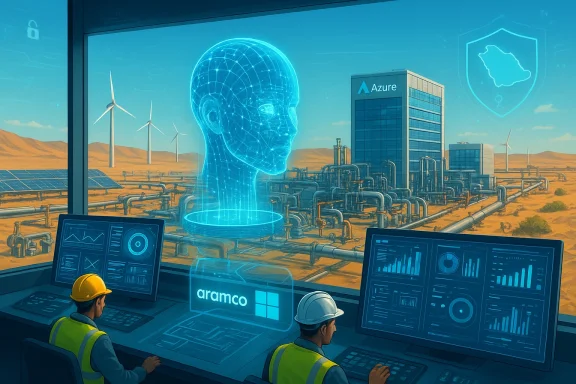
Saudi Aramco and Microsoft have signed a non‑binding Memorandum of Understanding (MoU) to accelerate the deployment of industrial AI, deepen cloud‑anchored digital transformation across the Kingdom, and build a measurable national pipeline of AI and cloud skills — a move that ties Aramco’s operational scale to Microsoft’s sovereign‑ready Azure strategy and signals a decisive step from pilot projects toward production‑grade industrial AI.
On February 12, 2026, Aramco published a statement announcing a non‑binding MoU with Microsoft to “explore a series of digital initiatives designed to accelerate industrial AI adoption, enhance digital capabilities, and strengthen workforce development in Saudi Arabia.” The statement lays out four explicit focus areas: digital sovereignty and data residency, operational efficiency and digital infrastructure, an industry alliance framework, and industrial AI IP co‑innovation. Both companies emphasized skills programs to build capabilities in AI engineering, cybersecurity, data governance, and product management, with measurable outcomes.
Microsoft’s public commentary and its related disclosure about the Saudi Azure datacenter program make the technology context explicit: Microsoft confirmed that its Saudi Arabia East Azure region is expected to be available for customers to run cloud workloads beginning in Q4 2026, an infrastructure milestone that directly supports the kind of sovereign‑ready deployments the MoU contemplates. That region will open with three availability zones and is framed by Microsoft as “sovereign‑ready” infrastructure intended to meet latency, residency and compliance needs for the Kingdom’s public and private sectors.
Independent press coverage picked up on Aramco’s announcement the same day, reiterating that the MoU is intended to explore cooperation rather than create binding commercial commitments — an important contractual distinction when evaluating near‑term outcomes.
Mitigation: insist on multi‑cloud portability standards, containerized model packaging, open formats for data models, and contractual rights to export data and models.
Mitigation: define explicit custody models, cryptographic key controls, independent audits and supply‑chain attestations in subsequent contracts.
Mitigation: implement separate hardened enclaves for OT‑facing models, independent safety verification regimes, and “air‑gap‑aware” deployment patterns where needed.
Mitigation: negotiate clear IP, licensing and commercialization frameworks up front; incorporate territory and export restrictions; consider joint venture arrangements where appropriate.
Mitigation: define measurable skilling metrics (number certified, placement rates, role transitions), fund retraining and change management, and map how AI roles integrate with existing operational teams.
Mitigation: build transparent governance processes, include carve‑outs for controlled technologies, and maintain legal and regulatory review capability.
Yet statements of intent are not the same as binding commitments. The real test will be in the execution details: how data custody and model IP are governed, how safety and security are engineered into OT‑facing systems, and whether skilling programs produce measurable, equitable outcomes for the Kingdom’s workforce. The availability of Microsoft’s Saudi Azure region from Q4 2026 is a necessary infrastructure milestone; whether it is sufficient to convert the MoU’s ambitions into operational realities depends on contract specifics, independent assurances, and a careful approach to vendor neutrality and safety.
For technologists and policymakers watching this space, the Aramco‑Microsoft MoU is worth following for the precedents it sets — but it should be evaluated by deliverables and measurables, not by rhetoric alone.
Aramco’s announcement and Microsoft’s regional timelines together outline a clear path; the coming 12–36 months will show whether this path becomes a durable highway for industrial AI or another well‑intentioned but under‑specified agreement.
Source: Rigzone Aramco, Microsoft Sign AI MOU
 Background: what was announced and why it matters
On February 12, 2026, Aramco published a statement announcing a non‑binding MoU with Microsoft to “explore a series of digital initiatives designed to accelerate industrial AI adoption, enhance digital capabilities, and strengthen workforce development in Saudi Arabia.” The statement lays out four explicit focus areas: digital sovereignty and data residency, operational efficiency and digital infrastructure, an industry alliance framework, and industrial AI IP co‑innovation. Both companies emphasized skills programs to build capabilities in AI engineering, cybersecurity, data governance, and product management, with measurable outcomes.Microsoft’s public commentary and its related disclosure about the Saudi Azure datacenter program make the technology context explicit: Microsoft confirmed that its Saudi Arabia East Azure region is expected to be available for customers to run cloud workloads beginning in Q4 2026, an infrastructure milestone that directly supports the kind of sovereign‑ready deployments the MoU contemplates. That region will open with three availability zones and is framed by Microsoft as “sovereign‑ready” infrastructure intended to meet latency, residency and compliance needs for the Kingdom’s public and private sectors.
Independent press coverage picked up on Aramco’s announcement the same day, reiterating that the MoU is intended to explore cooperation rather than create binding commercial commitments — an important contractual distinction when evaluating near‑term outcomes.
Overview: what the MoU actually covers
The MoU’s language is exploratory and intentionally wide in scope. Key areas called out by Aramco and Microsoft include:- Digital sovereignty and data residency — mapping how Azure deployments can be enhanced with sovereign controls to meet national regulatory requirements and Aramco’s own data governance standards.
- Operational efficiency and digital infrastructure — streamlining digital frameworks across Aramco’s global operations and integrating industrial AI into core operational systems.
- Industry alliance framework — scoping engagements with local integrators, academic institutions, and national programs to broaden industrial AI adoption across the Saudi supply chain.
- Industrial AI IP co‑innovation — exploring co‑development and commercialization of AI solutions and potentially creating marketplace models to export Saudi‑developed industrial AI capabilities.
- Skills and workforce programs — programs to scale AI engineering, cybersecurity, data governance, and product management capabilities across the Kingdom with measurable results.
Why Aramco chose this moment: strategic and operational drivers
From efficiency pilots to production operations
For years Aramco has publicly documented a steady pipeline of AI use cases — distributed across drilling, reservoir modelling, predictive maintenance, power consumption, emissions monitoring, inspection robotics and digital twins — that have moved from experiments to scaled deployments inside the company. Aramco’s leadership highlights hundreds of identified use cases and claims substantial value realized from AI‑driven solutions. The MoU signals an intent to make those AI systems more uniformly production‑grade and to anchor them to cloud infrastructure that meets national residency and governance objectives.Sovereignty and infrastructure timelines
The timing of the MoU ties directly to Microsoft’s announced Azure region availability in the Kingdom (customers can run workloads from Q4 2026). For a company the size of Aramco, the availability of locally hosted, low‑latency, sovereign‑aware cloud services materially changes architecture choices for critical systems and data pipelines. The MoU’s emphasis on “sovereign‑ready digital infrastructure” cannot be decoupled from the Microsoft datacenter timeline.National strategy and the HUMAIN context
This deal arrives against a broader Saudi strategy to consolidate AI assets at national scale. Aramco’s recent non‑binding term sheet to acquire a significant minority stake in PIF’s AI platform HUMAIN — itself launched and championed by the Public Investment Fund as a national AI player — is a complementary signal that the Kingdom is actively building raw compute, models, talent and commercialization channels concurrently with hyperscaler engagement. The Aramco‑Microsoft MoU can therefore be read both as an enterprise technology agreement and a building block of national AI infrastructure strategy.Technical and program specifics (what we can verify)
The MoU is explicit about intent, not obligations. What is verifiable from the primary statements:- The MoU is non‑binding; it sets out areas for exploration and collaboration rather than fixed deliverables or financial transfers.
- Microsoft’s Saudi Arabia East Azure region is expected to allow customers to run workloads from Q4 2026, and will include three availability zones with independent power, cooling and networking. That timeline was confirmed by Microsoft’s regional announcement.
- Both companies named specific topical areas (sovereignty/data residency, operational efficiency, industry alliances, IP co‑innovation, and skilling programs) as “key areas of focus” within the MoU. Those items appear verbatim in Aramco’s release.
- Aramco has separately signalled interest in consolidating AI assets through HUMAIN, where PIF retains majority control and Aramco is exploring a minority stake. That term sheet is also non‑binding and subject to definitive agreements.
- The MoU does not disclose commercial models, precise budgetary commitments, or timelines for specific pilots to move into production.
- There are no publicly announced, binding data governance contracts or specific third‑party attestations beyond the high‑level commitment to “sovereign‑ready” infrastructure.
- The MoU does not enumerate which specific industrial systems (e.g., refinery control systems, upstream SCADA systems, critical OT networks) will be migrated or re‑architected under any future agreement.
What each party brings to the table
Aramco — operational scale, industrial domain, and data assets
- One of the world’s largest integrated energy and chemicals companies with decades of operational telemetry, engineering expertise and a large global industrial footprint. Aramco emphasizes that it uses AI and IIoT across its value chain — from subsurface modelling to emissions detection and robotics inspections — and has identified hundreds of candidate AI use cases. Those domain assets make Aramco an attractive co‑development partner for industrial AI that aims to deliver measurable operational returns.
Microsoft — sovereign‑ready cloud, enterprise AI stack, and tooling
- Microsoft offers a global cloud platform (Azure), an enterprise software ecosystem (Microsoft 365, Power Platform, security/identity), and explicit commitments to build country‑specific infrastructure footprints that support residency, compliance and low latency for regulated workloads. Microsoft’s announced Saudi region and its stated investments in local skills and innovation hubs are the tangible infrastructure and go‑to‑market assets relevant to Aramco’s modernization goals.
A complementary national stack: HUMAIN and PIF
- The Public Investment Fund’s HUMAIN initiative aggregates national AI ambitions — data centers, models like ALLAM, and commercialization vehicles — and Aramco’s potential minority stake in HUMAIN ties corporate industrial capability to national AI industrial policy. Together, these elements create options to both retain national IP and to commercialize solutions externally.
Strategic opportunities: what this MoU enables (if executed)
- Faster scaling of industrial AI use cases that already show value in pilot programs, because cloud anchoring simplifies model retraining, deployment, and continuous monitoring.
- Creation of a measurable national skilling pipeline focused on AI engineering, data governance and cybersecurity — vital if the Kingdom expects to operationalize and govern AI at scale.
- Development of IP co‑innovation pathways that could let Aramco and partners productize industrial AI components, potentially creating an export market for Saudi‑developed solutions.
- A practical template for other regulated industries (utilities, transport, national infrastructure) in the region that require a mix of cloud innovation and sovereign controls.
- A competitive boost to local suppliers and integrators through an “industry alliance framework” that explicitly intends to broaden ecosystem participation.
Material risks, trade‑offs and unanswered questions
No transformational partnership is risk‑free. The MoU’s exploratory nature leaves a number of business, technical and geopolitical risks unresolved.1) Vendor concentration and lock‑in risk
Relying on a single hyperscaler to host, operate and co‑develop production‑grade industrial AI raises long‑term vendor concentration concerns. If Aramco’s workflows, data models, and IP become tightly coupled to Azure primitives, switching costs will be high. That in turn can limit bargaining leverage over pricing, future data access, or architectural choices.Mitigation: insist on multi‑cloud portability standards, containerized model packaging, open formats for data models, and contractual rights to export data and models.
2) Sovereignty vs. operational interdependence
Sovereign‑ready datacenters are necessary for data residency and regulatory compliance, but they don’t automatically solve governance or supply‑chain risks. Questions remain about where keys, model weights and backups will be held, and how third‑party dependencies (hardware, firmware, OS stacks) will be certified for critical OT environments.Mitigation: define explicit custody models, cryptographic key controls, independent audits and supply‑chain attestations in subsequent contracts.
3) Security of industrial control systems
Industrial AI that interfaces with OT systems (SCADA, DCS) creates new attack surfaces. Model‑driven automation that affects process control requires rigorous safety verification, robust segmentation, and fail‑safe design to avoid accidental damage or adversarial exploitation. Public announcements rarely detail the necessary safety engineering rigor.Mitigation: implement separate hardened enclaves for OT‑facing models, independent safety verification regimes, and “air‑gap‑aware” deployment patterns where needed.
4) IP ownership and commercialization complexity
While “industrial AI IP co‑innovation” is a stated objective, co‑ownership of models trained on Aramco’s proprietary operational data raises complex questions about commercialization rights, revenue sharing, export controls, and model licensing. These issues are especially sensitive when national strategies (HUMAIN) and multinational cloud providers intersect.Mitigation: negotiate clear IP, licensing and commercialization frameworks up front; incorporate territory and export restrictions; consider joint venture arrangements where appropriate.
5) Workforce displacement and skills mismatch
Large‑scale automation and AI can produce both upskilling opportunities and job redesign. Aramco and Microsoft talk about skills programs, but real outcomes depend on measurable placement, certification, and internal career pathing for the thousands of workers affected.Mitigation: define measurable skilling metrics (number certified, placement rates, role transitions), fund retraining and change management, and map how AI roles integrate with existing operational teams.
6) Geopolitical and export control pressures
Working across national tech stacks and strategic infrastructure invites geopolitical scrutiny. Western technology companies and their customers must navigate export controls, cross‑border data requests, and national security provisions that could complicate long‑term collaboration in heavily regulated sectors.Mitigation: build transparent governance processes, include carve‑outs for controlled technologies, and maintain legal and regulatory review capability.
What success looks like: measurable indicators to watch
If this MoU produces tangible outcomes, we should expect to see the following measurable indicators within 12–24 months (bearing in mind the non‑binding nature of the agreement):- A set of production deployments for industrial AI use cases (predictive maintenance, anomaly detection, scheduling optimization) with published ROI or KPIs validated by independent audits.
- Signed contractual frameworks that specify data residency, custody, and encryption primitives for operational data, including independent third‑party attestation or audit results.
- A published, measurable national skills program (number of certified AI engineers, cybersecurity specialists, product managers placed into roles) linked to specific educational and placement partners.
- Clear IP and commercialization frameworks — or a formal co‑innovation JV — that define ownership, revenue share and export pathways for AI solutions developed under the partnership.
- Demonstrable integration of Azure Saudi region capabilities into Aramco’s production pipelines once the datacenter region is available; testbed deployments timed to Azure’s Q4 2026 availability would be a convincing milestone.
Recommendations for IT leaders, engineers and policymakers
Whether you are an enterprise technologist, an OT engineer, a regulator or an integrator in the energy and industrial sectors, the Aramco‑Microsoft MoU creates both opportunities and obligations. Practical steps you should consider now:- For enterprise CIOs at energy and industrial firms:
- Treat “sovereign‑ready” cloud as an architectural requirement, not a marketing label. Confirm physical region capabilities, availability zones, SLAs, and local compliance certifications before committing production OT workloads.
- Demand portability: require containerized model packaging, standard model registries, and CI/CD pipelines for models so you can avoid costly lock‑in later.
- For OT and control‑system engineers:
- Engage early on safety and adversarial testing. Include model assurance in safety cases and require explicit runbooks for failover to human control.
- Use hardened enclaves and network micro‑segmentation to isolate AI inference from safety‑critical control loops.
- For HR and workforce planners:
- Define measurable skilling outcomes (certificates, role transitions, placement rates). Fund bridge programs that retrain frontline workers into AI‑augmented roles and measure long‑term career trajectories.
- For national policymakers and regulators:
- Create transparent frameworks for data residency, export controls, and cross‑border requests that are clear to both national champions and international partners.
- Support open standards initiatives that make industrial AI models and across vendors.
- For local systems integrators and startups:
- Position yourself as the integrator of hybrid stacks: edge‑to‑cloud solutions, model governance, and OT safety assurance will be repeatable needs across the Kingdom and the region.
Competitive and regional context
This MoU should be read alongside other regional initiatives in which hyperscalers and national champions are partnering to deliver industry‑focused AI and sovereign cloud services. Microsoft’s strategic moves in the Gulf (including partnerships and its regional datacenter build‑out) are mirrored by other players — hyperscalers, regional AI firms, and sovereign investment vehicles — forming a competitive ecosystem for industrial AI services. The PIF/HUMAIN initiative is the Kingdom’s centralized answer to building national scale AI infrastructure, while private players and integrators will compete to supply solutions, professional services and domain expertise.Likely near‑term timeline and deliverables (practical expectations)
- Short term (0–6 months): formation of working groups, technical evaluation of pilots that could be migrated to Azure, and definition of skilling programs and alliance frameworks. Expect non‑binding pilot statements rather than large procurements.
- Medium term (6–18 months): pilot maturation into validated production patterns, tighter governance frameworks, and initial proof points for joint IP or demonstrator projects. If Microsoft’s Saudi region progress remains on schedule, some production work may be staged in local datacenters beginning late 2026.
- Longer term (18–36 months): commercialization pathways and potential productized industrial AI solutions, plus broader adoption across Saudi industry if the alliance framework and local skilling programs achieve scale. Success at this stage would likely coincide with formalized commercialization contracts and potential HUMAIN integrations.
Critical read: what to watch for in the next announcements
- Concrete KPIs for the skilling programs (numbers trained, certified, and placed) — vague targets without measurement are a red flag.
- Explicit, contractual descriptions of data custody, encryption and key management for production AI workloads — not just aspirational language about sovereignty.
- Clear IP licensing terms for co‑developed models and a governance model for commercialization if “industrial AI IP co‑innovation” is to be realized.
- Concrete technical architecture patterns for OT–IT integration that include safety verification, adversarial testing and rollback plans.
- Any shifts from “non‑binding” MoU language to binding contracts, procurements, or equity commitments — especially where the HUMAIN involvement could materially change the ownership landscape.
Final assessment: opportunity with caveats
The Aramco‑Microsoft MoU is a natural and strategically sensible next step for both organizations. Aramco gains a pathway to take proven AI pilots into robust, sovereign‑aware cloud production, while Microsoft secures a high‑profile partner for demonstrating how Azure can support regulated industrial workloads at national scale. The MoU’s focus areas — sovereignty, infrastructure, alliances, IP co‑innovation and skills — reflect the real problems enterprises face when trying to embed AI into mission‑critical operations.Yet statements of intent are not the same as binding commitments. The real test will be in the execution details: how data custody and model IP are governed, how safety and security are engineered into OT‑facing systems, and whether skilling programs produce measurable, equitable outcomes for the Kingdom’s workforce. The availability of Microsoft’s Saudi Azure region from Q4 2026 is a necessary infrastructure milestone; whether it is sufficient to convert the MoU’s ambitions into operational realities depends on contract specifics, independent assurances, and a careful approach to vendor neutrality and safety.
For technologists and policymakers watching this space, the Aramco‑Microsoft MoU is worth following for the precedents it sets — but it should be evaluated by deliverables and measurables, not by rhetoric alone.
Aramco’s announcement and Microsoft’s regional timelines together outline a clear path; the coming 12–36 months will show whether this path becomes a durable highway for industrial AI or another well‑intentioned but under‑specified agreement.
Source: Rigzone Aramco, Microsoft Sign AI MOU