

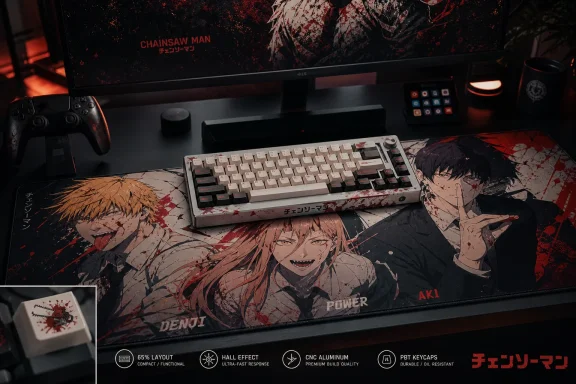
Arbiter Studio opened orders on July 3, 2026, for a limited Chainsaw Man gaming hardware collection built around premium magnetic-switch keyboards and character-themed mousepads, with designs based on Denji, Power, Aki Hayakawa, and the anime’s blood-splattered visual language. The drop, detailed by Essential Japan and confirmed on Arbiter Studio’s own storefront, is not just another logo slap on commodity gear. It shows how anime licensing has moved from apparel and figurines into the higher-margin world of enthusiast PC peripherals. For Windows gamers, the interesting part is not merely that Chainsaw Man is on a keyboard; it is that the keyboard is being sold as performance hardware first and fandom object second.
The Chainsaw Man Collection lands at a moment when the gaming desk has become a display case. A keyboard is no longer only an input device, and a mousepad is no longer just the thing under the mouse. For a certain kind of PC user, the desk is now a curated surface: monitor light bars, artisan keycaps, glass pads, resin wrist rests, themed controllers, and limited-run peripherals fighting for visual coherence.
Arbiter Studio understands that market. The company’s collaboration page frames the drop as an official Chainsaw Man collection, with a limited launch set for July 3 at 9 a.m. Pacific time. Essential Japan’s report fills in the product stack: the headline item is the TENKO ARC 65 Chainsaw Man Signature Edition at $180, joined by a $160 Standard Edition, $140 Polar 75+ HE keyboards in Denji, Power, and Aki designs, and $40 XL cloth mousepads.
That pricing tells the story. This is not a budget keyboard with anime art printed on top. It is priced in the neighborhood of serious prebuilt enthusiast boards, where buyers expect aluminum cases, tuned acoustics, stable firmware, and low-latency features that are at least credible on paper. The Chainsaw Man branding is the hook, but Arbiter is clearly trying to avoid the cheap-collab trap.
The result is a product line that sits at the strange intersection of licensed collectibles and competitive gaming hardware. It is meant to appeal to fans who want Denji on their desk, but it also speaks the language of people who know what Hall Effect switches, Rapid Trigger, and 8K polling are supposed to mean. That dual audience is difficult to serve, and the collection’s success will depend on whether Arbiter can make the hardware feel as deliberate as the art.
The 65 percent format matters. It keeps arrow keys and a few navigation controls while stripping away the function row and numpad, which makes it a familiar compromise for gamers who want more mouse room without going all the way to a 60 percent board. That layout has become one of the default shapes of modern gaming keyboards because it looks clean, travels well, and does not punish users quite as hard as ultra-compact designs.
The Signature Edition’s collaboration-specific CNC-machined aluminum frame is the collectible differentiator. Essential Japan reports that the Standard Edition keeps the core performance specifications but swaps the exclusive frame for a CNC-machined stone-texture finish. In other words, Arbiter is separating the mechanical proposition from the premium fan object: the performance pitch is shared, while the most visibly exclusive piece is reserved for the higher-priced model.
That is a smarter segmentation strategy than simply reserving all the best specs for the most expensive SKU. It lets a buyer who cares about the typing and gaming platform step down to $160 without feeling like they are buying a gutted version. It also makes the $20 jump to the Signature Edition feel like a design and collectibility decision rather than a ransom payment for the actual keyboard.
The danger, of course, is that “limited edition” can become a shield against scrutiny. Once a product is scarce and officially licensed, buyers may tolerate quirks they would not accept in an ordinary keyboard. Arbiter’s challenge is to make the Chainsaw Man board good enough that, after the novelty wears off, it still earns its USB port.
That is why the collection’s spec sheet leans so heavily on adjustable actuation, Rapid Trigger, and related input features. Essential Japan reports adjustable actuation down to 0.001 mm, Rapid Trigger with SOCD support, DKS, MPT, MT, TGL, and END functionality, along with true 8K polling and 256K full-key scanning. Some of those acronyms will mean little to casual buyers, but the message is obvious: this is a board aimed at the competitive keyboard market, not just anime collectors.
The broader industry context is that gaming keyboard marketing has shifted. For years, RGB lighting, switch color, and macro software carried the category. Now the premium conversation has moved toward analog-adjacent magnetic switches, rapid reset behavior, and firmware-level input customization. The pitch is not that the keyboard looks faster; it is that it can change how keypresses behave.
For Windows users, this is both exciting and messy. More functionality is being pushed into web apps and vendor utilities, which can be convenient when they work and infuriating when they do not. Arbiter says configuration runs through the ARC Web App, which should reduce the need for another permanently running Windows tray application, but web configuration still depends on browser support, firmware maturity, and a clear update path.
The uncomfortable truth is that many gamers will never use most of these functions. They will set an actuation point, maybe enable Rapid Trigger for movement keys, and leave the rest alone. That does not make the features worthless, but it does mean Arbiter must make the basics easy before the advanced options matter.
That makes SOCD more than a nerdy acronym. It is part of the growing debate over how much intelligence should be allowed inside input devices. Magnetic keyboards already blur old assumptions because they can reset faster, trigger at unusual points, and combine behaviors that once required specialized controllers or macros.
For the average Chainsaw Man fan buying a themed keyboard, this may be invisible. For competitive players, it could be decisive, or at least worth investigating before purchase. The same features that make a keyboard feel modern can also create compatibility questions in games with strict input rules.
This is where the licensed skin and the technical foundation pull in different directions. The anime branding invites impulse buying, while the feature set demands due diligence. A keyboard with SOCD options and rapid trigger behavior is not merely a decorative desktop object; it is a configurable input device whose legality and desirability can vary by game, rule set, and community norm.
Arbiter is hardly alone here. The entire enthusiast gaming keyboard market is racing toward deeper input customization. But when that technology is wrapped in a major anime license, it reaches buyers who may not be steeped in the debates that usually surround it.
That 75 percent layout may be the better daily-driver choice for many Windows users. It keeps the function row, arrow cluster, and more navigation keys while still saving desk space compared with a full-size board. For people who work and game on the same machine, 75 percent often feels less like a compromise than 65 percent.
The character split is also commercially tidy. Denji is the obvious hero SKU, Power gives the collection its loudest color personality, and Aki offers a cooler, more restrained visual identity. Instead of selling one Chainsaw Man keyboard and calling the job done, Arbiter is treating the cast as a design system.
That matters because anime hardware collaborations often fail when they flatten a series into a single logo. Chainsaw Man is a franchise built around clashing personalities: Denji’s hunger and chaos, Power’s arrogance and violence, Aki’s restraint and grief. A peripheral collection that recognizes those differences is more likely to feel intentional rather than licensed-by-spreadsheet.
At $140, however, these boards still sit above the impulse-buy range for most people. They are cheaper than the ARC 65 Signature Edition, but they are not cheap. The buyer is still being asked to believe the keyboard has enough substance to justify a premium after the character art has done its work.
The mousepad is also where anime art has the least friction. A keyboard must sound good, feel good, behave correctly in firmware, and survive daily use. A mousepad has to lie flat, track consistently, resist fraying, and look good. That makes it a natural canvas for licensed artwork.
There is also a display logic to the size. A 90 by 40 cm pad becomes the visual base layer of a setup, tying together keyboard, mouse, monitor stand, and desk accessories. For fans who do not want to commit to a themed keyboard, the pad offers a lower-cost way to bring the collaboration onto the desk.
The interesting wrinkle is that Arbiter’s own collection page currently emphasizes Chainsaw Man LUNAR SPEED glass pads at $110, with some variants marked sold out, while Essential Japan’s report describes $40 XL cloth mousepads in the new drop. That suggests Arbiter’s Chainsaw Man licensing may span multiple pad tiers or that storefront availability is shifting around launch. Either way, buyers should read the actual product listing carefully before assuming every design is the same material, price, or region.
That kind of storefront churn is common in limited drops, but it is especially important here because mousepad material is not a trivial detail. Cloth and glass pads behave very differently under a mouse. One is familiar and forgiving; the other is faster, harder, and more polarizing.
Scarcity can be legitimate. Licensed runs may have production limits, approval windows, and manufacturing constraints that make open-ended availability unrealistic. But scarcity is also a sales machine, and the gaming peripheral industry has learned how powerful it can be.
For buyers, the risk is that limited availability compresses the research window. You may have minutes or hours to decide whether a keyboard with complex firmware, unusual switches, and a premium price is right for you. That favors collectors and fans who already planned to buy, not cautious users comparing acoustics, latency, warranty terms, and software support.
For WindowsForum readers, the practical advice is simple: separate the license from the platform. A beautiful Chainsaw Man frame will not fix bad stabilizers, weak firmware, poor customer service, or a layout you dislike after two weeks. Conversely, a strong keyboard does not become unserious simply because it has anime art on it.
This is the mature way to read collaborations. The branding explains why the product exists. It should not be the only reason the product deserves to stay on your desk.
But web-based configuration is not magic. It can introduce its own support questions around browser compatibility, firmware flashing, account requirements, and long-term availability. If a board’s most important features depend on a vendor-hosted tool, buyers should care about what happens three years from now.
That concern is especially relevant for limited licensed hardware. A standard production keyboard may receive broader firmware attention because it remains part of the company’s main catalog. A collaboration board may be a short-run product with a narrower support window, even if it shares a platform with other models.
The safest version of this strategy is platform reuse, and Arbiter appears to be doing exactly that. The Chainsaw Man Signature Edition is built on the ARC 65 platform, while the character boards use the Polar 75+ line. That means the collaboration is not a one-off electronics experiment; it is a themed expression of existing hardware families.
That should reassure buyers, but not lull them. Before spending $140 to $180, users should check return policies, warranty language, firmware documentation, and whether the web app exposes the features they actually want. The best anime keyboard is still a keyboard first.
Power and Aki broaden the palette. Power gives designers permission to be loud and chaotic without losing the franchise’s tone. Aki allows a darker, cleaner look that can appeal to fans who do not want their entire desk screaming in red and orange.
This is where the collaboration has an advantage over more generic anime tie-ins. The best licensed hardware does not merely place characters on surfaces; it translates the series’ mood into material choices, color blocking, and silhouette. Arbiter’s use of a custom aluminum frame for the Signature Edition is significant because it suggests the design work moved beyond printing art on keycaps.
That said, the line between tasteful tribute and overdesigned collectible is thin. Enthusiast keyboard buyers can be ruthless about visual clutter, legends, novelty keys, and case geometry. Anime fans may want maximal recognition; keyboard hobbyists may want restraint. Serving both groups requires discipline.
The early product descriptions suggest Arbiter knows the assignment. The final judgment will come from real-world photos, typing tests, latency measurements, firmware behavior, and customer reports after the launch rush settles.
That reflects a larger shift in PC gaming culture. The old divide between “serious gear” and “fan merch” is collapsing. A user can want low-latency input and a Denji-themed desk at the same time. A sysadmin can care about stabilizer rattle. A competitive player can also be an anime collector.
Peripheral companies have noticed. Limited collections let them differentiate products in a market where many boards now promise the same familiar cluster of features: magnetic switches, rapid trigger, high polling rates, foam stacks, gasket-ish acoustics, and compact layouts. Licensing gives the product a story that pure specifications cannot.
The downside is that specifications become harder to parse when wrapped in fandom. A buyer may forgive vague claims because the art is compelling. A company may emphasize scarcity over measured performance. Reviewers may struggle to evaluate a product that is both a tool and a collectible.
That tension is not going away. If anything, this is where gaming hardware is headed: less anonymous, more personal, more expensive, and more entangled with entertainment IP.
 Anime Merch Has Found the Desk Setup
The Chainsaw Man Collection lands at a moment when the gaming desk has become a display case. A keyboard is no longer only an input device, and a mousepad is no longer just the thing under the mouse. For a certain kind of PC user, the desk is now a curated surface: monitor light bars, artisan keycaps, glass pads, resin wrist rests, themed controllers, and limited-run peripherals fighting for visual coherence.Arbiter Studio understands that market. The company’s collaboration page frames the drop as an official Chainsaw Man collection, with a limited launch set for July 3 at 9 a.m. Pacific time. Essential Japan’s report fills in the product stack: the headline item is the TENKO ARC 65 Chainsaw Man Signature Edition at $180, joined by a $160 Standard Edition, $140 Polar 75+ HE keyboards in Denji, Power, and Aki designs, and $40 XL cloth mousepads.
That pricing tells the story. This is not a budget keyboard with anime art printed on top. It is priced in the neighborhood of serious prebuilt enthusiast boards, where buyers expect aluminum cases, tuned acoustics, stable firmware, and low-latency features that are at least credible on paper. The Chainsaw Man branding is the hook, but Arbiter is clearly trying to avoid the cheap-collab trap.
The result is a product line that sits at the strange intersection of licensed collectibles and competitive gaming hardware. It is meant to appeal to fans who want Denji on their desk, but it also speaks the language of people who know what Hall Effect switches, Rapid Trigger, and 8K polling are supposed to mean. That dual audience is difficult to serve, and the collection’s success will depend on whether Arbiter can make the hardware feel as deliberate as the art.
The $180 Keyboard Is the Thesis Statement
The TENKO ARC 65 Chainsaw Man Signature Edition is the centerpiece because it carries the clearest argument: fandom hardware does not have to be technically compromised. According to Essential Japan, the Signature Edition uses Arbiter’s ARC 65 platform, a compact 65 percent layout, Hall Effect magnetic switches, an 8K polling rate, ARC PCB technology, Poron dampening, and a carbon fiber switch plate. Arbiter’s own page describes the product line as built around a premium custom ARC 65 Hall Effect keyboard.The 65 percent format matters. It keeps arrow keys and a few navigation controls while stripping away the function row and numpad, which makes it a familiar compromise for gamers who want more mouse room without going all the way to a 60 percent board. That layout has become one of the default shapes of modern gaming keyboards because it looks clean, travels well, and does not punish users quite as hard as ultra-compact designs.
The Signature Edition’s collaboration-specific CNC-machined aluminum frame is the collectible differentiator. Essential Japan reports that the Standard Edition keeps the core performance specifications but swaps the exclusive frame for a CNC-machined stone-texture finish. In other words, Arbiter is separating the mechanical proposition from the premium fan object: the performance pitch is shared, while the most visibly exclusive piece is reserved for the higher-priced model.
That is a smarter segmentation strategy than simply reserving all the best specs for the most expensive SKU. It lets a buyer who cares about the typing and gaming platform step down to $160 without feeling like they are buying a gutted version. It also makes the $20 jump to the Signature Edition feel like a design and collectibility decision rather than a ransom payment for the actual keyboard.
The danger, of course, is that “limited edition” can become a shield against scrutiny. Once a product is scarce and officially licensed, buyers may tolerate quirks they would not accept in an ordinary keyboard. Arbiter’s challenge is to make the Chainsaw Man board good enough that, after the novelty wears off, it still earns its USB port.
Hall Effect Has Become the New RGB
The most important technical phrase in the collection is Hall Effect. Magnetic switches use sensors to detect key position without relying on the same physical contact mechanism as traditional mechanical switches. In gaming keyboards, the selling point is that actuation can be adjusted in software, and keys can reset dynamically based on movement rather than a fixed mechanical point.That is why the collection’s spec sheet leans so heavily on adjustable actuation, Rapid Trigger, and related input features. Essential Japan reports adjustable actuation down to 0.001 mm, Rapid Trigger with SOCD support, DKS, MPT, MT, TGL, and END functionality, along with true 8K polling and 256K full-key scanning. Some of those acronyms will mean little to casual buyers, but the message is obvious: this is a board aimed at the competitive keyboard market, not just anime collectors.
The broader industry context is that gaming keyboard marketing has shifted. For years, RGB lighting, switch color, and macro software carried the category. Now the premium conversation has moved toward analog-adjacent magnetic switches, rapid reset behavior, and firmware-level input customization. The pitch is not that the keyboard looks faster; it is that it can change how keypresses behave.
For Windows users, this is both exciting and messy. More functionality is being pushed into web apps and vendor utilities, which can be convenient when they work and infuriating when they do not. Arbiter says configuration runs through the ARC Web App, which should reduce the need for another permanently running Windows tray application, but web configuration still depends on browser support, firmware maturity, and a clear update path.
The uncomfortable truth is that many gamers will never use most of these functions. They will set an actuation point, maybe enable Rapid Trigger for movement keys, and leave the rest alone. That does not make the features worthless, but it does mean Arbiter must make the basics easy before the advanced options matter.
The SOCD Detail Is Small but Politically Loaded
SOCD support is one of the more charged items on the spec sheet. In fighting games and keyboard-driven competitive titles, simultaneous opposing cardinal directions refers to what happens when opposite directions are pressed at once, such as left and right. Depending on how a device resolves that conflict, it can affect movement behavior in ways that tournament organizers and game developers may care about.That makes SOCD more than a nerdy acronym. It is part of the growing debate over how much intelligence should be allowed inside input devices. Magnetic keyboards already blur old assumptions because they can reset faster, trigger at unusual points, and combine behaviors that once required specialized controllers or macros.
For the average Chainsaw Man fan buying a themed keyboard, this may be invisible. For competitive players, it could be decisive, or at least worth investigating before purchase. The same features that make a keyboard feel modern can also create compatibility questions in games with strict input rules.
This is where the licensed skin and the technical foundation pull in different directions. The anime branding invites impulse buying, while the feature set demands due diligence. A keyboard with SOCD options and rapid trigger behavior is not merely a decorative desktop object; it is a configurable input device whose legality and desirability can vary by game, rule set, and community norm.
Arbiter is hardly alone here. The entire enthusiast gaming keyboard market is racing toward deeper input customization. But when that technology is wrapped in a major anime license, it reaches buyers who may not be steeped in the debates that usually surround it.
Power, Aki, and Denji Turn the Midrange Into the Mass-Market Play
The Polar 75+ HE models are likely to be the more accessible heart of the collection. Essential Japan reports three versions inspired by Chainsaw Man, Power, and Aki Hayakawa, each priced at $140. They use a compact 75 percent layout, magnetic switch technology, and a dedicated volume knob.That 75 percent layout may be the better daily-driver choice for many Windows users. It keeps the function row, arrow cluster, and more navigation keys while still saving desk space compared with a full-size board. For people who work and game on the same machine, 75 percent often feels less like a compromise than 65 percent.
The character split is also commercially tidy. Denji is the obvious hero SKU, Power gives the collection its loudest color personality, and Aki offers a cooler, more restrained visual identity. Instead of selling one Chainsaw Man keyboard and calling the job done, Arbiter is treating the cast as a design system.
That matters because anime hardware collaborations often fail when they flatten a series into a single logo. Chainsaw Man is a franchise built around clashing personalities: Denji’s hunger and chaos, Power’s arrogance and violence, Aki’s restraint and grief. A peripheral collection that recognizes those differences is more likely to feel intentional rather than licensed-by-spreadsheet.
At $140, however, these boards still sit above the impulse-buy range for most people. They are cheaper than the ARC 65 Signature Edition, but they are not cheap. The buyer is still being asked to believe the keyboard has enough substance to justify a premium after the character art has done its work.
Mousepads Are the Real Collectible Layer
The $40 XL cloth mousepads round out the collection with the most conventional merchandise logic. Essential Japan reports three designs featuring Chainsaw Man versus Katana Man, Power, and Aki, each measuring 90 by 40 cm with a 0.3 cm foam core, low-friction cloth surface, anti-fray stitched edges, and a non-slip rubber base. Compared with the keyboards, these are simpler products to understand and easier purchases to justify.The mousepad is also where anime art has the least friction. A keyboard must sound good, feel good, behave correctly in firmware, and survive daily use. A mousepad has to lie flat, track consistently, resist fraying, and look good. That makes it a natural canvas for licensed artwork.
There is also a display logic to the size. A 90 by 40 cm pad becomes the visual base layer of a setup, tying together keyboard, mouse, monitor stand, and desk accessories. For fans who do not want to commit to a themed keyboard, the pad offers a lower-cost way to bring the collaboration onto the desk.
The interesting wrinkle is that Arbiter’s own collection page currently emphasizes Chainsaw Man LUNAR SPEED glass pads at $110, with some variants marked sold out, while Essential Japan’s report describes $40 XL cloth mousepads in the new drop. That suggests Arbiter’s Chainsaw Man licensing may span multiple pad tiers or that storefront availability is shifting around launch. Either way, buyers should read the actual product listing carefully before assuming every design is the same material, price, or region.
That kind of storefront churn is common in limited drops, but it is especially important here because mousepad material is not a trivial detail. Cloth and glass pads behave very differently under a mouse. One is familiar and forgiving; the other is faster, harder, and more polarizing.
Limited Drops Turn Hardware Into FOMO
Arbiter’s launch language leans into scarcity. Its official page calls the Chainsaw Man Collection a limited drop, while Essential Japan reports that the products are available through Arbiter’s online store while stocks last. That phrasing is familiar to anyone who has watched sneakers, streetwear, artisan keycaps, and anime merch converge into the same retail ritual.Scarcity can be legitimate. Licensed runs may have production limits, approval windows, and manufacturing constraints that make open-ended availability unrealistic. But scarcity is also a sales machine, and the gaming peripheral industry has learned how powerful it can be.
For buyers, the risk is that limited availability compresses the research window. You may have minutes or hours to decide whether a keyboard with complex firmware, unusual switches, and a premium price is right for you. That favors collectors and fans who already planned to buy, not cautious users comparing acoustics, latency, warranty terms, and software support.
For WindowsForum readers, the practical advice is simple: separate the license from the platform. A beautiful Chainsaw Man frame will not fix bad stabilizers, weak firmware, poor customer service, or a layout you dislike after two weeks. Conversely, a strong keyboard does not become unserious simply because it has anime art on it.
This is the mature way to read collaborations. The branding explains why the product exists. It should not be the only reason the product deserves to stay on your desk.
The Windows Angle Is About Software, Not Just USB
A keyboard is one of the few peripherals that every Windows user depends on constantly, which makes configuration software more consequential than marketing copy suggests. Arbiter’s ARC Web App approach is notable because browser-based configuration can avoid some of the bloat associated with traditional gaming utilities. If implemented well, it can mean fewer background services, fewer startup entries, and less friction when moving between machines.But web-based configuration is not magic. It can introduce its own support questions around browser compatibility, firmware flashing, account requirements, and long-term availability. If a board’s most important features depend on a vendor-hosted tool, buyers should care about what happens three years from now.
That concern is especially relevant for limited licensed hardware. A standard production keyboard may receive broader firmware attention because it remains part of the company’s main catalog. A collaboration board may be a short-run product with a narrower support window, even if it shares a platform with other models.
The safest version of this strategy is platform reuse, and Arbiter appears to be doing exactly that. The Chainsaw Man Signature Edition is built on the ARC 65 platform, while the character boards use the Polar 75+ line. That means the collaboration is not a one-off electronics experiment; it is a themed expression of existing hardware families.
That should reassure buyers, but not lull them. Before spending $140 to $180, users should check return policies, warranty language, firmware documentation, and whether the web app exposes the features they actually want. The best anime keyboard is still a keyboard first.
Chainsaw Man Is a Perfect License for Peripheral Culture
Chainsaw Man is particularly well-suited to this kind of product because its visual identity already feels mechanical. Denji’s transformation is violent, industrial, and absurdly physical: teeth, blades, handles, blood, noise. A keyboard is not a chainsaw, but the metaphor of a sharp, aggressive input device practically writes itself.Power and Aki broaden the palette. Power gives designers permission to be loud and chaotic without losing the franchise’s tone. Aki allows a darker, cleaner look that can appeal to fans who do not want their entire desk screaming in red and orange.
This is where the collaboration has an advantage over more generic anime tie-ins. The best licensed hardware does not merely place characters on surfaces; it translates the series’ mood into material choices, color blocking, and silhouette. Arbiter’s use of a custom aluminum frame for the Signature Edition is significant because it suggests the design work moved beyond printing art on keycaps.
That said, the line between tasteful tribute and overdesigned collectible is thin. Enthusiast keyboard buyers can be ruthless about visual clutter, legends, novelty keys, and case geometry. Anime fans may want maximal recognition; keyboard hobbyists may want restraint. Serving both groups requires discipline.
The early product descriptions suggest Arbiter knows the assignment. The final judgment will come from real-world photos, typing tests, latency measurements, firmware behavior, and customer reports after the launch rush settles.
The Collaboration Economy Has Reached the Serious Peripheral Shelf
What makes this launch notable is not that Chainsaw Man merchandise exists. The franchise has already lived across figures, apparel, games, and other fan products. What matters is that a high-performance keyboard brand sees enough demand to build a multi-SKU hardware collection around it.That reflects a larger shift in PC gaming culture. The old divide between “serious gear” and “fan merch” is collapsing. A user can want low-latency input and a Denji-themed desk at the same time. A sysadmin can care about stabilizer rattle. A competitive player can also be an anime collector.
Peripheral companies have noticed. Limited collections let them differentiate products in a market where many boards now promise the same familiar cluster of features: magnetic switches, rapid trigger, high polling rates, foam stacks, gasket-ish acoustics, and compact layouts. Licensing gives the product a story that pure specifications cannot.
The downside is that specifications become harder to parse when wrapped in fandom. A buyer may forgive vague claims because the art is compelling. A company may emphasize scarcity over measured performance. Reviewers may struggle to evaluate a product that is both a tool and a collectible.
That tension is not going away. If anything, this is where gaming hardware is headed: less anonymous, more personal, more expensive, and more entangled with entertainment IP.
The Chainsaw Man Drop Rewards Fans Who Still Read the Spec Sheet
The cleanest way to understand Arbiter’s Chainsaw Man Collection is as a premium themed hardware drop with real enthusiast ambitions. It is neither just a keyboard release nor just anime merchandise. It is a test of whether licensed design can live comfortably inside performance PC gear without cheapening either side.- Arbiter Studio’s Chainsaw Man Collection launched on July 3, 2026, as a limited drop built around keyboards and mousepads inspired by Denji, Power, and Aki.
- The flagship TENKO ARC 65 Chainsaw Man Signature Edition costs $180 and pairs a compact 65 percent layout with Hall Effect switches, 8K polling, dampening materials, and a custom collaboration frame.
- The $160 ARC 65 Standard Edition keeps the core performance pitch while using a different CNC-machined finish instead of the Signature Edition’s exclusive case treatment.
- The $140 Polar 75+ HE models may be the more practical everyday option for many Windows users because they preserve more keys and add a volume knob while still using magnetic switch technology.
- The mousepad lineup is the easiest entry point, but buyers should pay close attention to whether a listing is cloth or glass because Arbiter’s Chainsaw Man pad offerings appear to span different materials and prices.
- The most important buying question is not whether the Chainsaw Man art looks good, but whether Arbiter’s firmware, web configuration, warranty support, and platform consistency justify the premium after the launch hype fades.
References
- Primary source: Essential Japan
Published: 2026-07-03T18:00:49.673644
Chainsaw Man Gets New High-End Gaming Collab Collection from Arbiter Studio
Arbiter Studio has announced a new collaboration with Chainsaw Man, introducing a premium collection of gaming hardware inspired by some of the anime's most recognizable characters.essential-japan.com - Related coverage: arbiterstudio.com
CHAINSAW MAN COLLECTION – Arbiter Studio
Introducing the official CHAINSAW MAN COLLECTION by Arbiter Studio — bold designs inspired by the popular anime series. arbiterstudio.com
- Related coverage: manga-news.com
Nouvelle collab' vêtement pour Chainsaw Man !, 16 Décembre 2025 - Manga news
Crunchyroll renouvelle son partenariat avec la marque italienne de streetwear Octopus pour une 2nde collection dédiée à l’univers de Chainsaw Man.Après un1er succès lors du...www.manga-news.com
- Related coverage: meganerd.it
Crunchyroll - La capsule collection di Octopus ispirata a Chainsaw Man - MegaNerd.it
Dopo il successo al Lucca Comics & Games, Octopus torna online con una nuova serie di pezzi esclusivi dedicati ad alcuni dei personaggi più iconici di Chainsaw Man, disponibile su Crunchyroll: Power, Himeno e Denji. Vediamo insieme i capi che potrete trovare sullo store online.www.meganerd.it - Related coverage: octopusbrand.com
OCTOPUS X CHAINSAW MAN, SECOND DROP - The new collection is now available online
Octopus meets Chainsaw Man, once again.After the success celebrated at Lucca Comics & Games, the collaboration returns online with a new series of exclusive pieces dedicated to some of the anime’s most iconic characters. This Second Drop puts the spotlight on Power, Himeno, and...www.octopusbrand.com
