

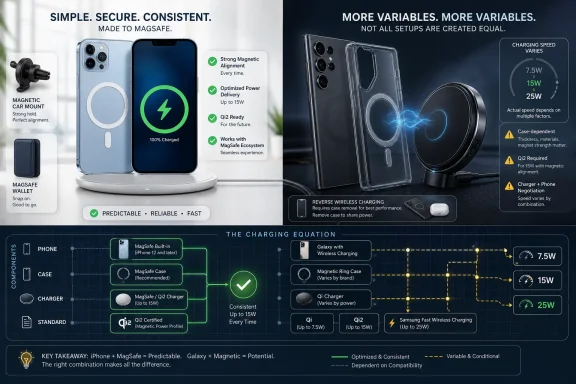
Samsung phones are not MagSafe-compatible in the Apple sense, but many Galaxy models can use MagSafe-style cases, mounts, wallets, batteries, and wireless chargers, with charging speeds depending heavily on Qi, Qi2, Samsung wireless-charging support, the case, and the charger. That distinction is the whole story. As BGR usefully summarized this week, a magnetic ring on the back of a Galaxy phone does not magically turn it into an iPhone. It turns Samsung’s wireless-charging story into a compatibility matrix — and that is exactly where consumers get burned.
MagSafe has become one of those rare Apple brand names that escaped the Apple store and became shorthand for an entire accessory category. People say “MagSafe case” when they mean “case with a magnetic ring.” They say “MagSafe charger” when they mean “round magnetic wireless puck.” That linguistic drift is convenient, but it hides a technical distinction that matters when money and charging speed are involved.
Apple’s MagSafe is a proprietary iPhone feature built around magnets, alignment, authentication, and charging behavior. A Samsung Galaxy phone does not become officially MagSafe-compatible because a case maker embedded a ring of magnets into a TPU shell. It may attach to the same wallet, car mount, battery pack, or charger, but attachment is only one layer of compatibility.
That is why the answer to “Are Samsung phones MagSafe compatible?” is both yes and no. Yes, they can often use MagSafe-style accessories if the phone is in a compatible magnetic case. No, they generally do not get the full Apple MagSafe experience, and they certainly should not be assumed to charge at Apple’s advertised MagSafe rates.
BGR’s piece lands on the most important practical point: the magnet is not the charger. A magnetic case can align a Samsung phone with a MagSafe puck, but the power negotiation underneath still follows wireless-charging standards and device-specific limits. For Galaxy owners, the accessory may snap on satisfyingly and still charge disappointingly slowly.
Often, it does not. BGR notes that Samsung phones using MagSafe-style cases and MagSafe chargers will generally fall back to around 7.5W unless the phone and charger support the right wireless-charging profile. That is not a minor footnote. It is the difference between a useful desk charger and a slow overnight pad wearing a magnetic costume.
This is where the accessory market has gotten ahead of the standards story. Case makers can honestly advertise magnetic compatibility if the case sticks to MagSafe accessories. Charger makers can honestly advertise MagSafe compatibility if the charger works with iPhones and magnetically aligned devices. Neither claim guarantees that a Galaxy phone will negotiate the fastest available charging mode.
The result is a buyer’s trap that feels like false advertising even when every individual box is technically defensible. A Galaxy user buys a magnetic case. Then a magnetic charger. Then maybe a magnetic battery. Everything attaches. The phone still charges at a speed that feels like 2019.
For Samsung, that promise arrived awkwardly. The Galaxy S25 generation introduced the phrase Qi2 Ready, which was both progress and compromise. As SamMobile, Android Central, Tom’s Guide, and other outlets reported around the S25 launch, Samsung’s 2025 flagships supported Qi2-style use with compatible cases, but did not simply put a magnetic ring inside the phone in the way many users expected.
That decision matters. A phone with magnets built in can snap directly to a magnetic charger or mount. A phone that is “Qi2 Ready” relies on the case to supply the magnetic alignment. Functionally, that can work well, but it shifts responsibility from the handset to the accessory stack.
The distinction sounds pedantic until you try to use the phone without a case, switch cases, use a thick rugged case, attach a battery pack near a large camera island, or rely on reverse wireless charging. Then the compromise becomes visible. Samsung adopted enough of the magnetic future to participate, but not enough to make the experience foolproof.
That is a subtle but important shift for buyers. In the old world, a bad case might make a phone bulky or ugly. In the magnetic-charging world, a bad case can misalign coils, weaken attachment, interfere with heat dissipation, or prevent the phone from reaching its best wireless-charging mode. The accessory becomes part of the power path.
Samsung was not alone in approaching Qi2 cautiously, but its scale makes the decision consequential. Galaxy S phones are among the most important Android flagships in the United States, and Samsung’s choices shape what accessory makers build. When Samsung says “case required,” the entire ecosystem has to route around that decision.
The charitable interpretation is that Samsung wanted flexibility. Built-in magnets can affect design, weight, internal layout, accessory positioning, and possibly interactions with other components. The less charitable interpretation is that Samsung treated magnetic charging as an accessory upsell rather than a core platform feature.
Either way, consumers get the same outcome: you need to know which phone, which case, which charger, and which charging standard you are actually using. That is not how mature consumer technology is supposed to feel.
But the broader reporting around the S26 line suggests the same caveat remains: faster wireless charging does not necessarily mean native, case-free magnetic attachment. Android Central and other outlets have reported that Samsung still stopped short of putting the full magnetic experience directly into the handset body. Notebookcheck and Gizmochina have described Samsung’s own magnetic charger and the S26 charging improvements, but the accessory and case story remains central.
That makes the S26 generation less of a clean break than a performance upgrade. Samsung appears to have raised the wireless-charging ceiling, especially for the Ultra, while still leaving users to verify whether their case and charger can actually unlock that ceiling. The headline speed is better. The buying experience is still messy.
This is where the “MagSafe compatible” label becomes especially dangerous. A charger may physically work with a Galaxy S26 Ultra. A case may attach firmly. But 25W charging depends on the right combination of Qi2 support, device support, case alignment, charger capability, and thermal conditions. If any one of those pieces falls short, the user sees a lower number and no obvious explanation.
Samsung enthusiasts are used to spec-sheet nuance. Normal buyers are not. They see “magnetic,” “Qi2,” “MagSafe-compatible,” and “25W” scattered across retail listings and assume the products compose into one coherent experience. Sometimes they do. Sometimes they do not.
A MagSafe-style case can interfere with that. BGR notes that users may need to remove the magnetic case to use reverse wireless charging, depending on the phone and accessory. That is not surprising. Reverse charging relies on coil alignment and close contact, and a ring of magnets or extra case thickness can complicate both.
This is a reminder that magnetic accessory ecosystems are not pure upside. They solve one alignment problem and can create another. A case optimized to snap to a car mount may not be optimized to charge Galaxy Buds on the back of the phone.
Apple can manage this more tightly because it controls the phone, the MagSafe geometry, the watch ecosystem, and a large slice of the accessory certification story. Samsung lives in a more open Android accessory market, which is good for variety and bad for predictability. The user gets more options, but also more ways for the pieces to almost work.
Accessory makers understand this. That is why “MagSafe compatible” appears across cases, power banks, tripods, ring grips, wallets, desk stands, and car mounts for Android phones that are not officially MagSafe devices. The phrase sells the feeling of Apple’s ecosystem without necessarily delivering the technical behavior behind it.
For non-charging accessories, that may be fine. A magnetic wallet either sticks securely or it does not. A car mount either holds the phone over bumps or it fails immediately enough that you notice. The risk is visible.
Charging accessories are different because partial success looks like success. The phone lights up. The battery percentage rises. The user may not know whether the charger is delivering 5W, 7.5W, 15W, 20W, or 25W unless the phone reports it clearly or the charger has a display. Slow charging can masquerade as normal charging until the morning you wake up with less battery than expected.
That is why Samsung’s version of the magnetic ecosystem needs better labeling than the market currently provides. “MagSafe compatible” is a physical-accessory claim. “Qi2 certified” is a standards claim. “Supports Samsung Super Fast Wireless Charging” is a device-and-charger claim. Retail listings often blur them into one blob of optimism.
On an iPhone, MagSafe is not perfectly simple, especially now that wattages vary by model and charger generation. But the basic promise is clear: MagSafe iPhone, MagSafe charger, expected MagSafe behavior. Apple’s branding compresses a lot of engineering into a consumer-friendly story.
Samsung does not have that story yet. It has Qi, Qi2, Qi2 Ready, Samsung Fast Wireless Charging, Samsung Super Fast Wireless Charging, case-dependent magnets, charger-dependent speed, and model-dependent ceilings. Each term may be technically meaningful, but together they create a fog.
This is not just a consumer annoyance. IT departments increasingly manage fleets of mobile devices, accessories, vehicle mounts, desk docks, and shared chargers. A purchasing manager trying to standardize on Galaxy phones and magnetic charging accessories needs more than vibes. They need predictable interoperability.
If a police department, field-service team, hospital, school district, or warehouse operation buys magnetic mounts and chargers at scale, “mostly compatible” is not good enough. A phone that attaches but overheats, charges slowly, blocks cameras, or requires a particular case revision becomes an operational headache. The same ambiguity that frustrates one enthusiast at a nightstand becomes real support cost at fleet scale.
But it also weakens one of Android’s traditional strengths. Android users expect choice. They expect to buy a rugged case from one brand, a leather case from another, a car charger from a third, and a power bank from whoever has the best deal. If the fastest charging path quietly depends on a narrow set of certified magnetic cases, the open ecosystem starts to feel less open.
The industry has seen this pattern before. Standards arrive to reduce fragmentation, then vendors add implementation details that recreate fragmentation at the edge. The logo says the products should work together. The fine print explains why they might not work together at full speed.
Samsung has to be careful here because its most loyal users are exactly the people most likely to notice. Galaxy Ultra buyers are spec readers. They know what 25W means. They will test chargers, watch thermal behavior, compare cases, and complain loudly when the advertised path is narrower than expected.
The company can survive that kind of enthusiast frustration. What it cannot do indefinitely is let the mass market believe “MagSafe for Samsung” means one thing when it actually means five.
Magnetic alignment helps because it centers the coils more reliably. Poor alignment wastes energy as heat, which slows charging and can make a phone uncomfortably warm. This is one of the strongest arguments for Qi2 and magnetic charging in general: the magnet is not a gimmick if it keeps the charging coils where they belong.
But magnets do not repeal physics. A thick case, metal plate, wallet attachment, hot car dashboard, or poorly ventilated charging stand can all degrade performance. That is why “up to 25W” should be read with the usual skepticism. It is a ceiling, not a contract.
Samsung’s challenge is that users may blame the wrong component. If a Galaxy S26 Ultra charges slowly on a third-party magnetic stand, is the problem the stand, the wall adapter, the case, the phone’s thermal state, the alignment, or Samsung’s charging negotiation? Without clearer diagnostics, the user is left guessing.
Windows users and IT pros will recognize the pattern. It is the same irritation as USB-C cables that all fit but do not all carry the same power, data, or display capabilities. Physical compatibility is the beginning of the story, not the end.
If you own an older Samsung phone without Qi2 support, a MagSafe-style case may still be useful. It can make car mounts, wallets, ring grips, and battery packs more convenient. It may also improve alignment on a wireless charger. But it should not be expected to unlock 15W or 25W charging by itself.
If you own a Galaxy S25 series phone, the case matters more. You are in the Qi2 Ready era, which means a compatible magnetic case is part of the expected experience. Choose cases and chargers that explicitly claim support for the S25 model you own, not just generic Android compatibility.
If you own or are considering a Galaxy S26 model, the speed story improves, especially at the high end. But the same principle applies. The Ultra’s higher ceiling is only meaningful if the charger, case, and phone all agree on the mode. A cheap magnetic puck may attach perfectly and still leave performance on the table.
The best practical test is still mundane: charge the phone from a known battery percentage for a fixed period, with the screen off, using the same wall adapter, and compare results across chargers or cases. If the phone reports “fast wireless charging” or “super fast wireless charging,” pay attention to that wording. Samsung’s status messages are not perfect instrumentation, but they are better than trusting the accessory box.
Samsung’s next step should be obvious: put the magnetic behavior directly into the phone, label charging modes plainly, and make Qi2 feel like a platform feature rather than an accessory puzzle. Until then, Galaxy users can absolutely enjoy the convenience of MagSafe-style gear, but they should buy it with the skepticism of someone shopping for USB-C cables: the connector may fit, the magnets may snap, and the real capability is still buried in the fine print.
 Samsung Borrowed the Magnet, Not the Ecosystem
MagSafe has become one of those rare Apple brand names that escaped the Apple store and became shorthand for an entire accessory category. People say “MagSafe case” when they mean “case with a magnetic ring.” They say “MagSafe charger” when they mean “round magnetic wireless puck.” That linguistic drift is convenient, but it hides a technical distinction that matters when money and charging speed are involved.Apple’s MagSafe is a proprietary iPhone feature built around magnets, alignment, authentication, and charging behavior. A Samsung Galaxy phone does not become officially MagSafe-compatible because a case maker embedded a ring of magnets into a TPU shell. It may attach to the same wallet, car mount, battery pack, or charger, but attachment is only one layer of compatibility.
That is why the answer to “Are Samsung phones MagSafe compatible?” is both yes and no. Yes, they can often use MagSafe-style accessories if the phone is in a compatible magnetic case. No, they generally do not get the full Apple MagSafe experience, and they certainly should not be assumed to charge at Apple’s advertised MagSafe rates.
BGR’s piece lands on the most important practical point: the magnet is not the charger. A magnetic case can align a Samsung phone with a MagSafe puck, but the power negotiation underneath still follows wireless-charging standards and device-specific limits. For Galaxy owners, the accessory may snap on satisfyingly and still charge disappointingly slowly.
The 7.5W Trap Is Where Marketing Meets Physics
The most common disappointment is speed. Many iPhone owners associate MagSafe with 15W charging, and newer iPhones can go higher with newer MagSafe hardware. Put a Samsung phone in a “MagSafe-compatible” case, slap it onto a magnetic charger, and the expectation is obvious: surely the same puck should deliver the same ballpark performance.Often, it does not. BGR notes that Samsung phones using MagSafe-style cases and MagSafe chargers will generally fall back to around 7.5W unless the phone and charger support the right wireless-charging profile. That is not a minor footnote. It is the difference between a useful desk charger and a slow overnight pad wearing a magnetic costume.
This is where the accessory market has gotten ahead of the standards story. Case makers can honestly advertise magnetic compatibility if the case sticks to MagSafe accessories. Charger makers can honestly advertise MagSafe compatibility if the charger works with iPhones and magnetically aligned devices. Neither claim guarantees that a Galaxy phone will negotiate the fastest available charging mode.
The result is a buyer’s trap that feels like false advertising even when every individual box is technically defensible. A Galaxy user buys a magnetic case. Then a magnetic charger. Then maybe a magnetic battery. Everything attaches. The phone still charges at a speed that feels like 2019.
Qi2 Was Supposed to Clean This Up
Qi2 was meant to bring order to this mess. Developed by the Wireless Power Consortium, the standard effectively took the magnetic-alignment idea popularized by Apple and pushed it into a broader wireless-charging framework. The promise was simple: better alignment, less wasted energy, more predictable accessory behavior, and charging speeds that Android users could understand without decoding proprietary branding.For Samsung, that promise arrived awkwardly. The Galaxy S25 generation introduced the phrase Qi2 Ready, which was both progress and compromise. As SamMobile, Android Central, Tom’s Guide, and other outlets reported around the S25 launch, Samsung’s 2025 flagships supported Qi2-style use with compatible cases, but did not simply put a magnetic ring inside the phone in the way many users expected.
That decision matters. A phone with magnets built in can snap directly to a magnetic charger or mount. A phone that is “Qi2 Ready” relies on the case to supply the magnetic alignment. Functionally, that can work well, but it shifts responsibility from the handset to the accessory stack.
The distinction sounds pedantic until you try to use the phone without a case, switch cases, use a thick rugged case, attach a battery pack near a large camera island, or rely on reverse wireless charging. Then the compromise becomes visible. Samsung adopted enough of the magnetic future to participate, but not enough to make the experience foolproof.
Galaxy S25 Made the Case Part of the Charging System
The Galaxy S25 series is the clearest example of Samsung’s half-step. The phones can participate in the Qi2 accessory world, but the magnetic experience is case-dependent. That means the case is no longer just protection or style. It becomes part of the charging system.That is a subtle but important shift for buyers. In the old world, a bad case might make a phone bulky or ugly. In the magnetic-charging world, a bad case can misalign coils, weaken attachment, interfere with heat dissipation, or prevent the phone from reaching its best wireless-charging mode. The accessory becomes part of the power path.
Samsung was not alone in approaching Qi2 cautiously, but its scale makes the decision consequential. Galaxy S phones are among the most important Android flagships in the United States, and Samsung’s choices shape what accessory makers build. When Samsung says “case required,” the entire ecosystem has to route around that decision.
The charitable interpretation is that Samsung wanted flexibility. Built-in magnets can affect design, weight, internal layout, accessory positioning, and possibly interactions with other components. The less charitable interpretation is that Samsung treated magnetic charging as an accessory upsell rather than a core platform feature.
Either way, consumers get the same outcome: you need to know which phone, which case, which charger, and which charging standard you are actually using. That is not how mature consumer technology is supposed to feel.
Galaxy S26 Raises the Speed Ceiling but Keeps the Confusion
BGR’s current framing points to the newer Galaxy S26 family as a more capable generation for Qi2-style charging. The article says the Galaxy S26 Ultra can reach 25W with a compatible Qi2 or MagSafe-style charger, while the S26+ is capped at 20W and the base S26 at 15W. That puts Samsung much closer to the high-end wireless-charging expectations Apple and the Wireless Power Consortium have been pushing.But the broader reporting around the S26 line suggests the same caveat remains: faster wireless charging does not necessarily mean native, case-free magnetic attachment. Android Central and other outlets have reported that Samsung still stopped short of putting the full magnetic experience directly into the handset body. Notebookcheck and Gizmochina have described Samsung’s own magnetic charger and the S26 charging improvements, but the accessory and case story remains central.
That makes the S26 generation less of a clean break than a performance upgrade. Samsung appears to have raised the wireless-charging ceiling, especially for the Ultra, while still leaving users to verify whether their case and charger can actually unlock that ceiling. The headline speed is better. The buying experience is still messy.
This is where the “MagSafe compatible” label becomes especially dangerous. A charger may physically work with a Galaxy S26 Ultra. A case may attach firmly. But 25W charging depends on the right combination of Qi2 support, device support, case alignment, charger capability, and thermal conditions. If any one of those pieces falls short, the user sees a lower number and no obvious explanation.
Samsung enthusiasts are used to spec-sheet nuance. Normal buyers are not. They see “magnetic,” “Qi2,” “MagSafe-compatible,” and “25W” scattered across retail listings and assume the products compose into one coherent experience. Sometimes they do. Sometimes they do not.
Reverse Wireless Charging Is the Forgotten Casualty
Magnetic cases introduce another wrinkle that rarely gets front-of-box treatment: reverse wireless charging. Samsung has long offered the ability to use certain Galaxy phones as small wireless charging pads for earbuds, watches, or other phones. It is a handy feature precisely because it is improvised; you use it when someone’s earbuds are dying at a restaurant table or your watch needs a top-up on a trip.A MagSafe-style case can interfere with that. BGR notes that users may need to remove the magnetic case to use reverse wireless charging, depending on the phone and accessory. That is not surprising. Reverse charging relies on coil alignment and close contact, and a ring of magnets or extra case thickness can complicate both.
This is a reminder that magnetic accessory ecosystems are not pure upside. They solve one alignment problem and can create another. A case optimized to snap to a car mount may not be optimized to charge Galaxy Buds on the back of the phone.
Apple can manage this more tightly because it controls the phone, the MagSafe geometry, the watch ecosystem, and a large slice of the accessory certification story. Samsung lives in a more open Android accessory market, which is good for variety and bad for predictability. The user gets more options, but also more ways for the pieces to almost work.
Accessory Makers Are Selling a Feeling Before a Standard
The reason MagSafe-style accessories have spread so quickly is not just charging. It is the snap. A magnetic wallet snapping into place feels more intentional than adhesive. A car mount that grabs the phone without clamps feels modern. A battery pack that centers itself feels like a small piece of engineering magic.Accessory makers understand this. That is why “MagSafe compatible” appears across cases, power banks, tripods, ring grips, wallets, desk stands, and car mounts for Android phones that are not officially MagSafe devices. The phrase sells the feeling of Apple’s ecosystem without necessarily delivering the technical behavior behind it.
For non-charging accessories, that may be fine. A magnetic wallet either sticks securely or it does not. A car mount either holds the phone over bumps or it fails immediately enough that you notice. The risk is visible.
Charging accessories are different because partial success looks like success. The phone lights up. The battery percentage rises. The user may not know whether the charger is delivering 5W, 7.5W, 15W, 20W, or 25W unless the phone reports it clearly or the charger has a display. Slow charging can masquerade as normal charging until the morning you wake up with less battery than expected.
That is why Samsung’s version of the magnetic ecosystem needs better labeling than the market currently provides. “MagSafe compatible” is a physical-accessory claim. “Qi2 certified” is a standards claim. “Supports Samsung Super Fast Wireless Charging” is a device-and-charger claim. Retail listings often blur them into one blob of optimism.
The Real Competition Is Not Apple — It Is User Trust
It is tempting to frame this as Samsung chasing Apple. That is partly true. Apple made magnetic phone accessories mainstream with MagSafe, and the Android world has spent years absorbing the idea. But Samsung’s bigger problem is not that Apple got there first. It is that Apple made the behavior legible.On an iPhone, MagSafe is not perfectly simple, especially now that wattages vary by model and charger generation. But the basic promise is clear: MagSafe iPhone, MagSafe charger, expected MagSafe behavior. Apple’s branding compresses a lot of engineering into a consumer-friendly story.
Samsung does not have that story yet. It has Qi, Qi2, Qi2 Ready, Samsung Fast Wireless Charging, Samsung Super Fast Wireless Charging, case-dependent magnets, charger-dependent speed, and model-dependent ceilings. Each term may be technically meaningful, but together they create a fog.
This is not just a consumer annoyance. IT departments increasingly manage fleets of mobile devices, accessories, vehicle mounts, desk docks, and shared chargers. A purchasing manager trying to standardize on Galaxy phones and magnetic charging accessories needs more than vibes. They need predictable interoperability.
If a police department, field-service team, hospital, school district, or warehouse operation buys magnetic mounts and chargers at scale, “mostly compatible” is not good enough. A phone that attaches but overheats, charges slowly, blocks cameras, or requires a particular case revision becomes an operational headache. The same ambiguity that frustrates one enthusiast at a nightstand becomes real support cost at fleet scale.
Samsung’s Case Strategy Gives It Control, but at a Price
There is an obvious business upside to Samsung’s case-dependent strategy. If the official or certified case is the safest way to get the best magnetic charging, Samsung and its partners gain a stronger role in the accessory purchase. That can improve quality control, reduce bad experiences, and create revenue around the phone after sale.But it also weakens one of Android’s traditional strengths. Android users expect choice. They expect to buy a rugged case from one brand, a leather case from another, a car charger from a third, and a power bank from whoever has the best deal. If the fastest charging path quietly depends on a narrow set of certified magnetic cases, the open ecosystem starts to feel less open.
The industry has seen this pattern before. Standards arrive to reduce fragmentation, then vendors add implementation details that recreate fragmentation at the edge. The logo says the products should work together. The fine print explains why they might not work together at full speed.
Samsung has to be careful here because its most loyal users are exactly the people most likely to notice. Galaxy Ultra buyers are spec readers. They know what 25W means. They will test chargers, watch thermal behavior, compare cases, and complain loudly when the advertised path is narrower than expected.
The company can survive that kind of enthusiast frustration. What it cannot do indefinitely is let the mass market believe “MagSafe for Samsung” means one thing when it actually means five.
Heat, Alignment, and Wattage Still Get a Vote
Wireless charging is not just a branding negotiation. It is a thermal and electrical compromise. Higher wattage generates more heat, and phones manage that heat by throttling charging speeds when needed. Even with the right charger and case, real-world speeds can fall below the maximum printed on the box.Magnetic alignment helps because it centers the coils more reliably. Poor alignment wastes energy as heat, which slows charging and can make a phone uncomfortably warm. This is one of the strongest arguments for Qi2 and magnetic charging in general: the magnet is not a gimmick if it keeps the charging coils where they belong.
But magnets do not repeal physics. A thick case, metal plate, wallet attachment, hot car dashboard, or poorly ventilated charging stand can all degrade performance. That is why “up to 25W” should be read with the usual skepticism. It is a ceiling, not a contract.
Samsung’s challenge is that users may blame the wrong component. If a Galaxy S26 Ultra charges slowly on a third-party magnetic stand, is the problem the stand, the wall adapter, the case, the phone’s thermal state, the alignment, or Samsung’s charging negotiation? Without clearer diagnostics, the user is left guessing.
Windows users and IT pros will recognize the pattern. It is the same irritation as USB-C cables that all fit but do not all carry the same power, data, or display capabilities. Physical compatibility is the beginning of the story, not the end.
The Buying Advice Is Boring Because the Ecosystem Is Not
For Galaxy owners, the safe advice is less exciting than the accessory marketing. Do not buy based only on the words “MagSafe compatible.” Treat that phrase as a promise that magnets are present, not as a promise of charging speed. Look for Qi2 certification, Samsung wireless-charging support, and model-specific claims that name your exact Galaxy phone.If you own an older Samsung phone without Qi2 support, a MagSafe-style case may still be useful. It can make car mounts, wallets, ring grips, and battery packs more convenient. It may also improve alignment on a wireless charger. But it should not be expected to unlock 15W or 25W charging by itself.
If you own a Galaxy S25 series phone, the case matters more. You are in the Qi2 Ready era, which means a compatible magnetic case is part of the expected experience. Choose cases and chargers that explicitly claim support for the S25 model you own, not just generic Android compatibility.
If you own or are considering a Galaxy S26 model, the speed story improves, especially at the high end. But the same principle applies. The Ultra’s higher ceiling is only meaningful if the charger, case, and phone all agree on the mode. A cheap magnetic puck may attach perfectly and still leave performance on the table.
The best practical test is still mundane: charge the phone from a known battery percentage for a fixed period, with the screen off, using the same wall adapter, and compare results across chargers or cases. If the phone reports “fast wireless charging” or “super fast wireless charging,” pay attention to that wording. Samsung’s status messages are not perfect instrumentation, but they are better than trusting the accessory box.
The Fine Print Galaxy Owners Actually Need to Read
The magnetic-accessory market is not hopeless; it just demands more precision than the word MagSafe provides. Before buying, Galaxy users should narrow the question from “Will it work?” to “What exactly will work, at what speed, on my phone, with my case?”- A Samsung phone is not officially MagSafe-compatible just because a magnetic case lets it attach to MagSafe-style accessories.
- A MagSafe-style case can make mounts, wallets, grips, and battery packs useful even when it does not improve charging speed.
- Older Galaxy phones may fall back to slower wireless charging on magnetic chargers unless the charger also supports Samsung’s faster wireless-charging modes.
- Galaxy S25 owners should treat the magnetic case as part of the Qi2 Ready charging system, not as a cosmetic accessory.
- Galaxy S26 buyers should verify model-specific charging limits, because the Ultra, Plus, and base models do not necessarily share the same wireless ceiling.
- Reverse wireless charging may require removing a magnetic case, especially when charging watches, earbuds, or another phone from the back of the Galaxy device.
Samsung’s next step should be obvious: put the magnetic behavior directly into the phone, label charging modes plainly, and make Qi2 feel like a platform feature rather than an accessory puzzle. Until then, Galaxy users can absolutely enjoy the convenience of MagSafe-style gear, but they should buy it with the skepticism of someone shopping for USB-C cables: the connector may fit, the magnets may snap, and the real capability is still buried in the fine print.
References
- Primary source: bgr.com
Published: Tue, 07 Jul 2026 02:47:00 GMT
Loading…
www.bgr.com - Related coverage: androidcentral.com
Loading…
www.androidcentral.com - Related coverage: whathifi.com
Samsung Galaxy S26 Ultra review: ultimate portable option for on-the-go cinephiles | What Hi-Fi?
Samsung’s upgraded flagship smartphone improves on an Award-winning formulawww.whathifi.com - Related coverage: gizmochina.com
Loading…
www.gizmochina.com - Related coverage: androidauthority.com
Loading…
www.androidauthority.com - Related coverage: tomsguide.com
Loading…
www.tomsguide.com
- Related coverage: maplee-tech.com
Loading…
maplee-tech.com - Related coverage: notebookcheck.net
Loading…
www.notebookcheck.net - Related coverage: t3.com
Loading…
www.t3.com - Related coverage: techradar.com
Leaked photos suggest the Samsung Galaxy S26 could be missing a major rumored upgrade | TechRadar
Missing magnetswww.techradar.com - Related coverage: cincodias.elpais.com
Loading…
cincodias.elpais.com