

MachineGames co-founder Jerk Gustafsson has reportedly taken over leadership of Arkane Studios as of June 30, replacing departing Arkane president Leonard Bendel, amid Microsoft’s wider Xbox restructuring and continuing uncertainty around Arkane Lyon’s in-development Marvel’s Blade project. The move, first spotted in French business filings and reported by Windows Central, looks less like a routine executive shuffle than a pressure valve for a studio that had suddenly become a symbol of Xbox’s post-acquisition dilemma. The Verge previously reported that Microsoft had weighed canceling Blade and closing or selling Arkane as part of a broader July cost-cutting wave. If those reports are directionally right, Gustafsson’s arrival is not just a personnel change; it is Microsoft trying to salvage optionality before the axe falls.
The timing is impossible to ignore. Windows Central says the legal change was recorded on June 30, while broader Xbox cuts were expected to begin Monday, July 6. That places Arkane’s leadership change in the narrowest possible window between internal deliberation and external consequence.
That does not prove Arkane is safe. It does, however, suggest Microsoft is not treating the studio as a simple shutdown candidate, at least not yet. Companies do not usually install a veteran studio operator into a doomed legal entity unless they need someone to manage a transition, restructure operations, prepare a sale, or stabilize a project that leadership still believes can be rescued.
The choice of Gustafsson is especially telling. MachineGames is one of the Bethesda-era studios that still fits Microsoft’s preferred first-party story: recognizable IP, disciplined production, and transmedia potential. Arkane, by contrast, has become the studio that represents the uncomfortable parts of the Bethesda acquisition — critical prestige, expensive development, unclear commercial ceiling, and a recent corporate memory scarred by Redfall and the closure of Arkane Austin.
That contrast is the real story. Xbox appears to be importing the management logic of a studio it trusts into one it is no longer sure how to value.
That kind of design is beloved by critics and forum diehards. It is also difficult to scale into the kind of predictable blockbuster return Microsoft now wants from an $80-billion-plus gaming empire stitched together from Xbox Game Studios, Bethesda, Activision Blizzard, and King. The gap between admired and financially indispensable has become brutal.
Marvel’s Blade was supposed to bridge that gap. Announced at The Game Awards 2023 by Bethesda, Marvel Games, and Arkane Lyon, the project promised a mature, single-player, third-person action game set in Paris. On paper, it solved the Arkane problem elegantly: keep the studio’s atmosphere, systemic design, and taste for stylish violence, but wrap it around a Marvel character with mainstream recognition.
The risk is that this solution may also have created the very budget pressure now threatening the project. Licensed superhero games are not cheap. Third-person action games carry animation, combat, cinematic, and accessibility expectations that differ sharply from Arkane’s first-person heritage. If The Verge’s reporting is accurate that Blade slipped internally and ran over budget, then Arkane may have found itself punished for doing exactly what Xbox needed it to do: become more broadly marketable.
That matters because Xbox is increasingly organizing around franchises, not studios. Asha Sharma’s reported “reset” language, echoed in recent coverage from GamesRadar and other outlets, is not just corporate theater. It describes a shift from the old Game Pass-era accumulation strategy — buy studios, fill the library, diversify output — toward a harder question: which teams can produce globally legible assets that work across console, PC, subscription, cloud, merchandise, and television?
MachineGames fits that question. Wolfenstein reportedly has a TV adaptation in development at Amazon from producers associated with Fallout’s successful screen transition, and Gustafsson has been linked to that project as an executive producer. That puts him at the intersection of studio operations and franchise expansion, precisely where Microsoft now seems to want its leaders.
Arkane’s Blade also sits at that intersection, but more awkwardly. It is Marvel’s IP, not Microsoft’s. If Blade becomes a hit, Xbox benefits from platform value and publishing upside, but it does not own the underlying character. If it becomes delayed, over-budget, or merely respectable, the license may magnify costs without giving Microsoft the long-tail control it gets from Fallout, Elder Scrolls, Halo, Gears, or Minecraft.
That is why Gustafsson’s appointment could mean several things at once. It could be a rescue mission for Blade. It could be the first step toward closer operational alignment between Arkane and MachineGames. It could be Microsoft preparing Arkane for a merger, sale, or post-layoff downsizing. The frustrating answer is that all of those possibilities are compatible with the same filing.
Arkane Lyon had not shipped a new full game since Deathloop in 2021. Blade was announced in late 2023 with no release date and little subsequent public gameplay detail. In the modern AAA economy, a five- or six-year development cycle is no longer unusual, but it is politically dangerous inside a company under margin pressure.
The longer a project stays invisible, the easier it becomes for executives to treat it as a spreadsheet entry rather than a creative asset. That is especially true when the game is tied to a license, a genre shift, and a studio whose commercial history is easier to praise than to model. “Arkane making Blade” sounds like a dream announcement to players; to a finance team, it may sound like a list of variables.
Todd Howard recently offered public reassurance that Arkane was doing strong work on Blade, according to PC Gamer and other outlets covering his comments. That matters, because Howard remains one of Bethesda’s most important internal validators. But public reassurance from a creative executive and cost discipline from corporate leadership can coexist right up until the meeting where one side loses.
This is where Xbox’s messaging problem becomes acute. If Microsoft kills Blade, it reinforces the view that no announced project is safe, no acquired studio’s identity is sacred, and no amount of fan goodwill protects a team from post-acquisition rationalization. If Microsoft saves Blade only by reshaping Arkane into something less Arkane-like, it risks winning the balance-sheet argument while losing the reason anyone cared.
That history changes how every new rumor lands. When The Verge reports that Microsoft has considered closing or selling Arkane, the audience does not hear a speculative restructuring option. It hears a sequel. It hears the company that once celebrated creative autonomy deciding, after the fact, that autonomy did not produce returns quickly enough.
Arkane Lyon is not Arkane Austin, and Blade is not Redfall. Lyon’s recent history includes Deathloop, a critically acclaimed game with a sharper identity and cleaner reception than Redfall ever managed. But corporate memory is rarely that granular. To Microsoft, Arkane may now be a brand with brilliance and volatility attached in equal measure.
That is why the Gustafsson move is potentially stabilizing but also ominous. A respected production leader can protect a team from chaos, but he can also be the person brought in to impose a new operating model. The same hire that reassures fans Blade may survive could signal that Arkane’s old latitude is over.
The reported July cuts are where that reclassification becomes real. According to The Verge, Microsoft’s latest wave could include studio closures, spin-offs, mergers, and cancellations. Windows Central’s reporting adds that multiple studios have been in discussions about their futures, with names such as Double Fine, Compulsion, Undead Labs, and others circulating in the broader rumor cloud.
This is not just Xbox “tightening belts.” It is Microsoft asking which parts of its gaming empire still fit the company’s current thesis. A studio that makes a brilliant but niche game every six years may be culturally valuable and financially awkward. A studio that can produce reusable franchise material across games, TV, and subscription ecosystems is easier to defend.
The uncomfortable part is that Xbox spent years selling the opposite philosophy. It presented Game Pass as a home for varied creative output, a place where smaller, stranger, riskier games could thrive because success did not depend solely on boxed sales. Now the logic seems to have reversed: Game Pass did not eliminate commercial pressure; it redistributed it upward until the whole portfolio had to justify itself.
For WindowsForum readers, this is not only a console-war spectacle. It affects PC Game Pass, Windows Store publishing, day-one release assumptions, cross-platform strategy, cloud gaming, and the practical question of whether Microsoft can be trusted to steward creative tools and studios over a long horizon. The operating system company is also a content conglomerate now, and its content decisions increasingly resemble enterprise portfolio management.
But a merger would not be painless. Arkane’s identity is not simply “good at action games.” It is a design culture built around systems, stealth, authored spaces, and consequences that emerge from player experimentation. MachineGames is also craft-heavy, but its strengths lean toward authored pacing, cinematic momentum, and punchy franchise adaptation.
Those cultures can complement each other. They can also flatten each other. If MachineGames’ production discipline helps Arkane ship Blade without losing its strangeness, Microsoft will look shrewd. If it turns Arkane into a support appendage for larger IP machinery, Xbox will have preserved the logo while hollowing out the reason it mattered.
A sale or spin-off would raise different questions. Arkane outside Microsoft might regain creative independence but lose the financial cushion required for AAA development. Arkane inside Microsoft may keep access to resources but face a narrower definition of acceptable output. Neither path is clean, which is why the current leadership change feels less like an answer than a holding pattern.
Blade is also a stranger commercial bet. The character has cultural cachet, especially among comics and film fans, but he is not Spider-Man. His tone is darker, his mainstream recognition is spikier, and the delayed Marvel Studios reboot has not exactly given the game a clean marketing runway. Arkane may be building a premium licensed action game around a character whose broader media momentum remains unsettled.
That does not mean Blade is a bad bet. In fact, Arkane may be unusually well-suited to the character. A vampire hunter in Paris, operating between nightlife, horror, stealth, and stylish combat, sounds far more compatible with Arkane’s sensibility than many safer superheroes would. If Microsoft wants distinctive first-party games rather than interchangeable franchise content, Blade could be exactly the kind of calculated risk worth protecting.
But calculated risks require patience. Microsoft’s current posture suggests patience is now rationed. The Blade decision, whatever it becomes, will tell us whether Xbox still believes in expensive differentiation or only in expensive certainty.
But journalism is often about reading the pattern around the fact. The pattern here is hard to miss: The Verge reports possible closures and cancellations; Windows Central reports a sudden leadership change; broader Xbox cuts are expected as Microsoft’s fiscal-year reset lands; and the studios under discussion are precisely the kind of teams whose value is easiest to romanticize and hardest to forecast.
The safest conclusion is that Arkane is in play. Not necessarily dead, not necessarily merged, not necessarily saved — but in play. That alone is a major shift for a studio once treated as one of Bethesda’s crown jewels.
Microsoft may yet present Gustafsson’s appointment as an operational strengthening move, a way to support Blade and give Arkane more production firepower. That could be true. It could also be incomplete. In corporate restructurings, the comforting explanation and the harsher strategic motive often travel together.
Now abundance has become the problem. Microsoft owns so many teams, franchises, and obligations that the question is no longer whether Xbox can find content. It is whether Xbox can govern content without destroying the cultures that made those teams worth buying. Arkane is the sharpest version of that question because it sits at the intersection of prestige design, licensed ambition, and corporate impatience.
If Blade survives and ships as a real Arkane game, Gustafsson’s appointment may be remembered as the moment Microsoft stopped the bleeding and put experienced hands around a troubled but promising project. If Blade is canceled or Arkane is folded into something less recognizable, the move will look like the first visible stitch in a much larger corporate surgery.
Either way, this is not a sidebar. It is a test case for the entire post-Spencer, post-acquisition Xbox era.
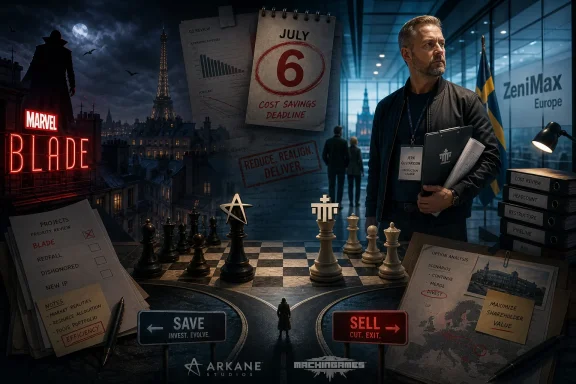 Microsoft Reaches for a Studio Fix Before the Layoff Clock Strikes
The timing is impossible to ignore. Windows Central says the legal change was recorded on June 30, while broader Xbox cuts were expected to begin Monday, July 6. That places Arkane’s leadership change in the narrowest possible window between internal deliberation and external consequence.That does not prove Arkane is safe. It does, however, suggest Microsoft is not treating the studio as a simple shutdown candidate, at least not yet. Companies do not usually install a veteran studio operator into a doomed legal entity unless they need someone to manage a transition, restructure operations, prepare a sale, or stabilize a project that leadership still believes can be rescued.
The choice of Gustafsson is especially telling. MachineGames is one of the Bethesda-era studios that still fits Microsoft’s preferred first-party story: recognizable IP, disciplined production, and transmedia potential. Arkane, by contrast, has become the studio that represents the uncomfortable parts of the Bethesda acquisition — critical prestige, expensive development, unclear commercial ceiling, and a recent corporate memory scarred by Redfall and the closure of Arkane Austin.
That contrast is the real story. Xbox appears to be importing the management logic of a studio it trusts into one it is no longer sure how to value.
Arkane’s Problem Is Not Talent; It Is Translation
Arkane Lyon is not some marginal team with a thin résumé. The studio’s lineage runs through Dishonored, Dishonored 2, and Deathloop — games that helped define the modern immersive sim vocabulary even as the genre itself remained commercially fragile. Arkane’s work is often described as “player-driven,” but that undersells the harder achievement: the studio builds clockwork worlds that make agency feel expensive, authored, and reactive.That kind of design is beloved by critics and forum diehards. It is also difficult to scale into the kind of predictable blockbuster return Microsoft now wants from an $80-billion-plus gaming empire stitched together from Xbox Game Studios, Bethesda, Activision Blizzard, and King. The gap between admired and financially indispensable has become brutal.
Marvel’s Blade was supposed to bridge that gap. Announced at The Game Awards 2023 by Bethesda, Marvel Games, and Arkane Lyon, the project promised a mature, single-player, third-person action game set in Paris. On paper, it solved the Arkane problem elegantly: keep the studio’s atmosphere, systemic design, and taste for stylish violence, but wrap it around a Marvel character with mainstream recognition.
The risk is that this solution may also have created the very budget pressure now threatening the project. Licensed superhero games are not cheap. Third-person action games carry animation, combat, cinematic, and accessibility expectations that differ sharply from Arkane’s first-person heritage. If The Verge’s reporting is accurate that Blade slipped internally and ran over budget, then Arkane may have found itself punished for doing exactly what Xbox needed it to do: become more broadly marketable.
MachineGames Looks Like Microsoft’s Preferred Template
MachineGames is not a low-risk studio either, but it has a profile Xbox can explain to accountants. The Swedish developer revived Wolfenstein with a muscular first-person identity, then delivered Indiana Jones and the Great Circle, a licensed adventure game that helped reposition the studio beyond Nazi-punching alt-history shooters. It is a shop with a demonstrated ability to handle beloved IP without sanding off all personality.That matters because Xbox is increasingly organizing around franchises, not studios. Asha Sharma’s reported “reset” language, echoed in recent coverage from GamesRadar and other outlets, is not just corporate theater. It describes a shift from the old Game Pass-era accumulation strategy — buy studios, fill the library, diversify output — toward a harder question: which teams can produce globally legible assets that work across console, PC, subscription, cloud, merchandise, and television?
MachineGames fits that question. Wolfenstein reportedly has a TV adaptation in development at Amazon from producers associated with Fallout’s successful screen transition, and Gustafsson has been linked to that project as an executive producer. That puts him at the intersection of studio operations and franchise expansion, precisely where Microsoft now seems to want its leaders.
Arkane’s Blade also sits at that intersection, but more awkwardly. It is Marvel’s IP, not Microsoft’s. If Blade becomes a hit, Xbox benefits from platform value and publishing upside, but it does not own the underlying character. If it becomes delayed, over-budget, or merely respectable, the license may magnify costs without giving Microsoft the long-tail control it gets from Fallout, Elder Scrolls, Halo, Gears, or Minecraft.
That is why Gustafsson’s appointment could mean several things at once. It could be a rescue mission for Blade. It could be the first step toward closer operational alignment between Arkane and MachineGames. It could be Microsoft preparing Arkane for a merger, sale, or post-layoff downsizing. The frustrating answer is that all of those possibilities are compatible with the same filing.
Blade Is Now a Test of Xbox’s Patience With Prestige
The ugliest version of this story is simple: Microsoft bought Bethesda, inherited Arkane, watched the economics worsen, and is now deciding whether the prestige is worth the burn. But that version misses how much Xbox helped create the conditions it is now trying to escape.Arkane Lyon had not shipped a new full game since Deathloop in 2021. Blade was announced in late 2023 with no release date and little subsequent public gameplay detail. In the modern AAA economy, a five- or six-year development cycle is no longer unusual, but it is politically dangerous inside a company under margin pressure.
The longer a project stays invisible, the easier it becomes for executives to treat it as a spreadsheet entry rather than a creative asset. That is especially true when the game is tied to a license, a genre shift, and a studio whose commercial history is easier to praise than to model. “Arkane making Blade” sounds like a dream announcement to players; to a finance team, it may sound like a list of variables.
Todd Howard recently offered public reassurance that Arkane was doing strong work on Blade, according to PC Gamer and other outlets covering his comments. That matters, because Howard remains one of Bethesda’s most important internal validators. But public reassurance from a creative executive and cost discipline from corporate leadership can coexist right up until the meeting where one side loses.
This is where Xbox’s messaging problem becomes acute. If Microsoft kills Blade, it reinforces the view that no announced project is safe, no acquired studio’s identity is sacred, and no amount of fan goodwill protects a team from post-acquisition rationalization. If Microsoft saves Blade only by reshaping Arkane into something less Arkane-like, it risks winning the balance-sheet argument while losing the reason anyone cared.
The Ghost of Arkane Austin Still Haunts Lyon
Microsoft cannot discuss Arkane Lyon in a vacuum because Arkane Austin already became a cautionary tale. The Austin branch, known for Prey and later Redfall, was closed in 2024 during a brutal round of Xbox studio cuts that also hit Tango Gameworks before that studio’s fate became an industry flashpoint. For players, the Arkane name is not abstract; it already carries the memory of a studio being shut after a troubled project.That history changes how every new rumor lands. When The Verge reports that Microsoft has considered closing or selling Arkane, the audience does not hear a speculative restructuring option. It hears a sequel. It hears the company that once celebrated creative autonomy deciding, after the fact, that autonomy did not produce returns quickly enough.
Arkane Lyon is not Arkane Austin, and Blade is not Redfall. Lyon’s recent history includes Deathloop, a critically acclaimed game with a sharper identity and cleaner reception than Redfall ever managed. But corporate memory is rarely that granular. To Microsoft, Arkane may now be a brand with brilliance and volatility attached in equal measure.
That is why the Gustafsson move is potentially stabilizing but also ominous. A respected production leader can protect a team from chaos, but he can also be the person brought in to impose a new operating model. The same hire that reassures fans Blade may survive could signal that Arkane’s old latitude is over.
The Xbox Reset Has Moved From Strategy Decks to Studio Doors
Asha Sharma’s arrival as Xbox CEO earlier this year was already a sign that Microsoft wanted a different kind of gaming business. Microsoft’s own announcement framed Sharma as the new leader of a division spanning Xbox, Bethesda, Activision Blizzard, and King, with Matt Booty moving into a broader content role. That was not a minor succession plan; it was a reclassification of gaming from console culture to platform portfolio.The reported July cuts are where that reclassification becomes real. According to The Verge, Microsoft’s latest wave could include studio closures, spin-offs, mergers, and cancellations. Windows Central’s reporting adds that multiple studios have been in discussions about their futures, with names such as Double Fine, Compulsion, Undead Labs, and others circulating in the broader rumor cloud.
This is not just Xbox “tightening belts.” It is Microsoft asking which parts of its gaming empire still fit the company’s current thesis. A studio that makes a brilliant but niche game every six years may be culturally valuable and financially awkward. A studio that can produce reusable franchise material across games, TV, and subscription ecosystems is easier to defend.
The uncomfortable part is that Xbox spent years selling the opposite philosophy. It presented Game Pass as a home for varied creative output, a place where smaller, stranger, riskier games could thrive because success did not depend solely on boxed sales. Now the logic seems to have reversed: Game Pass did not eliminate commercial pressure; it redistributed it upward until the whole portfolio had to justify itself.
For WindowsForum readers, this is not only a console-war spectacle. It affects PC Game Pass, Windows Store publishing, day-one release assumptions, cross-platform strategy, cloud gaming, and the practical question of whether Microsoft can be trusted to steward creative tools and studios over a long horizon. The operating system company is also a content conglomerate now, and its content decisions increasingly resemble enterprise portfolio management.
A Merger Would Solve One Problem and Create Another
The most obvious speculation is that Arkane and MachineGames could be tied more closely together. The geography makes that less absurd than it sounds: Arkane Lyon in France and MachineGames in Sweden are both European Bethesda studios, both experienced with stylized first-person action, and both now connected through Gustafsson’s role. A regional leadership layer could reduce overhead while preserving separate creative teams.But a merger would not be painless. Arkane’s identity is not simply “good at action games.” It is a design culture built around systems, stealth, authored spaces, and consequences that emerge from player experimentation. MachineGames is also craft-heavy, but its strengths lean toward authored pacing, cinematic momentum, and punchy franchise adaptation.
Those cultures can complement each other. They can also flatten each other. If MachineGames’ production discipline helps Arkane ship Blade without losing its strangeness, Microsoft will look shrewd. If it turns Arkane into a support appendage for larger IP machinery, Xbox will have preserved the logo while hollowing out the reason it mattered.
A sale or spin-off would raise different questions. Arkane outside Microsoft might regain creative independence but lose the financial cushion required for AAA development. Arkane inside Microsoft may keep access to resources but face a narrower definition of acceptable output. Neither path is clean, which is why the current leadership change feels less like an answer than a holding pattern.
Microsoft’s Marvel Math Is More Complicated Than Sony’s
It is tempting to compare Blade to Sony’s Spider-Man and Wolverine strategy, but that comparison obscures as much as it reveals. Sony’s Insomniac partnership became a platform-defining success because Spider-Man was a perfect fit for PlayStation’s cinematic action-adventure formula, and because Insomniac already had the production muscle to iterate quickly inside that format. Arkane is being asked to move toward that space from a very different design tradition.Blade is also a stranger commercial bet. The character has cultural cachet, especially among comics and film fans, but he is not Spider-Man. His tone is darker, his mainstream recognition is spikier, and the delayed Marvel Studios reboot has not exactly given the game a clean marketing runway. Arkane may be building a premium licensed action game around a character whose broader media momentum remains unsettled.
That does not mean Blade is a bad bet. In fact, Arkane may be unusually well-suited to the character. A vampire hunter in Paris, operating between nightlife, horror, stealth, and stylish combat, sounds far more compatible with Arkane’s sensibility than many safer superheroes would. If Microsoft wants distinctive first-party games rather than interchangeable franchise content, Blade could be exactly the kind of calculated risk worth protecting.
But calculated risks require patience. Microsoft’s current posture suggests patience is now rationed. The Blade decision, whatever it becomes, will tell us whether Xbox still believes in expensive differentiation or only in expensive certainty.
The Filing Says Less Than the Pattern Around It
A corporate filing can only tell us so much. Leonard Bendel resigned. Jerk Gustafsson took over. The date was June 30. Everything beyond that requires caution, because neither Microsoft nor Bethesda has publicly laid out the plan for Arkane, Blade, or any potential MachineGames relationship.But journalism is often about reading the pattern around the fact. The pattern here is hard to miss: The Verge reports possible closures and cancellations; Windows Central reports a sudden leadership change; broader Xbox cuts are expected as Microsoft’s fiscal-year reset lands; and the studios under discussion are precisely the kind of teams whose value is easiest to romanticize and hardest to forecast.
The safest conclusion is that Arkane is in play. Not necessarily dead, not necessarily merged, not necessarily saved — but in play. That alone is a major shift for a studio once treated as one of Bethesda’s crown jewels.
Microsoft may yet present Gustafsson’s appointment as an operational strengthening move, a way to support Blade and give Arkane more production firepower. That could be true. It could also be incomplete. In corporate restructurings, the comforting explanation and the harsher strategic motive often travel together.
The Blade Decision Will Reveal the Real Xbox
For years, Xbox’s first-party problem was scarcity. Microsoft did not have enough studios, enough exclusives, enough reasons for players to believe the next showcase would translate into shipped games. The Bethesda and Activision Blizzard acquisitions were supposed to solve that problem through abundance.Now abundance has become the problem. Microsoft owns so many teams, franchises, and obligations that the question is no longer whether Xbox can find content. It is whether Xbox can govern content without destroying the cultures that made those teams worth buying. Arkane is the sharpest version of that question because it sits at the intersection of prestige design, licensed ambition, and corporate impatience.
If Blade survives and ships as a real Arkane game, Gustafsson’s appointment may be remembered as the moment Microsoft stopped the bleeding and put experienced hands around a troubled but promising project. If Blade is canceled or Arkane is folded into something less recognizable, the move will look like the first visible stitch in a much larger corporate surgery.
Either way, this is not a sidebar. It is a test case for the entire post-Spencer, post-acquisition Xbox era.
The Arkane-MachineGames Shuffle Leaves Five Hard Signals
The immediate facts are limited, but the practical read for players and IT-minded Microsoft watchers is clearer than the rumor fog suggests. Arkane’s leadership change should be treated as a serious restructuring signal, not routine executive housekeeping.- Jerk Gustafsson’s reported appointment gives Arkane a veteran Bethesda production leader at the exact moment Microsoft is expected to begin wider Xbox cuts.
- The move may improve Blade’s odds of survival, but it does not prove the project is safe or that Arkane will remain unchanged.
- Microsoft appears to be favoring studios and franchises that can support broader platform, licensing, and transmedia strategies.
- Arkane’s challenge is not creative credibility; it is proving that its expensive, distinctive design culture can fit Xbox’s new financial model.
- A merger, sale, downsizing, or operational integration with MachineGames all remain plausible until Microsoft publicly clarifies the plan.
- The outcome will shape how much trust players and developers place in Xbox’s stewardship of acquired studios.
References
- Primary source: Windows Central
Published: 2026-07-04T18:52:07.566988
Loading…
www.windowscentral.com - Related coverage: gamesradar.com
Loading…
www.gamesradar.com - Related coverage: pcgamer.com
Loading…
www.pcgamer.com - Related coverage: gematsu.com
The Verge: Microsoft weighing Arkane Studios closure, Marvel’s Blade cancelation - Gematsu
Xbox plans to announce a wave of layoffs leading to studio closures, spinoffs, potential mergers, and canceled games next week, according to a The Verge report…www.gematsu.com - Official source: blogs.microsoft.com
Asha Sharma named EVP and CEO, Microsoft Gaming - The Official Microsoft Blog
Satya Nadella, Chairman and CEO, and members of his executive team shared the following communications with employees today. SATYA NADELLA MESSAGE Gaming has been part of Microsoft from the start. Flight Simulator shipped before Windows, and you can practically ray‑trace a line from DirectX in...blogs.microsoft.com - Related coverage: bloomberg.com
Loading…
www.bloomberg.com
- Related coverage: gameinformer.com
Report: Microsoft Is Considering Shutting Down Arkane Studios And Canceling Marvel’s Blade
The studio behind the Dishonored series and Deathloop may be at risk of closure.gameinformer.com - Related coverage: engadget.com
Xbox Layoff Plans Reportedly Include Closing Arkane, Canceling Blade
The cuts will apparently start next week.www.engadget.com - Related coverage: twistedvoxel.com
Loading…
twistedvoxel.com - Related coverage: fortune.com
‘Not an Allbirds Moment’: Xbox’s CEO says she is grounding the console in gaming roots, not AI | Fortune
Since stepping into the Xbox CEO role, Asha Sharma has preached a "return of Xbox."fortune.com
- Related coverage: bo3.gg
Loading…
bo3.gg - Related coverage: cambridgeanalytica.org
Loading…
cambridgeanalytica.org - Related coverage: ixbt.games
Loading…
ixbt.games - Related coverage: 45179bb5-2a1f-4bc9-a93f-f86df27a1ff5.atarimworker.io
Loading…
45179bb5-2a1f-4bc9-a93f-f86df27a1ff5.atarimworker.io - Related coverage: marvel.com
Loading…
www.marvel.com - Related coverage: techradar.com
Loading…
www.techradar.com - Related coverage: gadgets360.com
Loading…
www.gadgets360.com - Related coverage: digitaltrends.com
Loading…
www.digitaltrends.com