

Cisco Talos has identified ARToken, a React-based operator panel tied by infrastructure and API behavior to the EvilTokens phishing-as-a-service ecosystem, exposing more than 80 endpoints for Microsoft 365 device-code phishing, token persistence, mailbox abuse, BEC operations, and SharePoint exfiltration. The finding matters because it moves EvilTokens from an alarming phishing kit into something closer to a criminal productivity suite. For Windows and Microsoft 365 administrators, the lesson is blunt: the attack surface is no longer just the login page, and the cleanup cannot stop at a password reset.
The most important detail in the Talos write-up is not that another Microsoft 365 phishing kit exists. We have had years of adversary-in-the-middle pages, fake SharePoint portals, and “document review” lures that collapse under even modest scrutiny. ARToken is different because the visible lure is merely the public edge of a much larger operator workflow.
The platform Talos describes is not a one-off bundle of HTML and JavaScript tossed onto a compromised web server. It is a multi-tenant panel with a dashboard, API contracts, Cloudflare Workers deployment hooks, token handling, mailbox tooling, SharePoint access, and a companion Windows browser application for replaying stolen sessions. In other words, it looks less like a phishing kit and more like a SaaS product with an ugly customer base.
That evolution should unsettle defenders. Security teams are comfortable treating phishing as a message problem, a web-filtering problem, or a user-awareness problem. ARToken shows the trade has become an identity-operations problem, where a successful click is simply the first step in a managed post-compromise pipeline.
The practical implication is that organizations cannot judge the severity of a device-code phish by the simplicity of the email. A bland invoice query can now trigger a backend workflow designed to harvest tokens, read mail, suppress evidence, stage BEC, touch SharePoint, and preserve access. The social engineering is old; the industrialization behind it is not.
That design becomes dangerous when the “device” is controlled by an attacker. The victim is not entering credentials into a fake Microsoft page; they are authenticating at a real Microsoft endpoint. If multifactor authentication is required, the victim may satisfy it, believing they are authorizing access to a document or business workflow.
EvilTokens made that abuse commercially repeatable. Sekoia’s earlier reporting framed it as a phishing-as-a-service platform built specifically around Microsoft’s OAuth device authorization grant, while Microsoft later described an AI-enabled campaign using device-code abuse at scale. The ARToken panel, as described by Talos, appears to sit in that same operational universe: similar API behavior, similar Cloudflare Workers deployment patterns, similar lure themes, and a familiar obsession with Primary Refresh Token persistence.
This is why the “MFA bypass” shorthand is both useful and slightly misleading. The attack does not magically defeat MFA cryptography. It conscripts the victim into completing a legitimate authentication ceremony for the attacker’s session. From the perspective of a conditional access policy, the result may look like a user completing an expected sign-in flow, which is precisely why the technique is so slippery.
For Windows shops, the device-code angle lands in an uncomfortable place. Microsoft 365, Entra ID, Office, Outlook, SharePoint, Teams, Windows authentication brokers, and browser sessions form one enormous identity fabric. ARToken is built to exploit that fabric rather than merely imitate its branding.
The message reportedly carried the familiar tells: SPF, DKIM, and DMARC failures; a Reply-To pivot to an unrelated domain; small random strings for mutation; and an inline image signature. None of these are revolutionary. What matters is the abuse of an existing business relationship and the use of a real-looking SharePoint destination as the psychological anchor.
The visible link appeared to point at the vendor’s genuine SharePoint tenant, while the actual destination used a look-alike tenant under sharepoint.com. That distinction is poisonous for users and some defenses alike. The host still belongs to Microsoft’s SharePoint domain, so the link inherits a sheen of legitimacy even when the tenant name has been manipulated.
This is where old security advice starts to fray. “Check that the site is Microsoft” is no longer enough when the malicious path can run through a real Microsoft-owned hostname. “Hover over the link” helps only if the recipient understands tenant naming, recognizes a subtle string change, and has the time to investigate during a routine invoice workflow.
The better lesson is that identity security now has to account for trusted cloud services being used as attacker-controlled staging areas. A SharePoint URL is not an intent signal. It is a location signal, and criminals have learned to rent space in the same neighborhoods as everyone else.
That does not mean Talos “hacked” the panel. It means the client-side architecture disclosed enough of the application’s shape to reconstruct the operator experience. For defenders, this is a recurring gift and a recurring warning: modern web apps often expose their own threat model in the JavaScript they must serve to every browser.
The resulting picture is expansive. ARToken reportedly includes endpoints for starting device-code phishing, managing captured tokens, escalating toward PRT-based persistence, reading and sending Outlook mail, creating inbox rules, monitoring mailboxes for keywords, accessing attachments, browsing SharePoint and OneDrive, deploying Cloudflare Workers, and sharing token access between operators.
That breadth changes the economics of compromise. A low-skilled affiliate does not need to build a token harvester, write Graph API scripts, design BEC workflows, configure Cloudflare Workers, and maintain mailbox-monitoring tools. The panel gives them a sequence of buttons and forms. Crimeware wins when it turns tradecraft into interface.
There is a grim familiarity here for anyone who has watched ransomware mature. Early ransomware required operators to assemble tools and make decisions. Later affiliate platforms absorbed reconnaissance, negotiation, leak-site publishing, encryption deployment, and victim management into branded dashboards. ARToken suggests Microsoft 365 account takeover is traveling the same road.
A Primary Refresh Token is central to Microsoft’s modern sign-in experience on Windows devices joined or registered to Entra ID. In legitimate use, it helps provide single sign-on across apps and services without forcing users to reauthenticate constantly. In attacker hands, anything that approximates or abuses that persistence becomes a way to extend dwell time beyond the first detected phish.
Talos reports that ARToken exposes a PRT lifecycle through endpoints such as setup, refresh, renew, reacquire, and cookie handling. The submitted phishing payload even contains a flag indicating awareness that ordinary refresh tokens may be revoked after password reset, making escalation or rapid exfiltration necessary before remediation lands. That is not casual opportunism; it is operational planning.
This is where many help-desk-driven playbooks fail. A user reports a suspicious email, security resets the password, sessions may or may not be revoked, and the ticket closes. But if the adversary has obtained durable tokens, registered devices, created inbox rules, or used session replay tooling, the account may remain useful long after the password has changed.
The defensive response has to be identity-native. Token revocation, device review, app consent inspection, mailbox rule auditing, sign-in log analysis, risky-user remediation, and conditional access review all become part of the same incident. Password reset is one action in the chain, not the chain itself.
The point is not that any one of those checks is unbeatable. Headless browser detection is a cat-and-mouse game, and many signals can be spoofed or normalized. The point is that commodity phishing infrastructure is adopting the kind of layered evasion once associated with more selective intrusion sets.
Client-side evasion also creates a measurement problem. A gateway, sandbox, or URL scanner may retrieve a harmless wrapper, fail to move the mouse like a person, never satisfy the timing gate, or miss the decrypted payload entirely. The user, meanwhile, receives the working path because they naturally generate the required interaction.
Talos’ sample used XOR encryption for the delivered JavaScript payload, while earlier EvilTokens reporting described AES-GCM Web Crypto usage. That divergence does not break the linkage; it points to modularity. Affiliates may be able to swap anti-bot pages, payload wrappers, and deployment templates while still relying on the same broader service model.
This is a critical distinction for defenders chasing indicators. If the kit is modular, a hash, worker name, encryption scheme, or lure template has a short half-life. The more durable detections are behavioral: device-code initiation patterns, suspicious token grants, anomalous mailbox access, impossible or unusual geography, new inbox rules, and unexpected SharePoint operations.
That matters because document repositories are where business context lives. Contracts, invoices, employee files, procurement trails, customer lists, legal drafts, and M&A documents all help an attacker decide whether to extort, defraud, impersonate, or pivot. Mailbox access tells the story of a business; SharePoint often contains the evidence.
It also enables better phishing from inside the tenant. A malicious file placed in a real OneDrive or SharePoint location and shared from a compromised account is much harder to dismiss than a random external link. The recipient sees the right sender, the right platform, and often the right business context.
This is why BEC and data theft increasingly blur together. An attacker does not have to choose between stealing documents and sending fraudulent payment instructions. The same access can support both, with mailbox monitoring used to time the fraud and SharePoint reconnaissance used to make it believable.
For administrators, SharePoint auditing can no longer be treated as secondary to Exchange auditing. File access spikes, unusual sharing changes, mass downloads, new external shares, and uploads by recently compromised users should be part of the same investigation that begins with a phish.
Mailbox rules are one of the oldest BEC tricks in the book, but they remain effective because they exploit user trust and administrative blind spots. A rule that forwards vendor messages, hides security notifications, deletes replies, or routes finance threads into obscure folders can keep the attacker informed while making the victim less aware. Automated rule creation inside a phishing panel lowers the friction further.
The reported “Box Monitor” capability is especially revealing. Cross-account keyword monitoring means an operator can define terms such as invoice, wire, payroll, acquisition, payment, remittance, or overdue and let the platform surface opportunities across many compromised mailboxes. That is BEC at portfolio scale.
AI-assisted lure generation and translation, described in earlier EvilTokens reporting, fits naturally into this model. Once a mailbox is compromised, the attacker has tone, contacts, thread history, and financial context. A language model does not need to invent a scenario from scratch; it only needs to transform stolen business context into the next plausible message.
This is the uncomfortable future of email compromise. The threat is not just that criminals can send more phishing messages. It is that they can extract context from real accounts, rank financial opportunity, and automate the drudgery that used to limit BEC operations.
For attackers, serverless platforms are attractive because they reduce infrastructure management. A panel that can authenticate to Cloudflare, list Workers, deploy templates, manage allowed origins, and configure naming prefixes turns hosting into an operator setting. The affiliate does not need to understand much beyond which lure to launch and which victim list to feed.
For defenders, the problem is that blocking an entire provider is rarely realistic. Cloudflare, Microsoft, Google, Amazon, and other cloud platforms host too much legitimate business traffic. Attackers exploit that asymmetry: they hide in providers defenders cannot simply burn down.
This does not mean defenders are helpless. Tenant-specific allowlisting, browser isolation for risky flows, stronger email authentication enforcement, URL rewriting with tenant-aware inspection, and post-click behavioral analytics can all raise the cost. But the old perimeter instinct — find the bad domain, block the bad domain — is increasingly inadequate when domains are disposable and platforms are reputable.
The infrastructure story also reinforces why collaboration between cloud providers and security vendors matters. If a phishing service can spin up hundreds or thousands of pages across Workers and Microsoft-hosted tenants, takedown speed becomes part of defense. Slow abuse handling is effectively attacker dwell time.
Conditional Access can help, but only if it is configured with this technique in mind. Organizations should evaluate whether device-code flow is necessary for their users and workloads, and where possible restrict or block it. High-risk users, finance staff, executives, administrators, and accounts-payable personnel deserve especially tight policy treatment.
Sign-in logs become more important than mail headers after the click. Defenders should look for device-code authentication events followed by unusual Graph API activity, mailbox reads, inbox rule changes, SharePoint downloads, or access from unfamiliar geographies and hosting providers. The phish is the trigger; the identity telemetry is the crime scene.
Token hygiene also deserves more urgency. Revoking sessions, invalidating refresh tokens, reviewing registered devices, removing suspicious app grants, and forcing reauthentication should be routine in suspected device-code compromise. If the account belongs to a Windows user with Entra-joined devices, device state and brokered authentication artifacts deserve scrutiny too.
There is also a user-experience problem Microsoft and customers cannot ignore. Device-code prompts often ask users to confirm an application or code in ways that make sense to engineers but not to busy employees. If a victim believes they are opening a vendor invoice, any prompt that does not clearly communicate “you are authorizing another device or application to access your account” leaves room for abuse.
But the ARToken case also shows the limits of mail-centric defense. A message can be blocked, reported, or missed. Once a user reaches the device-code step, the action shifts to Microsoft identity. Once tokens are captured, it shifts again to Exchange Online, SharePoint, OneDrive, and Graph.
Security teams therefore need linked detections rather than isolated alerts. A failed-authentication email from a spoofed vendor should enrich later sign-in anomalies. A device-code sign-in should increase scrutiny on mailbox rules. A suspicious inbox rule should trigger review of SharePoint activity. A user reporting an invoice phish should start an identity containment workflow, not merely a mail search.
This is the part many organizations struggle to operationalize. Email security teams, identity teams, endpoint teams, and Microsoft 365 administrators often use different consoles, queues, and mental models. ARToken’s operators do not have that organizational separation; their panel unifies the workflow for them.
That asymmetry is painful. Attackers increasingly get integrated dashboards while defenders get fragmented ownership. Closing that gap may matter as much as any single detection rule.
That architecture is valuable because it makes legitimate work smoother. Users sign in once, Office apps work, browsers pick up SSO, and cloud resources feel local. But any identity fabric that reduces friction for users can become a high-value target for adversaries trying to reduce friction for themselves.
The lesson is not to panic about Windows authentication brokers. It is to understand that cloud account compromise and device trust are now intertwined. If an attacker can manipulate flows that lead to durable cloud access, then endpoint posture, device compliance, and identity policy all become part of the same security boundary.
Administrators should pay attention to whether compromised accounts have newly registered devices, unexpected authentication methods, suspicious compliant-device claims, or unusual brokered sign-ins. They should also validate that incident responders know where to find this evidence quickly. In a device-code campaign, minutes matter because the attacker’s first objective is often to turn a temporary token into durable access or immediate data theft.
Microsoft has spent years moving customers toward phishing-resistant authentication, conditional access, and device-aware policy. ARToken is a reminder that the migration is not just about replacing passwords. It is about making sure every delegated authorization path is understandable, monitored, and constrained.
The platform’s capabilities point to a practical response that is broader than user training and sharper than generic “zero trust” language.
The next phase of Microsoft 365 phishing will not be defined by prettier fake login pages; it will be defined by criminal platforms that turn legitimate authorization flows, cloud hosting, mailbox context, and Windows identity persistence into a packaged service. ARToken gives defenders a rare look at that machinery before it becomes invisible again, and the organizations that respond best will be the ones that stop treating phishing as a single bad email and start treating it as the opening move in an identity compromise campaign.
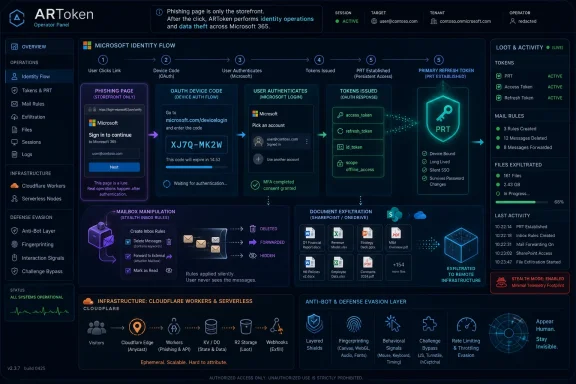 The Phishing Page Was Only the Storefront
The most important detail in the Talos write-up is not that another Microsoft 365 phishing kit exists. We have had years of adversary-in-the-middle pages, fake SharePoint portals, and “document review” lures that collapse under even modest scrutiny. ARToken is different because the visible lure is merely the public edge of a much larger operator workflow.The platform Talos describes is not a one-off bundle of HTML and JavaScript tossed onto a compromised web server. It is a multi-tenant panel with a dashboard, API contracts, Cloudflare Workers deployment hooks, token handling, mailbox tooling, SharePoint access, and a companion Windows browser application for replaying stolen sessions. In other words, it looks less like a phishing kit and more like a SaaS product with an ugly customer base.
That evolution should unsettle defenders. Security teams are comfortable treating phishing as a message problem, a web-filtering problem, or a user-awareness problem. ARToken shows the trade has become an identity-operations problem, where a successful click is simply the first step in a managed post-compromise pipeline.
The practical implication is that organizations cannot judge the severity of a device-code phish by the simplicity of the email. A bland invoice query can now trigger a backend workflow designed to harvest tokens, read mail, suppress evidence, stage BEC, touch SharePoint, and preserve access. The social engineering is old; the industrialization behind it is not.
EvilTokens Turned a Legitimate Microsoft Flow Into a Criminal Business Model
Device-code authentication was designed for constrained devices: TVs, CLI tools, printers, and other systems where typing a password directly is awkward or impossible. The user sees a short code, visits Microsoft’s legitimate device-login page, enters the code, and completes the normal authentication sequence. The device polling in the background receives authorization once the user approves the flow.That design becomes dangerous when the “device” is controlled by an attacker. The victim is not entering credentials into a fake Microsoft page; they are authenticating at a real Microsoft endpoint. If multifactor authentication is required, the victim may satisfy it, believing they are authorizing access to a document or business workflow.
EvilTokens made that abuse commercially repeatable. Sekoia’s earlier reporting framed it as a phishing-as-a-service platform built specifically around Microsoft’s OAuth device authorization grant, while Microsoft later described an AI-enabled campaign using device-code abuse at scale. The ARToken panel, as described by Talos, appears to sit in that same operational universe: similar API behavior, similar Cloudflare Workers deployment patterns, similar lure themes, and a familiar obsession with Primary Refresh Token persistence.
This is why the “MFA bypass” shorthand is both useful and slightly misleading. The attack does not magically defeat MFA cryptography. It conscripts the victim into completing a legitimate authentication ceremony for the attacker’s session. From the perspective of a conditional access policy, the result may look like a user completing an expected sign-in flow, which is precisely why the technique is so slippery.
For Windows shops, the device-code angle lands in an uncomfortable place. Microsoft 365, Entra ID, Office, Outlook, SharePoint, Teams, Windows authentication brokers, and browser sessions form one enormous identity fabric. ARToken is built to exploit that fabric rather than merely imitate its branding.
The Invoice Lure Is Boring Because Boring Works
Talos’ recovered lure is almost aggressively mundane: an accounts-payable note about outstanding invoices, spoofing a real Wisconsin contractor and addressing a recipient at a U.S. life-sciences company. That is exactly why it is credible. Accounts-payable staff are trained by their jobs to resolve invoice ambiguities quickly, not to treat every vendor email as a live-fire incident.The message reportedly carried the familiar tells: SPF, DKIM, and DMARC failures; a Reply-To pivot to an unrelated domain; small random strings for mutation; and an inline image signature. None of these are revolutionary. What matters is the abuse of an existing business relationship and the use of a real-looking SharePoint destination as the psychological anchor.
The visible link appeared to point at the vendor’s genuine SharePoint tenant, while the actual destination used a look-alike tenant under sharepoint.com. That distinction is poisonous for users and some defenses alike. The host still belongs to Microsoft’s SharePoint domain, so the link inherits a sheen of legitimacy even when the tenant name has been manipulated.
This is where old security advice starts to fray. “Check that the site is Microsoft” is no longer enough when the malicious path can run through a real Microsoft-owned hostname. “Hover over the link” helps only if the recipient understands tenant naming, recognizes a subtle string change, and has the time to investigate during a routine invoice workflow.
The better lesson is that identity security now has to account for trusted cloud services being used as attacker-controlled staging areas. A SharePoint URL is not an intent signal. It is a location signal, and criminals have learned to rent space in the same neighborhoods as everyone else.
ARToken Exposes the Criminal Back Office
The discovery path is almost as revealing as the panel itself. Talos found a management interface at a public dashboard host serving a React single-page application with a compiled JavaScript bundle. As with many SPAs, routes, UI labels, component logic, and API paths were shipped to the browser whether or not the visitor had authenticated.That does not mean Talos “hacked” the panel. It means the client-side architecture disclosed enough of the application’s shape to reconstruct the operator experience. For defenders, this is a recurring gift and a recurring warning: modern web apps often expose their own threat model in the JavaScript they must serve to every browser.
The resulting picture is expansive. ARToken reportedly includes endpoints for starting device-code phishing, managing captured tokens, escalating toward PRT-based persistence, reading and sending Outlook mail, creating inbox rules, monitoring mailboxes for keywords, accessing attachments, browsing SharePoint and OneDrive, deploying Cloudflare Workers, and sharing token access between operators.
That breadth changes the economics of compromise. A low-skilled affiliate does not need to build a token harvester, write Graph API scripts, design BEC workflows, configure Cloudflare Workers, and maintain mailbox-monitoring tools. The panel gives them a sequence of buttons and forms. Crimeware wins when it turns tradecraft into interface.
There is a grim familiarity here for anyone who has watched ransomware mature. Early ransomware required operators to assemble tools and make decisions. Later affiliate platforms absorbed reconnaissance, negotiation, leak-site publishing, encryption deployment, and victim management into branded dashboards. ARToken suggests Microsoft 365 account takeover is traveling the same road.
PRT Persistence Is the Feature Defenders Cannot Ignore
The most alarming phrase in Talos’ account is not “phishing-as-a-service” or “AI-powered lure.” It is the panel’s apparent promise that PRT-enabled access can persist across password changes. That claim goes to the heart of why identity incident response so often underestimates cloud account compromise.A Primary Refresh Token is central to Microsoft’s modern sign-in experience on Windows devices joined or registered to Entra ID. In legitimate use, it helps provide single sign-on across apps and services without forcing users to reauthenticate constantly. In attacker hands, anything that approximates or abuses that persistence becomes a way to extend dwell time beyond the first detected phish.
Talos reports that ARToken exposes a PRT lifecycle through endpoints such as setup, refresh, renew, reacquire, and cookie handling. The submitted phishing payload even contains a flag indicating awareness that ordinary refresh tokens may be revoked after password reset, making escalation or rapid exfiltration necessary before remediation lands. That is not casual opportunism; it is operational planning.
This is where many help-desk-driven playbooks fail. A user reports a suspicious email, security resets the password, sessions may or may not be revoked, and the ticket closes. But if the adversary has obtained durable tokens, registered devices, created inbox rules, or used session replay tooling, the account may remain useful long after the password has changed.
The defensive response has to be identity-native. Token revocation, device review, app consent inspection, mailbox rule auditing, sign-in log analysis, risky-user remediation, and conditional access review all become part of the same incident. Password reset is one action in the chain, not the chain itself.
The Anti-Bot Stack Shows the Market Is Learning
Talos also describes a seven-layer anti-analysis system in the ARToken phishing kit, including user-agent checks, automation detection throughnavigator.webdriver, browser feature fingerprinting, window-dimension analysis, interaction telemetry, timing gates, and movement-pattern validation. That is far more elaborate than a simple blocklist of security scanners. It is a behavioral filter designed to separate real humans from automated inspection.The point is not that any one of those checks is unbeatable. Headless browser detection is a cat-and-mouse game, and many signals can be spoofed or normalized. The point is that commodity phishing infrastructure is adopting the kind of layered evasion once associated with more selective intrusion sets.
Client-side evasion also creates a measurement problem. A gateway, sandbox, or URL scanner may retrieve a harmless wrapper, fail to move the mouse like a person, never satisfy the timing gate, or miss the decrypted payload entirely. The user, meanwhile, receives the working path because they naturally generate the required interaction.
Talos’ sample used XOR encryption for the delivered JavaScript payload, while earlier EvilTokens reporting described AES-GCM Web Crypto usage. That divergence does not break the linkage; it points to modularity. Affiliates may be able to swap anti-bot pages, payload wrappers, and deployment templates while still relying on the same broader service model.
This is a critical distinction for defenders chasing indicators. If the kit is modular, a hash, worker name, encryption scheme, or lure template has a short half-life. The more durable detections are behavioral: device-code initiation patterns, suspicious token grants, anomalous mailbox access, impossible or unusual geography, new inbox rules, and unexpected SharePoint operations.
SharePoint Is No Longer Just the Bait
For years, SharePoint-themed phishing has mostly meant one thing: a fake document prompt that steals credentials. ARToken’s apparent SharePoint and OneDrive tooling points to something broader. Once the attacker has access, the platform can browse files, download documents, upload malicious content, and adjust permissions.That matters because document repositories are where business context lives. Contracts, invoices, employee files, procurement trails, customer lists, legal drafts, and M&A documents all help an attacker decide whether to extort, defraud, impersonate, or pivot. Mailbox access tells the story of a business; SharePoint often contains the evidence.
It also enables better phishing from inside the tenant. A malicious file placed in a real OneDrive or SharePoint location and shared from a compromised account is much harder to dismiss than a random external link. The recipient sees the right sender, the right platform, and often the right business context.
This is why BEC and data theft increasingly blur together. An attacker does not have to choose between stealing documents and sending fraudulent payment instructions. The same access can support both, with mailbox monitoring used to time the fraud and SharePoint reconnaissance used to make it believable.
For administrators, SharePoint auditing can no longer be treated as secondary to Exchange auditing. File access spikes, unusual sharing changes, mass downloads, new external shares, and uploads by recently compromised users should be part of the same investigation that begins with a phish.
The BEC Pipeline Has Become a Product Feature
ARToken’s email tooling, branded in the submitted material as ARTSender, is the clearest sign that the platform is designed for monetization after compromise. Reading a mailbox is useful; sending as the victim is profitable. Creating forwarding and deletion rules turns profit into persistence and stealth.Mailbox rules are one of the oldest BEC tricks in the book, but they remain effective because they exploit user trust and administrative blind spots. A rule that forwards vendor messages, hides security notifications, deletes replies, or routes finance threads into obscure folders can keep the attacker informed while making the victim less aware. Automated rule creation inside a phishing panel lowers the friction further.
The reported “Box Monitor” capability is especially revealing. Cross-account keyword monitoring means an operator can define terms such as invoice, wire, payroll, acquisition, payment, remittance, or overdue and let the platform surface opportunities across many compromised mailboxes. That is BEC at portfolio scale.
AI-assisted lure generation and translation, described in earlier EvilTokens reporting, fits naturally into this model. Once a mailbox is compromised, the attacker has tone, contacts, thread history, and financial context. A language model does not need to invent a scenario from scratch; it only needs to transform stolen business context into the next plausible message.
This is the uncomfortable future of email compromise. The threat is not just that criminals can send more phishing messages. It is that they can extract context from real accounts, rank financial opportunity, and automate the drudgery that used to limit BEC operations.
Cloudflare Workers Make Disposable Infrastructure Feel Legitimate
Both EvilTokens and ARToken are described as using Cloudflare Workers-style deployment patterns for phishing lures. That choice is not accidental. Workers offer fast deployment, global reach, flexible routing, and enough legitimacy to blend into the modern web’s cloud-service noise.For attackers, serverless platforms are attractive because they reduce infrastructure management. A panel that can authenticate to Cloudflare, list Workers, deploy templates, manage allowed origins, and configure naming prefixes turns hosting into an operator setting. The affiliate does not need to understand much beyond which lure to launch and which victim list to feed.
For defenders, the problem is that blocking an entire provider is rarely realistic. Cloudflare, Microsoft, Google, Amazon, and other cloud platforms host too much legitimate business traffic. Attackers exploit that asymmetry: they hide in providers defenders cannot simply burn down.
This does not mean defenders are helpless. Tenant-specific allowlisting, browser isolation for risky flows, stronger email authentication enforcement, URL rewriting with tenant-aware inspection, and post-click behavioral analytics can all raise the cost. But the old perimeter instinct — find the bad domain, block the bad domain — is increasingly inadequate when domains are disposable and platforms are reputable.
The infrastructure story also reinforces why collaboration between cloud providers and security vendors matters. If a phishing service can spin up hundreds or thousands of pages across Workers and Microsoft-hosted tenants, takedown speed becomes part of defense. Slow abuse handling is effectively attacker dwell time.
Microsoft 365 Defenders Need to Watch the Authorization, Not Just the Authentication
The ARToken case should push organizations to revisit device-code flow governance. The uncomfortable truth is that many tenants allow flows they do not actively monitor, and many security teams cannot quickly answer which users recently completed device-code authentication, from where, and for what client.Conditional Access can help, but only if it is configured with this technique in mind. Organizations should evaluate whether device-code flow is necessary for their users and workloads, and where possible restrict or block it. High-risk users, finance staff, executives, administrators, and accounts-payable personnel deserve especially tight policy treatment.
Sign-in logs become more important than mail headers after the click. Defenders should look for device-code authentication events followed by unusual Graph API activity, mailbox reads, inbox rule changes, SharePoint downloads, or access from unfamiliar geographies and hosting providers. The phish is the trigger; the identity telemetry is the crime scene.
Token hygiene also deserves more urgency. Revoking sessions, invalidating refresh tokens, reviewing registered devices, removing suspicious app grants, and forcing reauthentication should be routine in suspected device-code compromise. If the account belongs to a Windows user with Entra-joined devices, device state and brokered authentication artifacts deserve scrutiny too.
There is also a user-experience problem Microsoft and customers cannot ignore. Device-code prompts often ask users to confirm an application or code in ways that make sense to engineers but not to busy employees. If a victim believes they are opening a vendor invoice, any prompt that does not clearly communicate “you are authorizing another device or application to access your account” leaves room for abuse.
Email Authentication Still Matters, But It Is Not the Finish Line
The recovered lure reportedly failed SPF, DKIM, and DMARC checks, which should be the easy part of the story. In a mature mail environment, unauthenticated vendor-impersonation mail should be treated harshly, especially when the sender claims a real partner domain and the reply path points elsewhere. DMARC enforcement, inbound authentication checks, and vendor-domain anomaly detection remain table stakes.But the ARToken case also shows the limits of mail-centric defense. A message can be blocked, reported, or missed. Once a user reaches the device-code step, the action shifts to Microsoft identity. Once tokens are captured, it shifts again to Exchange Online, SharePoint, OneDrive, and Graph.
Security teams therefore need linked detections rather than isolated alerts. A failed-authentication email from a spoofed vendor should enrich later sign-in anomalies. A device-code sign-in should increase scrutiny on mailbox rules. A suspicious inbox rule should trigger review of SharePoint activity. A user reporting an invoice phish should start an identity containment workflow, not merely a mail search.
This is the part many organizations struggle to operationalize. Email security teams, identity teams, endpoint teams, and Microsoft 365 administrators often use different consoles, queues, and mental models. ARToken’s operators do not have that organizational separation; their panel unifies the workflow for them.
That asymmetry is painful. Attackers increasingly get integrated dashboards while defenders get fragmented ownership. Closing that gap may matter as much as any single detection rule.
The Windows Angle Is the Brokered Identity Layer
For WindowsForum readers, ARToken is not just a Microsoft 365 story that happens to affect Outlook users. The reference to broker-style flows and PRT persistence pulls Windows into the middle of the attack path. Web Account Manager, device registration, Entra join state, and token brokerage are part of the modern Windows sign-in experience.That architecture is valuable because it makes legitimate work smoother. Users sign in once, Office apps work, browsers pick up SSO, and cloud resources feel local. But any identity fabric that reduces friction for users can become a high-value target for adversaries trying to reduce friction for themselves.
The lesson is not to panic about Windows authentication brokers. It is to understand that cloud account compromise and device trust are now intertwined. If an attacker can manipulate flows that lead to durable cloud access, then endpoint posture, device compliance, and identity policy all become part of the same security boundary.
Administrators should pay attention to whether compromised accounts have newly registered devices, unexpected authentication methods, suspicious compliant-device claims, or unusual brokered sign-ins. They should also validate that incident responders know where to find this evidence quickly. In a device-code campaign, minutes matter because the attacker’s first objective is often to turn a temporary token into durable access or immediate data theft.
Microsoft has spent years moving customers toward phishing-resistant authentication, conditional access, and device-aware policy. ARToken is a reminder that the migration is not just about replacing passwords. It is about making sure every delegated authorization path is understandable, monitored, and constrained.
The ARToken Lesson Is Written in the Operator Menu
The most concrete value in the Talos disclosure is that it shows what the affiliate sees after the victim clicks. That menu is the threat model. It tells defenders which actions are easy, which outcomes are monetized, and which logs are worth watching first.The platform’s capabilities point to a practical response that is broader than user training and sharper than generic “zero trust” language.
- Organizations should decide whether OAuth device-code authentication is genuinely needed and restrict it where business use is limited or nonexistent.
- Password resets after suspected device-code phishing should be paired with session revocation, token invalidation, device review, and mailbox-rule inspection.
- Finance, HR, logistics, and accounts-payable users should receive stricter monitoring because their normal workflows make invoice and document lures more credible.
- SharePoint and OneDrive activity should be investigated alongside Exchange activity when a Microsoft 365 account is suspected of compromise.
- Detection engineering should focus on behavior chains, including device-code sign-ins followed by mailbox access, inbox rule creation, Graph activity, file downloads, or unusual sharing changes.
- Security teams should treat failed email authentication on vendor-themed messages as a signal that can enrich identity investigations, not merely as a mail-filtering verdict.
The next phase of Microsoft 365 phishing will not be defined by prettier fake login pages; it will be defined by criminal platforms that turn legitimate authorization flows, cloud hosting, mailbox context, and Windows identity persistence into a packaged service. ARToken gives defenders a rare look at that machinery before it becomes invisible again, and the organizations that respond best will be the ones that stop treating phishing as a single bad email and start treating it as the opening move in an identity compromise campaign.
References
- Primary source: Cisco Talos Blog
Published: Wed, 01 Jul 2026 10:03:49 GMT
ARToken: Inside an EvilTokens affiliate panel targeting Microsoft 365
* Cisco Talos identified a fully-featured phishing-as-a-service (PhaaS) operator panel, branded "ARToken," that shares infrastructure, API contracts, and operational patterns with the EvilTokens platform documented by Sekoia and Microsoft in early 2026. * The ARToken panel exposes 80+... blog.talosintelligence.com
- Official source: microsoft.com
Inside an AI‑enabled device code phishing campaign | Microsoft Security Blog
A new wave of device code phishing shows how threat actors are scaling account compromise using AI and end‑to‑end automation. This campaign goes beyond traditional phishing by generating live authentication codes on demand, enabling higher success rates and sustained post‑compromise access.www.microsoft.com - Related coverage: labs.cloudsecurityalliance.org
EvilTokens: Device-Code Phishing Renders MFA Irrelevant – Lab Space
EvilTokens: Device-Code Phishing Renders MFA Irrelevant Key Takeaways EvilTokens is a Phishing-as-a-Service (PhaaS) platform launched in mid-February 2026 that weaponizes the OAuth 2.0 Device Authorization Grant to steal persistent Microsoft 365 access tokens—without capturing any credentials...labs.cloudsecurityalliance.org - Related coverage: innovationnetworkdesign.com
HIGH: Device Code Phishing Campaign Hammers 340+ Micr… | Innovation ND
Over 340 organizations across five countries compromised in aggressive device code phishing campaign exploiting OAuth device authorization flow. Attackers harvest tokens that survive password resets using PhaaS platform EvilTokens.www.innovationnetworkdesign.com - Related coverage: cybershieldtips.com
Device Code Phishing in 2026: How EvilTokens Bypasses MFA and Hijacks Microsoft 365 Accounts — CyberShieldTips
EvilTokens device code phishing hit 340+ Microsoft 365 orgs in 2026, bypassing MFA. Learn how the AI-powered attack works and 5 defenses to stop it.cybershieldtips.com - Related coverage: securityboulevard.com
EvilTokens Campaign Reveals Device Code Phishing Ticks Up 1,380%, Powered by AI - Security Boulevard
Huntress research shows that EvilTokens AI phishing campaigns are becoming faster and nearly impossible to detect using traditional methods.securityboulevard.com
- Related coverage: scworld.com
Global Microsoft device code phishing facilitated by novel EvilTokens kit | brief | SC Media
BleepingComputer reports that organizations around the world, particularly in the U.S., Canada, France, Australia, India, Switzerland, and the United Arab Emirates, have been subjected to attacks involving the nascent EvilTokens device code phishing kit compromising Microsoft accounts.www.scworld.com - Related coverage: vpncentral.com
EvilTokens turns Microsoft’s device code flow into a phishing tool for account takeover
A new phishing-as-a-service platform called EvilTokens is helping cybercriminals hijack Microsoft 365 accounts by abusing Microsoft’s legitimate device code authentication flow. Sekoia says the kit began circulating in phishing-focused underground communities in early March 2026 and stands out... vpncentral.com
- Related coverage: helpnetsecurity.com
EvilTokens ramps up device code phishing targeting Microsoft 365 users - Help Net Security
Device code phishing activity aimed at Microsoft 365 users is increasing due to EvilTokens, specialized toolkit offered as-a-service.www.helpnetsecurity.com - Related coverage: proofpoint.com
Device Code Phishing is an Evolution in Identity Takeover | Proofpoint US
Key Findings Device code phishing is exploding across the threat landscape, with new device code phishing tools emerging every week. The spike in device code phishingwww.proofpoint.com
- Related coverage: gnerdsec.com
EvilTokens Turns Microsoft's Device Code Flow Into a Criminal Subscription Service || gNerdSEC Cybersecurity
A new phishing-as-a-service platform exploits Microsoft's legitimate device code authentication to hijack enterprise accounts at scale. 340+ organizations compromised across five countries.gnerdsec.com
- Related coverage: csoonline.com
EvilTokens abuses Microsoft device code flow for account takeovers | CSO Online
The phishing-as-a-service toolkit leverages legitimate authentication to capture tokens and access Microsoft 365 services.www.csoonline.com
- Related coverage: cincodias.elpais.com
EvilTokens: el nuevo fraude que usa páginas reales de Microsoft para colarse en cuentas corporativas | Lifestyle | SmartLife | Cinco Días
Un peligro muy realcincodias.elpais.com
