

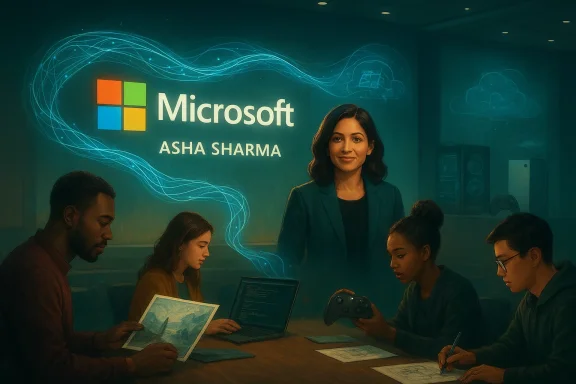
Microsoft’s gaming leadership just changed course: Phil Spencer, the executive who shepherded Xbox through acquisitions, Game Pass expansion, and the cloud era, has retired after 38 years at the company, and Microsoft has tapped Asha Sharma — an executive best known for leading CoreAI and large consumer product teams — to be the new CEO of Microsoft Gaming. In her first memo to the organization Sharma laid out three priorities — great games, a renewed commitment to Xbox hardware, and a vision for the “future of play” — and delivered a line that will be quoted and parsed for months: “As monetization and AI evolve and influence this future, we will not chase short-term efficiency or flood our ecosystem with soulless AI slop.” That sentence is both a promise and a challenge: it signals enthusiasm for the power of AI, while explicitly trying to set a creative and ethical boundary for its use in games.
Microsoft’s gaming unit is not a corner of the company; it is a multi-billion-dollar ecosystem that spans console hardware, PC and cloud platforms, subscription services, and a portfolio of studios that includes some of the industry’s most recognizable franchises. Under Phil Spencer’s leadership, Xbox moved from a hardware-first identity to a platform-and-services play: Game Pass became Microsoft’s signature product, acquisitions expanded the company’s creative horsepower, and the Xbox brand broadened into PC and cloud gaming.
Those strategic bets created a set of connected tensions. Game Pass delivered predictable recurring revenue but raised questions about long-term monetization and studio economics. Cloud and cross-device ambitions promised scale, but pushed Microsoft into deeper infrastructure investments and partnerships. And as Microsoft — like every major tech firm — doubled down on AI across Office, Windows, Azure, and consumer services, gaming became a natural next frontier for machine learning and generative systems.
Asha Sharma’s appointment arrives at that inflection point. She joins Microsoft Gaming with deep experience building large consumer systems and AI products inside Microsoft’s CoreAI organization, and with executive experience at Meta and Instacart prior to her return to Microsoft. Her background signals one thing clearly: Microsoft intends to lean into AI as a capability across gaming, but it wants to do so under the direction of a leader who understands product-scale engineering and the governance challenges of modern AI.
Sharma’s memo does two important things at once. First, it signals a corporate-level endorsement of creative integrity and studio autonomy — a reassurance to developers and fans who worry that AI could be misused. Second, it telegraphs that Microsoft will still pursue AI-driven efficiency and innovation, but wants to place guardrails around what passes for acceptable use.
What matters now is execution. Microsoft has the technical resources, the studio portfolio, and the leverage to architect a future in which AI amplifies creator skill rather than replaces it. But doing so will require clear policies, provenance, creator compensation, and a commitment to human-in-the-loop workflows that are visible and enforceable.
The next year will be telling: the transitional months with Phil Spencer advising, the announcements at GDC and Microsoft’s shows, and the first wave of AI tooling pilots will reveal whether the promise of “no soulless AI slop” is a governing principle or simply a soundbite. For players and creators who have built Xbox’s cultural capital over decades, words will matter — but so will the decisions that follow them.
Source: TechPowerUp Microsoft Gaming's New CEO Wants To Embrace AI Without "Soulless AI Slop" | TechPowerUp}
 Background / Overview
Microsoft’s gaming unit is not a corner of the company; it is a multi-billion-dollar ecosystem that spans console hardware, PC and cloud platforms, subscription services, and a portfolio of studios that includes some of the industry’s most recognizable franchises. Under Phil Spencer’s leadership, Xbox moved from a hardware-first identity to a platform-and-services play: Game Pass became Microsoft’s signature product, acquisitions expanded the company’s creative horsepower, and the Xbox brand broadened into PC and cloud gaming.Those strategic bets created a set of connected tensions. Game Pass delivered predictable recurring revenue but raised questions about long-term monetization and studio economics. Cloud and cross-device ambitions promised scale, but pushed Microsoft into deeper infrastructure investments and partnerships. And as Microsoft — like every major tech firm — doubled down on AI across Office, Windows, Azure, and consumer services, gaming became a natural next frontier for machine learning and generative systems.
Asha Sharma’s appointment arrives at that inflection point. She joins Microsoft Gaming with deep experience building large consumer systems and AI products inside Microsoft’s CoreAI organization, and with executive experience at Meta and Instacart prior to her return to Microsoft. Her background signals one thing clearly: Microsoft intends to lean into AI as a capability across gaming, but it wants to do so under the direction of a leader who understands product-scale engineering and the governance challenges of modern AI.
What Sharma Said — The Memo and Its Three Priorities
Sharma’s first message to the gaming organization distilled her priorities into three pillars:- Great games — a renewed focus on empowering studios, investing in franchises, and backing bold new ideas.
- Recommit to Xbox as a platform — a promise that console roots will be honored while expanding Xbox’s reach across PC, mobile, and cloud.
- Shape the future of play — inventing new business models, tools, and ways for creators and communities to build and share experiences.
Sharma’s memo does two important things at once. First, it signals a corporate-level endorsement of creative integrity and studio autonomy — a reassurance to developers and fans who worry that AI could be misused. Second, it telegraphs that Microsoft will still pursue AI-driven efficiency and innovation, but wants to place guardrails around what passes for acceptable use.
Who Is Asha Sharma — Strengths and Gaps
Asha Sharma is not a gaming industry lifer. Her executive resume includes leadership roles in product and operations at Meta and Instacart, followed by a senior role inside Microsoft leading CoreAI product efforts. That background offers several advantages for Microsoft Gaming:- System-scale product leadership: Sharma has experience shipping consumer-facing services at scale and managing product teams that must balance user experience, monetization, and regulatory constraints.
- AI and infrastructure fluency: Leading CoreAI gives her an appreciation for how models are built, deployed, monitored, and governed — knowledge that is directly relevant to integrating AI tools across studios and platforms.
- Operational rigor: Her track record suggests she understands the complexities of distributed engineering organizations and the operational discipline required to keep large portfolios healthy.
- Creative empathy gap: Games are both technology and cultural products. Long-term studio relationships and creative credibility are built on shared language and lived experience in game development — areas where an outsider must rapidly earn trust.
- Studio autonomy vs. platform control: Microsoft’s studios have historically defended creative independence. Sharma must balance corporate-level platform ambitions with the practical realities of multi-year, passion-driven development cycles.
- Community perceptions: Gamers are sensitive to changes in how beloved franchises are treated. Any misstep — particularly involving AI or monetization — can quickly become a reputational issue.
Parsing “Soulless AI Slop”: What She Likely Meant
That phrase is rhetorically potent. But translating it into policy requires specificity. Here are reasonable interpretations of what Sharma is signaling:- She rejects using generative AI as a shortcut to replace human-authored narrative, character design, or voice work in a way that produces derivative, low-quality results.
- She endorses selective, responsible uses of AI: tooling that augments creators’ productivity (e.g., prototyping, localization, QA) rather than replacing the creative core of a title.
- She warns against short-term monetization plays that rely on algorithmic churn — such as flooding a marketplace with procedurally-generated skins or narratives designed purely to drive microtransaction revenue without creative value.
- She signals an intolerance for sloppy AI deployments that degrade player trust (e.g., glitchy NPC behavior, inaccurate in-game info, or opaque personalization that feels manipulative).
Where AI Can Add Real Value — Concrete, Positive Uses
If applied thoughtfully, AI can help studios and players in measurable ways. Examples where Microsoft can legitimately claim benefit:- Tooling for creators
- Procedural content as a starting point: AI can generate level prototypes, concept art, or iterated design options to accelerate creative workflows — with human artists retaining final authorship.
- Localization and accessibility: Automating translation, lip-syncing, or subtitle generation can make games accessible to global audiences faster and at lower marginal cost.
- QA and playtesting: Automated playthroughs and bug detection can find regressions that human testers might miss or uncover at scale.
- Player-facing features
- Personalized accessibility presets, tutoring, or dynamic difficulty that respect player intent and preserve design integrity.
- Enhanced NPCs or companion AI that enrich storytelling when constrained by clear design rules and provenance.
- Backend optimization
- Better matchmaking, server scaling, and telemetry analysis that reduce latency and improve the overall player experience.
Risks: Where AI Could Go Wrong in Gaming
Sharma’s admonition is prudent because there are concrete, foreseeable risks if AI is treated as an efficiency magic bullet:- Creative dilution: Over-reliance on generative content can produce worlds and stories that feel formulaic or hollow.
- Job displacement: Automation in art, writing, or audio could displace roles if not implemented as augmentation-first tools.
- IP and copyright friction: Generative systems trained on external datasets raise licensing and attribution questions that can trigger legal and ethical disputes.
- Monetization creep: AI-driven content churn can be weaponized to extract more spend from players through novelty fatigue and microtransaction fatigue.
- Player trust erosion: Opaque personalization, unexplainable NPC behavior, or generative content that reproduces biases can damage community trust.
- Quality control failures: Insufficient testing of AI-generated systems can create immersive-breaking bugs or exploits.
Organizational and Studio-Level Effects
The leadership realignment — Sharma at the top, Booty overseeing content, and Phil Spencer transitioning to an advisory role through the handoff — reflects an attempt to align platform depth with content stewardship. The practical implications:- Studio relations: To preserve creative output, Microsoft must reinforce studio autonomy while providing optional AI tooling and platform-level services. That means clear boundaries about what Microsoft centrally mandates versus what studios opt into.
- Game Pass economics: AI can help content velocity and personalization inside Game Pass, but it won’t solve underlying economic tensions around margins and studio compensation. Any plan to use AI to drive short-term efficiency in studio workflows must be balanced with long-term investment in talent and IP.
- Hardware commitments: Sharma’s memo emphasized a recommitment to console roots. That matters — console hardware remains a trust signal for core fans and a differentiator against purely cloud-first competitors.
- Talent recruiting and retention: Microsoft will need to sell a balanced narrative: AI as an enabler, not a cost-cutting cudgel. Developers and artists will expect meaningful creative control and evidence that new tools raise, not replace, their craft.
Market and Competitive Implications
Sharma’s appointment will be watched closely by competitors, investors, and regulators:- For competitors: Sony and Nintendo will interpret Microsoft’s messaging as an attempt to stabilize core-console credibility while exploring AI-driven product enhancements. Microsoft’s scale in cloud and AI is a threat, but the company must avoid alienating the fanbases that underpin franchise value.
- For investors: Messaging that ties AI to long-term creative value rather than immediate efficiency should be reassuring if matched by execution. However, investors will demand clarity on studio economics and Game Pass margins.
- For regulators and industry stakeholders: Any broad AI rollout across creative content will trigger questions about training data, creator compensation, and content provenance — all areas where Microsoft’s governance will be scrutinized.
Near-Term Expectations: What to Watch For
- Transition cadence: Phil Spencer will likely assist with the handoff in the coming months, providing continuity while Sharma establishes her leadership cadence.
- GDC and Xbox showcase signals: Microsoft’s presence at the industry calendar — especially GDC and any spring showcase — will be the first public test of Sharma’s promises. Expect announcements that emphasize studio roadmaps, tools for creators, and perhaps early AI tooling pilots framed as optional, studio-driven features.
- Developer policy updates: Concrete documentation on AI usage policies — specifying provenance, attribution, and opt-in/opt-out options — will be essential to calm creators and players.
- Studio autonomy guarantees: Microsoft should formalize commitments to studio independence, especially for narrative-first franchises.
- Pilot programs: Expect measured launches of AI tooling for internal teams and select partners, with metrics-driven pilots that foreground quality, retention, and creative output rather than raw cost-savings.
Practical Recommendations: How Microsoft Should Make AI Work for Games
If Microsoft wants to keep Sharma’s promise credible, here are concrete steps the company should adopt immediately:- Publish a clear AI-for-games policy
- Define acceptable uses of generative models, data provenance requirements, and compensation expectations for creator-sourced content.
- Make AI tools optional by default for studios
- Position Microsoft as offering tooling — not mandates — and require studio sign-off for any AI-led content decisions.
- Implement provenance metadata
- Every piece of generative content exposed to players should carry machine-readable provenance: which model produced it, which dataset(s) were used, and what post-editing occurred.
- Create creator revenue-sharing mechanisms
- If AI features monetize creator-driven worlds, ensure a transparent revenue model that compensates original creators and contributors.
- Invest in QA and human-in-the-loop workflows
- AI outputs should always be reviewed and polished by human creators before shipping; invest in tooling and processes to make that review efficient.
- Launch public transparency reports
- Regularly publish audits of AI deployment, incidents, and red-teaming results to build trust with players and regulators.
- Pilot community opt-ins
- For player-facing generative features, start with opt-in betas that let communities shape the product before full rollout.
Strengths in Microsoft’s Position — Why This Can Work
- Scale and resources: Microsoft has unmatched cloud scale and a deep bench of AI talent that can build robust, governed systems rather than ad-hoc integrations.
- Platform reach: Bundling AI capabilities across Xbox, Windows, and Azure gives Microsoft unique leverage to deliver cross-device experiences.
- Studio portfolio: With nearly 40 studios under its umbrella, Microsoft can conduct controlled pilots and surface-success stories that demonstrate good uses of AI.
- Leadership pairing: The combination of Sharma’s system-building background and Booty’s content experience creates a natural tension that can be productive: platform capability paired with artistic stewardship.
Red Flags and Hard Questions
- How will Microsoft measure and report the creative impact of AI tools versus their economic impact? Without transparency, “no soulless AI slop” risks becoming marketing language.
- Can Microsoft reconcile the short-term pressure to reduce costs with the long-term investments required to maintain studio quality and morale?
- Will provenance and creator compensation be mandatory or optional? Voluntary frameworks may be insufficient to prevent exploitation.
- How will Microsoft respond if a high-profile game — using company-endorsed AI tooling — produces clearly derivative or biased content? Rapid, credible remediation processes are essential.
- Will community trust be rebuilt or eroded if early AI experiments go public without sufficient polish?
Conclusion
Asha Sharma’s arrival at the helm of Microsoft Gaming marks a deliberate pivot: the company wants to bring AI’s capabilities to the gaming stack while publicly rejecting low-quality, exploitative deployments that diminish creative value. Her memo’s phrase “we will not chase short-term efficiency or flood our ecosystem with soulless AI slop” is intentionally provocative because it speaks to the raw anxieties of developers and players who have watched technology sometimes outrun taste and responsibility.What matters now is execution. Microsoft has the technical resources, the studio portfolio, and the leverage to architect a future in which AI amplifies creator skill rather than replaces it. But doing so will require clear policies, provenance, creator compensation, and a commitment to human-in-the-loop workflows that are visible and enforceable.
The next year will be telling: the transitional months with Phil Spencer advising, the announcements at GDC and Microsoft’s shows, and the first wave of AI tooling pilots will reveal whether the promise of “no soulless AI slop” is a governing principle or simply a soundbite. For players and creators who have built Xbox’s cultural capital over decades, words will matter — but so will the decisions that follow them.
Source: TechPowerUp Microsoft Gaming's New CEO Wants To Embrace AI Without "Soulless AI Slop" | TechPowerUp}
