

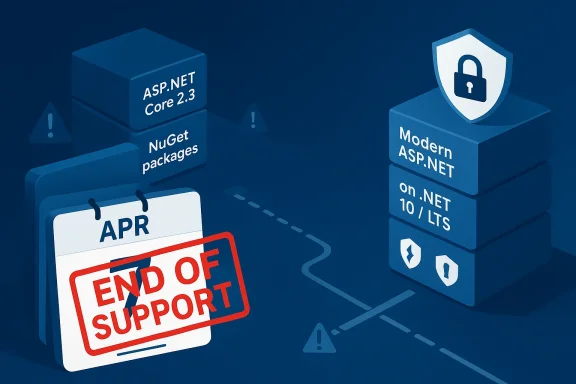
Microsoft’s decision to end support for ASP.NET Core 2.3 on .NET Framework on April 7, 2027 is less a sudden reversal than the final act in a long, awkward compatibility story. The move closes the book on the last supported package line that let legacy ASP.NET Core applications keep running on the Windows-only .NET Framework, while leaving the framework itself supported as part of Windows. For enterprises still dependent on those packages, the message is blunt: the code may keep running, but the security and servicing safety net will not. (devblogs.microsoft.com)
The modern .NET ecosystem has spent years untangling three overlapping realities: old ASP.NET, the Windows-bound .NET Framework, and the cross-platform .NET Core line that later became simply .NET. ASP.NET Core originally straddled both worlds, which made migration easier but also created versioning traps that many organizations did not notice until support dates started to bite. Microsoft’s own support pages now reflect that split history clearly, noting that ASP.NET Core and Entity Framework Core follow the same lifecycle as .NET Core, while .NET Framework follows the separate Component Lifecycle Policy tied to Windows. (learn.microsoft.com)
The core of the problem is that ASP.NET Core 2.x on .NET Framework was shipped as NuGet packages rather than as a traditional monolithic framework install. Microsoft’s earlier servicing note explains that ASP.NET Core 2.1 was reshipped as ASP.NET Core 2.3 to give customers a supported target after 2.2 fell out of support, and that 2.3 was intentionally “the same code as 2.1.” That was a practical answer to a messy migration problem, but it also meant 2.3 was always a stopgap, not a strategic destination. (devblogs.microsoft.com)
The next major transition arrived with ASP.NET Core 3.0, when Microsoft dropped .NET Framework as a target framework entirely. Microsoft’s compatibility documentation says plainly that starting with ASP.NET Core 3.0, .NET Framework is an unsupported target, and new ASP.NET Core apps should be built on .NET Core. That decision created a clean architectural boundary for the future, but it also left older server estates with a shrinking set of acceptable options.
At the same time, .NET Framework itself did not disappear. Microsoft continues to support it as a Windows component, and the latest release is .NET Framework 4.8.1, with support tied to the parent operating system’s lifecycle. That matters because many enterprises interpret “.NET is supported” as a single story, when in fact the platform now operates on two different clocks: the Windows servicing clock for .NET Framework and the modern release cadence for .NET 8, .NET 9, and .NET 10.
The April 7, 2027 sunset changes the meaning of that lifeline. Microsoft says applications will continue to run after end of support, but there will be no new security updates. For large estates, that distinction is critical: uptime is not the same as safety, and the absence of patches can quickly convert a working system into a compliance problem. That is especially true for internet-facing workloads, regulated environments, and anything with a long vendor chain. (devblogs.microsoft.com)
This is where semantic versioning expectations collided with Microsoft’s support reality. Customers upgrading from 2.1 to 2.3 were told the packages contained the exact same code, while customers on 2.2 were told to remove dependencies on 2.2-specific behavior before upgrading. In other words, 2.3 solved a servicing problem, but it did so by bending intuitive version logic in a way that was bound to frustrate some teams. (devblogs.microsoft.com)
The official support policy framework gives Microsoft a procedural justification too. ASP.NET Core 2.3 is classified as a Tool, and Microsoft’s support lifecycle policy says tools require at least 12 months’ notice before support ends. The April 7, 2026 announcement to end support on April 7, 2027 fits that rule precisely, which means the company is not improvising; it is applying a policy it has already reserved for package-based and utility-style products.
That distinction matters because many legacy applications are really a stack of aged dependencies rather than a single framework choice. A business may still be fully supported at the OS and runtime layer while using an ASP.NET Core package line that is about to become unsupportable. In practice, the security posture of the whole application is only as strong as the oldest unsupported component in the chain.
In theory, the move should be straightforward: modernize the runtime, retarget the app, and resolve compatibility gaps. In reality, migration work is usually blocked by libraries, auth flows, custom middleware, data access assumptions, and deployment processes that were designed around older IIS-era patterns. That is why Microsoft’s latest post leans on modernization tooling, including GitHub Copilot modernization, to reduce the labor cost of the transition. (devblogs.microsoft.com)
For rivals and adjacent ecosystems, this strengthens the case for open, portable application stacks. If a team is already facing a forced migration, alternatives such as containerized Linux hosting or cross-platform frameworks become more attractive not because they are fashionable, but because they reduce the risk of future lock-in. Microsoft knows this, which is why it has worked so hard to position modern .NET as a general-purpose application platform rather than a Windows-only runtime. (learn.microsoft.com)
For enterprises, the issue is immediate and measurable. Security teams must factor unsupported code into risk registers, procurement teams may need to budget for modernization work, and auditors may ask why a known deadline was ignored. The real cost is often not the migration itself, but the time lost pretending the migration can be postponed indefinitely. (devblogs.microsoft.com)
There is a genuine opportunity here if the tooling is good enough. Code transformation assistants can accelerate repetitive changes, help locate obsolete APIs, and surface compatibility pitfalls earlier in the process. But AI can only assist with patterns it understands; it cannot fully reason about a business-specific authentication model, a fragile deployment chain, or a vendor SDK that no longer exists. (devblogs.microsoft.com)
That can create a dangerous false sense of security. Administrators may see the packages still available in NuGet and assume the software is therefore safe to keep in production. But package availability is not the same as vendor support, and Microsoft has now drawn a line between the two. (devblogs.microsoft.com)
There is also a broader product lesson here for Microsoft: the company can support old bridges for a long time, but it will not preserve them forever. That is understandable, and in many ways healthy, yet it also means every temporary compatibility concession should be treated as exactly that — temporary. For teams still on ASP.NET Core 2.3 on .NET Framework, the right response is not panic, but urgency.
Source: theregister.com Microsoft calls time on ASP.NET Core 2.3 on .NET Framework
 Background
The modern .NET ecosystem has spent years untangling three overlapping realities: old ASP.NET, the Windows-bound .NET Framework, and the cross-platform .NET Core line that later became simply .NET. ASP.NET Core originally straddled both worlds, which made migration easier but also created versioning traps that many organizations did not notice until support dates started to bite. Microsoft’s own support pages now reflect that split history clearly, noting that ASP.NET Core and Entity Framework Core follow the same lifecycle as .NET Core, while .NET Framework follows the separate Component Lifecycle Policy tied to Windows. (learn.microsoft.com)The core of the problem is that ASP.NET Core 2.x on .NET Framework was shipped as NuGet packages rather than as a traditional monolithic framework install. Microsoft’s earlier servicing note explains that ASP.NET Core 2.1 was reshipped as ASP.NET Core 2.3 to give customers a supported target after 2.2 fell out of support, and that 2.3 was intentionally “the same code as 2.1.” That was a practical answer to a messy migration problem, but it also meant 2.3 was always a stopgap, not a strategic destination. (devblogs.microsoft.com)
The next major transition arrived with ASP.NET Core 3.0, when Microsoft dropped .NET Framework as a target framework entirely. Microsoft’s compatibility documentation says plainly that starting with ASP.NET Core 3.0, .NET Framework is an unsupported target, and new ASP.NET Core apps should be built on .NET Core. That decision created a clean architectural boundary for the future, but it also left older server estates with a shrinking set of acceptable options.
At the same time, .NET Framework itself did not disappear. Microsoft continues to support it as a Windows component, and the latest release is .NET Framework 4.8.1, with support tied to the parent operating system’s lifecycle. That matters because many enterprises interpret “.NET is supported” as a single story, when in fact the platform now operates on two different clocks: the Windows servicing clock for .NET Framework and the modern release cadence for .NET 8, .NET 9, and .NET 10.
Why ASP.NET Core 2.3 Matters
ASP.NET Core 2.3 is not just another old package version; it is the last officially supported bridge for teams that stayed on .NET Framework while adopting some of the ASP.NET Core stack. Microsoft’s advisory says users on .NET Framework should update to the latest 2.3 release to remain in support, and that future servicing fixes for ASP.NET Core on .NET Framework would be based on 2.3. In practice, that turned 2.3 into a compatibility lifeline for organizations that could not yet move to the modern platform. (devblogs.microsoft.com)The April 7, 2027 sunset changes the meaning of that lifeline. Microsoft says applications will continue to run after end of support, but there will be no new security updates. For large estates, that distinction is critical: uptime is not the same as safety, and the absence of patches can quickly convert a working system into a compliance problem. That is especially true for internet-facing workloads, regulated environments, and anything with a long vendor chain. (devblogs.microsoft.com)
The practical enterprise implication
Many organizations never migrated to ASP.NET Core 3.x or later because the change would have forced a platform move, not just a package update. That means ASP.NET Core 2.3 became the “good enough” answer for a subset of applications that were modern enough to be awkward on classic ASP.NET, but not modern enough to justify a rewrite. The new end date forces those teams to confront the deferred cost of staying in the middle. (devblogs.microsoft.com)- The app may keep running after April 7, 2027.
- The app will no longer receive security patches.
- Support incidents become harder to justify internally.
- Audit and compliance teams will likely push for remediation.
- Dependency chains become the hidden risk, not just the app itself.
The SemVer Mess and the 2.2 Trap
A lot of the frustration around 2.3 comes from the fact that Microsoft had already created a versioning anomaly. The earlier support advisory explains that 2.3 was essentially a re-release of 2.1 because 2.2 had introduced breaking changes and was already unsupported. That was a sensible support decision, but it also created confusion for developers who saw a higher version number and assumed a normal forward upgrade path. (devblogs.microsoft.com)This is where semantic versioning expectations collided with Microsoft’s support reality. Customers upgrading from 2.1 to 2.3 were told the packages contained the exact same code, while customers on 2.2 were told to remove dependencies on 2.2-specific behavior before upgrading. In other words, 2.3 solved a servicing problem, but it did so by bending intuitive version logic in a way that was bound to frustrate some teams. (devblogs.microsoft.com)
Why that still matters now
The support deadline is a reminder that temporary fixes rarely stay temporary in the minds of users. Once a stopgap becomes the only safe harbor, people build roadmaps, procurement plans, and operational processes around it. When Microsoft now says 2.3 will be retired, it is not just ending a package line; it is unraveling a planning assumption that some enterprises may have treated as settled. (devblogs.microsoft.com)- 2.1 was the originally supported anchor.
- 2.2 was the troublesome release with breaking changes.
- 2.3 was the reissued bridge back to support.
- 2027 is the point at which that bridge is finally removed.
- The result is a support cliff for legacy .NET Framework apps.
Microsoft’s Official Rationale
Microsoft says the reason for ending support is cost and focus. Daniel Roth’s announcement states that maintaining ASP.NET Core 2.3 on .NET Framework pulls resources away from the company’s modern .NET platform, and that 2.3 is now so out of date that Microsoft no longer recommends it as a long-term migration strategy. That is a familiar Microsoft argument, but it is also a credible one: a company cannot indefinitely staff old package lines without slowing down work on newer runtimes and tooling. (devblogs.microsoft.com)The official support policy framework gives Microsoft a procedural justification too. ASP.NET Core 2.3 is classified as a Tool, and Microsoft’s support lifecycle policy says tools require at least 12 months’ notice before support ends. The April 7, 2026 announcement to end support on April 7, 2027 fits that rule precisely, which means the company is not improvising; it is applying a policy it has already reserved for package-based and utility-style products.
Why the classification matters
This classification is more than bureaucracy. By treating ASP.NET Core 2.3 as a tool rather than as a platform, Microsoft narrows the moral weight of the commitment it made. That may be legally tidy, but to customers who built production systems around the package, it can feel like a relabeling of what was once a support promise..NET Framework Is Still Supported, But That’s Not the Same Thing
One of the easiest mistakes to make is assuming that because .NET Framework continues to receive support, every application built on it remains safe. Microsoft’s lifecycle page makes clear that .NET Framework 4.8.1 is current, and its support depends on the operating system lifecycle. But the support status of the framework does not automatically extend to every package layer that used to run on top of it.That distinction matters because many legacy applications are really a stack of aged dependencies rather than a single framework choice. A business may still be fully supported at the OS and runtime layer while using an ASP.NET Core package line that is about to become unsupportable. In practice, the security posture of the whole application is only as strong as the oldest unsupported component in the chain.
Windows-only support is not future-proofing
Microsoft has also been clear that .NET Framework remains Windows-only, while modern .NET is cross-platform. That technical split is why the company keeps urging migrations to .NET 10 and modern ASP.NET. The longer an application remains pinned to .NET Framework, the more it becomes a Windows-anchored asset rather than a portable, future-friendly platform investment. (learn.microsoft.com)- .NET Framework 4.8.1 is still current.
- Support is tied to Windows lifecycle policy.
- ASP.NET Core 2.3 support ends separately.
- Modern .NET is the strategic target Microsoft wants customers on.
- The support gap is now the bigger risk than the runtime itself.
What the Migration Path Looks Like
Microsoft’s announcement pushes users toward modern ASP.NET on .NET 10, and that advice is consistent with the broader .NET release model. Microsoft’s support pages show .NET 10 as the current LTS release with support running until November 2028, while .NET 9 is STS and .NET 8 remains LTS until November 2026. That gives organizations a clear target stack and a predictable servicing cadence. (learn.microsoft.com)In theory, the move should be straightforward: modernize the runtime, retarget the app, and resolve compatibility gaps. In reality, migration work is usually blocked by libraries, auth flows, custom middleware, data access assumptions, and deployment processes that were designed around older IIS-era patterns. That is why Microsoft’s latest post leans on modernization tooling, including GitHub Copilot modernization, to reduce the labor cost of the transition. (devblogs.microsoft.com)
The enterprise calculation
For consumer-facing teams, a migration can often be staged behind feature flags and blue-green deployment. For internal line-of-business systems, the burden is different: business owners often care more about continuity than refactoring elegance. That creates a political as well as technical challenge, because the system that is “good enough” today becomes expensive the moment it needs a safety case for 2027 and beyond. (devblogs.microsoft.com)- Inventory every application using ASP.NET Core 2.3 on .NET Framework.
- Identify whether it is internet-facing, internal-only, or isolated.
- Map all package and runtime dependencies.
- Decide whether the app can move directly to modern ASP.NET on .NET 10.
- Set a remediation timeline well before April 7, 2027.
The Market and Competitive Angle
Microsoft is not just simplifying support; it is reinforcing the strategic center of gravity around the modern .NET platform. The company’s support pages, release cadence, and migration guidance all point in the same direction: fewer legacy exceptions, more alignment with the current LTS track, and more emphasis on cross-platform deployment. That nudges enterprises toward architectures that are easier for Microsoft to sustain and easier for customers to modernize. (learn.microsoft.com)For rivals and adjacent ecosystems, this strengthens the case for open, portable application stacks. If a team is already facing a forced migration, alternatives such as containerized Linux hosting or cross-platform frameworks become more attractive not because they are fashionable, but because they reduce the risk of future lock-in. Microsoft knows this, which is why it has worked so hard to position modern .NET as a general-purpose application platform rather than a Windows-only runtime. (learn.microsoft.com)
Why this is a signal, not just a date
The support deadline is also a market signal that Microsoft is comfortable ending the longest tail of compatibility debt. That is significant because it tells enterprises there will be fewer exceptions over time, not more. In the long run, that can improve engineering discipline; in the short run, it can feel like the company is tightening the exit door behind customers who moved carefully and late. (devblogs.microsoft.com)- It reinforces modern .NET as the strategic default.
- It reduces the value of staying on package-era bridges.
- It makes Linux and container adoption easier to justify.
- It increases pressure on competitors offering platform neutrality.
- It signals less tolerance for long-tail legacy servicing.
Enterprise Versus Consumer Impact
For consumers, this story will be almost invisible unless a website or desktop-connected web application they use happens to sit on one of these older stacks. Most consumers care only that the service works; they are unlikely to know or care whether the back end is ASP.NET Core 2.3 or a newer release. But even consumer-facing services can become vulnerable if operators leave unpatched code online after support ends. (devblogs.microsoft.com)For enterprises, the issue is immediate and measurable. Security teams must factor unsupported code into risk registers, procurement teams may need to budget for modernization work, and auditors may ask why a known deadline was ignored. The real cost is often not the migration itself, but the time lost pretending the migration can be postponed indefinitely. (devblogs.microsoft.com)
Legacy continuity is not free
The hardest truth here is that “it still works” is a maintenance argument, not a support argument. Microsoft is saying it will no longer underwrite the risk of old package lines, even if business users would prefer the software to remain untouched. That may be frustrating, but it also reflects the reality that legacy continuity always depends on someone paying the bill. (devblogs.microsoft.com)Developer Tooling and AI Assistance
Microsoft’s push toward modernization tooling is not accidental. The company is explicitly telling users to use AI tools to assist migrations from ASP.NET, and it has started presenting modernization as a productivity problem as much as a platform decision. That framing matters because many organizations are not short on theoretical migration advice; they are short on engineering hours. (devblogs.microsoft.com)There is a genuine opportunity here if the tooling is good enough. Code transformation assistants can accelerate repetitive changes, help locate obsolete APIs, and surface compatibility pitfalls earlier in the process. But AI can only assist with patterns it understands; it cannot fully reason about a business-specific authentication model, a fragile deployment chain, or a vendor SDK that no longer exists. (devblogs.microsoft.com)
Where AI helps, and where it doesn’t
AI is best used as a first-pass accelerator, not as a substitute for architecture review. Teams that treat modernization assistants as a magic migration button will likely create a second problem: a faster way to introduce subtle bugs into systems that are already brittle. The best outcome is not fully automated conversion, but a faster path to human-reviewed, test-backed modernization. (devblogs.microsoft.com)- AI can inventory repetitive code patterns.
- AI can suggest API replacements.
- AI cannot validate business rules on its own.
- AI does not remove the need for test coverage.
- AI is most useful when paired with staged refactoring.
The NuGet Signal
Microsoft’s own package pages show that ASP.NET Core 2.3 is still a real deployment target, with a long list of supported 2.3.x packages. That is one reason the announcement matters so much: it affects an actual package ecosystem, not a theoretical product line. When support ends, the packages do not disappear, but the operational meaning of installing them changes immediately.That can create a dangerous false sense of security. Administrators may see the packages still available in NuGet and assume the software is therefore safe to keep in production. But package availability is not the same as vendor support, and Microsoft has now drawn a line between the two. (devblogs.microsoft.com)
The hidden dependency problem
The package-based model also makes dependency drift harder to spot. A single app may pull in dozens or even hundreds of packages, and Microsoft’s earlier advisory acknowledged that downgrading or moving away from the 2.2-era package mix could be awkward because of inconsistent version numbers. That kind of complexity is exactly why support deadlines become organizational events rather than merely technical footnotes. (devblogs.microsoft.com)Strengths and Opportunities
Microsoft’s move is frustrating for some customers, but it also has real strengths from a platform and ecosystem perspective. It reduces ambiguity, forces a clearer modernization path, and aligns the company’s engineering investment with the runtime it is actively advancing. If handled well, the change can also prompt overdue cleanup in application portfolios that have been living on borrowed time.- It clarifies that modern ASP.NET on .NET 10 is the strategic target.
- It reduces long-term servicing fragmentation inside Microsoft.
- It encourages cleaner architecture and better dependency hygiene.
- It gives enterprises a fixed deadline for planning.
- It can improve security by shrinking the legacy support surface.
- It makes modernization tooling more relevant and practical.
- It strengthens the case for cross-platform deployment.
Risks and Concerns
The risks are equally real, and they are mostly borne by customers who have already stretched their migration budgets thin. Some of these applications are not stalled by indecision; they are stalled by old servers, vendor dependencies, compliance constraints, or the sheer difficulty of touching fragile code. Microsoft is right that old support costs money, but customers are also right to worry that the exit path is harder than the announcement suggests.- Unsupported code will continue to run, which may lull teams into delay.
- Security exposure increases after the support deadline.
- Compliance teams may flag old package use sooner than app owners expect.
- Some legacy apps may be too brittle for quick migration.
- Vendor dependencies may block retargeting to modern .NET.
- Smaller teams may lack time to test a full platform move.
- The announcement may push organizations into rushed, high-risk rewrites.
Looking Ahead
The next two years will probably determine whether this becomes a manageable modernization cycle or a scramble. Well-run organizations will use the lead time to inventory dependencies, prioritize exposed systems, and choose which apps deserve a real port rather than a tactical patch. The less organized ones will wait until the deadline is uncomfortably close, then discover that “simple migration” was always a myth. (devblogs.microsoft.com)There is also a broader product lesson here for Microsoft: the company can support old bridges for a long time, but it will not preserve them forever. That is understandable, and in many ways healthy, yet it also means every temporary compatibility concession should be treated as exactly that — temporary. For teams still on ASP.NET Core 2.3 on .NET Framework, the right response is not panic, but urgency.
- Audit every ASP.NET Core 2.3 deployment immediately.
- Separate externally facing apps from low-risk internal tools.
- Start modernization pilots on the least complex systems first.
- Budget for testing, not just code changes.
- Track the deadline in governance, not just engineering backlogs.
Source: theregister.com Microsoft calls time on ASP.NET Core 2.3 on .NET Framework
