

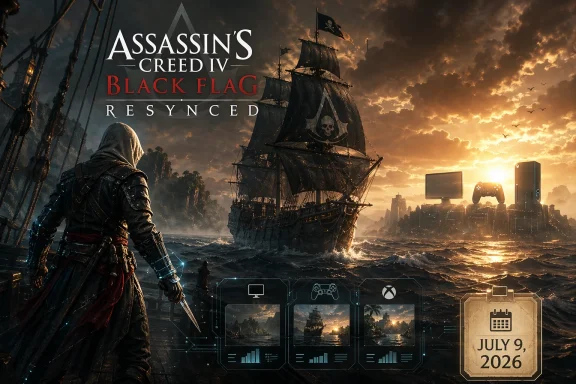
Just as promised, Ubisoft has now pulled back the curtain on Assassin’s Creed Black Flag Resynced, and the timing matters as much as the game itself. The remake is no longer just a rumor that refused to die; it is a dated release, a confirmed platform lineup, and, perhaps most importantly for PC players, a clear set of hardware targets. The headline takeaway is simple: the game lands on July 9, 2026 for PC, PlayStation 5, and Xbox Series X/S, with PC availability through the Ubisoft Store, Steam, and Epic Games Store.
Few modern remakes have had the same long, slow burn as Assassin’s Creed IV: Black Flag. The original 2013 release became one of the most beloved entries in the series because it blended naval combat, open-sea exploration, and a charismatic lead in Edward Kenway. It was the moment where Assassin’s Creed’s historical playground stopped feeling like a guided museum tour and started feeling like an adventure with real swagger.
The remake’s existence was, for years, an open secret. Leaks, ratings chatter, and recurring industry rumors kept the project in circulation long before Ubisoft made it official. That history matters because it shapes expectations: players are not approaching this as a blank-slate reboot, but as a comparison piece against a game many fans already consider a high point for the franchise. Ubisoft’s own messaging has leaned into that familiarity by framing the project as a faithful recreation enhanced for modern hardware rather than a radical reimagining.
The new title, Black Flag Resynced, signals that Ubisoft is trying to preserve the emotional core of the original while rebuilding the technical foundation. According to Ubisoft’s launch materials, the remake uses the latest version of the Anvil Engine and includes new content alongside the original story. That combination is important because it suggests the company is trying to solve a classic remake problem: how to modernize a game without sanding off the qualities that made it memorable in the first place.
On PC, that balancing act always comes back to one question: how expensive is the modern version of an old favorite? Ubisoft has answered that with a requirements table that is, in some respects, surprisingly approachable and, in others, conspicuously ambitious. Minimum specs remain modest by 2026 standards, but the upper tiers make it clear that the remake is being built to scale up sharply for high-resolution play and visual features that were not part of the 2013 experience.
Ubisoft also clarified the game’s direction. Rather than presenting this as an alternate-universe reinterpretation, the publisher describes it as a faithful recreation of Black Flag, now rebuilt in a newer version of Anvil and supplemented with new content. That matters because the company is signaling continuity first and novelty second. Fans who want the original game’s rhythm can breathe easier, but they should also expect a degree of structural polish that comes from building on modern tools rather than merely upscaling textures.
The timing also helps explain why Ubisoft chose to reveal hardware targets so early. PC players are often among the first to make upgrade decisions, and a remake with a known date and known requirements can influence GPU and storage purchases months ahead of launch. That is particularly true when the game’s visual pitch leans on something as technically sensitive as water, lighting, and large-scale ocean scenes.
That subtlety matters because Black Flag has always lived in an awkward place in franchise history: beloved by fans, yet frequently discussed as a game whose systems sometimes outran its narrative. A remake can either sharpen that identity or flatten it. Ubisoft appears to be betting on the former.
That entry point is respectable for a 2026 release. It means a large segment of midrange PC owners will likely be able to run the game without a dramatic hardware upgrade, especially if they are comfortable with 30 FPS or lower visual settings. In a year when many new games are pushing far beyond what used to count as mainstream hardware, that is an encouraging sign for accessibility.
The upper tiers tell a different story. The Ultra spec climbs to an Intel Core i7-12700K or Ryzen 7 5700X3D, paired with an RTX 4090 or Radeon RX 7900 XTX for 4K at 60 FPS on the Ultra preset. That is a serious leap, and it suggests Ubisoft wants the game to have enough visual headroom to reward expensive rigs, not just run acceptably on average ones.
There is also a notable emphasis on dual-channel 16GB memory across the board. That suggests the game’s performance profile may lean more heavily on memory bandwidth and platform balance than a simple VRAM number would indicate. In practical terms, players with mismatched sticks or older budget builds may see more benefit from platform cleanup than from a single component swap.
It also reinforces the idea that Ubisoft is building this remake for current-generation expectations rather than preserving last-gen accommodation. That is a clean break from the original game’s era, and it likely improves technical consistency across the map.
But the specification table also sends a message about expectations. The game is not being framed as a “best effort” remaster that happens to run on PC; it is being presented as a full contemporary production with a wide performance envelope. That means players will likely need to think carefully about settings, resolution scaling, and frame-rate targets rather than assuming the game will simply cruise on older hardware.
That has a ripple effect. A PC gamer who has been postponing a GPU upgrade may suddenly see this as the excuse to pull the trigger. For a remake tied to nostalgia, that can be a powerful selling point: buy the game, justify the hardware, relive the classic.
It also protects the company against the criticism that a remake is merely old content in a new wrapper. By showing a top-end target that can meaningfully challenge elite hardware, Ubisoft is positioning the project as technically relevant in 2026 rather than historically interesting in 2013 terms.
On consoles, Ubisoft has an easier job of defining the target environment. On PC, the company must handle a sprawling spread of processors, GPUs, and storage configurations. The fact that the published requirements are relatively clean and evenly tiered suggests the studio has spent time thinking about scalability rather than treating PC as an afterthought.
That likely helps the PC version more than it hurts it. Cross-platform development on modern hardware tends to encourage stronger visual consistency, and consistent foundations are easier to scale up than weak ones are to rescue.
At the same time, PC users can expect more room to tweak performance and image quality. The real test will be whether Ubisoft balances console parity with meaningful PC customization, rather than forcing one environment’s assumptions onto another.
The company says the remake includes new content, which is the right move for a game that has been discussed, replayed, and dissected for more than a decade. A pure visual refresh would struggle to justify its existence at full remake pricing. New scenes, extra context, or expanded narrative beats give Ubisoft more room to defend the project as more than nostalgia banking.
That said, the danger is overcorrection. Add too much, and the remake stops feeling like Black Flag. Add too little, and it looks like a premium paint job. Ubisoft is operating in the narrowest of lanes.
Ubisoft has also confirmed that the original voice actor, Matt Ryan, returned to record new lines for the game. That detail is more important than it may seem, because authenticity in a remake is often won or lost in the performance layer. The right voice can make players feel that the older character has simply matured into the new version of the world.
A remake of Black Flag sits nicely inside that strategy because it targets both lapsed fans and newer players who may know the game by reputation alone. It is easier to market than a new IP, easier to explain than a niche experimental title, and easier to benchmark than a sprawling sequel with unfamiliar systems. In a crowded release calendar, familiarity has real monetary value.
But remakes are not free money. They invite direct comparison, and every visual upgrade or missing feature becomes a talking point. If the remake disappoints, it does so in full view of an audience that already knows exactly what it wanted.
That calculus will be especially important for PC buyers, who often compare the value of a remake against the original game, the existing backlog, and the cost of any needed hardware upgrades. In that environment, value perception can be as important as raw content volume.
Ubisoft’s job now is to prove that Black Flag Resynced is not just a technically sensible remake, but a creatively convincing one. If the new scenes enrich Edward Kenway’s arc, if the gameplay modernization respects the original pacing, and if the PC version lands cleanly across the hardware tiers Ubisoft has published, the game could become one of the more successful legacy revivals of the year. If not, it risks becoming a high-profile reminder that nostalgia is not the same thing as value.
Source: KitGuru Assassin’s Creed Black Flag Resynced PC system requirements announced - KitGuru
 Background
Few modern remakes have had the same long, slow burn as Assassin’s Creed IV: Black Flag. The original 2013 release became one of the most beloved entries in the series because it blended naval combat, open-sea exploration, and a charismatic lead in Edward Kenway. It was the moment where Assassin’s Creed’s historical playground stopped feeling like a guided museum tour and started feeling like an adventure with real swagger.The remake’s existence was, for years, an open secret. Leaks, ratings chatter, and recurring industry rumors kept the project in circulation long before Ubisoft made it official. That history matters because it shapes expectations: players are not approaching this as a blank-slate reboot, but as a comparison piece against a game many fans already consider a high point for the franchise. Ubisoft’s own messaging has leaned into that familiarity by framing the project as a faithful recreation enhanced for modern hardware rather than a radical reimagining.
The new title, Black Flag Resynced, signals that Ubisoft is trying to preserve the emotional core of the original while rebuilding the technical foundation. According to Ubisoft’s launch materials, the remake uses the latest version of the Anvil Engine and includes new content alongside the original story. That combination is important because it suggests the company is trying to solve a classic remake problem: how to modernize a game without sanding off the qualities that made it memorable in the first place.
On PC, that balancing act always comes back to one question: how expensive is the modern version of an old favorite? Ubisoft has answered that with a requirements table that is, in some respects, surprisingly approachable and, in others, conspicuously ambitious. Minimum specs remain modest by 2026 standards, but the upper tiers make it clear that the remake is being built to scale up sharply for high-resolution play and visual features that were not part of the 2013 experience.
What Ubisoft Actually Confirmed
The most important thing about this reveal is that it ends speculation and replaces it with concrete release planning. Assassin’s Creed Black Flag Resynced launches on July 9, 2026, and Ubisoft has confirmed support for PlayStation 5, Xbox Series X/S, and PC. On PC, the game will be sold through the Ubisoft Store, Steam, and Epic Games Store, which is a useful detail for players who prefer to keep their libraries in one place or avoid launcher friction.Ubisoft also clarified the game’s direction. Rather than presenting this as an alternate-universe reinterpretation, the publisher describes it as a faithful recreation of Black Flag, now rebuilt in a newer version of Anvil and supplemented with new content. That matters because the company is signaling continuity first and novelty second. Fans who want the original game’s rhythm can breathe easier, but they should also expect a degree of structural polish that comes from building on modern tools rather than merely upscaling textures.
The release window is more than a date
A July launch places the game squarely in the summer release season, where publisher competition can be fierce but attention can be easier to capture if the field is not overcrowded. For Ubisoft, that window also gives the company a chance to ride the momentum of the reveal, preorder cycle, and collector’s edition marketing without being lost in the holiday crush. It is a clean runway for a nostalgia-driven blockbuster.The timing also helps explain why Ubisoft chose to reveal hardware targets so early. PC players are often among the first to make upgrade decisions, and a remake with a known date and known requirements can influence GPU and storage purchases months ahead of launch. That is particularly true when the game’s visual pitch leans on something as technically sensitive as water, lighting, and large-scale ocean scenes.
Why the “resynced” label matters
The title is doing marketing work. Resynced suggests a reconstruction of rhythm, systems, and presentation rather than a barebones port of the original. It also fits a broader pattern in modern game branding, where publishers use distinctive subtitle language to imply both reverence and modernization without overcommitting to a full-scale reinvention.That subtlety matters because Black Flag has always lived in an awkward place in franchise history: beloved by fans, yet frequently discussed as a game whose systems sometimes outran its narrative. A remake can either sharpen that identity or flatten it. Ubisoft appears to be betting on the former.
PC System Requirements: A Tale of Two Ends
At the minimum end, Black Flag Resynced is not especially punishing. Ubisoft lists Windows 10 or Windows 11 64-bit, 16GB of RAM, an Intel Core i7-8700K or AMD Ryzen 5 3600, and a GTX 1660, Radeon RX 5500 XT, or Intel Arc A580 for a 1080p, 30 FPS, low-preset experience. The game also requires 65GB of SSD storage, which is increasingly standard but still worth noting for players sitting on aging hard drives.That entry point is respectable for a 2026 release. It means a large segment of midrange PC owners will likely be able to run the game without a dramatic hardware upgrade, especially if they are comfortable with 30 FPS or lower visual settings. In a year when many new games are pushing far beyond what used to count as mainstream hardware, that is an encouraging sign for accessibility.
The upper tiers tell a different story. The Ultra spec climbs to an Intel Core i7-12700K or Ryzen 7 5700X3D, paired with an RTX 4090 or Radeon RX 7900 XTX for 4K at 60 FPS on the Ultra preset. That is a serious leap, and it suggests Ubisoft wants the game to have enough visual headroom to reward expensive rigs, not just run acceptably on average ones.
The midrange target is the real market signal
The most revealing row is the recommended spec, where Ubisoft targets RTX 3060, RX 6600 XT, or Intel Arc B580 territory for 1080p at 60 FPS. That is an important clue about what the company considers a healthy mainstream baseline. It tells PC gamers that the remake is designed to be broadly playable, but also that smooth 60 FPS has a specific hardware cost.There is also a notable emphasis on dual-channel 16GB memory across the board. That suggests the game’s performance profile may lean more heavily on memory bandwidth and platform balance than a simple VRAM number would indicate. In practical terms, players with mismatched sticks or older budget builds may see more benefit from platform cleanup than from a single component swap.
Why SSD-only storage is no longer surprising
The requirement for an SSD is no longer shocking, but it still carries design implications. Open-world games with streaming assets, dense environmental detail, and long traversal paths benefit enormously from solid-state storage, especially when the game also needs to keep a large number of textures, effects, and world-state data available at once. A pirate game set across water-heavy environments is exactly the sort of project where slow storage can become a visible bottleneck.It also reinforces the idea that Ubisoft is building this remake for current-generation expectations rather than preserving last-gen accommodation. That is a clean break from the original game’s era, and it likely improves technical consistency across the map.
- Minimum 1080p/30 FPS is aimed at accessibility rather than bragging rights.
- Recommended 1080p/60 FPS is the most practical target for most players.
- High and Ultra are clearly designed for newer high-end GPUs.
- 16GB RAM is the floor and the ceiling, which is unusual but not unheard of.
- SSD-only storage implies aggressive asset streaming and modern loading assumptions.
What This Means for PC Gamers
For PC players, the biggest positive is that the minimum barrier is not absurdly high. A system built around late-2010s mainstream parts is still within striking distance, and that makes the game approachable for a much broader audience than some modern blockbusters. If Ubisoft is serious about broad adoption, that matters more than a few shiny benchmark slides.But the specification table also sends a message about expectations. The game is not being framed as a “best effort” remaster that happens to run on PC; it is being presented as a full contemporary production with a wide performance envelope. That means players will likely need to think carefully about settings, resolution scaling, and frame-rate targets rather than assuming the game will simply cruise on older hardware.
The upgrade conversation starts early
The use of cards like the RTX 3060 and RX 6600 XT as recommended hardware tells us where the sweet spot lies. These are not bleeding-edge GPUs, but they are still a meaningful step above entry-level cards. In other words, the game is calibrated for systems that were midrange or better within the last several years, not for everything that can technically still boot Windows 11.That has a ripple effect. A PC gamer who has been postponing a GPU upgrade may suddenly see this as the excuse to pull the trigger. For a remake tied to nostalgia, that can be a powerful selling point: buy the game, justify the hardware, relive the classic.
The 4K ceiling is a branding statement
The Ultra spec may not reflect the experience most players will choose, but it still serves a purpose. Listing an RTX 4090 or RX 7900 XTX at 4K/60 is Ubisoft’s way of saying this remake has room to scale all the way up. That matters for influencers, benchmarkers, and enthusiast buyers who use these tables as shorthand for how ambitious a game is.It also protects the company against the criticism that a remake is merely old content in a new wrapper. By showing a top-end target that can meaningfully challenge elite hardware, Ubisoft is positioning the project as technically relevant in 2026 rather than historically interesting in 2013 terms.
- PC players with older hardware should still have a reasonable shot.
- Midrange GPUs appear to be the practical target.
- High-end systems are clearly being given something to chew on.
- Settings flexibility will likely matter a great deal.
- The SSD requirement is a sign of modern asset streaming, not marketing theater.
The Console Context Still Matters
Although the system requirements are a PC-specific story, the console releases matter because they shape how Ubisoft thinks about parity. A remake like this must satisfy multiple audiences at once, and the technical choices made for PC often flow from the same asset pipeline that serves PS5 and Xbox Series X/S. That means the PC spec table is not just about PC optimization; it is also a window into the game’s broader development philosophy.On consoles, Ubisoft has an easier job of defining the target environment. On PC, the company must handle a sprawling spread of processors, GPUs, and storage configurations. The fact that the published requirements are relatively clean and evenly tiered suggests the studio has spent time thinking about scalability rather than treating PC as an afterthought.
A modern cross-platform baseline
The game’s launch on current-generation consoles only is telling. Ubisoft is not trying to support older systems with split technical ambitions, which usually forces compromises. Instead, the studio can build around the expectation that players have SSDs, higher memory bandwidth, and more powerful CPU/GPU combinations.That likely helps the PC version more than it hurts it. Cross-platform development on modern hardware tends to encourage stronger visual consistency, and consistent foundations are easier to scale up than weak ones are to rescue.
Controller-first expectations, PC-first flexibility
Black Flag was always a game that benefited from the feel of a controller, especially in ship navigation and broader traversal. That console heritage will probably remain intact in the remake, even if PC players have the usual mouse-and-keyboard flexibility. The result is a game that should feel familiar across platforms but may still be best enjoyed on a couch-style input setup.At the same time, PC users can expect more room to tweak performance and image quality. The real test will be whether Ubisoft balances console parity with meaningful PC customization, rather than forcing one environment’s assumptions onto another.
- Console parity likely helps stabilize the PC version.
- Current-gen-only support simplifies optimization.
- The remake should retain its controller-friendly roots.
- PC players will still expect deeper graphics controls.
- Broad platform release strengthens the business case for a higher-budget production.
A Faithful Remake, or a Safer One?
Ubisoft’s description of the game as a faithful recreation is both reassuring and limiting. Reassuring, because many fans do not want a drastic rewrite of Black Flag’s tone or structure. Limiting, because it suggests the remake may prioritize preservation over bold reinterpretation, and that can be risky when the audience is already deeply familiar with the source material.The company says the remake includes new content, which is the right move for a game that has been discussed, replayed, and dissected for more than a decade. A pure visual refresh would struggle to justify its existence at full remake pricing. New scenes, extra context, or expanded narrative beats give Ubisoft more room to defend the project as more than nostalgia banking.
Why new content is essential
For remakes, new content is not just a bonus feature; it is often the difference between a premium release and a collector’s curiosity. If Ubisoft is adding story scenes and expanding character moments, the studio is effectively trying to solve the “why now?” question. Players need a reason to revisit a world they already know, and narrative enrichment is usually the safest answer.That said, the danger is overcorrection. Add too much, and the remake stops feeling like Black Flag. Add too little, and it looks like a premium paint job. Ubisoft is operating in the narrowest of lanes.
Edward Kenway still carries the emotional load
The return of Edward Kenway remains the remake’s strongest asset. He is one of the series’ most charismatic protagonists, and his arc balances greed, regret, survival, and reluctant self-discovery in a way that made the original game resonate. If the new material deepens that emotional line rather than replacing it, the remake has a strong narrative foundation.Ubisoft has also confirmed that the original voice actor, Matt Ryan, returned to record new lines for the game. That detail is more important than it may seem, because authenticity in a remake is often won or lost in the performance layer. The right voice can make players feel that the older character has simply matured into the new version of the world.
- New content helps justify the remake’s existence.
- Edward Kenway remains the emotional anchor.
- Voice continuity supports fan trust.
- Excessive rewriting could alienate the core audience.
- Too little change could make the project feel redundant.
How This Fits Ubisoft’s Bigger Strategy
Black Flag Resynced is not happening in a vacuum. Ubisoft has been leaning harder into recognizable brands, especially the ones with proven fandom and clear marketing hooks. That is smart business in a cautious market, but it also reveals how much the company now depends on legacy trust to reduce commercial risk.A remake of Black Flag sits nicely inside that strategy because it targets both lapsed fans and newer players who may know the game by reputation alone. It is easier to market than a new IP, easier to explain than a niche experimental title, and easier to benchmark than a sprawling sequel with unfamiliar systems. In a crowded release calendar, familiarity has real monetary value.
Remakes as risk management
A high-profile remake gives a publisher several advantages. It can revive dormant interest in an older franchise, create cross-promotional opportunities, and generate media coverage without requiring audiences to learn a new setting from scratch. For Ubisoft, the move also reduces some of the volatility associated with brand-new creative bets.But remakes are not free money. They invite direct comparison, and every visual upgrade or missing feature becomes a talking point. If the remake disappoints, it does so in full view of an audience that already knows exactly what it wanted.
The launch price conversation
Early pricing signals from retail listings and coverage suggest Ubisoft is positioning the game in standard premium territory rather than as a discounted nostalgia project. That is not surprising, but it raises the stakes. A premium remake must convince players that the combination of rebuilt visuals, extra content, and technical modernization is worth full-price investment.That calculus will be especially important for PC buyers, who often compare the value of a remake against the original game, the existing backlog, and the cost of any needed hardware upgrades. In that environment, value perception can be as important as raw content volume.
- Ubisoft is using legacy IP as a commercial anchor.
- Remakes reduce development risk but increase comparison risk.
- Premium pricing demands meaningful new value.
- Brand familiarity helps marketing, but it also narrows tolerance for mistakes.
- Black Flag is a strong candidate because it already has built-in affection.
Strengths and Opportunities
The clearest strength here is that Ubisoft has chosen a game with a durable fan base and a distinct identity. Black Flag still stands out in the Assassin’s Creed catalog because it mixes pirate fantasy, open-sea exploration, and stealth action in a way few other entries have matched. That gives Resynced a built-in emotional advantage, while the new PC specs suggest the studio is serious about modern performance scaling.- Strong nostalgia value without needing to explain the premise from scratch.
- Clear hardware tiers make upgrade planning easier for PC players.
- Current-gen-only development should reduce last-gen compromise.
- New content gives the remake a better justification than a visual refresh.
- Platform availability on Steam, Epic, and Ubisoft Store broadens reach.
- Midrange recommended specs should keep the game approachable.
- High-end scalability helps the game market itself to enthusiasts.
Risks and Concerns
The biggest risk is that Ubisoft may be trying to satisfy too many versions of “Black Flag” at once. Longtime fans want authenticity, newer players want polish, and PC buyers want performance transparency. If any one of those groups feels shortchanged, the conversation around the remake could turn sour very quickly.- Faithful remake expectations can conflict with the desire for meaningful innovation.
- Premium pricing may be hard to justify if changes feel superficial.
- High-end 4K requirements could create a perception of heavy optimization demands.
- Removed multiplayer may disappoint players hoping for a complete return package.
- PC performance variance remains a risk across a wide hardware range.
- Early leak fatigue may dull the impact of the official release campaign.
- Comparisons to the original will be relentless and often unforgiving.
Looking Ahead
The next phase of the conversation will likely focus less on the existence of the game and more on how well it performs in practice. Once the showcase dust settles, players will want hands-on impressions, benchmark tests, and a better sense of how the remake handles the specific systems that made Black Flag memorable: naval battles, ocean traversal, stealth loops, and the rhythm of free-form pirate life. The PC specs answer only the first question, not the hardest ones.Ubisoft’s job now is to prove that Black Flag Resynced is not just a technically sensible remake, but a creatively convincing one. If the new scenes enrich Edward Kenway’s arc, if the gameplay modernization respects the original pacing, and if the PC version lands cleanly across the hardware tiers Ubisoft has published, the game could become one of the more successful legacy revivals of the year. If not, it risks becoming a high-profile reminder that nostalgia is not the same thing as value.
What to watch next
- Hands-on previews that explain how the remake actually feels to play.
- Benchmark coverage on a wider mix of GPUs and CPUs.
- Details on the new narrative content and how substantial it really is.
- Performance reports for ultrawide, high-refresh, and 4K setups.
- Any post-reveal clarifications about missing modes or features.
- Final launch-day pricing and edition differences for PC buyers.
Source: KitGuru Assassin’s Creed Black Flag Resynced PC system requirements announced - KitGuru
