

Windows 11 24H2 Turned an Old Piracy Problem Into a Platform Problem
Windows 11 version 24H2 was already a bruising release for parts of the PC gaming ecosystem. Microsoft acknowledged that several Ubisoft games could stop responding, freeze, or present black screens after the upgrade, and the company applied safeguard holds to prevent some affected PCs from receiving the update. The impacted list included Assassin’s Creed Origins, Assassin’s Creed Odyssey, Assassin’s Creed Valhalla, Star Wars Outlaws, and Avatar: Frontiers of Pandora.
For legitimate owners, the repair path was conventional, if frustrating. Ubisoft shipped updates. Microsoft updated its release-health guidance. Assassin’s Creed Origins moved to version 1.62, and Valhalla received its own compatibility update. Over time, the official channel did what it is supposed to do: absorb the operating-system change, patch the application, and restore the user’s right to play a game they bought.
Pirated builds do not have that luxury. A cracked release is a frozen little ecosystem: a specific executable, a specific DRM bypass, a specific set of assumptions about Windows internals, and often a pile of loader code that was never meant to survive a platform shift. When 24H2 changed enough of the surrounding environment, many older Denuvo cracks reportedly stopped working, not because the game itself had become impossible to run, but because the unofficial scaffolding around it had collapsed.
That distinction matters. The official compatibility problem was a consumer-support failure. The cracked-release problem is a supply-chain and trust failure. Both may present to the user as the same thing — “the game won’t launch” — but only one of them asks the user to install opaque software that tampers with the security boundary of the operating system.
The Hypervisor Is Not a Harmless Compatibility Shim
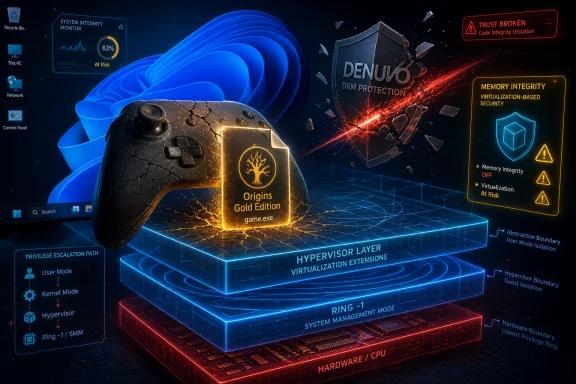
The GameGPU report says the updated pirate release uses modern hypervisor technology to neutralize Denuvo, while also including older 1.51 and 1.21 builds without the new method. That phrasing should stop any security-conscious Windows user cold. A hypervisor is not just another DLL dropped into a game folder; it is a layer that can sit beneath, beside, or in close conversation with the operating system’s own virtualization and isolation machinery.
Windows itself increasingly depends on virtualization-based security. Features such as memory integrity, credential isolation, and kernel protections are built around the idea that some parts of the system must be kept away from ordinary code, even privileged code. When a third-party piracy tool says it needs to play in the hypervisor space, it is effectively asking the user to trust anonymous release engineers with one of the most sensitive positions in the PC stack.
That does not automatically mean every such tool is malware. It does mean the user has almost no practical way to verify that it is not. The entire bargain is backward: the tool exists to defeat a protection system, is distributed outside normal update channels, commonly requires exclusions from security software, and may depend on techniques that look indistinguishable from rootkit behavior to ordinary endpoint defenses.
For gamers, the temptation is obvious. A game that will not launch after an OS upgrade creates resentment, and resentment makes risky workarounds feel justified. But the security model does not care whether the motivation is frustration, nostalgia, or curiosity. Code running at that depth can observe, alter, or destabilize far more than a seven-year-old open-world game.
Denuvo Remains the Villain Users Love to Blame
Denuvo has long been one of the most disliked names in PC gaming, sometimes fairly and sometimes reflexively. Players blame it for performance drops, launch failures, activation headaches, and the general indignity of having purchased software behave like contraband. Developers and publishers, by contrast, see DRM as a launch-window revenue shield in an industry where day-one piracy can shape sales narratives before patches, discounts, and subscriptions enter the picture.
Assassin’s Creed Origins occupies a particularly awkward place in that argument. It is an older Ubisoft release that has already passed through the stages of premium launch, discount staple, and backlog resident. The continued presence and support burden of its protection stack looks different in 2026 than it did around release. When an operating-system upgrade can break a game years later, users naturally ask why the anti-tamper layer is still part of the equation at all.
Yet the piracy response does not vindicate the pirate ecosystem. It exposes the other half of the same dysfunction. DRM can create fragility for paying customers, but cracks create a parallel market where security expectations are inverted. The official game may annoy you, phone home, or fail after an update. The unofficial launcher may ask you to disable protections and install privileged code from strangers.
That is not a moral equivalence; it is a practical warning. Denuvo may be unpopular, but a hypervisor-level bypass is not consumer advocacy. It is a technical escalation that turns dissatisfaction with DRM into an attack surface.
24H2 Exposed How Fragile PC Gaming Compatibility Still Is
Windows compatibility is one of Microsoft’s greatest engineering achievements and one of its biggest reputational traps. Users expect decades of software to run because, for the most part, decades of software often does run. When that contract breaks, even for a small class of games, the failure feels larger than the affected titles.
The Ubisoft 24H2 issue was embarrassing precisely because the affected games were mainstream, recognizable, and still commercially available. This was not an obscure abandoned utility or a no-name driver from the Windows Vista era. It was a set of high-profile games from one of the industry’s largest publishers breaking on the current version of the world’s dominant desktop gaming operating system.
Microsoft handled the situation in the modern Windows way: known-issue documentation, compatibility holds, warnings not to force the upgrade, and eventual resolution as the publisher shipped fixes. That process is better than pretending nothing is wrong, but it also reinforces how messy the Windows gaming substrate has become. Graphics drivers, anti-cheat systems, anti-tamper systems, overlays, launchers, store clients, and OS-level security features all crowd into the same user experience.
Pirated builds sit outside that support loop. They do not get clean release notes. They do not get staged rollout protection. They get repacks, crackfixes, forum posts, and trust-me archives. When the OS changes, the unofficial ecosystem races to catch up without any of the accountability that applies to Microsoft, Ubisoft, Valve, Epic, or GPU vendors.
The Crackfix Economy Thrives on Official Friction
The most uncomfortable part of this story is that piracy tooling often becomes more attractive when legitimate ownership becomes more irritating. If a Steam or Ubisoft Connect copy breaks after Windows Update, while a community-circulated workaround appears to promise a one-click fix, some users will treat the pirate release not as theft but as maintenance. That is especially true for players who already bought the game and now see DRM as the thing standing between them and their library.
Publishers should not dismiss that anger. A paid game that fails because of compatibility between Windows, DRM, and publisher code is still a paid game that fails. If the official fix arrives weeks late, demands a huge validation process, or leaves performance concerns unresolved, users will remember the inconvenience more vividly than the eventual patch.
But the crackfix economy exploits that frustration. It wraps itself in the language of preservation and compatibility while distributing binaries that users cannot audit. A tool that “fixes” a Windows 11 24H2 launch problem may also disable protections, install persistent components, scrape credentials, or simply destabilize the system in ways that surface months later as random crashes and security anomalies.
For sysadmins and IT pros, this is not hypothetical. Gaming PCs are often personal machines, but personal machines increasingly touch work accounts, cloud storage, password managers, VPN clients, and passkeys. A compromised enthusiast rig can become a stepping stone into much more valuable accounts and networks. The old mental separation between “my gaming box” and “my real computer” is less true every year.
Microsoft’s Security Direction Makes These Workarounds More Dangerous, Not Less
Windows is moving toward more isolation, more virtualization, more signed components, and more suspicion of code that wants deep system access. That direction is not always popular with power users, because it can break old tools and make the PC feel less owner-controlled. But it is the direction Microsoft has chosen because the threat model changed.
Credential theft, kernel implants, malicious drivers, firmware persistence, and supply-chain attacks are not edge cases anymore. A Windows machine is not merely a place to run applications; it is a vault for identity. The operating system increasingly treats low-level access as something to be earned, measured, and constrained.
A hypervisor-style Denuvo bypass cuts directly against that trend. It asks the user to privilege a piracy tool over the platform’s security model. It is one thing to run an old trainer, mod, or compatibility wrapper in user space. It is another to accept a tool whose core selling point is that it can operate beneath the game’s assumptions and around the OS changes that broke older cracks.
This is why the warning attached to the GameGPU report is not boilerplate. Running unofficial anti-DRM software that requires deep intervention into the system architecture is risky in a way that ordinary piracy warnings sometimes fail to convey. The danger is not just that the download might include malware. The danger is that the technique itself resembles the kind of privileged foothold malware wants.
Ubisoft Fixed the Game; Pirates Fixed the Crack
There is a clean line here that should not be blurred. Ubisoft’s official update to Assassin’s Creed Origins was a compatibility fix for a commercial game on a supported operating system. The reported pirate update is a compatibility fix for an illicit bypass that stopped functioning after Windows changed.
That difference matters for legal reasons, but also for technical accountability. If Ubisoft ships a bad update, users can complain through Steam, Ubisoft Connect, support channels, and public reviews. If Microsoft mishandles a compatibility hold, enterprise administrators and consumers can point to release-health documentation and deployment policies. The process may be slow, but there is a process.
With a crack, accountability is mostly theatrical. Reputation exists, but it is informal. Release groups and repackers live on trust, mystique, and community validation, none of which substitutes for code signing, source review, responsible disclosure, or a patch rollback mechanism. If the tool breaks Windows Defender, conflicts with Hyper-V, interferes with memory integrity, or leaves a persistent component behind, the user is on their own.
That is why the presence of multiple versions in the reported release is notable. Bundling 1.62 with older 1.51 and 1.21 options suggests a pirate package optimized for compatibility across machines and preferences. To some users, that looks generous. To a security analyst, it looks like a larger decision tree of unknown binaries, each with its own assumptions and risk profile.
The Preservation Argument Has Limits
There is a serious preservation debate around games, DRM, and long-term access. Servers shut down. Launchers change. Activation systems fail. Storefronts delist titles. Scholars, archivists, modders, and players have legitimate concerns about how much of modern game culture depends on infrastructure that may not exist in ten or twenty years.
Assassin’s Creed Origins is not abandonware. It is a commercially available Ubisoft title that just received a compatibility update for Windows 11 24H2. Whatever one thinks about DRM in principle, this is not a case where a vanished publisher left players with no legal route to run the game.
That weakens the preservation defense considerably. The pirate update is not rescuing a lost work from oblivion; it is adapting an illicit distribution to survive a modern Windows update. The difference is important because preservation rhetoric can become a shield for ordinary convenience piracy, and convenience piracy can become a distribution channel for high-risk system tools.
The better lesson for publishers is still uncomfortable. If companies want users to reject unofficial builds, official builds need to remain reliable, available, and reasonably unencumbered. Old games should not become compatibility hostages to anti-tamper systems whose commercial justification expired years earlier.
The Windows Enthusiast’s Instinct Can Be a Liability
Windows power users are trained by experience to fix things. A driver fails, so they roll it back. A game crashes, so they edit an INI file. A device is blocked from an upgrade, so they reach for an ISO, a registry key, or a compatibility flag. That tinkering culture is one of the reasons Windows remains resilient and beloved.
But not every fix is just a fix. The same instinct that makes someone comfortable bypassing an upgrade block can make them too comfortable bypassing a security boundary. In the 24H2 Ubisoft case, Microsoft explicitly used safeguard holds because it knew certain configurations had a bad experience. For legitimate users, circumventing the hold was already risky. For pirate users, layering a hypervisor-level crack on top of the OS transition compounds the risk.
This is where WindowsForum readers should be more skeptical than the average Reddit thread. If a workaround requires disabling memory integrity, adding antivirus exclusions, running unsigned loaders, or allowing virtualization-adjacent components from an unknown source, the burden of proof should be extremely high. “It launched the game” is not proof of safety.
The smarter enthusiast response is patience, isolation, or avoidance. Keep a separate test machine if you insist on experimenting. Use official patches where they exist. Do not run high-privilege mystery code on the same Windows installation that holds your email, banking session, work credentials, and password vault.
The Lesson for IT Is Hiding in a Gaming Story
Enterprise administrators may be tempted to ignore a story about a pirated Assassin’s Creed release. That would be a mistake. The same dynamics appear in less colorful forms across business environments: unsupported tools, cracked plugins, unsigned utilities, driver hacks, and “temporary” compatibility workarounds that become permanent fixtures.
Windows 11 24H2 has already forced organizations to think carefully about application readiness, safeguard holds, driver compatibility, and security baselines. Gaming just makes the issue more visible because failures are public, emotional, and easy to reproduce. A broken line-of-business tool can generate tickets; a broken blockbuster game generates headlines, review bombs, and a cottage industry of fixes.
The hypervisor angle is particularly relevant for managed environments. Modern endpoint security depends on the integrity of the layers below the user session. If users can be convinced to install deep system components for entertainment, they can be convinced to do the same for fake VPN clients, cracked design software, or malicious “performance optimizers.”
The policy answer is not merely “block piracy,” though organizations should absolutely do that. The better answer is to reduce the conditions that make shadow tooling attractive: keep update rings predictable, communicate known issues clearly, provide sanctioned alternatives, and monitor for the kinds of privileged changes that no ordinary application should be making.
The Real Cost of a Free Game Is Control
The updated Assassin’s Creed Origins crack is a small story with a large subtext: the PC is becoming a contested stack. Microsoft wants a more secure Windows. Publishers want stronger revenue protection. Players want old purchases to keep working. Pirates want bypasses that survive OS churn. Security vendors want visibility into all of it.
Those goals do not align neatly. When they collide, the user becomes the integration layer, which is a polite way of saying the user gets the crash, the warning, the forum thread, and the dangerous download link. The more complex the stack becomes, the more valuable official support and trustworthy distribution become.
This is why the “free” copy is not really free. The user pays in uncertainty. They pay by surrendering visibility into what code is running, why it needs that level of access, and what it will do when the next Windows cumulative update lands. They pay by moving trust away from accountable vendors, however flawed, and toward anonymous packages optimized to defeat protections.
None of that excuses DRM failures or slow publisher patches. It does, however, put the risk in the right order. A broken game is irritating. A compromised operating system is a much larger problem.
Origins’ 24H2 Crackfix Says More About Windows Than About Assassin’s Creed
The practical reading of this episode is narrow, but the implications are broad.
- Windows 11 24H2 broke or exposed compatibility problems in several Ubisoft games, and official fixes eventually restored support for affected legitimate copies.
- The reported updated pirated Assassin’s Creed Origins Gold Edition release exists because older Denuvo bypasses failed under newer Windows builds.
- A bypass that uses hypervisor-level techniques should be treated as a serious security risk, not as an ordinary game patch.
- Users who own the game are safer using Ubisoft’s official 1.62 update than installing third-party crackfixes from untrusted sources.
- IT administrators should view this as another example of why unsupported low-level tools and user-installed bypasses are a threat to endpoint integrity.
- Publishers should recognize that leaving old DRM in aging games creates friction that unofficial ecosystems are eager to exploit.
The forward path is not mysterious, even if the industry keeps resisting it. Microsoft needs to keep tightening Windows without surprising the software ecosystem into breakage; publishers need to patch quickly and remove aging DRM when its business case has faded; users need to stop treating privileged piracy tools as harmless convenience fixes. The Assassin’s Creed Origins 24H2 crackfix may look like a niche footnote in the endless war between DRM and piracy, but it is really a warning about where that war is moving: downward into the layers of the PC where mistakes are harder to see, harder to undo, and far more expensive than a game that refuses to launch.