

Assassin’s Creed Black Flag Resynced has gone from industry rumor to officially staged comeback, and Ubisoft has now pulled back the curtain on one of the most anticipated remakes in its catalog. With a July 9, 2026 launch locked for PlayStation 5, Xbox Series X/S, and PC, the real surprise is not that the game exists, but how aggressively it is targeting modern hardware. The newly published PC specification tiers make that clear: this is not a lightweight nostalgia package, but a full-scale current-generation release built to lean on dynamic resolution, upscaling, and ray tracing across every preset. Ubisoft says the game is a faithful recreation of the 2013 original, but the performance targets suggest a far more demanding technical profile than many fans may have expected.
The original Assassin’s Creed IV: Black Flag arrived in 2013 and quickly became one of the most beloved entries in the franchise because it fused classic Assassin’s Creed stealth with open-sea exploration and pirate fantasy. Ubisoft’s new release, now branded Black Flag Resynced, is positioned as a “faithful recreation” in the latest version of the Anvil engine, led by Ubisoft Singapore with returning developers on board. That framing matters, because it signals a remake that is likely aiming to preserve the soul of the original while upgrading the technology and presentation around it.
The remake’s path to announcement was unusually noisy. Ubisoft first confirmed the project in March, then followed up with a reveal showcase scheduled for April 23, 2026, after weeks of leaks and speculation that had already spoiled much of the surprise. Game Informer described it as Ubisoft’s “worst-kept secret,” and that language captures the broader mood around the project: fans were not waiting to learn whether the game existed, but what form it would take once Ubisoft finally spoke publicly.
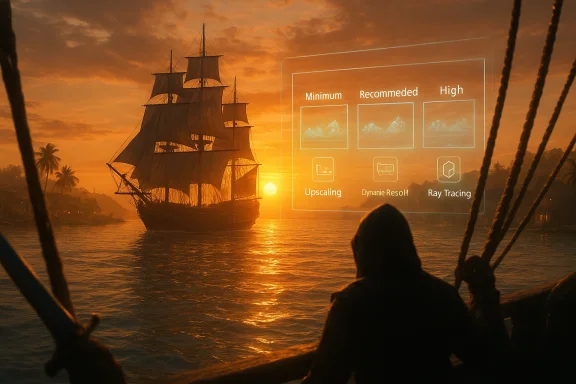
What makes the PC specs especially interesting is their structure. Ubisoft is not offering a simple low/medium/high split, but four named presets: Minimum, Recommended, High, and Extreme. Each tier pairs a visual target with a rendering target, and every preset assumes upscaling. That means the studio is effectively telling players that the game’s fidelity goals are tied to reconstruction technologies, not brute-force native rendering at every setting.
There is also a subtle but important shift in how Ubisoft is messaging the game. The company is emphasizing not just visuals, but “many improvements and new content,” along with a “parry-driven combat system” and a “total visual overhaul.” That places Resynced between a remaster and a remake in spirit, even if the marketing language leans toward reconstruction. In practical terms, that often means fans should expect meaningful modernizations in animation, lighting, and combat feel, not just sharper textures on the old framework.
That also means the conversation around Black Flag Resynced is no longer just about nostalgia. It is about whether a beloved pirate adventure can be rebuilt to match current expectations for image quality, lighting, and smoothness without losing the sense of freedom that made the original so memorable. For PC players, that balance will matter more than the headline release date.
The Recommended preset raises the bar to 1080p60, medium visuals, and the same standard ray tracing path. Here, Ubisoft moves up to the RTX 3060, RX 6600 XT, and Arc B580, with the CPU stepping up to chips like the Core i5-10600K. For many players, this will likely be the practical sweet spot: a compromise that prioritizes smoothness without forcing the game into the hardest-to-drive settings.
The High preset is where the PC story gets more serious. Ubisoft targets 1440p60 with high visuals and quality upscaling, requiring a Core i5-11600K or Ryzen 5 5600X, plus GPUs such as the RTX 3080 or RX 6800 XT. That is a significant jump, but it is also a realistic reflection of what modern open-world remakes often demand once dense lighting, improved draw distance, and more advanced scene complexity enter the picture.
Just as notable is the fact that 16GB of RAM is required at every tier, along with an SSD and Windows 10 or 11. In 2026, that no longer feels unusual, but it does reinforce that the game expects fast asset streaming and a modern system baseline. The storage footprint is a comparatively restrained 65GB, which is moderate for a AAA remake and suggests Ubisoft may be optimizing around a tighter asset set than some sprawling open-world peers.
That design choice has consequences for performance and perception. Players with capable hardware may get a much more cinematic Caribbean, with richer water reflections, more convincing sunlight, and deeper interior lighting. But players hovering near the minimum spec may also see a more aggressive reliance on reconstruction to preserve frame rate, which can sometimes introduce softness or artifacting if the implementation is not carefully tuned.
There is a broader industry trend here as well. More AAA games are being built around upscaling first, with native rendering increasingly reserved for the highest-end rigs or quality-focused enthusiasts. Black Flag Resynced appears to fit that pattern almost perfectly, which may frustrate purists but should not surprise anyone following modern rendering design.
That matters because Black Flag’s identity was never purely about one mechanic. The game’s appeal came from a blend of pirate fantasy, naval warfare, exploration, stealth, and the personality of Edward Kenway. If Ubisoft modernizes the combat and presentation without flattening that blend into a more generic action template, the remake could land with both veterans and newcomers.
That is the central tension for Ubisoft. It needs to preserve the pirate fantasy and the exploratory rhythm while making the game feel contemporary enough to justify a full remake. Faithful is a helpful word in marketing, but in practice the best remakes are always selective about what they preserve and what they rebuild.
That legacy helps explain why Ubisoft is treating the project as more than a simple nostalgia play. The original game arrived 13 years before this remake, which means there is now a generational gap between the hardware era it was built for and the systems it is being rebuilt on. A remake of this scale is not just about bringing old content forward; it is about repositioning a classic for a new audience that may know the title more through reputation than firsthand memory.
It also creates a useful contrast with the rest of the franchise. Modern Assassin’s Creed games have leaned heavily into RPG systems and expansive progression structures, while Black Flag’s original design sat closer to the older action-adventure model. If Resynced retains that identity, it may appeal to fans who want a cleaner, more focused Assassin’s Creed experience.
That distinction matters because the most demanding preset is effectively a showcase mode, not a universal expectation. Many PC players will never aim for the Extreme target, just as many console players will be satisfied with the default balance struck by the platform version. Still, the existence of that top tier tells the market that Ubisoft is aiming for technical prestige as well as broad accessibility.
That said, the specs also hint that PC players with midrange systems may need to manage expectations. The fact that 1080p30 is the minimum target, even with upscaling, tells us this is not a game designed to run comfortably on older gaming laptops or aging desktop GPUs. The remake is asking users to meet it halfway, and that is increasingly common for large-scale remakes built on modern rendering stacks.
There is also a catalog-management advantage here. A remake like this can refresh the franchise’s visibility without requiring a brand-new historical setting or a risky mechanical reinvention. That reduces creative risk, even if it does not eliminate technical and reputational risk. Ubisoft is essentially betting that nostalgia, modern presentation, and current-generation hardware will align.
But that also raises expectations. Once a remake promises new content and a visual overhaul, it has to justify its existence against the original rather than merely echo it. For longtime fans, the comparison will not be flattering unless the new version can enhance the experience without muting its spirit.
The second opportunity is technical credibility. If the game runs well and looks spectacular on a range of systems, it could become a benchmark for how to rebuild a legacy title without stripping away its personality. That would be especially valuable for PC players who want the best possible version of a known classic.
The PC specs themselves create another form of scrutiny. Players who see a 4090-class top tier will expect near-flawless presentation at the highest settings. If the experience is uneven, the headline hardware ambitions could become a liability rather than a selling point.
The other key question is how Ubisoft balances authenticity with modernization. The original Black Flag succeeded because it felt broad, breezy, and adventurous, even when its systems were imperfect. If the remake finds a way to preserve that sense of open-water freedom while tightening the mechanics and presentation, it could become a standout release in the current remake boom.
Source: Game Informer Here Are The Assassin's Creed Black Flag Resynced PC Specs And Requirements
 Overview
The original Assassin’s Creed IV: Black Flag arrived in 2013 and quickly became one of the most beloved entries in the franchise because it fused classic Assassin’s Creed stealth with open-sea exploration and pirate fantasy. Ubisoft’s new release, now branded Black Flag Resynced, is positioned as a “faithful recreation” in the latest version of the Anvil engine, led by Ubisoft Singapore with returning developers on board. That framing matters, because it signals a remake that is likely aiming to preserve the soul of the original while upgrading the technology and presentation around it.The remake’s path to announcement was unusually noisy. Ubisoft first confirmed the project in March, then followed up with a reveal showcase scheduled for April 23, 2026, after weeks of leaks and speculation that had already spoiled much of the surprise. Game Informer described it as Ubisoft’s “worst-kept secret,” and that language captures the broader mood around the project: fans were not waiting to learn whether the game existed, but what form it would take once Ubisoft finally spoke publicly.
What makes the PC specs especially interesting is their structure. Ubisoft is not offering a simple low/medium/high split, but four named presets: Minimum, Recommended, High, and Extreme. Each tier pairs a visual target with a rendering target, and every preset assumes upscaling. That means the studio is effectively telling players that the game’s fidelity goals are tied to reconstruction technologies, not brute-force native rendering at every setting.
There is also a subtle but important shift in how Ubisoft is messaging the game. The company is emphasizing not just visuals, but “many improvements and new content,” along with a “parry-driven combat system” and a “total visual overhaul.” That places Resynced between a remaster and a remake in spirit, even if the marketing language leans toward reconstruction. In practical terms, that often means fans should expect meaningful modernizations in animation, lighting, and combat feel, not just sharper textures on the old framework.
Why the specs matter now
The PC requirements are more than a checklist. They are an early indicator of how Ubisoft wants the remake to scale across audiences and hardware generations. A game that asks for RTX 4090-class performance at 4K60 in its top preset is making a statement about what “ultra” means in 2026.That also means the conversation around Black Flag Resynced is no longer just about nostalgia. It is about whether a beloved pirate adventure can be rebuilt to match current expectations for image quality, lighting, and smoothness without losing the sense of freedom that made the original so memorable. For PC players, that balance will matter more than the headline release date.
The PC Specs, Decoded
At the low end, the Minimum preset targets 1080p at 30 FPS with low visuals, standard ray tracing, and balanced upscaling. Ubisoft lists CPU options like the Intel Core i7-8700K and AMD Ryzen 5 3600, along with GPUs such as the GeForce GTX 1660, Radeon RX 5500 XT, and Intel Arc A580 with ReBAR enabled. The fact that ray tracing is present even at this floor suggests the lighting pipeline is built around that feature, rather than treating it as a premium bonus.The Recommended preset raises the bar to 1080p60, medium visuals, and the same standard ray tracing path. Here, Ubisoft moves up to the RTX 3060, RX 6600 XT, and Arc B580, with the CPU stepping up to chips like the Core i5-10600K. For many players, this will likely be the practical sweet spot: a compromise that prioritizes smoothness without forcing the game into the hardest-to-drive settings.
The High preset is where the PC story gets more serious. Ubisoft targets 1440p60 with high visuals and quality upscaling, requiring a Core i5-11600K or Ryzen 5 5600X, plus GPUs such as the RTX 3080 or RX 6800 XT. That is a significant jump, but it is also a realistic reflection of what modern open-world remakes often demand once dense lighting, improved draw distance, and more advanced scene complexity enter the picture.
Hardware tiers and what they imply
The Extreme preset is the clearest signal of the remake’s ambition. Ubisoft is aiming for 4K60 with ultra visuals and extended ray tracing, and the listed GPUs are the RTX 4090 and RX 7900 XTX. That is elite-end hardware, which means the best version of the game is being built for enthusiasts who have invested heavily in their rigs.Just as notable is the fact that 16GB of RAM is required at every tier, along with an SSD and Windows 10 or 11. In 2026, that no longer feels unusual, but it does reinforce that the game expects fast asset streaming and a modern system baseline. The storage footprint is a comparatively restrained 65GB, which is moderate for a AAA remake and suggests Ubisoft may be optimizing around a tighter asset set than some sprawling open-world peers.
Ray Tracing Becomes the Baseline
One of the most revealing choices in the spec sheet is Ubisoft’s decision to make standard ray tracing part of the Minimum and Recommended presets, then escalate to extended ray tracing at the Extreme level. That implies the remake’s lighting model is not merely decorated with RT effects; it is fundamentally dependent on them for its intended look. In other words, ray tracing is part of the art direction, not an afterthought.That design choice has consequences for performance and perception. Players with capable hardware may get a much more cinematic Caribbean, with richer water reflections, more convincing sunlight, and deeper interior lighting. But players hovering near the minimum spec may also see a more aggressive reliance on reconstruction to preserve frame rate, which can sometimes introduce softness or artifacting if the implementation is not carefully tuned.
Upscaling is doing a lot of work
Ubisoft’s use of Balanced and Quality presets for the upscaler is just as important as the raw hardware list. It suggests the studio expects the game to lean on modern temporal reconstruction methods to hold frame targets while maintaining image fidelity. That is a sensible move for a detailed open-world remake, but it also means the quality of the final experience will depend heavily on how cleanly those algorithms integrate with motion, foliage, ship combat, and camera movement.There is a broader industry trend here as well. More AAA games are being built around upscaling first, with native rendering increasingly reserved for the highest-end rigs or quality-focused enthusiasts. Black Flag Resynced appears to fit that pattern almost perfectly, which may frustrate purists but should not surprise anyone following modern rendering design.
What Ubisoft Is Promising Beyond Graphics
Ubisoft’s announcement language does more than confirm a remake. It also points to a project that will include new content, a refreshed combat approach, and a more modern visual treatment of the Caribbean. The company’s description of the game as a “faithful recreation” is carefully chosen, because it promises continuity with the original while leaving room for contemporary redesign.That matters because Black Flag’s identity was never purely about one mechanic. The game’s appeal came from a blend of pirate fantasy, naval warfare, exploration, stealth, and the personality of Edward Kenway. If Ubisoft modernizes the combat and presentation without flattening that blend into a more generic action template, the remake could land with both veterans and newcomers.
The risk of over-correction
The challenge is that remakes can easily over-correct. A game like Black Flag succeeds partly because it feels loose, adventurous, and slightly unruly, and too much systemization can sand down that charm. If the new parry-driven combat system becomes too rigid, or if mission flow is retooled to fit a more modern structure without preserving pacing, the remake could lose the magic that made the original so replayable.That is the central tension for Ubisoft. It needs to preserve the pirate fantasy and the exploratory rhythm while making the game feel contemporary enough to justify a full remake. Faithful is a helpful word in marketing, but in practice the best remakes are always selective about what they preserve and what they rebuild.
Why Black Flag Still Matters
Part of the reason this remake is drawing so much attention is that the original game has only become more symbolic over time. Black Flag is widely remembered as the entry where Assassin’s Creed leaned hardest into freedom, travel, and atmosphere. Its mix of Caribbean routes, naval combat, and personality-driven storytelling gave it a distinct identity even within a franchise known for reinvention.That legacy helps explain why Ubisoft is treating the project as more than a simple nostalgia play. The original game arrived 13 years before this remake, which means there is now a generational gap between the hardware era it was built for and the systems it is being rebuilt on. A remake of this scale is not just about bringing old content forward; it is about repositioning a classic for a new audience that may know the title more through reputation than firsthand memory.
The franchise angle
For the broader Assassin’s Creed series, Resynced also serves a strategic purpose. Ubisoft can keep the brand active between newer entries while revisiting one of its strongest single-player success stories. That allows the publisher to deepen catalog value without waiting on an entirely new creative direction to carry the brand alone.It also creates a useful contrast with the rest of the franchise. Modern Assassin’s Creed games have leaned heavily into RPG systems and expansive progression structures, while Black Flag’s original design sat closer to the older action-adventure model. If Resynced retains that identity, it may appeal to fans who want a cleaner, more focused Assassin’s Creed experience.
Console Versus PC: Different Audiences, Different Expectations
Ubisoft is launching the remake on PlayStation 5, Xbox Series X/S, and PC on the same day, but the PC audience will read these specs differently from console players. On console, performance modes and visual tradeoffs are largely predetermined. On PC, those same tradeoffs become part of the hobby, with players comparing settings, frame pacing, and image reconstruction in much more granular ways.That distinction matters because the most demanding preset is effectively a showcase mode, not a universal expectation. Many PC players will never aim for the Extreme target, just as many console players will be satisfied with the default balance struck by the platform version. Still, the existence of that top tier tells the market that Ubisoft is aiming for technical prestige as well as broad accessibility.
Practical implications for buyers
For buyers choosing between console and PC, the question may come down to how much they value control versus convenience. PC offers the chance to tune settings, chase higher frame rates, and push visual fidelity if the hardware is there. Consoles, by contrast, will offer a more fixed—but often more predictable—delivery.That said, the specs also hint that PC players with midrange systems may need to manage expectations. The fact that 1080p30 is the minimum target, even with upscaling, tells us this is not a game designed to run comfortably on older gaming laptops or aging desktop GPUs. The remake is asking users to meet it halfway, and that is increasingly common for large-scale remakes built on modern rendering stacks.
The Business Logic Behind the Remake
From a publisher perspective, Black Flag Resynced is easy to understand. The brand is strong, the original is well-liked, and a remake can reach both lapsed fans and newer players who missed the 2013 release. Because the project is being framed as a faithful recreation with enhancements, Ubisoft can market familiarity while still charging full premium-game pricing for a modern release.There is also a catalog-management advantage here. A remake like this can refresh the franchise’s visibility without requiring a brand-new historical setting or a risky mechanical reinvention. That reduces creative risk, even if it does not eliminate technical and reputational risk. Ubisoft is essentially betting that nostalgia, modern presentation, and current-generation hardware will align.
Market positioning
Compared with many remakes that simply upscale textures and call it a day, Black Flag Resynced appears to be aiming for a more substantive rebuild. That could help it stand out in a crowded remake market where players are increasingly skeptical of minimal-effort revivals. The inclusion of new content and revised combat gives Ubisoft room to argue that this is a genuine modernization rather than a cosmetic touch-up.But that also raises expectations. Once a remake promises new content and a visual overhaul, it has to justify its existence against the original rather than merely echo it. For longtime fans, the comparison will not be flattering unless the new version can enhance the experience without muting its spirit.
Strengths and Opportunities
Black Flag Resynced has several clear advantages going into launch, and most of them come from the strength of the original game combined with the scale of the technical rebuild. The remake sits on a powerful foundation, but it also has room to modernize in ways that can broaden the audience. If Ubisoft executes well, this could become one of the more credible examples of a remake that preserves identity while upgrading the experience.- Strong brand recognition from one of the franchise’s most beloved entries.
- Modern Anvil engine upgrades that can deliver a dramatic leap in lighting and scene quality.
- Broad hardware support across a spread of PC presets, not just a single target audience.
- Clear performance tiers that help players understand what their rigs can achieve.
- Ray tracing baked into the experience, giving the remake a contemporary visual signature.
- Potential new content that can make the remake feel additive rather than redundant.
- A proven pirate fantasy that still has obvious market appeal in 2026.
Why this could work
The strongest opportunity is emotional. Fans already care about Black Flag, so Ubisoft does not need to invent a new premise from scratch. It only needs to re-present a cherished one in a form that feels more vivid, more responsive, and more technically polished. That is a much easier marketing proposition than launching an entirely new historical adventure.The second opportunity is technical credibility. If the game runs well and looks spectacular on a range of systems, it could become a benchmark for how to rebuild a legacy title without stripping away its personality. That would be especially valuable for PC players who want the best possible version of a known classic.
Risks and Concerns
The biggest danger is that the remake could become too dependent on technology and not enough on feel. A high-end lighting model and impressive GPU demands do not automatically produce a better game if the sailing, combat, and pacing no longer feel as intuitive as they did in the original. Remakes often fail when they confuse visual density with design improvement.- High hardware demands may put off players with older systems.
- Upscaling dependence could affect image clarity or introduce artifacts.
- Ray tracing baseline may limit accessibility for weaker GPUs.
- Combat changes could disrupt the identity of the original game.
- Remake fatigue may make players less forgiving of aggressive pricing.
- Expectation inflation is inevitable after years of leaks and speculation.
- Nostalgia backlash can hit hard if the final product feels overdesigned.
The most important concern
There is also a reputational risk tied to the leak-heavy rollout. Because fans have been hearing about this game for so long, Ubisoft has very little room for a merely decent outcome. The final product will be judged not just against the 2013 game, but against years of hopes, rumors, and self-generated hype. That is a difficult position for any publisher, especially when the project is being positioned as both faithful and upgraded.The PC specs themselves create another form of scrutiny. Players who see a 4090-class top tier will expect near-flawless presentation at the highest settings. If the experience is uneven, the headline hardware ambitions could become a liability rather than a selling point.
Looking Ahead
The most important thing to watch next is not just the launch date, but the quality of the gameplay reveal and the final technical messaging around PC. Ubisoft has already established the broad framework: a July 9 release, a full remake posture, and a demanding hardware profile. What comes next will determine whether Black Flag Resynced is remembered as a bold modernization or merely a well-marketed revisit.The other key question is how Ubisoft balances authenticity with modernization. The original Black Flag succeeded because it felt broad, breezy, and adventurous, even when its systems were imperfect. If the remake finds a way to preserve that sense of open-water freedom while tightening the mechanics and presentation, it could become a standout release in the current remake boom.
Things to watch
- Final confirmation of custom graphics options and how granular they are.
- Real-world performance on midrange GPUs like the RTX 3060 and RX 6600 XT.
- How aggressively ray tracing affects battery life and thermals on PCs.
- Whether Ubisoft clarifies any new content beyond visual and combat changes.
- Community reaction to the remake’s balance between fidelity and redesign.
Source: Game Informer Here Are The Assassin's Creed Black Flag Resynced PC Specs And Requirements
