

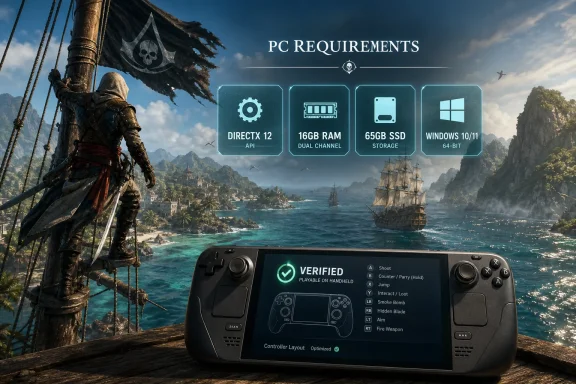
Assassin’s Creed: Black Flag Resynced launches for PC, PlayStation 5, and Xbox Series X|S on July 9, 2026, with Ubisoft listing Windows 10 or 11, 16GB of RAM, DirectX 12, 65GB of SSD storage, and Steam Deck Verified status for Valve’s handheld. The short version is that this is not a museum-piece remaster asking 2013-era hardware to come back on deck. As Radio Times summarized in its requirements roundup, and as Ubisoft’s Steam listing and subsequent coverage from PC Gamer, GameSpot, and GamingOnLinux underline, Resynced is being positioned like a modern PC release with modern expectations. That makes the system requirements less a formality than a statement of intent: Ubisoft wants Black Flag nostalgia, but it wants it running through today’s graphics pipeline.
The original Assassin’s Creed IV: Black Flag arrived in 2013, when a high-end gaming PC meant something very different. Resynced may wear the same tricorn hat, but its published requirements tell us Ubisoft is not merely bolting higher-resolution textures onto an old executable. The game asks for a 64-bit version of Windows 10 or Windows 11, DirectX 12, 16GB of RAM, and an SSD even at the minimum tier.
That SSD requirement is the tell. For years, publishers treated solid-state storage as a recommendation, a nice-to-have for shaving down load screens. Now it is increasingly part of the baseline, because streaming assets into a world without stutter has become central to how modern open-world games are built.
The GPU floor is also revealing. Ubisoft lists the GeForce GTX 1660 with 6GB of VRAM, Radeon RX 5500 XT with 8GB, or Intel Arc A580 with 8GB for minimum play. Those are not exotic cards in 2026, but they are a long way from the hardware that ran Black Flag comfortably in its first life.
The recommended tier jumps to a GeForce RTX 3060 12GB, Radeon RX 6600 XT 8GB, or Intel Arc B580 12GB. That suggests Ubisoft expects Resynced to behave more like a current-generation remake than a lightweight nostalgia release. It also means the PC version is likely to sort users into two groups: those who can brute-force the Caribbean, and those who will be learning exactly what the graphics preset menu does.
The Intel Core i7-8700K and Ryzen 5 3600 are interesting choices. The 8700K is an older six-core, twelve-thread chip that once sat near the top of Intel’s consumer stack. The Ryzen 5 3600, by contrast, became the poster child for affordable, competent PC gaming in the early 2020s. By naming both, Ubisoft is effectively saying that six cores and decent thread handling are now table stakes.
That matters for WindowsForum readers because CPU age is often harder to judge than GPU age. A PC with a newer budget graphics card and an old quad-core processor may look fine on paper until a dense city, naval battle, or shader-heavy scene starts chewing through background work. Resynced’s requirements imply that the CPU cannot be treated as an afterthought.
The RAM requirement is equally blunt. There is no 8GB tier. The game starts at 16GB, which has become the practical floor for serious Windows gaming in the current era. Anyone still running 8GB on a Windows 10 or Windows 11 desktop may be able to launch plenty of older games, but Resynced is another reminder that modern AAA development has moved on.
For now, the practical answer is simple: if your Windows 10 machine meets the CPU, GPU, RAM, and SSD requirements, Resynced should be in scope. The OS alone is not the gating factor. The larger question is whether the rest of the platform has kept up.
Windows 11 users are likely to have the smoother runway, not because Ubisoft has said Windows 10 is second-class, but because the PC ecosystem is moving that way. GPU driver attention, handheld gaming features, DirectStorage-adjacent expectations, and anti-cheat compatibility all tend to orbit the newest supported Windows platform first. For a game launching in July 2026, that gravitational pull matters.
The DirectX 12 requirement also fits the pattern. This is not a DirectX 11-era PC release dressed up for Steam. Ubisoft is aiming at a rendering stack that assumes modern APIs, modern drivers, and modern shader compilation behavior. That is usually good for scalability, but it also means old Windows installs with neglected drivers are asking for trouble.
But Steam Deck Verified does not mean “ultra settings at 60 frames per second.” It means Valve’s compatibility checks indicate the game can run on the device with controller support, readable text, suitable default configuration, and no major launcher or compatibility failures. For a Ubisoft game, that last part matters almost as much as frame rate.
Ubisoft’s PC releases have long carried the extra complication of Ubisoft Connect, even when purchased through Steam. The Steam listing for Resynced notes that a Ubisoft account is required and supports linking to Steam. On a desktop, that is annoying but familiar; on Steam Deck, it can be the difference between a console-like experience and a login-screen wrestling match.
The Verified status suggests Ubisoft and Valve have at least done the work to make that chain behave. That is a meaningful improvement over the bad old days of publisher launchers breaking the handheld illusion. Still, buyers should understand what is being certified: compatibility, not miracles.
That is a shift worth paying attention to. The Steam Deck’s hardware is modest by desktop standards, with an AMD APU and shared memory architecture that require careful compromises. A game that happens to run on it and a game that ships with sensible handheld defaults are not the same thing.
For players, the likely experience is a familiar one: lower settings, upscaling, a capped frame rate, and an emphasis on frame pacing over raw maximum FPS. Radio Times speculated that something around 40 FPS may be realistic, though Ubisoft has not publicly guaranteed a precise Deck performance target. That is the right kind of caution.
A well-tuned 30 or 40 FPS on the Deck can feel excellent in an adventure game, especially one built around traversal, naval exploration, stealth, and melee combat rather than twitch shooting. The danger is not that the Deck cannot run Resynced; the danger is that players interpret “Verified” as a desktop-class promise. It is not.
The recommended Nvidia card being an RTX 3060 is not accidental. It brings dedicated ray-tracing hardware and DLSS support, giving Ubisoft a safer path to attractive visuals without relying only on raw rasterization. AMD’s RX 6600 XT and Intel’s Arc B580 point to the same broader truth: the recommended tier assumes relatively modern GPU features, not merely enough shader horsepower to draw the old Caribbean at higher resolution.
This is where the PC version may become more interesting than the console versions. On Windows, users can usually decide whether ray tracing is worth the cost. A player with an older but still capable GPU may get a better experience by turning down reflections, shadows, or global illumination features rather than chasing a prestige checkbox.
The Steam Deck complicates that conversation. Ubisoft’s quoted line about ray tracing across platforms should not be read as a guarantee that ray tracing will be practical on the Deck. If anything, handheld presets are likely to be built around aggressive compromises. The Deck can still deliver the fantasy of Black Flag; it just may not deliver the prettiest version of the water.
That has changed. Intel’s discrete GPUs have had a messy road, especially with older DirectX 9 and DirectX 11 games, but modern DirectX 12 titles are exactly where Arc hardware has had the best chance to look credible. By naming Intel parts directly, Ubisoft is acknowledging a third GPU vendor in the mainstream PC gaming market.
For Windows users, this is encouraging but also a reminder to stay current. Arc performance has historically depended heavily on driver maturity. Anyone planning to run Resynced on Intel graphics should treat day-one drivers as mandatory, not optional.
It also hints at why DirectX 12 matters. A modern API gives developers more control and gives newer GPU architectures a cleaner target. That does not guarantee flawless launch-day performance, but it does make Intel’s inclusion more plausible than it would have been for an older rendering path.
Either way, the recommended tier is not outrageous. An RTX 3060 12GB or RX 6600 XT is not cutting-edge hardware in 2026. Plenty of midrange gaming desktops already meet or exceed that mark, and many users who upgraded during the last GPU cycle should be fine.
The VRAM numbers deserve attention, though. Ubisoft’s recommended Nvidia card specifically has 12GB, while the AMD option has 8GB and Intel’s recommended Arc B580 has 12GB. That does not automatically mean 8GB cards are doomed, but it does suggest texture quality, ray-traced effects, and resolution targets may create uncomfortable tradeoffs on lower-memory GPUs.
The minimum cards also start at 6GB to 8GB of VRAM. The days of 4GB cards hanging on in big-budget releases are largely over. If your Windows PC still has a GTX 1650, RX 570, or similar low-memory stalwart, Resynced may be where nostalgia meets the upgrade wall.
That requirement changes upgrade math. A user with a decent CPU and GPU but an older hard-drive-heavy setup may find that the cheapest path to Resynced is not a new graphics card but a 1TB SATA or NVMe SSD. For many WindowsForum readers, that is a painless fix; for older prebuilt desktops and laptops, it may require checking available slots, BIOS behavior, and thermal constraints.
The reason is obvious enough. Open-world games increasingly stream assets constantly. A pirate game built around sailing between islands, entering settlements, diving into wrecks, and transitioning through dense environments cannot afford to wait on a mechanical drive.
This is not only about load times. HDD installs can create stutter, delayed texture loads, and traversal hiccups that feel like GPU problems but are really storage problems. Ubisoft making SSD mandatory is blunt, but it may spare users from a worse experience.
The first launch experience will matter. If account linking, cloud saves, offline mode, and Ubisoft Connect authentication behave cleanly, Deck owners may barely notice the extra layer. If any of those pieces wobble, the Verified badge will be cold comfort to someone staring at a tiny login prompt.
This is the larger challenge for PC handhelds. The hardware is no longer the only obstacle. Windows handhelds, SteamOS devices, and hybrid living-room PCs increasingly live or die by software friction. A game can be technically compatible and still feel clumsy if launchers, overlays, and account systems intrude.
Valve’s verification system has pushed publishers in the right direction. Ubisoft seeking and advertising Deck readiness before launch suggests it understands the audience has changed. The PC is no longer just a tower under a desk; it is also a seven-inch screen with suspend-resume expectations.
This matters because not every AAA game benefits equally from handheld compatibility. Some demand long uninterrupted sessions or rely on visual density that collapses on a small screen. Black Flag’s appeal has always been broader and more rhythmic: the horizon, the sea shanties, the next target.
If Resynced preserves that cadence while modernizing the visuals and controls, the Steam Deck could be more than a compromise platform. It could be one of the best ways to play, provided expectations are calibrated around battery life and frame rate.
The Windows angle is also interesting. Steam Deck success often pressures Windows handheld makers to improve their own software stacks. If Resynced runs well on SteamOS with Verified status, buyers of Windows-based handhelds from Asus, Lenovo, MSI, and others will expect at least comparable results. That raises the bar for both Ubisoft and Microsoft’s partners.
That means current GPU drivers, enough RAM headroom, a real SSD, a 64-bit Windows install, and a CPU that is not coasting on ancient glory. It also means being ready for shader compilation, upscalers, frame caps, and settings profiles. Modern PC gaming is less about one magic component and more about platform hygiene.
There is a lesson here for anyone who treats remakes as inherently lightweight. The industry’s remake economy is not built around making old games run on old computers. It is built around selling familiar worlds with new lighting, new assets, new animation, new accessibility options, and new platform targets.
That is not necessarily cynical. A rebuilt Black Flag that runs well on modern PCs and handhelds could be a better long-term product than a barebones remaster. But players should not confuse emotional familiarity with technical modesty.
On PC, that cost becomes negotiable. A desktop with a stronger GPU can push higher settings. A midrange box can aim for balance. A Steam Deck can prioritize portability. That flexibility is the PC’s strength, but it also shifts responsibility to the user.
The upside is that Resynced’s requirements appear sane rather than punitive. Ubisoft is not asking for an RTX 4080 to get a decent experience. The recommended tier sits in the broad middle of the installed gaming market, and the minimum tier is reachable for many users who upgraded within the past several years.
The downside is that “reachable” is not the same as “already met.” The gulf between Black Flag’s original audience and Resynced’s target hardware will be wide for anyone who has not kept their PC refreshed. This is a remake, but it is not a free pass for neglected rigs.
That ambiguity matters. A GTX 1660 minimum could mean 1080p at low settings and 30 FPS with upscaling. An RTX 3060 recommendation could mean 1080p high, 1440p medium, or some ray-traced preset with reconstruction. Without precise targets, users must treat the spec sheet as guidance rather than a contract.
The Steam Deck situation is similar. Verified tells us the game passes Valve’s compatibility checks, but not what frame rate Ubisoft considers acceptable. It does not tell us battery drain, whether ray tracing is disabled by default, or how aggressive the handheld preset becomes in busy scenes.
Those answers will come from launch-day testing. Digital Foundry-style analysis, community benchmarks, ProtonDB reports, and Steam user reviews will quickly reveal whether Ubisoft’s optimism holds. Until then, the safest assumption is that Resynced will run on the Deck, but desktop-quality expectations belong on a desktop.
That usually means storage or RAM before a full rebuild. Moving from an HDD to an SSD can transform modern game behavior. Moving from 8GB to 16GB can reduce paging and background contention under Windows. These upgrades are less glamorous than a GPU purchase, but they align directly with Ubisoft’s baseline.
GPU upgrades are more nuanced. If you are below the GTX 1660 or RX 5500 XT class, the writing is on the wall. If you are near the recommended tier, your experience will likely depend on resolution, ray tracing, and tolerance for upscaling. If you are on a 4GB card, the better question is not whether Resynced will launch, but whether you will enjoy the compromises.
CPU upgrades should be judged by platform. A Ryzen 5 3600 still being named in the recommended tier is good news for AM4 users, while older Intel quad-core systems are more suspect. In modern open-world games, frame-time consistency often exposes CPUs that average FPS charts flatter.
 Ubisoft Is Selling a Memory of 2013 With a 2026 Hardware Bill
The original Assassin’s Creed IV: Black Flag arrived in 2013, when a high-end gaming PC meant something very different. Resynced may wear the same tricorn hat, but its published requirements tell us Ubisoft is not merely bolting higher-resolution textures onto an old executable. The game asks for a 64-bit version of Windows 10 or Windows 11, DirectX 12, 16GB of RAM, and an SSD even at the minimum tier.That SSD requirement is the tell. For years, publishers treated solid-state storage as a recommendation, a nice-to-have for shaving down load screens. Now it is increasingly part of the baseline, because streaming assets into a world without stutter has become central to how modern open-world games are built.
The GPU floor is also revealing. Ubisoft lists the GeForce GTX 1660 with 6GB of VRAM, Radeon RX 5500 XT with 8GB, or Intel Arc A580 with 8GB for minimum play. Those are not exotic cards in 2026, but they are a long way from the hardware that ran Black Flag comfortably in its first life.
The recommended tier jumps to a GeForce RTX 3060 12GB, Radeon RX 6600 XT 8GB, or Intel Arc B580 12GB. That suggests Ubisoft expects Resynced to behave more like a current-generation remake than a lightweight nostalgia release. It also means the PC version is likely to sort users into two groups: those who can brute-force the Caribbean, and those who will be learning exactly what the graphics preset menu does.
The Minimum Spec Is Really the New Mainstream Spec
Minimum requirements used to be a kind of warning label: yes, the game would launch, but the experience might be grim. Resynced’s minimum spec is different. It looks less like an emergency ladder and more like Ubisoft defining the bottom edge of a modern mainstream gaming PC.The Intel Core i7-8700K and Ryzen 5 3600 are interesting choices. The 8700K is an older six-core, twelve-thread chip that once sat near the top of Intel’s consumer stack. The Ryzen 5 3600, by contrast, became the poster child for affordable, competent PC gaming in the early 2020s. By naming both, Ubisoft is effectively saying that six cores and decent thread handling are now table stakes.
That matters for WindowsForum readers because CPU age is often harder to judge than GPU age. A PC with a newer budget graphics card and an old quad-core processor may look fine on paper until a dense city, naval battle, or shader-heavy scene starts chewing through background work. Resynced’s requirements imply that the CPU cannot be treated as an afterthought.
The RAM requirement is equally blunt. There is no 8GB tier. The game starts at 16GB, which has become the practical floor for serious Windows gaming in the current era. Anyone still running 8GB on a Windows 10 or Windows 11 desktop may be able to launch plenty of older games, but Resynced is another reminder that modern AAA development has moved on.
Windows 10 Survives the Voyage, but Windows 11 Is the Safer Harbor
Ubisoft’s listing of Windows 10 64-bit and Windows 11 is good news for holdouts, especially given how many gaming PCs remain on Windows 10 for driver, workflow, or simple inertia reasons. But the presence of Windows 10 should not be mistaken for a long-term comfort blanket. Microsoft’s consumer support lifecycle has already made Windows 10 a shrinking target, and game developers increasingly optimize around newer driver models, scheduler behavior, and platform assumptions.For now, the practical answer is simple: if your Windows 10 machine meets the CPU, GPU, RAM, and SSD requirements, Resynced should be in scope. The OS alone is not the gating factor. The larger question is whether the rest of the platform has kept up.
Windows 11 users are likely to have the smoother runway, not because Ubisoft has said Windows 10 is second-class, but because the PC ecosystem is moving that way. GPU driver attention, handheld gaming features, DirectStorage-adjacent expectations, and anti-cheat compatibility all tend to orbit the newest supported Windows platform first. For a game launching in July 2026, that gravitational pull matters.
The DirectX 12 requirement also fits the pattern. This is not a DirectX 11-era PC release dressed up for Steam. Ubisoft is aiming at a rendering stack that assumes modern APIs, modern drivers, and modern shader compilation behavior. That is usually good for scalability, but it also means old Windows installs with neglected drivers are asking for trouble.
The Steam Deck Badge Is a Promise, Not a Benchmark
The most eye-catching detail for handheld players is that Assassin’s Creed: Black Flag Resynced is Steam Deck Verified. GamingOnLinux and other outlets reported the status ahead of launch, while Radio Times pointed to Ubisoft’s claim that the game has been tuned for Valve’s handheld. In a year when handheld PCs have become a real battleground rather than a novelty, that badge is not marketing fluff.But Steam Deck Verified does not mean “ultra settings at 60 frames per second.” It means Valve’s compatibility checks indicate the game can run on the device with controller support, readable text, suitable default configuration, and no major launcher or compatibility failures. For a Ubisoft game, that last part matters almost as much as frame rate.
Ubisoft’s PC releases have long carried the extra complication of Ubisoft Connect, even when purchased through Steam. The Steam listing for Resynced notes that a Ubisoft account is required and supports linking to Steam. On a desktop, that is annoying but familiar; on Steam Deck, it can be the difference between a console-like experience and a login-screen wrestling match.
The Verified status suggests Ubisoft and Valve have at least done the work to make that chain behave. That is a meaningful improvement over the bad old days of publisher launchers breaking the handheld illusion. Still, buyers should understand what is being certified: compatibility, not miracles.
Handheld Presets Are the Real Story Behind the Badge
The more important signal is not merely that Resynced is Steam Deck Verified, but that reporting around the game has pointed to handheld-aware tuning. PC Guide noted Ubisoft’s references to dedicated handheld presets when the requirements were revealed. That suggests the Deck is not being treated as an accidental beneficiary of Proton compatibility; it is part of the design target.That is a shift worth paying attention to. The Steam Deck’s hardware is modest by desktop standards, with an AMD APU and shared memory architecture that require careful compromises. A game that happens to run on it and a game that ships with sensible handheld defaults are not the same thing.
For players, the likely experience is a familiar one: lower settings, upscaling, a capped frame rate, and an emphasis on frame pacing over raw maximum FPS. Radio Times speculated that something around 40 FPS may be realistic, though Ubisoft has not publicly guaranteed a precise Deck performance target. That is the right kind of caution.
A well-tuned 30 or 40 FPS on the Deck can feel excellent in an adventure game, especially one built around traversal, naval exploration, stealth, and melee combat rather than twitch shooting. The danger is not that the Deck cannot run Resynced; the danger is that players interpret “Verified” as a desktop-class promise. It is not.
Ray Tracing Makes the Caribbean Prettier and the Spec Sheet Heavier
Ubisoft has talked up visual modernization for Resynced, including ray tracing across platforms according to the developer comments quoted by Radio Times. That phrase alone explains why the requirements look nothing like what a simple remaster would need. Ray tracing is computationally expensive, and even when used selectively, it changes the profile of a game.The recommended Nvidia card being an RTX 3060 is not accidental. It brings dedicated ray-tracing hardware and DLSS support, giving Ubisoft a safer path to attractive visuals without relying only on raw rasterization. AMD’s RX 6600 XT and Intel’s Arc B580 point to the same broader truth: the recommended tier assumes relatively modern GPU features, not merely enough shader horsepower to draw the old Caribbean at higher resolution.
This is where the PC version may become more interesting than the console versions. On Windows, users can usually decide whether ray tracing is worth the cost. A player with an older but still capable GPU may get a better experience by turning down reflections, shadows, or global illumination features rather than chasing a prestige checkbox.
The Steam Deck complicates that conversation. Ubisoft’s quoted line about ray tracing across platforms should not be read as a guarantee that ray tracing will be practical on the Deck. If anything, handheld presets are likely to be built around aggressive compromises. The Deck can still deliver the fantasy of Black Flag; it just may not deliver the prettiest version of the water.
The GPU List Quietly Welcomes Intel Back Into the Conversation
One of the more notable details in the requirements is Intel’s presence in both minimum and recommended GPU tiers. Ubisoft lists the Arc A580 at minimum and the Arc B580 at recommended. For years, PC spec sheets were essentially an Nvidia-and-AMD conversation with Intel relegated to integrated graphics footnotes.That has changed. Intel’s discrete GPUs have had a messy road, especially with older DirectX 9 and DirectX 11 games, but modern DirectX 12 titles are exactly where Arc hardware has had the best chance to look credible. By naming Intel parts directly, Ubisoft is acknowledging a third GPU vendor in the mainstream PC gaming market.
For Windows users, this is encouraging but also a reminder to stay current. Arc performance has historically depended heavily on driver maturity. Anyone planning to run Resynced on Intel graphics should treat day-one drivers as mandatory, not optional.
It also hints at why DirectX 12 matters. A modern API gives developers more control and gives newer GPU architectures a cleaner target. That does not guarantee flawless launch-day performance, but it does make Intel’s inclusion more plausible than it would have been for an older rendering path.
The Recommended Spec Is Built for Comfort, Not Excess
The recommended CPU pairing looks odd at first glance: Intel Core i5-10600K and Ryzen 5 3600. The Ryzen chip appears in both minimum and recommended CPU lines in the Radio Times summary, while the Intel recommendation moves to a newer six-core part. That could reflect how Ubisoft bins performance across vendors, or it may simply indicate that the GPU is the bigger lever once a six-core CPU baseline is met.Either way, the recommended tier is not outrageous. An RTX 3060 12GB or RX 6600 XT is not cutting-edge hardware in 2026. Plenty of midrange gaming desktops already meet or exceed that mark, and many users who upgraded during the last GPU cycle should be fine.
The VRAM numbers deserve attention, though. Ubisoft’s recommended Nvidia card specifically has 12GB, while the AMD option has 8GB and Intel’s recommended Arc B580 has 12GB. That does not automatically mean 8GB cards are doomed, but it does suggest texture quality, ray-traced effects, and resolution targets may create uncomfortable tradeoffs on lower-memory GPUs.
The minimum cards also start at 6GB to 8GB of VRAM. The days of 4GB cards hanging on in big-budget releases are largely over. If your Windows PC still has a GTX 1650, RX 570, or similar low-memory stalwart, Resynced may be where nostalgia meets the upgrade wall.
The SSD Requirement Is a Line in the Sand for Older PCs
The 65GB install size is not shocking for a modern AAA game. In fact, it is almost restrained compared with the worst offenders. The more consequential line is the additional note that the game must be installed on an SSD.That requirement changes upgrade math. A user with a decent CPU and GPU but an older hard-drive-heavy setup may find that the cheapest path to Resynced is not a new graphics card but a 1TB SATA or NVMe SSD. For many WindowsForum readers, that is a painless fix; for older prebuilt desktops and laptops, it may require checking available slots, BIOS behavior, and thermal constraints.
The reason is obvious enough. Open-world games increasingly stream assets constantly. A pirate game built around sailing between islands, entering settlements, diving into wrecks, and transitioning through dense environments cannot afford to wait on a mechanical drive.
This is not only about load times. HDD installs can create stutter, delayed texture loads, and traversal hiccups that feel like GPU problems but are really storage problems. Ubisoft making SSD mandatory is blunt, but it may spare users from a worse experience.
Steam Deck Compatibility Makes the PC Version More Console-Like, but Not Console-Simple
For many players, the most appealing version of Resynced may be the one they can suspend, resume, and play on a couch without thinking about settings. The Steam Deck badge supports that fantasy. But Ubisoft’s account requirement keeps the PC version from becoming fully console-simple.The first launch experience will matter. If account linking, cloud saves, offline mode, and Ubisoft Connect authentication behave cleanly, Deck owners may barely notice the extra layer. If any of those pieces wobble, the Verified badge will be cold comfort to someone staring at a tiny login prompt.
This is the larger challenge for PC handhelds. The hardware is no longer the only obstacle. Windows handhelds, SteamOS devices, and hybrid living-room PCs increasingly live or die by software friction. A game can be technically compatible and still feel clumsy if launchers, overlays, and account systems intrude.
Valve’s verification system has pushed publishers in the right direction. Ubisoft seeking and advertising Deck readiness before launch suggests it understands the audience has changed. The PC is no longer just a tower under a desk; it is also a seven-inch screen with suspend-resume expectations.
Black Flag Is the Right Game for the Handheld Moment
Black Flag’s design is unusually well suited to handheld play. Its loop is built around discrete activities: sail to a marker, board a ship, raid a warehouse, dive a wreck, synchronize a viewpoint, upgrade the Jackdaw, and move on. That structure maps neatly to shorter play sessions.This matters because not every AAA game benefits equally from handheld compatibility. Some demand long uninterrupted sessions or rely on visual density that collapses on a small screen. Black Flag’s appeal has always been broader and more rhythmic: the horizon, the sea shanties, the next target.
If Resynced preserves that cadence while modernizing the visuals and controls, the Steam Deck could be more than a compromise platform. It could be one of the best ways to play, provided expectations are calibrated around battery life and frame rate.
The Windows angle is also interesting. Steam Deck success often pressures Windows handheld makers to improve their own software stacks. If Resynced runs well on SteamOS with Verified status, buyers of Windows-based handhelds from Asus, Lenovo, MSI, and others will expect at least comparable results. That raises the bar for both Ubisoft and Microsoft’s partners.
The Price of Nostalgia Is Now Paid in Platform Hygiene
The system requirements are only half the story. The other half is what they imply about the state of the average gaming PC. Resynced is a remake of a beloved 2013 game, but it assumes a machine maintained like a 2026 system.That means current GPU drivers, enough RAM headroom, a real SSD, a 64-bit Windows install, and a CPU that is not coasting on ancient glory. It also means being ready for shader compilation, upscalers, frame caps, and settings profiles. Modern PC gaming is less about one magic component and more about platform hygiene.
There is a lesson here for anyone who treats remakes as inherently lightweight. The industry’s remake economy is not built around making old games run on old computers. It is built around selling familiar worlds with new lighting, new assets, new animation, new accessibility options, and new platform targets.
That is not necessarily cynical. A rebuilt Black Flag that runs well on modern PCs and handhelds could be a better long-term product than a barebones remaster. But players should not confuse emotional familiarity with technical modesty.
The Console Comparison Cuts Both Ways
On consoles, Resynced has a cleaner message: buy the game for your current-generation box and play. Windows Central has reported that the Xbox Series X targets 60 FPS while the Series S is limited to 30 FPS, a split that mirrors the broader reality of this console generation. Even in fixed hardware land, visual ambition has a cost.On PC, that cost becomes negotiable. A desktop with a stronger GPU can push higher settings. A midrange box can aim for balance. A Steam Deck can prioritize portability. That flexibility is the PC’s strength, but it also shifts responsibility to the user.
The upside is that Resynced’s requirements appear sane rather than punitive. Ubisoft is not asking for an RTX 4080 to get a decent experience. The recommended tier sits in the broad middle of the installed gaming market, and the minimum tier is reachable for many users who upgraded within the past several years.
The downside is that “reachable” is not the same as “already met.” The gulf between Black Flag’s original audience and Resynced’s target hardware will be wide for anyone who has not kept their PC refreshed. This is a remake, but it is not a free pass for neglected rigs.
The Spec Sheet Leaves Some Important Questions Unanswered
Ubisoft’s published tiers tell us the components, but they do not fully define the experience. The most useful requirements tables specify target resolution, frame rate, graphics preset, ray-tracing mode, and upscaler assumptions. Some reporting has referenced broader PC-spec breakdowns, but the consumer-facing summaries still leave room for ambiguity.That ambiguity matters. A GTX 1660 minimum could mean 1080p at low settings and 30 FPS with upscaling. An RTX 3060 recommendation could mean 1080p high, 1440p medium, or some ray-traced preset with reconstruction. Without precise targets, users must treat the spec sheet as guidance rather than a contract.
The Steam Deck situation is similar. Verified tells us the game passes Valve’s compatibility checks, but not what frame rate Ubisoft considers acceptable. It does not tell us battery drain, whether ray tracing is disabled by default, or how aggressive the handheld preset becomes in busy scenes.
Those answers will come from launch-day testing. Digital Foundry-style analysis, community benchmarks, ProtonDB reports, and Steam user reviews will quickly reveal whether Ubisoft’s optimism holds. Until then, the safest assumption is that Resynced will run on the Deck, but desktop-quality expectations belong on a desktop.
The Smart Upgrade Path Is Boring, Which Is Good News
For users trying to decide whether to upgrade, the advice is refreshingly practical. If you already have 16GB of RAM, a six-core CPU from the last several generations, a midrange GPU with at least 6GB to 8GB of VRAM, and an SSD, you are probably in the conversation. If one of those pillars is missing, fix the obvious bottleneck first.That usually means storage or RAM before a full rebuild. Moving from an HDD to an SSD can transform modern game behavior. Moving from 8GB to 16GB can reduce paging and background contention under Windows. These upgrades are less glamorous than a GPU purchase, but they align directly with Ubisoft’s baseline.
GPU upgrades are more nuanced. If you are below the GTX 1660 or RX 5500 XT class, the writing is on the wall. If you are near the recommended tier, your experience will likely depend on resolution, ray tracing, and tolerance for upscaling. If you are on a 4GB card, the better question is not whether Resynced will launch, but whether you will enjoy the compromises.
CPU upgrades should be judged by platform. A Ryzen 5 3600 still being named in the recommended tier is good news for AM4 users, while older Intel quad-core systems are more suspect. In modern open-world games, frame-time consistency often exposes CPUs that average FPS charts flatter.
The Deck Can Sail, but the Desktop Still Commands the Fleet
The concrete picture is clearer than the marketing fog suggests:- Assassin’s Creed: Black Flag Resynced requires Windows 10 64-bit or Windows 11, DirectX 12, 16GB of RAM, and 65GB of SSD storage on PC.
- Ubisoft’s minimum GPU tier starts with the GeForce GTX 1660, Radeon RX 5500 XT, or Intel Arc A580, so very old 4GB cards should not be treated as safe bets.
- The recommended tier points to the GeForce RTX 3060, Radeon RX 6600 XT, or Intel Arc B580, which makes modern midrange hardware the intended comfort zone.
- Steam Deck Verified status means Valve’s handheld should run the game with acceptable compatibility, but it does not guarantee high settings or 60 FPS.
- Ubisoft’s account requirement remains part of the PC experience even through Steam, so launcher behavior will be especially important on handhelds.
- The most sensible upgrades for borderline PCs are likely to be an SSD and 16GB of RAM before chasing more expensive components.
References
- Primary source: Radio Times
Published: 2026-07-07T15:20:21.971738
AC Black Flag Resynced PC system requirements and Steam Deck Verification | Radio Times
We've got the minimum and recommended system requirements for Assassin's Creed: Black Flag Resynced listed, as well as if it runs on the Steam Deck.www.radiotimes.com - Related coverage: gamesradar.com
Assassin's Creed Black Flag Resynced – Everything you need to know about the Assassin's Creed Black Flag remake | GamesRadar+
Assassin's Creed Black Flag Resynced is officially going to bring us an Assassin's Creed Black Flag Remake this July, and we've brought together everything you need to knowwww.gamesradar.com - Related coverage: gematsu.com
Assassin’s Creed Black Flag Resynced launches July 9 for PS5, Xbox Series, and PC - Gematsu
Publisher Ubisoft and developer Ubisoft Quebec have announced Assassin’s Creed Black Flag Resynced, a remake of Assassin’s Creed IV: Black Flag.www.gematsu.com - Related coverage: gamespot.com
Assassin's Creed: Black Flag Resynced PC Requirements Revealed - Check If Your Rig Is Seaworthy - GameSpot
Is your PC ready to sail on the Assassin's Creed: Black Flag Resynced tides?www.gamespot.com - Related coverage: pcgamer.com
Assassin's Creed Black Flag Resynced is finally official, and it's coming in July | PC Gamer
After a year of leaks, we finally got to see what it's all about.www.pcgamer.com - Related coverage: gameinformer.com
Here Are The Assassin's Creed Black Flag Resynced PC Specs And Requirements
Make sure your PC is ready to go for Ubisoft's first-ever Assassin's Creed remake.gameinformer.com
- Related coverage: store.steampowered.com
Předobjednávka produktu Assassin's Creed Black Flag Resynced ve službě Steam
The iconic solo pirate adventure returns. Sail the Caribbean as Edward Kenway during the Golden Age of Piracy in this faithfully enhanced remake featuring stunning visuals, upgraded gameplay, and new content.store.steampowered.com
- Related coverage: pcguide.com
Assassin's Creed Black Flag Resynced will run on Steam Deck and have "Dedicated handheld presets" as system requirements revealed - PC Guide
Ubisoft has shared the system requirements for Assassin’s Creed Black Flag Resynced, and there's some good news for Steam Deck users.www.pcguide.com - Related coverage: ixbt.games
Assassin's Creed Black Flag Resynced will run perfectly on Steam Deck right at launch
Ubisoft has worked on optimization.ixbt.games - Related coverage: thefpsreview.com
- Related coverage: gamingonlinux.com
Assassin's Creed Black Flag Resynced is Steam Deck Verified / SteamOS Compatible ahead of release | GamingOnLinux
Assassin's Creed Black Flag Resynced from Ubisoft arrives July 9th, and it is now officially rated Steam Deck Verified / SteamOS Compatible.www.gamingonlinux.com
- Related coverage: tweaktown.com
Ubisoft confirms PC requirements for Assassin's Creed Black Flag Resynced
Black Flag Resynced PC specs revealed, showing higher requirements and modern upgrades that signal a full remake rather than a remaster. www.tweaktown.com
- Related coverage: overclock3d.net
Assassin's Creed Black Flag Resynced is now Steam Deck Verified - OC3D
Ubisoft has confirmed that Assassin's Creed Black Flag Resynced is now Steam Deck Verified. Great news for handheld PC gamers.overclock3d.net - Related coverage: techradar.com
'We know you know' — Ubisoft officially announces Assassin's Creed Black Flag Resynced, which will receive a 'dedicated' worldwide reveal showcase this week | TechRadar
Ubisoft has announced that the Assassin's Creed IV Black Flag remake will be officially revealed this week.www.techradar.com - Related coverage: windowscentral.com
Assassin's Creed Black Flag Resynced targets 60 FPS on Xbox Series X, but Series S misses out — limited to 30 FPS | Windows Central
Assassin's Creed Black Flag Resynced targets 60FPS on Xbox Series X, while Series S is limited to a single graphics mode.www.windowscentral.com - Related coverage: ubistatic-a.ubisoft.com
- Related coverage: cdn.steamstatic.com
