

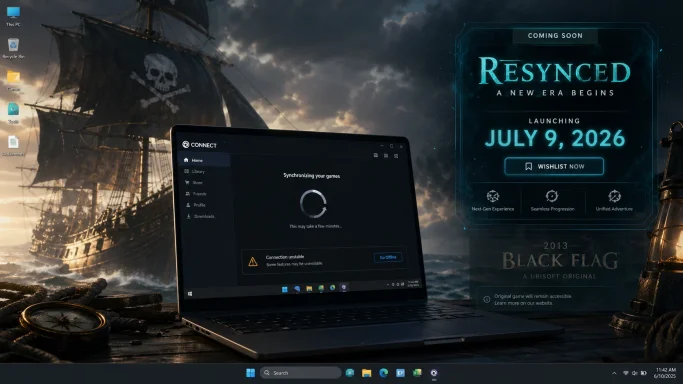
The original PC version of Assassin’s Creed IV Black Flag is suddenly at the center of a familiar but still frustrating modern-gaming problem: a back-catalog favorite appears to be failing on Windows 11 while the publisher’s attention shifts to a new remake. Ubisoft has confirmed that Assassin’s Creed Black Flag Resynced is due on July 9, 2026, and that remake is being positioned as a rebuilt, modernized version of the pirate adventure for current hardware. At the same time, the original 2013 game remains listed by Ubisoft as a separate product, yet reports from players suggest the older launcher path is increasingly unreliable on Windows 11. That combination has turned a routine compatibility complaint into a bigger debate about preservation, ownership, and what publishers owe customers after a decade on the market.
Assassin’s Creed IV Black Flag was released in 2013 and quickly became one of the most admired entries in Ubisoft’s long-running franchise. On Ubisoft’s own store page, the game is still described as a classic pirate action-adventure set in 1715, emphasizing its Caribbean setting, naval combat, and Edward Kenway’s rise through the Golden Age of Piracy. That original release established the template for much of the series’ later open-sea exploration, and it also became one of the most replayed entries in the Assassin’s Creed catalog.
The relevance of Black Flag did not end with its launch window. Ubisoft has continued to sell the original edition through its storefront, where it remains listed as a distinct product rather than being folded into a single evergreen package. That matters because many players who bought the game years ago still expect to keep launching the same entitlement they purchased, even as operating systems, launchers, and account systems evolve around it. When a game remains on sale, the consumer expectation is not merely that it existed once, but that it should continue to function in a reasonably supported state.
The new wave of attention comes from Assassin’s Creed Black Flag Resynced, Ubisoft’s remake of the pirate classic. Ubisoft says the game is built on the latest version of Anvil, includes upgraded gameplay and new content, and will arrive on July 9, 2026 for PlayStation 5, Xbox Series X|S, and PC. On PC, the remake will be available via the Ubisoft Store, Steam, and the Epic Games Store, which gives it a much broader distribution footprint than the original PC version ever had.
The timing is what creates the controversy. Ubisoft is preparing a fresh commercial release of Black Flag at the exact moment that some users are saying the original version is no longer launching on Windows 11. In practical terms, that means the company’s newest Black Flag messaging is centered on a remake, while the older edition is being left to whatever level of compatibility survives with the current launcher stack. For players, that can feel less like progress and more like a quiet abandonment of an already purchased product. That perception, whether or not every individual report is reproducible, is now part of the story.
For players, the difference is not academic. A game that hangs in a launcher is still inaccessible, and the distinction between “problem with the game” and “problem with the platform” matters less than the fact that the product no longer opens. That is why publisher-owned launchers tend to attract frustration faster than standalone games: they insert a dependency that can fail independently of the title the customer actually bought. The launcher becomes the gatekeeper, and the gatekeeper can lock out legitimate owners.
A useful way to think about this is in terms of user trust. If a customer sees a game listed in their library and then cannot launch it, the assumption is not that the operating system has changed in a subtle way; the assumption is that the publisher has not kept the promise of access current. That is a reputational problem as much as a technical one.
That is where consumer frustration spikes. Ubisoft says the remake will be a faithful recreation with new content, but it is still a separate purchase. Even if the original and remake share the same narrative skeleton, they are not identical products, and players are right to notice when access to the legacy version appears to deteriorate just as a paid upgrade arrives. The optics are unavoidable, especially in a market increasingly sensitive to whether companies are preserving older games or simply monetizing them again.
The company’s own store listings reinforce this split. The original game remains listed as a 2013 product, while the remake is being marketed as a 2026 release with current-gen support and broader PC distribution. That is not inherently improper, but it does highlight how modern remakes can coexist with, and sometimes overshadow, the originals they are based on.
There is also the broader reality that launchers evolve faster than many games do. Ubisoft Connect has to coordinate entitlement, cloud features, storefront identity, and more across a portfolio of titles spanning many years. Older games can become edge cases when new authentication flows or Windows updates alter expected behavior. The result is a familiar support pattern: the publisher may have no immediate, elegant fix, and the older title becomes the one that absorbs the compatibility hit.
For consumers, this creates a troubling asymmetry. New releases are engineered for present-day systems, while older purchases become dependent on whether a publisher continues to invest in compatibility maintenance. If that maintenance stops, the customer effectively bears the cost of software obsolescence without having opted into a subscription model. That is the part many players find hardest to accept.
The Black Flag situation also highlights a more subtle point: access is not binary. A game can be technically “owned” and yet functionally unavailable. That is a worse user outcome than a clean delisting because it creates uncertainty. The game sits in the library as a promise, but one that the platform may no longer fulfill on current hardware. That broken promise is why preservation advocates pay close attention to launcher-dependent games.
This does not mean every old title must be patched forever, but it does mean publishers should be transparent about support boundaries. If a game is unsupported on the latest OS version, customers deserve to know before buying, or at minimum before the catalog listing implies continuity that no longer exists.
That does not prove intentional neglect in a legal sense, but it does suggest a business priority. Companies allocate engineering time to the products they believe will generate the most value, and a remake can be a more attractive destination for resources than a decade-old edition tied to legacy systems. In the short term, that is rational. In the long term, it risks alienating the very audience most likely to care about a beloved old installment.
The broader market has seen this pattern before. Publishers often let old launcher-dependent games degrade until the remake or successor becomes the recommended path. The danger is that the original stops being a preserved classic and becomes a marketing bridge to the new product. That is a very different kind of continuity.
For enterprise observers, the lesson is broader. The publisher ecosystem has built a fragile layer cake: storefronts, launchers, DRM, telemetry, cloud saves, and account identity all sit between customer and executable. Each layer can modernize independently, but every added layer also increases the chance that an old title will break as the stack evolves. From a business perspective, maintaining old games is a cost center. From a customer perspective, it is part of the product they already paid for.
This split is why legacy game support has become part technical issue, part brand management. A publisher can survive one compatibility incident, but repeated patterns erode trust in the platform itself. That trust is especially important for franchise ecosystems like Assassin’s Creed, where older entries remain attractive and new releases often benefit from a long tail of goodwill.
In that environment, compatibility matters more than ever. If the old version still works, consumers can choose between the classic and the remake. If it doesn’t, the remake becomes less of an option and more of a forced destination. That shifts the balance of power from the customer to the publisher in a way that is hard to miss.
There is also a preservation angle. When a publisher allows a notable single-player title to degrade on modern systems while pushing a premium remake, it raises the question of whether back catalogs are being treated as living products or merely as intellectual property assets. That question may seem abstract until a favorite game stops launching, at which point it becomes painfully concrete.
The other variable is player behavior. Some fans will simply wait for Resynced, especially if they want the improved presentation and modern convenience. Others will continue to argue that the original should remain playable regardless of the new release, and that debate will only grow louder as more classic PC games depend on layers of launcher-based authentication.
Source: https://en.gamegpu.com/news/igry/or...eed-black-flag-ne-zapuskaetsya-na-windows-11/
 Background
Assassin’s Creed IV Black Flag was released in 2013 and quickly became one of the most admired entries in Ubisoft’s long-running franchise. On Ubisoft’s own store page, the game is still described as a classic pirate action-adventure set in 1715, emphasizing its Caribbean setting, naval combat, and Edward Kenway’s rise through the Golden Age of Piracy. That original release established the template for much of the series’ later open-sea exploration, and it also became one of the most replayed entries in the Assassin’s Creed catalog.The relevance of Black Flag did not end with its launch window. Ubisoft has continued to sell the original edition through its storefront, where it remains listed as a distinct product rather than being folded into a single evergreen package. That matters because many players who bought the game years ago still expect to keep launching the same entitlement they purchased, even as operating systems, launchers, and account systems evolve around it. When a game remains on sale, the consumer expectation is not merely that it existed once, but that it should continue to function in a reasonably supported state.
The new wave of attention comes from Assassin’s Creed Black Flag Resynced, Ubisoft’s remake of the pirate classic. Ubisoft says the game is built on the latest version of Anvil, includes upgraded gameplay and new content, and will arrive on July 9, 2026 for PlayStation 5, Xbox Series X|S, and PC. On PC, the remake will be available via the Ubisoft Store, Steam, and the Epic Games Store, which gives it a much broader distribution footprint than the original PC version ever had.
The timing is what creates the controversy. Ubisoft is preparing a fresh commercial release of Black Flag at the exact moment that some users are saying the original version is no longer launching on Windows 11. In practical terms, that means the company’s newest Black Flag messaging is centered on a remake, while the older edition is being left to whatever level of compatibility survives with the current launcher stack. For players, that can feel less like progress and more like a quiet abandonment of an already purchased product. That perception, whether or not every individual report is reproducible, is now part of the story.
What Players Are Reporting
The core complaint is simple: owners of the original PC version say the game fails to start on Windows 11 after going through Ubisoft Connect. The symptom described by the circulating report is an endless launcher loading cycle rather than a clean crash or an obvious error message. That kind of failure is especially aggravating because it can look like a login issue, a network problem, or a bad install, when the underlying cause may be a launcher integration mismatch.Why launcher failures are so disruptive
A modern PC game rarely launches in a single step anymore. Between account authentication, entitlement checks, anti-tamper systems, overlay services, cloud sync, and storefront hooks, the “start game” button often represents a chain of separate software handshakes. If one link in that chain breaks, the user experience can look like the game itself is broken even when the executable is technically intact. In this case, the report points to Ubisoft Connect as the place where the launch process appears to stall.For players, the difference is not academic. A game that hangs in a launcher is still inaccessible, and the distinction between “problem with the game” and “problem with the platform” matters less than the fact that the product no longer opens. That is why publisher-owned launchers tend to attract frustration faster than standalone games: they insert a dependency that can fail independently of the title the customer actually bought. The launcher becomes the gatekeeper, and the gatekeeper can lock out legitimate owners.
A useful way to think about this is in terms of user trust. If a customer sees a game listed in their library and then cannot launch it, the assumption is not that the operating system has changed in a subtle way; the assumption is that the publisher has not kept the promise of access current. That is a reputational problem as much as a technical one.
- Endless launcher loops are often interpreted by players as a broken game, even when the root cause sits elsewhere.
- Account-linked launchers multiply failure points.
- Legacy titles tend to reveal compatibility gaps first.
- User perception matters as much as the technical diagnosis.
- Publisher silence can turn a solvable bug into a trust issue.
Ubisoft’s Remake Strategy
Ubisoft’s public messaging makes it clear that Black Flag Resynced is not a minor facelift. The company describes it as a remake rebuilt from the ground up on the latest Anvil engine, with improved visuals, upgraded gameplay mechanics, and new content. Ubisoft also says the project is led by Ubisoft Singapore, with many of the original developers returning, which suggests a deliberate attempt to position the remake as both nostalgic and technically contemporary.A remake does not automatically solve legacy support
The crucial question is whether a remake should replace, rather than complement, the original game. In a clean market, the answer would usually be no: the new version gives players an enhanced option, while the original remains available for those who prefer the classic build or already own it. But that ideal depends on the publisher preserving the older product’s functionality. When the original stops working on a modern OS, the remake effectively becomes the only practical path back to the experience.That is where consumer frustration spikes. Ubisoft says the remake will be a faithful recreation with new content, but it is still a separate purchase. Even if the original and remake share the same narrative skeleton, they are not identical products, and players are right to notice when access to the legacy version appears to deteriorate just as a paid upgrade arrives. The optics are unavoidable, especially in a market increasingly sensitive to whether companies are preserving older games or simply monetizing them again.
The company’s own store listings reinforce this split. The original game remains listed as a 2013 product, while the remake is being marketed as a 2026 release with current-gen support and broader PC distribution. That is not inherently improper, but it does highlight how modern remakes can coexist with, and sometimes overshadow, the originals they are based on.
Windows 11 Compatibility and the Launcher Stack
Windows 11 compatibility issues have become one of the defining headaches for older PC games, especially those tied to third-party launchers. Even when the game binary itself is stable, a launcher, authentication layer, or overlay can break after platform updates. The problem is rarely dramatic in a single obvious way; more often it appears as delayed launches, silent exits, or authentication loops that seem to have no clear cause.The hidden complexity of old PC releases
Black Flag originally launched in an era when Windows 10 was the dominant forward-looking baseline, and Ubisoft’s store pages for the older edition still reference Windows 10-era support information. The remake, by contrast, explicitly targets Windows 10 and Windows 11 on PC, signaling that it has been built and tested with modern operating environments in mind. That gap alone explains part of the issue: a 2013 PC release and a 2026 PC release are not being maintained under the same assumptions.There is also the broader reality that launchers evolve faster than many games do. Ubisoft Connect has to coordinate entitlement, cloud features, storefront identity, and more across a portfolio of titles spanning many years. Older games can become edge cases when new authentication flows or Windows updates alter expected behavior. The result is a familiar support pattern: the publisher may have no immediate, elegant fix, and the older title becomes the one that absorbs the compatibility hit.
For consumers, this creates a troubling asymmetry. New releases are engineered for present-day systems, while older purchases become dependent on whether a publisher continues to invest in compatibility maintenance. If that maintenance stops, the customer effectively bears the cost of software obsolescence without having opted into a subscription model. That is the part many players find hardest to accept.
- Windows 11 can expose weaknesses in older launcher integrations.
- Launcher dependencies are often the weakest point in the chain.
- Legacy PC games are more vulnerable to platform changes than console counterparts.
- Modern remakes usually receive better baseline compatibility work.
- A broken login loop can make a game feel dead even when files remain installed.
Ownership, Access, and the Right to Play
The controversy around Black Flag is not only about one game failing to launch. It touches a much larger argument about digital ownership and what it means to “own” a PC game in a publisher-controlled ecosystem. If a user bought the original edition years ago, they reasonably expect to continue accessing it, especially when the product remains part of the seller’s current storefront lineup.When purchase becomes permission
That expectation collides with the reality of modern digital distribution. In practice, most consumers are not buying a permanent local artifact; they are buying ongoing permission to access content through systems the publisher controls. If the launcher, account system, or backend goes sideways, the user’s “ownership” can become conditional in a way that is easy to ignore during the sale and impossible to miss during a failure. That tension is especially sharp when a game is old enough to be considered a classic but still sold like an active product.The Black Flag situation also highlights a more subtle point: access is not binary. A game can be technically “owned” and yet functionally unavailable. That is a worse user outcome than a clean delisting because it creates uncertainty. The game sits in the library as a promise, but one that the platform may no longer fulfill on current hardware. That broken promise is why preservation advocates pay close attention to launcher-dependent games.
This does not mean every old title must be patched forever, but it does mean publishers should be transparent about support boundaries. If a game is unsupported on the latest OS version, customers deserve to know before buying, or at minimum before the catalog listing implies continuity that no longer exists.
- Ownership is increasingly conditional in digital storefronts.
- Access can fail silently even when the entitlement remains valid.
- Transparency matters when support windows narrow.
- Preservation is not the same as marketing.
- Older games should not be left in a limbo state.
What Ubisoft Says, and What It Does Not Say
Ubisoft has been very clear about the remake. It has specified the release date, platforms, and broad features, and it has presented Black Flag Resynced as a modernized return to Edward Kenway’s story. The company has even said the game will include new content, upgraded mechanics, and a more seamless open world built on the latest Anvil engine. That is a level of detail the marketing team clearly wants consumers to notice.Silence on the original game is the key signal
What Ubisoft has not provided, at least in the public materials surfaced here, is an official fix or explicit compatibility roadmap for the original Black Flag on Windows 11. That absence matters because it transforms a technical complaint into a policy signal. If the company had a readily available workaround, support note, or patch plan, that would likely be the first thing it would want customers to see. Instead, the public emphasis is on the remake.That does not prove intentional neglect in a legal sense, but it does suggest a business priority. Companies allocate engineering time to the products they believe will generate the most value, and a remake can be a more attractive destination for resources than a decade-old edition tied to legacy systems. In the short term, that is rational. In the long term, it risks alienating the very audience most likely to care about a beloved old installment.
The broader market has seen this pattern before. Publishers often let old launcher-dependent games degrade until the remake or successor becomes the recommended path. The danger is that the original stops being a preserved classic and becomes a marketing bridge to the new product. That is a very different kind of continuity.
- Official detail is strong for the remake.
- Official detail is weak for the original game’s Windows 11 status.
- Resource allocation follows future revenue, not nostalgia.
- Silence can be a strategy, even if it is not called one.
- Legacy support is often the first casualty of remake planning.
Consumer Impact vs. Enterprise Reality
For consumers, the issue is obvious: they want the game they bought to run on the machine they own today. A Windows 11 user does not care whether the problem sits in a launcher, an overlay, or a backend service; they care that the game is unavailable. This is especially true for single-player titles, where offline play is part of the implicit bargain.Why this feels different from a live-service outage
A live-service game being temporarily unavailable is frustrating but expected. A solo premium game failing to start because the platform has drifted away from its original launch assumptions feels different, because the user paid once for the right to access a finished product. Black Flag is not a seasonal multiplayer release that depends on constant content updates; it is a catalog title with a clear end state. That makes launcher lockout feel less like a temporary service interruption and more like a breach of purchase expectations.For enterprise observers, the lesson is broader. The publisher ecosystem has built a fragile layer cake: storefronts, launchers, DRM, telemetry, cloud saves, and account identity all sit between customer and executable. Each layer can modernize independently, but every added layer also increases the chance that an old title will break as the stack evolves. From a business perspective, maintaining old games is a cost center. From a customer perspective, it is part of the product they already paid for.
This split is why legacy game support has become part technical issue, part brand management. A publisher can survive one compatibility incident, but repeated patterns erode trust in the platform itself. That trust is especially important for franchise ecosystems like Assassin’s Creed, where older entries remain attractive and new releases often benefit from a long tail of goodwill.
- Consumers care about immediate launch reliability.
- Enterprises care about support costs and resource allocation.
- Single-player games have a stronger expectation of offline continuity.
- Launcher complexity amplifies the risk of old-title breakage.
- Brand trust can be damaged by repeated access failures.
Historical Context: Remasters, Remakes, and Back-Catalog Tension
The gaming industry has increasingly leaned on remakes and remasters as a way to monetize beloved catalog titles while adapting them for modern systems. That strategy makes business sense because established franchises carry built-in recognition, and a polished remake can attract both returning fans and new players. But the model only works cleanly when the original remains accessible as a reference point, a collector’s item, or a cheaper alternative.The Black Flag case in industry context
Black Flag is a particularly strong candidate for reissue because it was already a commercial and critical high point. Ubisoft’s own pages frame it as one of the franchise’s largest and most immersive adventures, and the remake’s marketing leans heavily on the same pirate fantasy that made the original so successful. That creates a natural bridge for sales, but also a natural comparison for players who want to know whether they are paying twice for the same experience.In that environment, compatibility matters more than ever. If the old version still works, consumers can choose between the classic and the remake. If it doesn’t, the remake becomes less of an option and more of a forced destination. That shifts the balance of power from the customer to the publisher in a way that is hard to miss.
There is also a preservation angle. When a publisher allows a notable single-player title to degrade on modern systems while pushing a premium remake, it raises the question of whether back catalogs are being treated as living products or merely as intellectual property assets. That question may seem abstract until a favorite game stops launching, at which point it becomes painfully concrete.
- Remakes are commercially efficient but culturally sensitive.
- Classic titles are most valuable when they remain playable.
- Choice disappears when the original breaks.
- Preservation concerns intensify with launcher-dependent libraries.
- Catalog value depends on accessibility, not just brand awareness.
Strengths and Opportunities
Despite the controversy, Ubisoft is also sitting on a powerful opportunity. If handled carefully, the remake can reintroduce one of the franchise’s most beloved settings to a new audience while giving long-time fans a reason to revisit a landmark game in a more modern form. The same situation that creates backlash around the original version could also generate goodwill if Ubisoft communicates clearly and supports both legacy and remake players.- Strong brand recognition gives Ubisoft a built-in audience.
- A beloved original reduces the marketing burden.
- Modern PC storefronts broaden reach beyond the old launcher model.
- Current-gen hardware gives the remake room for visual and systems improvements.
- New content can justify the remake beyond a simple graphical refresh.
- Transparent support messaging could ease consumer concerns.
- Offline-play positioning may appeal to single-player buyers.
Risks and Concerns
The biggest risk is not that the remake will fail commercially; it is that the company will appear to be replacing access with reselling. If the original remains broken on Windows 11 while the new version is sold as the answer, Ubisoft risks reinforcing the idea that ownership in its ecosystem is provisional. That perception can spill beyond Black Flag and affect trust in the broader Assassin’s Creed catalog.- Consumer backlash over paying twice for access to the same core game.
- Legacy title abandonment could damage goodwill with long-time fans.
- Launcher dependence remains a structural fragility.
- Negative preservation optics may attract wider criticism.
- Mixed messaging between original sales and remake promotion can confuse buyers.
- Support gaps on Windows 11 could expand to other older Ubisoft titles.
- Price sensitivity may increase if the remake is seen as a mandatory fix rather than a premium upgrade.
Looking Ahead
The most important question now is whether Ubisoft will address the original Black Flag’s Windows 11 problem in a meaningful way or simply let the remake absorb all attention. If the company issues a compatibility fix, a support note, or a more explicit policy statement about legacy access, it could turn a messy situation into a manageable one. If not, the remake’s launch may be accompanied by a persistent conversation about publisher responsibility.The other variable is player behavior. Some fans will simply wait for Resynced, especially if they want the improved presentation and modern convenience. Others will continue to argue that the original should remain playable regardless of the new release, and that debate will only grow louder as more classic PC games depend on layers of launcher-based authentication.
- Official support guidance for the original game would be the clearest stabilizer.
- Patch or workaround announcements could reduce uncertainty quickly.
- Pre-launch communication for the remake will shape consumer sentiment.
- Community reports may determine how widely the Windows 11 issue spreads.
- Sales performance of Resynced will show whether nostalgia outweighs dissatisfaction.
Source: https://en.gamegpu.com/news/igry/or...eed-black-flag-ne-zapuskaetsya-na-windows-11/
