

Astellas Pharma has deployed NVIDIA’s Boltz-2 NIM to guide membrane-protein drug discovery, using Tokyo-1 as a computational foundation and reporting that 10 selected compounds all showed the expected medicinal effects while evaluated compounds fell by more than 90% and the research period by more than 70%.
Those numbers make this more than another pharmaceutical company announcing an AI experiment. Astellas is showing what enterprise adoption looks like when a powerful scientific model is wrapped in production infrastructure, translated into the visual language chemists already use, and distributed through a browser rather than reserved for computational specialists. The consequential technology is not merely Boltz-2; it is the system that turns a model prediction into a faster Design-Make-Test-Analyze decision.
The strongest claim in NVIDIA’s Astellas customer story is also the easiest to misunderstand. Medicinal chemist Dr. Matsumura said the company used hypotheses derived from Boltz-2 NIM to select 10 compounds from a library, tested those compounds in assays, and found that all 10 exhibited the expected medicinal effects.
That is an unusually clean result for an AI-guided selection step, but it should not be inflated into a claim that Boltz-2 independently discovered a finished medicine. The reported experiment concerns compound prioritization within a drug-discovery project: the model helped researchers decide which candidates deserved scarce laboratory attention. It does not establish clinical efficacy, regulatory viability, manufacturability, safety in patients, or the many other properties that separate an interesting compound from a medicine.
What it does establish, according to Astellas, is that the model’s output was useful enough to alter experimental planning. Dr. Matsumura said researchers had initially expected to run many more assays, but the Boltz-2 NIM-guided narrowing reduced the number of evaluated compounds by more than 90% and shortened the research period by more than 70%.
That is the operational center of the story. Drug discovery contains countless points at which teams must choose what to synthesize, test, discard, refine, or investigate next. Even when AI cannot eliminate laboratory work, it may create value by moving better candidates toward the front of the queue and preventing weaker hypotheses from consuming the same resources.
The result also avoids one of the weakest forms of AI benchmarking: asking whether a model’s internal score looks impressive on a benchmark designed for machine-learning researchers. Astellas took predictions back into an assay workflow. The evidence remains limited to the project described in NVIDIA’s customer account, but it at least crosses the boundary between computational output and experimental observation.
Kazuya, quoted in the case study, said Astellas applied Boltz-2 NIM to a project targeting membrane proteins and believes it advanced both the quality and speed of therapeutically relevant compound-design proposals. The careful word is proposals. The system is helping create and prioritize design hypotheses, while medicinal chemists and laboratory assays remain responsible for testing whether those hypotheses survive contact with biology.
That distinction matters because membrane-protein projects can present precisely the kind of complex structural and interaction problems that make computational assistance attractive. The model is not replacing the scientific loop. It is being inserted into the loop at the point where researchers need to convert a large search space into a manageable experimental plan.
That is a meaningful acceleration, but a seven-second prediction is not the largest time saving reported by Astellas. The larger gain came downstream: more than 70% off the research period after the system helped reduce the compounds requiring evaluation by more than 90%.
This is an important lesson for enterprise AI deployments. Infrastructure teams tend to measure latency because it is visible, repeatable, and relatively easy to benchmark. Research organizations care about latency, but they ultimately need to know whether lower latency changes the behavior of the workflow around the model.
A reduction from more than 20 seconds to seven seconds makes the model easier to use interactively. It also matters when the same operation is repeated automatically across multiple compound-protein combinations, where seconds accumulate into queue time and determine how much exploration can be performed within a working session.
Yet the most valuable speedup is organizational rather than computational. If a medicinal chemist can draw a compound, submit it without writing code, compare results, queue additional combinations, and use the output to reduce the next batch of assays, the model begins compressing the entire decision cycle. The seven-second result is therefore best understood as an enabling constraint: fast enough to keep a scientist engaged instead of forcing the work into a specialist-operated batch process.
This is where NVIDIA NIM’s packaging becomes more consequential than a conventional model benchmark. NVIDIA describes NIM as a performance-optimized, containerized method of exposing models through a standardized service. For Astellas, the benefit is not simply that TensorRT can execute the model faster. It is that the optimized model can sit behind an application used by researchers who do not need to manage Python environments, model dependencies, optimization parameters, or GPU-specific deployment details.
Kazuya called the combination of performance optimization and ready-to-use container packaging a “groundbreaking mechanism.” That assessment reflects a recurring enterprise problem: publishing a capable model is not the same as creating a dependable service that a global organization can support.
A research repository may be entirely adequate for a computational scientist running controlled experiments. A pharmaceutical company trying to place the same capability inside a repeatable discovery workflow needs predictable deployment, an application interface, resource management, monitoring, version control, and a path for support. The model is only one component in that stack.
Astellas responded by building an application that lets researchers draw compounds as structural formulas and converts those structures into SMILES notation for processing. The company also implemented automatic sequential execution for multiple compound combinations against specified proteins, with the explicit goal of shortening the DMTA — Design-Make-Test-Analyze — cycle.
This adaptation is not a cosmetic front end. It is the layer that determines who can use the system, how quickly they can use it, and whether using it requires abandoning established scientific habits.
Forcing medicinal chemists to manually translate their work into an unfamiliar machine-oriented input format would preserve the model’s technical capability while limiting its practical audience. It would also introduce opportunities for transcription errors, create training burdens, and encourage researchers to route every job through a smaller informatics team.
By accepting structural formulas and handling conversion to SMILES notation, Astellas made the application conform to the user rather than demanding that the user conform to the model. That is the real meaning of democratization in this deployment: removing the operational tax that previously separated a scientific question from an AI prediction.
The same reasoning applies to the sequential-execution feature. A model that handles one compound-protein combination at a time may demonstrate its capability, but a production research workflow must support comparison and iteration. Automating a sequence of combinations turns a prediction service into something closer to a screening instrument.
It also shifts the limiting factor. Once submissions become easy and results arrive in seconds, demand can rise rapidly. Researchers who previously avoided a cumbersome computational process may begin exploring more variations, while automated runs can create bursts of inference work that are very different from isolated manual requests.
For IT, that means the friendly browser interface cannot be treated as separate from the underlying capacity plan. Better usability is likely to increase utilization, and increased utilization can expose scheduling, observability, access-control, and reproducibility problems that were invisible during a small pilot.
Those two figures describe different kinds of adoption. More than 2,000 total users indicates broad exposure across the organization; more than 50 regular users points to a smaller group integrating the tool more consistently into their work.
That gap is not necessarily a weakness. Enterprise scientific tools rarely move from availability to habitual use in a single step. Some researchers may use the application only when a project reaches a suitable design question, while others may test it once, review a colleague’s result, or depend on outputs generated by a smaller core group.
The important change is that access no longer appears to be confined to the team that deployed the model. A browser application can give departments in different locations a common entry point while the computational execution remains centralized. It can also permit the organization to update the service without requiring every scientist to maintain a local installation.
This architecture resembles the pattern that transformed many general enterprise applications: move specialized execution behind a managed service and give users a thin, broadly accessible client. In a scientific environment, however, the backend must preserve far more than basic availability. It must capture enough context for researchers to understand which inputs, model configuration, service version, and workflow produced a result.
A prediction displayed in a browser can look deceptively final. Scientific users need the ability to distinguish a generated hypothesis from an experimentally validated conclusion, compare current output with earlier runs, and identify whether an underlying model or workflow change affected the result.
A companywide rollout therefore raises governance questions alongside scalability questions. Who can submit which data? Which projects require additional controls? How long are inputs and outputs retained? What metadata must accompany a prediction? What happens when a model update changes rankings or confidence?
The source material does not detail Astellas’s answers to those questions. But the company’s move from a specialist implementation to a globally available browser application means those questions now belong to platform engineering and research governance, not only to the scientists who first evaluated the model.
Boltz-2 NIM primarily strengthens the design and prioritization side of that loop. Astellas’s application attempts to connect that capability to the surrounding process by allowing scientists to submit multiple combinations sequentially and use the results to narrow the next experimental step.
That turns model inference into workflow orchestration. The platform must decide how jobs enter the system, how they are queued, how failures are surfaced, and how results are linked to the compounds and proteins that generated them. If automated execution becomes common, the system also needs to prevent a single large submission from making interactive work unusable for everyone else.
The reported reduction in evaluated compounds illustrates why this integration matters. An isolated prediction may save seconds or minutes. A prediction that changes what the laboratory tests can save a substantial portion of the research period.
It also shows why successful scientific AI is unlikely to be measured by the model alone. The value appears when model output is connected to an experiment that researchers were already preparing to run. If that handoff remains manual, poorly documented, or difficult to reproduce, the organization loses part of the advantage gained through faster inference.
For Windows-oriented enterprise teams, the browser-based design is familiar even if the scientific workload is not. End users need not know whether the backend is a container running on specialized accelerated infrastructure. They need an authenticated application, a responsive interface, reliable job status, understandable errors, and results that can move into their existing work.
The backend team, meanwhile, must treat the NIM as a service dependency rather than a desktop application. That means planning for upgrades, rollback, workload isolation, service health, and compatibility with the application that translates structural formulas into model-ready notation.
That expansion reveals a broader platform strategy. One model can solve a bounded prediction problem; a collection of models can support different stages of generation, docking, structure analysis, and prioritization. Tokyo-1 becomes valuable not merely because it runs an individual workload quickly, but because it provides a shared computational foundation on which those workloads can be connected.
Astellas has already extended this approach to proteins and peptides through a De Novo Protein/Peptide Design Workflow on Tokyo-1. That workflow uses RFdiffusion NIM for three-dimensional structures, ProteinMPNN NIM for sequence design, and Boltz-2 NIM for binding prediction.
The sequence is significant. RFdiffusion NIM creates candidate structural forms, ProteinMPNN NIM designs sequences associated with those structures, and Boltz-2 NIM evaluates binding. Instead of presenting researchers with three disconnected model demos, Astellas has implemented a consistent route from structure and sequence design to binding prediction.
This is where containerized model services can change the economics of scientific software. A team does not have to turn every research repository into its own bespoke production environment before testing how the models work together. Standardized service packaging can reduce integration friction and let platform engineers concentrate on orchestration, interfaces, data movement, and governance.
It does not eliminate integration work. Models can expect different representations, produce outputs with different confidence characteristics, and evolve independently. A workflow that joins them must define how one service’s output becomes another service’s input, what validation occurs between stages, and how a researcher can inspect the intermediate results.
The orchestration layer also becomes a source of scientific assumptions. Choosing which structure to pass forward, how many sequences to generate, or which binding predictions to prioritize can influence the candidates ultimately presented to a chemist. Those choices must be explicit and reviewable rather than disappearing inside an automated pipeline.
Astellas’s plan to add DiffDock, GenMol, and MolMIM suggests that Boltz-2 NIM is serving as a proof point for a larger catalogue approach. If the first deployment demonstrates that optimized containers can be placed behind scientist-friendly applications, the organization can reuse the same operational patterns for subsequent models.
That is potentially more durable than any single performance gain. Models will improve, be replaced, or become specialized. A platform capable of onboarding, exposing, and governing new scientific models gives Astellas a way to absorb those changes without rebuilding the entire user experience each time.
Astellas’s evaluation gives that proposition a practical example. The open-source implementation worked, but the TensorRT-optimized NIM produced the reported result in seven seconds rather than more than 20. More importantly, the NIM could be placed behind an internal application and incorporated into automated workflows.
This is a familiar pattern in enterprise software: the freely available component establishes capability, while companies pay for packaging, performance, support, security processes, and operational predictability. In drug discovery, where models can require specialized hardware and rapidly changing software dependencies, the packaging layer may determine whether a tool remains an experiment or becomes a service.
NVIDIA’s customer story is promotional material, and its framing should be read accordingly. It showcases the strongest reported outcomes and does not provide the level of experimental detail required to judge how broadly the 10-compound result will generalize across targets, chemical libraries, or discovery programs.
The case study also does not establish that every Boltz-2 NIM prediction will produce a comparable reduction in assays or research time. Astellas reports success on a membrane-protein project and a performance comparison for a particular target. Those results are important, but they remain workload-specific evidence rather than universal guarantees.
Still, dismissing the account as vendor marketing would miss the concrete operational signal. Astellas built an application, made it available across departments globally, accumulated more than 2,000 total users by the end of February 2026, and is extending the deployment pattern to additional NIM services. Those are signs of institutional commitment, not merely a benchmark run prepared for a press release.
The source material does not provide a comparison with a randomly selected group, a conventional computational workflow, or an expert-only selection process run on the same library. It does not specify the original number of candidates beyond saying evaluated compounds were reduced by more than 90%, nor does it disclose the detailed assay criteria behind the expected effects.
That does not negate the result. It limits what can responsibly be concluded from it.
The appropriate conclusion is that Boltz-2 NIM-generated hypotheses proved useful in the described Astellas project and enabled a sharply smaller experimental set. The inappropriate conclusion would be that the model has demonstrated a perfect hit rate generally, or that laboratories can now skip broad validation whenever it ranks 10 candidates.
AI-guided drug discovery will ultimately be judged by repeatability across different targets, modalities, chemical spaces, and teams. A result that depends on extensive expert filtering before the model is consulted may still be valuable, but it represents a different kind of automation from a system that performs reliably across a broad internal portfolio.
The same caution applies to the speed comparison. More than 20 seconds versus seven seconds is a clear result for the workload Dr. Ide described. It is not a universal benchmark for every input size, target, infrastructure configuration, or concurrency level.
Production performance also includes more than inference latency. A user experiences the time required to submit a structure, convert it into SMILES notation, enter a queue, run the model, retrieve the output, and render the result. Under global use, capacity and scheduling may matter as much as raw TensorRT execution.
The next level of evidence would therefore combine scientific and operational measurements: prediction quality across multiple projects, assay reduction by target class, total DMTA-cycle time, service utilization, failure rates, queue latency, and the extent to which researchers repeatedly act on the system’s output.
Astellas has reported enough to justify attention. It has not reported enough to suspend the usual skepticism applied to a promising result delivered through a vendor case study.
Every prediction that influences compound selection should be traceable to the inputs and software state that produced it. If Boltz-2 NIM, TensorRT optimization, or Astellas’s surrounding application changes, teams need to know whether an older prediction can be reproduced and whether newer output can be compared fairly with earlier results.
Model upgrades present a particular challenge. A newer release may be faster or more accurate overall while changing the ranking of compounds in an active project. Automatically replacing the production model without validation could make ongoing research difficult to interpret.
Scientific platforms therefore need a more cautious release process than ordinary internal productivity tools. Updates should be tested against representative Astellas workloads, with researchers reviewing whether changed output reflects an improvement, an expected model difference, or a regression relevant to their projects.
The application’s conversion of structural formulas into SMILES notation should also be treated as part of the validated workflow. If that translation layer changes, the effective model input can change even when the NIM itself does not. The user interface, conversion service, orchestration logic, and model container together constitute the production system.
Access is equally important. Companywide rollout and global departmental use imply a mix of users, projects, and potentially sensitive research inputs. Administrators need controls that match the organization’s data-classification and project-separation requirements without making the application so restrictive that researchers retreat to ungoverned alternatives.
That structure is more realistic than the idea that widespread AI adoption will occur because thousands of scientists begin cloning repositories and managing local Python environments. Open-source availability expands access to the underlying science, but internal product engineering is what turns access into routine use.
The reported user figures show the beginning of that transition. A total audience exceeding 2,000 can create awareness and organizational reach, while more than 50 regular users can supply the repeated feedback needed to improve the product. Those regular users are likely to reveal where predictions are useful, where the interface is confusing, and which automated workflows deserve further investment.
The planned companywide rollout should increase that feedback pressure. Different departments will bring different targets, expectations, data formats, and standards of evidence. A system that worked for its original developers may require stronger documentation, clearer error handling, and more explicit uncertainty communication when it reaches scientists who did not participate in its design.
This is another reason the application layer matters. A model API typically communicates in machine-oriented structures. A research application must explain enough of the result for a scientist to make a decision without pretending that a probabilistic prediction is a laboratory fact.
The best interface will not merely make Boltz-2 NIM easy to invoke. It will help researchers understand what was submitted, what the system predicted, how the output should be interpreted, and what experiment could test the hypothesis next.
DiffDock, GenMol, MolMIM, RFdiffusion NIM, ProteinMPNN NIM, and Boltz-2 NIM occupy different positions in a discovery workflow. Their inputs and outputs may be connected technically, but scientists still need to decide when each model is appropriate and what evidence is required before its output moves to the next stage.
As the portfolio expands, Astellas will need common conventions for job submission, identity, metadata, output storage, monitoring, and release management. Without those conventions, each NIM could become a separate platform with its own interface and operational assumptions, recreating the fragmentation that container packaging was supposed to reduce.
The De Novo Protein/Peptide Design Workflow offers the clearer architectural direction. Rather than exposing a catalogue and asking users to choose among services, Astellas has assembled RFdiffusion NIM, ProteinMPNN NIM, and Boltz-2 NIM into a consistent progression from three-dimensional structure and sequence design to binding prediction.
That workflow-oriented approach can hide model boundaries where they do not matter to the user while preserving intermediate artifacts for experts who need to inspect them. It also allows the organization to replace an individual model later without necessarily redesigning the scientist’s entire interaction.
The danger is allowing automation to turn a sequence of uncertain predictions into an apparently authoritative final answer. Each model can introduce its own error, and downstream services may magnify an upstream assumption. A composed workflow therefore needs validation at the boundaries as well as at the final output.
If Astellas manages that problem, Tokyo-1 can function as more than accelerated hardware. It can become an internal scientific computing platform where models are deployed as governed services, combined into validated workflows, and delivered through interfaces matched to researchers rather than infrastructure specialists.
It remains a bounded case reported through NVIDIA rather than an independent, comprehensive evaluation. But within those boundaries, it demonstrates a credible route from open scientific model to enterprise research service.
Those numbers make this more than another pharmaceutical company announcing an AI experiment. Astellas is showing what enterprise adoption looks like when a powerful scientific model is wrapped in production infrastructure, translated into the visual language chemists already use, and distributed through a browser rather than reserved for computational specialists. The consequential technology is not merely Boltz-2; it is the system that turns a model prediction into a faster Design-Make-Test-Analyze decision.
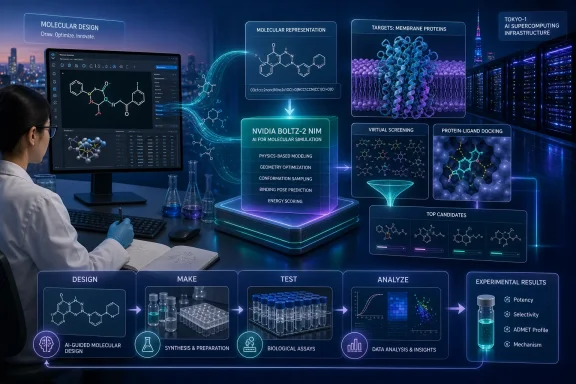 Ten Compounds Turn an AI Prediction Into an Experimental Result
The strongest claim in NVIDIA’s Astellas customer story is also the easiest to misunderstand. Medicinal chemist Dr. Matsumura said the company used hypotheses derived from Boltz-2 NIM to select 10 compounds from a library, tested those compounds in assays, and found that all 10 exhibited the expected medicinal effects.That is an unusually clean result for an AI-guided selection step, but it should not be inflated into a claim that Boltz-2 independently discovered a finished medicine. The reported experiment concerns compound prioritization within a drug-discovery project: the model helped researchers decide which candidates deserved scarce laboratory attention. It does not establish clinical efficacy, regulatory viability, manufacturability, safety in patients, or the many other properties that separate an interesting compound from a medicine.
What it does establish, according to Astellas, is that the model’s output was useful enough to alter experimental planning. Dr. Matsumura said researchers had initially expected to run many more assays, but the Boltz-2 NIM-guided narrowing reduced the number of evaluated compounds by more than 90% and shortened the research period by more than 70%.
That is the operational center of the story. Drug discovery contains countless points at which teams must choose what to synthesize, test, discard, refine, or investigate next. Even when AI cannot eliminate laboratory work, it may create value by moving better candidates toward the front of the queue and preventing weaker hypotheses from consuming the same resources.
The result also avoids one of the weakest forms of AI benchmarking: asking whether a model’s internal score looks impressive on a benchmark designed for machine-learning researchers. Astellas took predictions back into an assay workflow. The evidence remains limited to the project described in NVIDIA’s customer account, but it at least crosses the boundary between computational output and experimental observation.
Kazuya, quoted in the case study, said Astellas applied Boltz-2 NIM to a project targeting membrane proteins and believes it advanced both the quality and speed of therapeutically relevant compound-design proposals. The careful word is proposals. The system is helping create and prioritize design hypotheses, while medicinal chemists and laboratory assays remain responsible for testing whether those hypotheses survive contact with biology.
That distinction matters because membrane-protein projects can present precisely the kind of complex structural and interaction problems that make computational assistance attractive. The model is not replacing the scientific loop. It is being inserted into the loop at the point where researchers need to convert a large search space into a manageable experimental plan.
The Breakthrough Is Fewer Experiments, Not Merely Faster Inference
NVIDIA naturally emphasizes the performance of its packaged NIM implementation. Dr. Ide reported that open-source Boltz-2 written in Python took more than 20 seconds for complex modeling and activity prediction on a particular target, while the TensorRT-optimized Boltz-2 NIM returned results in seven seconds.That is a meaningful acceleration, but a seven-second prediction is not the largest time saving reported by Astellas. The larger gain came downstream: more than 70% off the research period after the system helped reduce the compounds requiring evaluation by more than 90%.
This is an important lesson for enterprise AI deployments. Infrastructure teams tend to measure latency because it is visible, repeatable, and relatively easy to benchmark. Research organizations care about latency, but they ultimately need to know whether lower latency changes the behavior of the workflow around the model.
| Variant | Implementation | Optimization | Reported processing time | Reported role |
|---|---|---|---|---|
| Open-source Boltz-2 | Python model | Not described as TensorRT-optimized | More than 20 seconds | Baseline for complex modeling and activity prediction |
| Boltz-2 NIM | Ready-to-use NIM deployment | TensorRT | 7 seconds | Faster interactive and automated prediction workflow |
Yet the most valuable speedup is organizational rather than computational. If a medicinal chemist can draw a compound, submit it without writing code, compare results, queue additional combinations, and use the output to reduce the next batch of assays, the model begins compressing the entire decision cycle. The seven-second result is therefore best understood as an enabling constraint: fast enough to keep a scientist engaged instead of forcing the work into a specialist-operated batch process.
This is where NVIDIA NIM’s packaging becomes more consequential than a conventional model benchmark. NVIDIA describes NIM as a performance-optimized, containerized method of exposing models through a standardized service. For Astellas, the benefit is not simply that TensorRT can execute the model faster. It is that the optimized model can sit behind an application used by researchers who do not need to manage Python environments, model dependencies, optimization parameters, or GPU-specific deployment details.
Kazuya called the combination of performance optimization and ready-to-use container packaging a “groundbreaking mechanism.” That assessment reflects a recurring enterprise problem: publishing a capable model is not the same as creating a dependable service that a global organization can support.
A research repository may be entirely adequate for a computational scientist running controlled experiments. A pharmaceutical company trying to place the same capability inside a repeatable discovery workflow needs predictable deployment, an application interface, resource management, monitoring, version control, and a path for support. The model is only one component in that stack.
Astellas Built the Missing Interface for Medicinal Chemists
Boltz-2 NIM did not arrive with the interface Astellas’s medicinal chemists wanted. Toshiyuki Ohfusa, the company’s team lead of lab automation, said chemists prefer to work with visually intuitive structural formulas, while Boltz-2 NIM does not directly support that form of interaction.Astellas responded by building an application that lets researchers draw compounds as structural formulas and converts those structures into SMILES notation for processing. The company also implemented automatic sequential execution for multiple compound combinations against specified proteins, with the explicit goal of shortening the DMTA — Design-Make-Test-Analyze — cycle.
This adaptation is not a cosmetic front end. It is the layer that determines who can use the system, how quickly they can use it, and whether using it requires abandoning established scientific habits.
Forcing medicinal chemists to manually translate their work into an unfamiliar machine-oriented input format would preserve the model’s technical capability while limiting its practical audience. It would also introduce opportunities for transcription errors, create training burdens, and encourage researchers to route every job through a smaller informatics team.
By accepting structural formulas and handling conversion to SMILES notation, Astellas made the application conform to the user rather than demanding that the user conform to the model. That is the real meaning of democratization in this deployment: removing the operational tax that previously separated a scientific question from an AI prediction.
The same reasoning applies to the sequential-execution feature. A model that handles one compound-protein combination at a time may demonstrate its capability, but a production research workflow must support comparison and iteration. Automating a sequence of combinations turns a prediction service into something closer to a screening instrument.
It also shifts the limiting factor. Once submissions become easy and results arrive in seconds, demand can rise rapidly. Researchers who previously avoided a cumbersome computational process may begin exploring more variations, while automated runs can create bursts of inference work that are very different from isolated manual requests.
For IT, that means the friendly browser interface cannot be treated as separate from the underlying capacity plan. Better usability is likely to increase utilization, and increased utilization can expose scheduling, observability, access-control, and reproducibility problems that were invisible during a small pilot.
Browser Delivery Converts a Specialist Tool Into Shared Infrastructure
Dr. Ide’s browser-based application is already being provided to various departments globally, according to NVIDIA’s case study. As of the end of February 2026, it had more than 50 regular users and a total user count exceeding 2,000.Those two figures describe different kinds of adoption. More than 2,000 total users indicates broad exposure across the organization; more than 50 regular users points to a smaller group integrating the tool more consistently into their work.
That gap is not necessarily a weakness. Enterprise scientific tools rarely move from availability to habitual use in a single step. Some researchers may use the application only when a project reaches a suitable design question, while others may test it once, review a colleague’s result, or depend on outputs generated by a smaller core group.
The important change is that access no longer appears to be confined to the team that deployed the model. A browser application can give departments in different locations a common entry point while the computational execution remains centralized. It can also permit the organization to update the service without requiring every scientist to maintain a local installation.
This architecture resembles the pattern that transformed many general enterprise applications: move specialized execution behind a managed service and give users a thin, broadly accessible client. In a scientific environment, however, the backend must preserve far more than basic availability. It must capture enough context for researchers to understand which inputs, model configuration, service version, and workflow produced a result.
A prediction displayed in a browser can look deceptively final. Scientific users need the ability to distinguish a generated hypothesis from an experimentally validated conclusion, compare current output with earlier runs, and identify whether an underlying model or workflow change affected the result.
A companywide rollout therefore raises governance questions alongside scalability questions. Who can submit which data? Which projects require additional controls? How long are inputs and outputs retained? What metadata must accompany a prediction? What happens when a model update changes rankings or confidence?
The source material does not detail Astellas’s answers to those questions. But the company’s move from a specialist implementation to a globally available browser application means those questions now belong to platform engineering and research governance, not only to the scientists who first evaluated the model.
The DMTA Cycle Becomes a Software-Orchestration Problem
Design-Make-Test-Analyze is often represented as a simple loop, but each word hides a collection of systems, people, queues, and decisions. Design can involve structural modeling and compound proposals; making a compound can require laboratory scheduling; testing produces assay data; analysis determines what should happen next.Boltz-2 NIM primarily strengthens the design and prioritization side of that loop. Astellas’s application attempts to connect that capability to the surrounding process by allowing scientists to submit multiple combinations sequentially and use the results to narrow the next experimental step.
That turns model inference into workflow orchestration. The platform must decide how jobs enter the system, how they are queued, how failures are surfaced, and how results are linked to the compounds and proteins that generated them. If automated execution becomes common, the system also needs to prevent a single large submission from making interactive work unusable for everyone else.
The reported reduction in evaluated compounds illustrates why this integration matters. An isolated prediction may save seconds or minutes. A prediction that changes what the laboratory tests can save a substantial portion of the research period.
It also shows why successful scientific AI is unlikely to be measured by the model alone. The value appears when model output is connected to an experiment that researchers were already preparing to run. If that handoff remains manual, poorly documented, or difficult to reproduce, the organization loses part of the advantage gained through faster inference.
For Windows-oriented enterprise teams, the browser-based design is familiar even if the scientific workload is not. End users need not know whether the backend is a container running on specialized accelerated infrastructure. They need an authenticated application, a responsive interface, reliable job status, understandable errors, and results that can move into their existing work.
The backend team, meanwhile, must treat the NIM as a service dependency rather than a desktop application. That means planning for upgrades, rollback, workload isolation, service health, and compatibility with the application that translates structural formulas into model-ready notation.
Tokyo-1 Is Becoming a Platform, Not Just a Pool of GPUs
Astellas is not stopping with Boltz-2 NIM. In compound-modality drug discovery, the company plans to deploy DiffDock, GenMol, and MolMIM on Tokyo-1 and combine them with Boltz-2 NIM.That expansion reveals a broader platform strategy. One model can solve a bounded prediction problem; a collection of models can support different stages of generation, docking, structure analysis, and prioritization. Tokyo-1 becomes valuable not merely because it runs an individual workload quickly, but because it provides a shared computational foundation on which those workloads can be connected.
Astellas has already extended this approach to proteins and peptides through a De Novo Protein/Peptide Design Workflow on Tokyo-1. That workflow uses RFdiffusion NIM for three-dimensional structures, ProteinMPNN NIM for sequence design, and Boltz-2 NIM for binding prediction.
The sequence is significant. RFdiffusion NIM creates candidate structural forms, ProteinMPNN NIM designs sequences associated with those structures, and Boltz-2 NIM evaluates binding. Instead of presenting researchers with three disconnected model demos, Astellas has implemented a consistent route from structure and sequence design to binding prediction.
This is where containerized model services can change the economics of scientific software. A team does not have to turn every research repository into its own bespoke production environment before testing how the models work together. Standardized service packaging can reduce integration friction and let platform engineers concentrate on orchestration, interfaces, data movement, and governance.
It does not eliminate integration work. Models can expect different representations, produce outputs with different confidence characteristics, and evolve independently. A workflow that joins them must define how one service’s output becomes another service’s input, what validation occurs between stages, and how a researcher can inspect the intermediate results.
The orchestration layer also becomes a source of scientific assumptions. Choosing which structure to pass forward, how many sequences to generate, or which binding predictions to prioritize can influence the candidates ultimately presented to a chemist. Those choices must be explicit and reviewable rather than disappearing inside an automated pipeline.
Astellas’s plan to add DiffDock, GenMol, and MolMIM suggests that Boltz-2 NIM is serving as a proof point for a larger catalogue approach. If the first deployment demonstrates that optimized containers can be placed behind scientist-friendly applications, the organization can reuse the same operational patterns for subsequent models.
That is potentially more durable than any single performance gain. Models will improve, be replaced, or become specialized. A platform capable of onboarding, exposing, and governing new scientific models gives Astellas a way to absorb those changes without rebuilding the entire user experience each time.
NVIDIA Is Selling the Deployment Layer Around Open Science
The comparison between open-source Boltz-2 and Boltz-2 NIM clarifies NVIDIA’s commercial role. The underlying scientific model can be available as Python code, while NVIDIA sells an optimized, supported, containerized route for operating it as enterprise infrastructure.Astellas’s evaluation gives that proposition a practical example. The open-source implementation worked, but the TensorRT-optimized NIM produced the reported result in seven seconds rather than more than 20. More importantly, the NIM could be placed behind an internal application and incorporated into automated workflows.
This is a familiar pattern in enterprise software: the freely available component establishes capability, while companies pay for packaging, performance, support, security processes, and operational predictability. In drug discovery, where models can require specialized hardware and rapidly changing software dependencies, the packaging layer may determine whether a tool remains an experiment or becomes a service.
NVIDIA’s customer story is promotional material, and its framing should be read accordingly. It showcases the strongest reported outcomes and does not provide the level of experimental detail required to judge how broadly the 10-compound result will generalize across targets, chemical libraries, or discovery programs.
The case study also does not establish that every Boltz-2 NIM prediction will produce a comparable reduction in assays or research time. Astellas reports success on a membrane-protein project and a performance comparison for a particular target. Those results are important, but they remain workload-specific evidence rather than universal guarantees.
Still, dismissing the account as vendor marketing would miss the concrete operational signal. Astellas built an application, made it available across departments globally, accumulated more than 2,000 total users by the end of February 2026, and is extending the deployment pattern to additional NIM services. Those are signs of institutional commitment, not merely a benchmark run prepared for a press release.
The Missing Evidence Defines the Next Test
The most eye-catching number is that all 10 selected compounds showed the expected medicinal effects. The most important unanswered question is how that result behaves outside the reported experiment.The source material does not provide a comparison with a randomly selected group, a conventional computational workflow, or an expert-only selection process run on the same library. It does not specify the original number of candidates beyond saying evaluated compounds were reduced by more than 90%, nor does it disclose the detailed assay criteria behind the expected effects.
That does not negate the result. It limits what can responsibly be concluded from it.
The appropriate conclusion is that Boltz-2 NIM-generated hypotheses proved useful in the described Astellas project and enabled a sharply smaller experimental set. The inappropriate conclusion would be that the model has demonstrated a perfect hit rate generally, or that laboratories can now skip broad validation whenever it ranks 10 candidates.
AI-guided drug discovery will ultimately be judged by repeatability across different targets, modalities, chemical spaces, and teams. A result that depends on extensive expert filtering before the model is consulted may still be valuable, but it represents a different kind of automation from a system that performs reliably across a broad internal portfolio.
The same caution applies to the speed comparison. More than 20 seconds versus seven seconds is a clear result for the workload Dr. Ide described. It is not a universal benchmark for every input size, target, infrastructure configuration, or concurrency level.
Production performance also includes more than inference latency. A user experiences the time required to submit a structure, convert it into SMILES notation, enter a queue, run the model, retrieve the output, and render the result. Under global use, capacity and scheduling may matter as much as raw TensorRT execution.
The next level of evidence would therefore combine scientific and operational measurements: prediction quality across multiple projects, assay reduction by target class, total DMTA-cycle time, service utilization, failure rates, queue latency, and the extent to which researchers repeatedly act on the system’s output.
Astellas has reported enough to justify attention. It has not reported enough to suspend the usual skepticism applied to a promising result delivered through a vendor case study.
Enterprise Adoption Depends on Reproducibility as Much as Speed
A browser front end can make a sophisticated model appear as straightforward as any other web application. That simplicity is valuable for users, but it places additional responsibility on the administrators operating the service.Every prediction that influences compound selection should be traceable to the inputs and software state that produced it. If Boltz-2 NIM, TensorRT optimization, or Astellas’s surrounding application changes, teams need to know whether an older prediction can be reproduced and whether newer output can be compared fairly with earlier results.
Model upgrades present a particular challenge. A newer release may be faster or more accurate overall while changing the ranking of compounds in an active project. Automatically replacing the production model without validation could make ongoing research difficult to interpret.
Scientific platforms therefore need a more cautious release process than ordinary internal productivity tools. Updates should be tested against representative Astellas workloads, with researchers reviewing whether changed output reflects an improvement, an expected model difference, or a regression relevant to their projects.
The application’s conversion of structural formulas into SMILES notation should also be treated as part of the validated workflow. If that translation layer changes, the effective model input can change even when the NIM itself does not. The user interface, conversion service, orchestration logic, and model container together constitute the production system.
Access is equally important. Companywide rollout and global departmental use imply a mix of users, projects, and potentially sensitive research inputs. Administrators need controls that match the organization’s data-classification and project-separation requirements without making the application so restrictive that researchers retreat to ungoverned alternatives.
Action checklist for admins
- Record the NIM version, TensorRT configuration, application version, model inputs, and relevant workflow parameters with every submitted job.
- Validate upgrades against representative internal targets before promoting a new container or optimization configuration to production.
- Separate interactive submissions from large automated compound-protein batches so sequential jobs cannot starve browser users.
- Monitor end-to-end response time, queue depth, GPU utilization, job failures, conversion errors, and repeated submissions rather than measuring inference latency alone.
- Apply project-appropriate authentication, authorization, retention, and audit controls to compounds, proteins, predictions, and exported results.
- Preserve rollback paths and reproducible historical environments for predictions that influenced experimental decisions.
- Give medicinal chemists a visible way to report questionable predictions, notation problems, and workflow failures to both platform and scientific teams.
Astellas Is Standardizing the Path From Model to Scientist
The broader strategic lesson is that Astellas is not asking every researcher to become an AI engineer. It is building a division of labor in which platform teams operate optimized models, application teams translate those models into familiar scientific interactions, and medicinal chemists use the results inside existing discovery decisions.That structure is more realistic than the idea that widespread AI adoption will occur because thousands of scientists begin cloning repositories and managing local Python environments. Open-source availability expands access to the underlying science, but internal product engineering is what turns access into routine use.
The reported user figures show the beginning of that transition. A total audience exceeding 2,000 can create awareness and organizational reach, while more than 50 regular users can supply the repeated feedback needed to improve the product. Those regular users are likely to reveal where predictions are useful, where the interface is confusing, and which automated workflows deserve further investment.
The planned companywide rollout should increase that feedback pressure. Different departments will bring different targets, expectations, data formats, and standards of evidence. A system that worked for its original developers may require stronger documentation, clearer error handling, and more explicit uncertainty communication when it reaches scientists who did not participate in its design.
This is another reason the application layer matters. A model API typically communicates in machine-oriented structures. A research application must explain enough of the result for a scientist to make a decision without pretending that a probabilistic prediction is a laboratory fact.
The best interface will not merely make Boltz-2 NIM easy to invoke. It will help researchers understand what was submitted, what the system predicted, how the output should be interpreted, and what experiment could test the hypothesis next.
The Model Portfolio Will Test Whether NIM Is Truly Modular
Boltz-2 NIM’s success has encouraged Astellas to consider a wider NIM lineup, according to Kazuya. That is a rational next step, but operating one model well does not automatically mean several models will compose cleanly.DiffDock, GenMol, MolMIM, RFdiffusion NIM, ProteinMPNN NIM, and Boltz-2 NIM occupy different positions in a discovery workflow. Their inputs and outputs may be connected technically, but scientists still need to decide when each model is appropriate and what evidence is required before its output moves to the next stage.
As the portfolio expands, Astellas will need common conventions for job submission, identity, metadata, output storage, monitoring, and release management. Without those conventions, each NIM could become a separate platform with its own interface and operational assumptions, recreating the fragmentation that container packaging was supposed to reduce.
The De Novo Protein/Peptide Design Workflow offers the clearer architectural direction. Rather than exposing a catalogue and asking users to choose among services, Astellas has assembled RFdiffusion NIM, ProteinMPNN NIM, and Boltz-2 NIM into a consistent progression from three-dimensional structure and sequence design to binding prediction.
That workflow-oriented approach can hide model boundaries where they do not matter to the user while preserving intermediate artifacts for experts who need to inspect them. It also allows the organization to replace an individual model later without necessarily redesigning the scientist’s entire interaction.
The danger is allowing automation to turn a sequence of uncertain predictions into an apparently authoritative final answer. Each model can introduce its own error, and downstream services may magnify an upstream assumption. A composed workflow therefore needs validation at the boundaries as well as at the final output.
If Astellas manages that problem, Tokyo-1 can function as more than accelerated hardware. It can become an internal scientific computing platform where models are deployed as governed services, combined into validated workflows, and delivered through interfaces matched to researchers rather than infrastructure specialists.
What the Astellas Result Actually Proves
Astellas’s deployment is compelling because it contains several elements that AI announcements often omit: a real target category, laboratory assays, a measurable reduction in experimental work, a latency comparison, a purpose-built interface, global distribution, reported adoption, and plans for a broader model portfolio.It remains a bounded case reported through NVIDIA rather than an independent, comprehensive evaluation. But within those boundaries, it demonstrates a credible route from open scientific model to enterprise research service.
- Astellas applied Boltz-2 NIM to a drug-discovery project targeting membrane proteins.
- Researchers selected 10 compounds from a library using model-derived hypotheses, and all 10 showed the expected medicinal effects in assays.
- The company reports reducing evaluated compounds by more than 90% and the research period by more than 70%.
- TensorRT-optimized Boltz-2 NIM returned the tested result in seven seconds, compared with more than 20 seconds for open-source Boltz-2 written in Python.
- A browser application converts chemists’ structural formulas into SMILES notation and automates multiple compound-protein submissions.
- By the end of February 2026, the application had more than 50 regular users and more than 2,000 total users, with broader NIM deployment planned on Tokyo-1.
References
- Primary source: NVIDIA
Published: 2026-07-10T18:40:11.614427
Loading…
www.nvidia.com - Related coverage: astellas.com
Loading…
www.astellas.com - Related coverage: jp.newsroom.astellas.com
Loading…
jp.newsroom.astellas.com - Related coverage: blogs.nvidia.com
Loading…
blogs.nvidia.com - Related coverage: newsroom.astellas.com
Loading…
newsroom.astellas.com - Related coverage: docs.nvidia.com
Loading…
docs.nvidia.com
- Related coverage: docs.api.nvidia.com
Loading…
docs.api.nvidia.com - Related coverage: boltz.bio
Loading…
boltz.bio - Related coverage: build.nvidia.com
Loading…
build.nvidia.com - Related coverage: developer.nvidia.com
Loading…
developer.nvidia.com - Related coverage: prnewswire.com
Loading…
www.prnewswire.com - Related coverage: cen.acs.org
Loading…
cen.acs.org - Related coverage: fiercebiotech.com
Loading…
www.fiercebiotech.com - Related coverage: genengnews.com
Loading…
www.genengnews.com