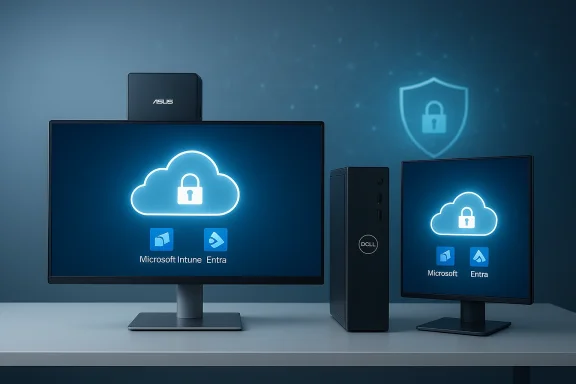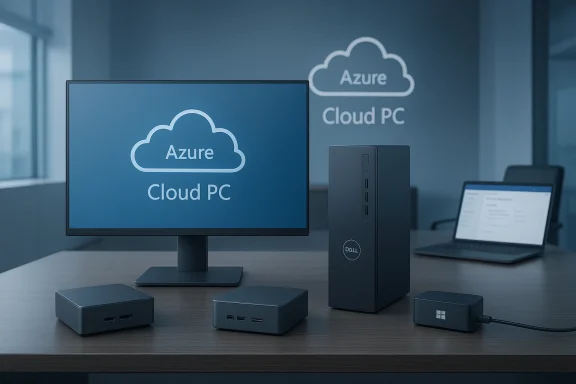
Microsoft has found two new hardware allies in its bid to make the cloud PC the default endpoint in many workplaces: ASUS and Dell will ship dedicated Windows 365 Cloud PC devices alongside Microsoft’s own Windows 365 Link hardware, expanding a product category that promises simpler management, tighter control over data, and a smaller local attack surface — but which also raises questions about network dependence, vendor lock‑in, and total cost of ownership.
Background / Overview
The cloud PC concept is straightforward: instead of running the full Windows desktop locally, an endpoint device boots directly into a cloud‑hosted Windows instance (a Cloud PC). The device’s local operating environment is minimalist — enough to attach peripherals, network, and authentication — while applications, user profiles, and data live in Azure. Microsoft has been selling the idea and the service under the Windows 365 banner for several years, and in 2025 introduced its own Windows 365 Link mini‑PC to demonstrate the model end‑to‑end.This week’s announcements broaden the hardware ecosystem. Microsoft’s Windows Experience blog and OEM briefings preview two partner devices targeted at enterprises: the ASUS NUC 16 for Windows 365 and the Dell Pro Desktop for Windows 365. Both are compact, can drive multiple displays, and are built around a locked‑down client OS that intentionally stores no user data locally. Microsoft says the Cloud PC device software will also add conveniences such as Bluetooth pairing during the out‑of‑box experience and customizable sign‑in branding for organisations. These changes position the devices as turnkey endpoints for organisations that want to centralise desktop compute and management in Azure rather than on physical machines.
What Microsoft, ASUS and Dell are shipping (and what they won’t yet tell you)
The new devices — the public facts
- ASUS NUC 16 for Windows 365 — ASUS describes this as a tiny 0.7‑liter mini‑PC that can be mounted behind displays and drive up to three displays. Microsoft’s announcement and ASUS’ CES coverage indicate support for DDR5 memory, Wi‑Fi 6E, 2.5GbE Ethernet, Bluetooth 5.3, HDMI, USB‑C and USB‑A ports. ASUS’ wider NUC 16 family includes models built around Intel Core Ultra processors, but Microsoft and ASUS have not published exact CPU SKUs for the Windows 365 variant. The device is slated for general availability in Q3 2026 in the US and Europe.
- Dell Pro Desktop for Windows 365 — Dell’s preview materials call this a fanless, compact desktop aimed at quiet operation and durability. Dell confirms support for up to three displays and emphasises flexible mounting and enterprise manageability through Microsoft Intune. Like ASUS, Dell has not released a full spec sheet for the Windows 365 edition; Microsoft’s blog references Intel N‑series processors for Dell’s Cloud PC device.
- Microsoft Windows 365 Link — Microsoft’s own Windows 365 Link (first sold in 2025) remains available. It’s a compact, fanless device with Wi‑Fi 6E, Bluetooth 5.3, multiple USB ports and dual‑4K display capability. The Link demonstrated Microsoft’s initial hardware design and formed the baseline user expectations for boot‑to‑cloud endpoints.
What is confirmed by multiple sources
- All three devices are purpose‑built to boot into a Cloud PC experience and are tightly integrated with Intune for management.
- Microsoft has updated the Cloud PC device OS to support Bluetooth pairing during setup and custom branding on sign‑in screens, features intended to smooth rollouts at scale.
- OEM positioning emphasises reduced local attack surface (no local apps/data) and simpler lifecycle for IT: deploy the device, enrol with Intune, and assign a Cloud PC profile.
Items vendors are still vague about (and why that matters)
- Exact processors and memory configurations for the Windows 365 SKUs are not fully disclosed by OEMs in the early previews. ASUS’ general NUC 16 family includes Intel Core Ultra chips; Dell references Intel N‑series, and Microsoft uses the phrase “latest Intel processor” for some materials. That ambiguity makes direct perf comparisons — particularly for video encoding/decoding or local media handling during Teams calls — hard for IT buyers to evaluate today.
- Local multimedia offload and remote protocol specifics. Vendors confirm local support for video codecs and hardware acceleration for conferencing, but organisations should demand detailed benchmarks for real‑world workloads (video conferencing, local USB peripherals, audio DSP, webcams) before widescale deployment.
- Pricing and bundling. OEMs are publishing availability windows but not full commercial packaging; Windows 365 subscription costs, Azure infrastructure spend, and selected device pricing combined will determine real TCO.
Why Microsoft and OEMs are pushing Cloud PC devices now
There are several concurrent market and strategic drivers behind this push:- Analysts have been clear that Desktop‑as‑a‑Service (DaaS) — hosted desktops delivered from the cloud — is moving from niche to mainstream. Industry analyst commentary in recent DaaS studies predicts accelerating adoption through 2027 as economics, remote work, and vendor offerings mature. Gartner’s DaaS guidance (summarised in public press coverage) suggests virtual desktops will become cost‑effective for a broad majority of workers by 2027 and could represent a primary workspace for a materially larger share of the workforce. That shift creates an opportunity for cloud‑first endpoints to replace or augment traditional PCs.
- The market shake‑up in virtualization software licensing after Broadcom’s acquisition of VMware has motivated some organisations to reconsider their VDI strategies. Broadcom’s licensing changes and ported product bundles have led to customers re‑evaluating whether they should keep on‑premises VDI stacks, move to hyperscaler DaaS offerings, or adopt alternative architectures. That uncertainty opens the door for Microsoft (Windows 365) and Azure‑centric device offerings.
- OEMs want to expand their endpoint portfolios beyond conventional laptops and desktops. Mini‑PCs and NUC‑style devices boardroom deployments, kiosks, hot‑desking, and managed office spaces — all of which map well to a Cloud PC form factor.
Practical benefits for IT (the sell)
- Simpler management and faster redeployment. With the OS image and user data in Azure, provisioning becomes an exercise of assigning a Cloud PC image and Intune policy rather than imaging a local disk and reinstalling apps. Devices can be reassigned and reused quickly.
- Reduced data exposure on lost or stolen devices. If an endpoint doesn’t store user files, data exfiltration risk from physical theft is lower; IT can wipe access centrally by de‑provisioning the associated Cloud PC instance.
- Lower endpoint support footprint. Thin, locked devices have fewer moving parts, fewer patch paths, and fewer user‑installed apps to troubleshoot.
- Predictable lifecycle and refresh. OEMs can supply compact, low‑power hardware designed for long life in a managed estate, simplifying replacement cycles and potentially improving sustainability metrics.
The technical and operational tradeoffs (the realities)
These benefits come with non‑trivial tradeoffs IT must weigh.1) Network dependence and user experience
A Cloud PC is effectively a streamed or remotely hosted desktop experience. That means:- Connectivity is critical. Latency, packet loss, and bandwidth constraints directly affect perceived responsiveness for interactive tasks (office apps, collaboration) and can further degrade GPU‑accelerated workloads. Organisations must audit LAN/WAN and home‑user broadband to ensure consistent performance.
- Offline scenarios are constrained. These devices are built around being always‑connected. Local productivity during network outages will be limited compared to a fully offline laptop, which matters for field operations, travel, and some frontline roles.
- Video conferencing requires careful design. While vendors say the devices will offload some encoding/decoding locally, complex conferencing topologies may still be sensitive to jitter and throughput. Expect to test real workloads (Teams/Zoom calls, shared screens, webcam use) to validate QoE.
2) Peripherals and local device support
- USB and specialized peripherals. Thin clients historically struggle when organisations rely on specialised USB devices (scanners, measurement equipment, dongles). While Windows 365 device firmware and protocol stacks are improving, IT must validate each peripheral class.
- Local AI/NPU acceleration. Many advanced Copilot+ or Windows AI features rely on local NPUs. Cloud PC devices may not include on‑device NPUs the way new Copilot+ PCs do, which limits some local AI experiences unless Microsoft’s streaming paths extend those features.
3) Cost model and vendor lock‑in
- Shifting costs to subscriptions. Windows 365 subscription fees and Azure compute/storage charges create a predictable monthly spend, but long‑term TCO depends on user density, workload sizing, and reserved capacity choices. In many scenarios thin clients plus Windows 365 will be cheaper to operate than fully provisioned laptops—especially for task or seasonal workers—but that’s not universal.
- Vendor lock‑in risk. The combination of Microsoft’s cloud services, Intune management, and closed client OS means switching away would have migration costs. Organisations that want vendor flexibility should plan exit strategies and test multi‑cloud or multi‑VDI architectures.
4) Security is both stronger and different
- Reduced local attack surface lowers some risks — but cloud‑centric architectures raise other exposure vectors: identity compromise, misconfigured cloud access, and dependence on the hypervisor/cloud provider security posture. Robust identity and conditional access controls become essential.
- Firmware and supply‑chain risk. Even a thin client has firmware and firmware update processes; attackers targeting firmware or the device provisioning chain could undermine the trust model.
How to evaluate Cloud PC devices in your environment: a practical checklist
- Map user personas. Identify which workers are best suited for Cloud PCs (call center, help desk, frontline, hot‑desk) and which are not (designers, engineers needing local GPUs, disconnected field roles).
- Network readiness audit. Measure latency, jitter, and available bandwidth across typical work locations and home networks. Test using representative workloads not synthetic benchmarks.
- Pilot with real workloads. Deploy a small fleet to power users who can provide measurable feedback: Teams calls, multi‑monitor sessions, peripheral‑heavy workflows.
- Cost scenario modelling. Build a 3‑year TCO model including device costs, Windows 365 seats, Azure compute/storage, network upgrades, and helpdesk savings.
- Security and identity design. Implement conditional access, MFA, device attestation, endpoint monitoring, and a cloud‑first incident response plan.
- Peripheral and hardware validation list. Test all specialized hardware (card readers, biometric devices, industrial scanners) before committing.
Use cases where Cloud PC devices shine
- Hot‑desking and shared workspaces. Devices that can mount behind displays and be swapped across users simplify flexible‑workspace strategies.
- Call centers and kiosks. Predictable device functionality and centralised desktop images reduce user churn and on‑floor support.
- Regulated environments with strict data locality rules. If the Cloud PC architecture and Azure tenancy meet regulatory requirements, organisations can reduce local endpoint risk while retaining controlled data residency.
- Seasonal or temporary staffing. Rapid provisioning and re‑assignment of Cloud PC profiles can be far quicker than procuring, imaging, and securing traditional laptops.
Strategic implications: how this changes the endpoint market
- OEMs competing for the post‑PC desktop. ASUS and Dell joining Microsoft’s partner ecosystem signals the start of a broader commodity market for Cloud PC endpoints. Expect other OEMs to follow with tailored designs for verticals (retail, healthcare, manufacturing).
- Hyperscaler consolidation. The shift from on‑premises VDI to DaaS places hyperscalers and their cloud services at the centre of endpoint strategy. Microsoft is positioning Windows 365 and Azure to capture a substantial portion of that transition.
- Pressure on on‑prem VDI vendors. Changes to VMware’s product and licensing strategy under Broadcom have accelerated re‑evaluation. Organisations migrating away from older on‑prem stacks may choose Windows 365, Azure Virtual Desktop, or alternatives like Citrix (where still appropriate), depending on workloads and contractual constraints.
Security deep dive: what you gain and what you must add
- Gains
- Minimal local attack surface means stolen devices are less likely to yield data.
- Centralized policy and telemetry via Intune allow consistent enforcement and faster remediation.
- Hardware‑mediated device attestation can be used to establish stronger trust chains at sign‑in.
- Must‑have controls
- Strong identity and credential safeguards. Passwordless MFA, conditional access policies, and continuous session verification.
- Network segmentation and SASE. Traffic engineering to ensure Cloud PC traffic uses appropriate security stacks and low‑latency paths.
- Cloud hygiene. Azure tenant hardening, subscription governance, role‑based access, and vigilant monitoring of resource usage to detect anomalies.
Risks that deserve explicit attention
- Silent performance failures. Poorly provisioned Azure sizing or a rushed migration can create invisible performance bottlenecks that erode user trust.
- Subscription inflation. Aggressive cloud consumption or poor pooling strategies can lead to subscription and infrastructure costs that outstrip savings on device maintenance.
- Regulatory and audit complexity. Sensitive data policies, eDiscovery, and forensics in a cloud PC model require retooling of compliance workflows.
- Single‑vendor exposure. Consolidating on a single cloud provider and management stack increases dependence on that vendor’s roadmap, pricing, and support quality.
A short buyer’s playbook (three‑month plan)
- Month 0–1: Discovery
- Classify users into personas, conduct network readiness sampling, and identify pilot candidates.
- Month 1–2: Pilot
- Purchase or arrange evaluation devices (Windows 365 Link and a partner device) and run a 30–60 day pilot focused on collaboration workloads, peripheral interoperability, and multi‑display setups.
- Month 2–3: Financial and security validation
- Run cost modelling and security posture checks. Confirm Azure sizing and Intune configuration. If results meet thresholds, expand to a defined business unit.
Conclusion — what to watch next
The arrival of ASUS’ NUC 16 for Windows 365 and Dell’s Pro Desktop for Windows 365 marks a pivotal moment: Cloud PC devices are transitioning from a Microsoft proof‑point into an OEM‑backed category. For enterprises, this means new choices — and new decisions. The architecture can simplify management and reduce endpoint risk, but those gains are contingent on robust networks, disciplined identity/security design, and careful cost management.Organisations should not treat these devices as a plug‑and‑play cure for endpoint complexity. Instead, run measured pilots, test real workloads, and model long‑term economics alongside security and compliance impacts. If you already run a strong cloud strategy, these devices can be an efficient next step toward a cloud‑centric workplace. If your environment depends on offline, high‑GPU, or specialised peripherals, expect a hybrid future where Cloud PC devices complement rather than replace traditional endpoints.
In short: the Cloud PC endpoint era is accelerating, but success will come to organisations that pair enthusiasm with rigorous technical and financial validation.
Source: theregister.com NUC, NUC! Who’s there? ASUS with a thin client for cloud PCs