

iFixit has challenged Asus’ 10/10 repairability rating for the 2025 ROG Flow Z13, finding that the Windows gaming tablet is notably easier to service than most thin performance machines—but not perfect.
As reported by Notebookcheck, iFixit’s teardown awards the Flow Z13 a 7/10. The dispute centers on the score Asus reports in France under the country’s repairability-label system, rather than a claim that the device is difficult to open or that routine component swaps are impossible.
The Flow Z13 gets several important design decisions right. Its display can be removed cleanly, opening access to internal hardware without an adhesive-heavy fight. The battery is held in with screws rather than glue, a meaningful advantage for a component that will eventually wear out. The M.2 SSD is accessible, as are the camera modules.
That matters for owners using the Z13 as an expensive portable Windows workstation or gaming machine. A battery replacement, storage upgrade, or display repair is less likely to require destructive disassembly than on many tablet-style PCs.
Asus’ own support site lists a service manual for the French edition of the 2025 GZ302 model, dated March 3, 2026. That is a positive development for repairers, although documentation is only one part of a practical repair ecosystem.
The repair specialist also criticized what it described as incomplete documentation and uneven replacement-parts availability, particularly for US customers. Those limits matter because a device is not meaningfully repairable to most owners if the necessary part cannot be purchased, or if the only viable fix is replacing the entire mainboard.
Under iFixit’s current scoring model, design accounts for 80% of a repairability score, while publicly available service documentation and official replacement-parts availability and cost account for 10% each. A 10/10 rating therefore implies more than straightforward access to an SSD and battery; it also signals a complete set of instructions and parts to support repairs.
But prospective owners should treat the French 10/10 label as a manufacturer-reported assessment, not proof of full modularity or long-term upgradeability. The 7/10 from iFixit is a more useful shorthand: good access to high-priority parts, but soldered core components and uncertain parts support cap what users can realistically repair.
For US buyers, the practical next step is to confirm local parts availability and service-manual coverage before treating the Flow Z13 as a machine designed for years of self-service.
As reported by Notebookcheck, iFixit’s teardown awards the Flow Z13 a 7/10. The dispute centers on the score Asus reports in France under the country’s repairability-label system, rather than a claim that the device is difficult to open or that routine component swaps are impossible.
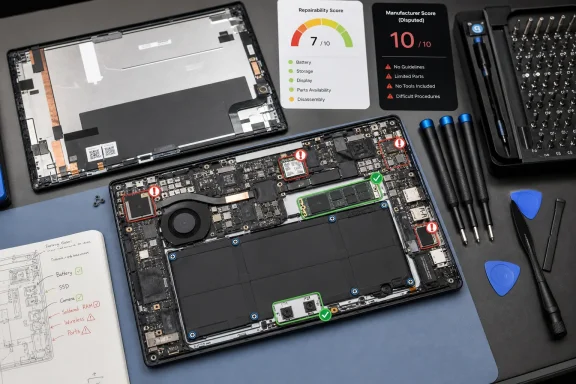 Good access to the parts most likely to fail
The Flow Z13 gets several important design decisions right. Its display can be removed cleanly, opening access to internal hardware without an adhesive-heavy fight. The battery is held in with screws rather than glue, a meaningful advantage for a component that will eventually wear out. The M.2 SSD is accessible, as are the camera modules.That matters for owners using the Z13 as an expensive portable Windows workstation or gaming machine. A battery replacement, storage upgrade, or display repair is less likely to require destructive disassembly than on many tablet-style PCs.
Asus’ own support site lists a service manual for the French edition of the 2025 GZ302 model, dated March 3, 2026. That is a positive development for repairers, although documentation is only one part of a practical repair ecosystem.
Where the perfect score falls apart
iFixit’s objections are less about opening the chassis and more about what can actually be replaced once inside. The RAM, wireless hardware, and ports are soldered to the motherboard. That rules out memory upgrades and turns a failed port or wireless component into a board-level repair or a costly motherboard replacement.The repair specialist also criticized what it described as incomplete documentation and uneven replacement-parts availability, particularly for US customers. Those limits matter because a device is not meaningfully repairable to most owners if the necessary part cannot be purchased, or if the only viable fix is replacing the entire mainboard.
Under iFixit’s current scoring model, design accounts for 80% of a repairability score, while publicly available service documentation and official replacement-parts availability and cost account for 10% each. A 10/10 rating therefore implies more than straightforward access to an SSD and battery; it also signals a complete set of instructions and parts to support repairs.
What Windows buyers should take from this
The ROG Flow Z13 still looks unusually service-friendly for a high-end detachable gaming PC. Buyers who expect to replace a battery, swap the SSD, or potentially service the screen have reason to view it more favorably than many sealed tablet-laptop hybrids.But prospective owners should treat the French 10/10 label as a manufacturer-reported assessment, not proof of full modularity or long-term upgradeability. The 7/10 from iFixit is a more useful shorthand: good access to high-priority parts, but soldered core components and uncertain parts support cap what users can realistically repair.
For US buyers, the practical next step is to confirm local parts availability and service-manual coverage before treating the Flow Z13 as a machine designed for years of self-service.
References
- Primary source: Notebookcheck
Published: 2026-07-14T03:33:00+00:00
iFixit disputes Asus ROG Flow Z13's perfect 10/10 repairability score - Notebookcheck News
iFixit has scrutinized Asus' perfect repairability rating for the ROG Flow Z13. While praising its accessible battery, display and SSD, the repair specialist gives the model a more modest rating owing to soldered components, among other things. www.notebookcheck.net
- Related coverage: rog.asus.com
ROG - Republic of Gamers|France | For Those Who Dare
rog.asus.com
- Related coverage: ifixit.com
Laptop Repairability Scores | Most Repairable Laptops - iFixit
Our engineers tear down the latest laptops and score their repairability from 0 to 10. What are the most repairable laptops? Let’s find out.www.ifixit.com - Related coverage: techradar.com
Asus ROG Flow Z13 review: great on-the-go gaming, but at a cost | TechRadar
While this device delivers great performance, what else would you expect for over $2,000?www.techradar.com - Related coverage: gamesradar.com
Asus ROG Flow Z13 (2025) review: "a true blend of power and portability" | GamesRadar+
The 2025 Asus ROG Flow Z13 is a hybrid device that never quite feels at home amongst either laptops or tablets. It’s still one of the best devices I’ve had the pleasure of testing, though.www.gamesradar.com - Related coverage: as.com
