

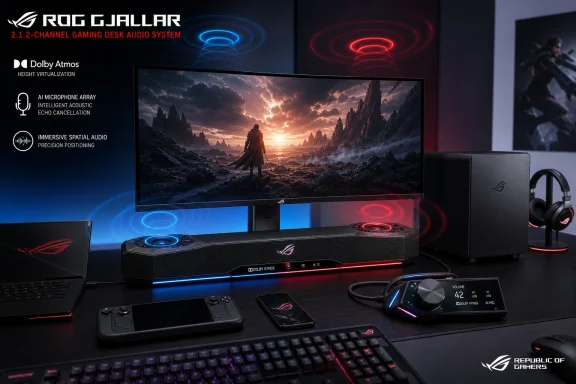
ASUS Republic of Gamers is entering a new corner of the premium gaming market with the ROG Gjallar, a compact 2.1.2-channel Dolby Atmos soundbar system that combines upward-firing speakers, a wireless subwoofer, an external control hub, and built-in acoustic echo cancellation microphones. The hardware is notable not simply because it is ROG’s first dedicated gaming soundbar, but because it treats listening, voice capture, device switching, and software-controlled signal processing as parts of one desktop platform. Gjallar suggests that the next battle in gaming peripherals may be fought over intelligent audio systems that can hear the player, suppress their speakers, manage several devices, and deliver spatial sound without requiring a headset.
Gaming audio has traditionally forced players to choose among three imperfect options. Headsets provide isolation, positional detail, and a microphone, but they can become uncomfortable during long sessions. Conventional desktop speakers sound more open and natural, yet consume valuable space and usually lack gaming-focused voice features, while television soundbars often work well for entertainment but are too large or poorly optimized for close-range desktop listening.
The ROG Gjallar attempts to collapse those categories into one system. ASUS has built it around a compact soundbar intended to sit below a monitor, a 6.5-inch wireless subwoofer, and a wired desktop control hub that also houses the microphone array.
That puts ASUS into more direct competition with Razer’s Leviathan family, SteelSeries’ Arena products, Creative’s Sound Blaster speakers, Logitech’s gaming audio ecosystem, and traditional audio companies adapting soundbars for monitors and desks. It also gives ROG another product capable of tying together a visually coordinated gaming setup.
A soundbar solves part of that problem by placing several drivers in the otherwise underused space beneath the display. The challenge is producing a wide and convincing soundstage from a comparatively narrow enclosure, particularly when the listener sits only a few feet away.
That positioning will create high expectations for output, bass integration, dialogue clarity, spatial accuracy, and price. At the time of announcement, ASUS had not disclosed final regional pricing or a comprehensive retail availability schedule, leaving the system’s ultimate value proposition unresolved.
Gjallar therefore combines left and right playback, dedicated low-frequency reproduction, and two upward-firing channels intended to create a sense of vertical space. It is more ambitious than an ordinary stereo soundbar, although it should not be confused with a full room-scale Atmos installation using physically separated surround and ceiling speakers.
The separate subwoofer uses a 6.5-inch driver and carries a stated 65-watt rating. It communicates with the main unit over a 5GHz wireless connection, an approach intended to reduce cable clutter while offering lower latency and more consistent bandwidth than a basic Bluetooth link.
The advantage will vary significantly by game, content format, seating position, room geometry, and Windows configuration. Upward-firing speakers depend on reflected sound, so a low or moderately high flat ceiling is generally more favorable than a vaulted, heavily treated, or acoustically irregular room.
That is still more space-efficient than many component speaker systems, especially around an ultrawide monitor. However, users should measure monitor-stand clearance, desk depth, and subwoofer placement before assuming that “compact” means effortless.
For Windows users, this makes installation and setup more important than it would be with a basic pair of stereo speakers. Incorrect output modes, virtual-surround layers, or application settings can flatten the presentation or apply processing twice.
That can produce an expansive result at a desk, where the listener occupies a relatively predictable position. It cannot completely recreate the spatial separation of speakers placed around and above a room, and competitive players should not assume that every Atmos preset will improve directional accuracy.
A sensible setup process is therefore sequential:
Gjallar may be more attractive for cinematic single-player games, racing titles, simulators, action games, local multiplayer, and general entertainment. It could still work for competitive play, but speaker leakage and microphone processing introduce variables that a closed headset avoids.
AEC attempts to prevent sound coming from the speakers from being captured and retransmitted through the microphone. Without it, teammates can hear their own voices, game effects, music, or delayed feedback coming through another player’s system.
The problem is dynamic. The acoustic path changes when the player moves, changes volume, relocates the microphone, opens a door, or places an object between the soundbar and control hub.
Effective cancellation therefore requires continuous adaptation. It must remove speaker output without aggressively damaging the user’s speech, producing robotic artifacts, clipping syllables, or suppressing quiet words.
Acoustic echo cancellation predates the current AI boom by decades. Traditional adaptive filters, digital signal processors, and statistical techniques can perform it without the kind of neural processing consumers now associate with AI-branded PCs.
Calling every advanced audio filter “AI” risks obscuring the engineering that actually matters. Buyers need practical evidence about echo rejection, voice naturalness, latency, background-noise handling, and resilience at high speaker volume—not merely an intelligence label.
That arrangement may improve the ratio between the user’s voice and surrounding noise. It could also make performance more predictable if ASUS specifies a recommended location, although moving the hub around the desk will still alter the acoustic conditions the cancellation system must manage.
This reflects an important trend in premium peripherals: physical controls are returning after years of software-only customization. Players want immediate access to frequently used settings without opening an application or leaving a full-screen game.
The display can make the system easier to understand by showing the active input or profile. Its long-term usefulness will depend on readability, viewing angles, interface responsiveness, and whether the most common operations require unnecessary menus.
It also creates an ecosystem opportunity. Future ROG speakers, headsets, microphones, streaming controls, and software profiles could potentially share a common control architecture, turning the hub into a recognizable feature across several product generations.
Its value will therefore depend on whether it can replace other controls. If it becomes the user’s primary audio interface, it earns its footprint; if most settings still require software, it risks becoming an elaborate volume knob.
That variety is crucial because the modern gaming desk no longer revolves around one Windows tower. A sound system may need to serve a PC, Mac, PlayStation, Xbox, Nintendo Switch, handheld gaming PC, television, work laptop, and phone.
The implementation will need independent testing. Buyers will want confirmation of variable refresh rate behavior, HDR formats, audio-format support, wake and sleep reliability, lip synchronization, and compatibility with different GPUs, consoles, displays, and cables.
Windows audio devices are vulnerable to driver conflicts, default-device changes, sleep-state problems, and application-specific routing. ASUS must make the Gjallar behave reliably as both an output and an input if it wants the system to replace separate speakers and a desktop microphone.
The breadth of connections is one of Gjallar’s strongest practical arguments. A premium soundbar earns its place more easily when it serves the entire desk rather than one computer.
ASUS is directing Gjallar users toward Gear Link for equalizer tuning, RGB settings, and microphone adjustments. This gives the company an opportunity to provide a cleaner experience than traditional peripheral suites, but it also introduces questions about account requirements, firmware updates, profile storage, and long-term support.
The software should also explain complex options in plain language. Users should not need to understand adaptive filters or channel matrices simply to prevent teammates from hearing an echo.
Without on-device memory, the experience could become inconsistent across sources. A carefully tuned microphone profile on Windows would be less valuable if the system reverted to an unsuitable default whenever it was connected to a console.
Synchronization will matter more than the number of colors. Users with ROG keyboards, mice, motherboards, monitors, and cases will expect the soundbar to participate in coordinated lighting without requiring another independent process.
That includes echo cancellation, noise suppression, beamforming, automatic gain control, voice isolation, head tracking, room correction, personalized hearing profiles, and context-sensitive equalization. Some of these capabilities use machine learning; others rely on conventional digital signal processing; the best products may combine both.
Software platforms are advancing in parallel. Windows, voice-chat applications, streaming tools, GPU utilities, and game engines can all perform overlapping forms of audio enhancement, creating both opportunity and confusion.
A future gaming audio system could determine whether the user is playing competitively, watching a film, joining a meeting, speaking to an in-game character, or listening to music. It could then select an appropriate sound field, microphone pattern, dynamic range, and noise policy automatically.
Dedicated local processors can respond immediately while keeping raw audio on the device. This makes intelligent audio a natural application for edge computing, even if the marketing language eventually settles on terms other than AI.
That could be valuable for users who experience headset fatigue, share a room with another person, or want cinematic sound without installing rear speakers. It may also suit content creators who need rapid control over several sources.
Open microphones can also capture household speech unless voice isolation is effective. Users should not interpret echo cancellation as a complete privacy system.
A single-user home office could benefit from the same AEC technology that helps a gamer communicate over loud speakers. The control hub’s proximity to the user may also be preferable to relying on microphones embedded in a distant monitor or laptop.
Gjallar could follow that pattern for users who alternate between games and video meetings at the same desk. However, enterprise adoption would require more than strong specifications.
RGB lighting and aggressive ROG branding could limit Gjallar’s formal workplace appeal. The underlying architecture, however, could inform a future ASUS business audio product with more conservative design and enterprise management features.
Gjallar takes a different approach. Rather than focusing primarily on personalizing the sound beam, ASUS is emphasizing speaker-based voice communication, Atmos height effects, connectivity, and an external control center.
Both address weaknesses inherent in desktop speakers. Beamforming tackles the narrow listening sweet spot, while AEC tackles feedback and voice-chat contamination.
Regional availability will matter as well. ROG products sometimes reach different markets on different schedules, and the absence of a clear local release can weaken momentum after an announcement.
Voice quality should be evaluated separately from echo removal. An algorithm can suppress feedback effectively while making the speaker sound thin, metallic, or intermittently clipped.
Reviewers should also determine whether Atmos setup is automatic or requires manual Windows configuration. A feature that works only after extensive troubleshooting will have limited mainstream appeal.
ASUS could also use room sensing, listener detection, or automatic calibration in a future premium model. If Gjallar succeeds, competitors are likely to accelerate their own combinations of microphones, beamforming, spatial rendering, and software-controlled routing.
Gjallar does not prove that artificial intelligence has conquered the gaming desk, and ASUS should not receive an automatic AI halo simply for implementing acoustic echo cancellation. It does, however, show where gaming audio is heading: away from passive speakers and isolated peripherals, and toward adaptive systems that coordinate playback, voice capture, spatial processing, physical controls, and multiple platforms. If Gjallar can deliver natural voice communication while producing convincing cinematic sound at a competitive price, it will make intelligent audio one of the most consequential new fronts in the gaming-peripheral market—and force rivals to compete on far more than volume, bass, and RGB lighting.
 Background
Gaming audio has traditionally forced players to choose among three imperfect options. Headsets provide isolation, positional detail, and a microphone, but they can become uncomfortable during long sessions. Conventional desktop speakers sound more open and natural, yet consume valuable space and usually lack gaming-focused voice features, while television soundbars often work well for entertainment but are too large or poorly optimized for close-range desktop listening.The ROG Gjallar attempts to collapse those categories into one system. ASUS has built it around a compact soundbar intended to sit below a monitor, a 6.5-inch wireless subwoofer, and a wired desktop control hub that also houses the microphone array.
ROG moves beyond headsets
ASUS already sells gaming headsets, microphones, motherboards with elaborate audio subsystems, and other products that touch the audio chain. Gjallar is nevertheless a meaningful expansion because it turns ROG into a competitor in complete desktop speaker systems rather than merely personal audio.That puts ASUS into more direct competition with Razer’s Leviathan family, SteelSeries’ Arena products, Creative’s Sound Blaster speakers, Logitech’s gaming audio ecosystem, and traditional audio companies adapting soundbars for monitors and desks. It also gives ROG another product capable of tying together a visually coordinated gaming setup.
Why soundbars are returning to the gaming desk
Modern displays are growing wider while desktop systems are becoming more complicated. Ultrawide monitors, handheld docks, consoles, work laptops, streaming devices, and gaming PCs can all occupy the same desk, leaving less room for separate left and right speakers.A soundbar solves part of that problem by placing several drivers in the otherwise underused space beneath the display. The challenge is producing a wide and convincing soundstage from a comparatively narrow enclosure, particularly when the listener sits only a few feet away.
The meaning behind Gjallar
ASUS says the product’s name is inspired by Gjallarhorn, the powerful horn associated with Norse mythology. The choice follows ROG’s established preference for dramatic naming, but it also communicates the intended positioning: this is supposed to be a commanding, cinematic audio system rather than an inexpensive replacement for weak monitor speakers.That positioning will create high expectations for output, bass integration, dialogue clarity, spatial accuracy, and price. At the time of announcement, ASUS had not disclosed final regional pricing or a comprehensive retail availability schedule, leaving the system’s ultimate value proposition unresolved.
The Gjallar Hardware Explained
The headline specification is 2.1.2-channel Dolby Atmos audio. In home-theater terminology, the first number represents the main horizontal channels, the second denotes a subwoofer channel, and the final number refers to height channels.Gjallar therefore combines left and right playback, dedicated low-frequency reproduction, and two upward-firing channels intended to create a sense of vertical space. It is more ambitious than an ordinary stereo soundbar, although it should not be confused with a full room-scale Atmos installation using physically separated surround and ceiling speakers.
Six soundbar drivers and a separate subwoofer
ASUS has equipped the bar with left and right full-range drivers, two dedicated tweeters, and two upward-firing speakers. The upward-firing channels can be disabled, which should help when listening to conventional stereo material or using the system in a room where reflected height effects do not work well.The separate subwoofer uses a 6.5-inch driver and carries a stated 65-watt rating. It communicates with the main unit over a 5GHz wireless connection, an approach intended to reduce cable clutter while offering lower latency and more consistent bandwidth than a basic Bluetooth link.
Why the 2.1.2 layout matters
Many games now contain sophisticated three-dimensional audio engines, but speakers can reproduce only what their physical placement and processing permit. A height-capable system has the potential to make aircraft, weather, environmental effects, and action occurring above the player feel more convincing.The advantage will vary significantly by game, content format, seating position, room geometry, and Windows configuration. Upward-firing speakers depend on reflected sound, so a low or moderately high flat ceiling is generally more favorable than a vaulted, heavily treated, or acoustically irregular room.
Compact design, substantial system
The soundbar itself is designed to fit beneath a monitor, but the complete package is not truly a one-piece solution. Buyers must also accommodate the wireless subwoofer and desktop control hub, along with power, HDMI, USB, or other connection cables.That is still more space-efficient than many component speaker systems, especially around an ultrawide monitor. However, users should measure monitor-stand clearance, desk depth, and subwoofer placement before assuming that “compact” means effortless.
Dolby Atmos on a Windows Gaming Desktop
Dolby Atmos is one of Gjallar’s strongest marketing features, but the logo alone cannot guarantee convincing spatial audio. The result depends on the source, operating system, application, connection method, speaker configuration, and quality of the soundbar’s processing.For Windows users, this makes installation and setup more important than it would be with a basic pair of stereo speakers. Incorrect output modes, virtual-surround layers, or application settings can flatten the presentation or apply processing twice.
Native channels versus virtualization
A 2.1.2 system has genuine height-oriented drivers, but it does not contain discrete rear speakers. It must therefore combine physical playback with digital processing to represent a larger multichannel environment.That can produce an expansive result at a desk, where the listener occupies a relatively predictable position. It cannot completely recreate the spatial separation of speakers placed around and above a room, and competitive players should not assume that every Atmos preset will improve directional accuracy.
Avoiding double processing
Windows gaming systems frequently accumulate multiple sound enhancements. A user may have Windows spatial sound, a game’s binaural-headphone mode, Dolby processing, motherboard software, GPU audio features, and the peripheral’s own equalization enabled simultaneously.A sensible setup process is therefore sequential:
- Connect the soundbar through the most appropriate digital interface, preferably USB-C or HDMI when the desired features require it.
- Confirm that Windows detects the intended channel and sample configuration rather than falling back to generic stereo.
- Choose one primary spatial-processing path and disable unnecessary competing virtualizers.
- Test both native multichannel and stereo content before changing the equalizer.
- Verify voice-chat behavior with the speakers at realistic volume, not only during a quiet microphone check.
- Save separate profiles for games, films, music, and communication if the software permits rapid switching.
Competitive gaming remains a special case
Headphones still offer major advantages in esports and other sound-sensitive competitive games. They isolate external noise, limit room reflections, and deliver positional cues directly to each ear without requiring speakers to overcome the acoustics of the room.Gjallar may be more attractive for cinematic single-player games, racing titles, simulators, action games, local multiplayer, and general entertainment. It could still work for competitive play, but speaker leakage and microphone processing introduce variables that a closed headset avoids.
The AEC Microphone Is the Real Differentiator
The most strategically interesting component may not be the Dolby Atmos speaker system. It is the acoustic echo cancellation microphone array built into the external control hub.AEC attempts to prevent sound coming from the speakers from being captured and retransmitted through the microphone. Without it, teammates can hear their own voices, game effects, music, or delayed feedback coming through another player’s system.
How acoustic echo cancellation works
An AEC system receives a reference representation of the audio being sent to the speakers. It models how that signal travels through the speakers, room, furniture, and air before reaching the microphones, then estimates and subtracts the resulting echo from the captured signal.The problem is dynamic. The acoustic path changes when the player moves, changes volume, relocates the microphone, opens a door, or places an object between the soundbar and control hub.
Effective cancellation therefore requires continuous adaptation. It must remove speaker output without aggressively damaging the user’s speech, producing robotic artifacts, clipping syllables, or suppressing quiet words.
AEC is intelligent processing, but not automatically AI
ASUS describes the Gjallar microphone system as intelligent, and modern echo-cancellation pipelines may incorporate machine-learning models. However, AEC itself is not inherently artificial intelligence, nor has ASUS publicly established that Gjallar runs a generative or neural AI model dedicated to voice processing.Acoustic echo cancellation predates the current AI boom by decades. Traditional adaptive filters, digital signal processors, and statistical techniques can perform it without the kind of neural processing consumers now associate with AI-branded PCs.
Calling every advanced audio filter “AI” risks obscuring the engineering that actually matters. Buyers need practical evidence about echo rejection, voice naturalness, latency, background-noise handling, and resilience at high speaker volume—not merely an intelligence label.
Why microphone placement is clever
Putting the microphones in the control hub rather than the soundbar creates several potential advantages. The hub can sit closer to the player, reducing the distance between voice and microphone while allowing the soundbar to remain beneath the display.That arrangement may improve the ratio between the user’s voice and surrounding noise. It could also make performance more predictable if ASUS specifies a recommended location, although moving the hub around the desk will still alter the acoustic conditions the cancellation system must manage.
The Control Hub Becomes the Center of the Experience
The Gjallar control hub is more than an oversized volume wheel. It provides access to volume, playback functions, input selection, equalizer profiles, RGB lighting, and microphone controls, while an integrated display communicates system status.This reflects an important trend in premium peripherals: physical controls are returning after years of software-only customization. Players want immediate access to frequently used settings without opening an application or leaving a full-screen game.
Physical controls reduce software friction
A dedicated volume dial is faster and more dependable than searching for the correct Windows mixer or keyboard shortcut. Physical input buttons are similarly useful in a setup shared by a gaming PC, console, laptop, and phone.The display can make the system easier to understand by showing the active input or profile. Its long-term usefulness will depend on readability, viewing angles, interface responsiveness, and whether the most common operations require unnecessary menus.
The hub is also a strategic anchor
By combining microphone capture and speaker control, ASUS can coordinate the audio playback and recording paths. That integration is particularly helpful for AEC because the system has direct knowledge of what it is playing and what its microphones are hearing.It also creates an ecosystem opportunity. Future ROG speakers, headsets, microphones, streaming controls, and software profiles could potentially share a common control architecture, turning the hub into a recognizable feature across several product generations.
One more device on an already crowded desk
The trade-off is obvious: the hub occupies desk space and requires a wired connection to the soundbar. Users who prefer a minimalist setup may see it as another box competing with a keyboard, mouse, charging dock, stream controller, and work equipment.Its value will therefore depend on whether it can replace other controls. If it becomes the user’s primary audio interface, it earns its footprint; if most settings still require software, it risks becoming an elaborate volume knob.
Connectivity May Be Gjallar’s Most Practical Strength
ASUS has given Gjallar an unusually broad collection of inputs: USB-C, HDMI 2.1 with eARC, optical audio, auxiliary analog input, and Bluetooth 5.3. The soundbar also contains two USB Type-A ports that function as a small integrated hub.That variety is crucial because the modern gaming desk no longer revolves around one Windows tower. A sound system may need to serve a PC, Mac, PlayStation, Xbox, Nintendo Switch, handheld gaming PC, television, work laptop, and phone.
HDMI 2.1 and eARC
ASUS says the HDMI connection supports eARC and pass-through of video signals up to 4K at 120Hz. That makes the product more relevant to current-generation consoles and high-refresh televisions or monitors than soundbars limited to older HDMI bandwidth.The implementation will need independent testing. Buyers will want confirmation of variable refresh rate behavior, HDR formats, audio-format support, wake and sleep reliability, lip synchronization, and compatibility with different GPUs, consoles, displays, and cables.
USB-C for Windows PCs
USB-C should provide a relatively straightforward digital audio path for desktop and laptop users. It may also enable tighter integration with Gear Link, ASUS’s configuration software, although the exact division between hardware controls and application settings will matter.Windows audio devices are vulnerable to driver conflicts, default-device changes, sleep-state problems, and application-specific routing. ASUS must make the Gjallar behave reliably as both an output and an input if it wants the system to replace separate speakers and a desktop microphone.
Optical, AUX, and Bluetooth remain useful
Optical audio helps with older televisions, consoles, docks, and PCs, while analog AUX preserves compatibility with traditional sources. Bluetooth 5.3 adds convenience for phones, tablets, and casual listening, though it may not be the preferred path for latency-sensitive gaming.The breadth of connections is one of Gjallar’s strongest practical arguments. A premium soundbar earns its place more easily when it serves the entire desk rather than one computer.
Windows and Software Integration Will Decide the Outcome
Gaming peripherals increasingly live or die by their software. Strong hardware can become frustrating when configuration tools are slow, intrusive, unstable, or dependent on large background services.ASUS is directing Gjallar users toward Gear Link for equalizer tuning, RGB settings, and microphone adjustments. This gives the company an opportunity to provide a cleaner experience than traditional peripheral suites, but it also introduces questions about account requirements, firmware updates, profile storage, and long-term support.
The ideal Windows experience
A well-integrated Gjallar should appear in Windows as clearly labeled playback and recording devices. Volume synchronization should work consistently, microphone mute status should remain obvious, and firmware updates should not reset saved settings.The software should also explain complex options in plain language. Users should not need to understand adaptive filters or channel matrices simply to prevent teammates from hearing an echo.
On-device profiles matter
Hardware-stored profiles would allow EQ and microphone settings to follow the soundbar between PCs and consoles. That capability becomes particularly important when some platforms cannot run ASUS configuration software.Without on-device memory, the experience could become inconsistent across sources. A carefully tuned microphone profile on Windows would be less valuable if the system reverted to an unsuitable default whenever it was connected to a console.
RGB is secondary but commercially important
Gjallar supports customizable RGB lighting with millions of colors and several preset effects. Lighting does nothing for audio quality, yet it helps ASUS sell the soundbar as part of a complete ROG environment rather than a generic black speaker.Synchronization will matter more than the number of colors. Users with ROG keyboards, mice, motherboards, monitors, and cases will expect the soundbar to participate in coordinated lighting without requiring another independent process.
Is AI Audio the Next Peripheral Battleground?
The short answer is yes, but not because every peripheral will suddenly run a large language model. The more credible transformation involves specialized real-time processing that makes audio devices adapt to users and environments with less manual intervention.That includes echo cancellation, noise suppression, beamforming, automatic gain control, voice isolation, head tracking, room correction, personalized hearing profiles, and context-sensitive equalization. Some of these capabilities use machine learning; others rely on conventional digital signal processing; the best products may combine both.
The battle has already started
Razer previously brought head-tracking and adaptive beamforming to the Leviathan V2 Pro, directing audio toward the listener through a dynamically maintained sweet spot. Headset vendors increasingly promote neural noise reduction, personalized spatial profiles, and automatic microphone processing.Software platforms are advancing in parallel. Windows, voice-chat applications, streaming tools, GPU utilities, and game engines can all perform overlapping forms of audio enhancement, creating both opportunity and confusion.
The endpoint becomes intelligent
Historically, a speaker reproduced an input signal and a microphone captured whatever reached it. Intelligent peripherals attempt to understand the context around those signals.A future gaming audio system could determine whether the user is playing competitively, watching a film, joining a meeting, speaking to an in-game character, or listening to music. It could then select an appropriate sound field, microphone pattern, dynamic range, and noise policy automatically.
Local processing has strategic value
Real-time audio functions benefit from running locally because latency is critical. Sending microphone audio to a cloud service for echo cancellation would add delay, consume bandwidth, and raise privacy concerns.Dedicated local processors can respond immediately while keeping raw audio on the device. This makes intelligent audio a natural application for edge computing, even if the marketing language eventually settles on terms other than AI.
Consumer Impact
For consumers, Gjallar’s appeal is easiest to understand as a convenience proposition. It promises one audio system for games, movies, music, communication, consoles, and mobile devices, with fewer reasons to wear a headset.That could be valuable for users who experience headset fatigue, share a room with another person, or want cinematic sound without installing rear speakers. It may also suit content creators who need rapid control over several sources.
Who is most likely to benefit
The strongest prospective audiences include:- Single-player and simulation gamers who prioritize atmosphere, bass, and a broad soundstage over maximum acoustic isolation.
- Multiplatform players who regularly switch among Windows PCs, consoles, handhelds, and mobile devices.
- Users with ultrawide displays who lack space for conventional left and right speakers.
- Players who dislike headsets but still need integrated voice communication.
- Hybrid entertainment users who want one desktop system for gaming, streaming video, music, and calls.
- ROG ecosystem buyers who value visual and software consistency across their setup.
Privacy and social considerations
A headset keeps most game audio private. A soundbar does not, and AEC only prevents the microphone from retransmitting speaker output; it does not stop other people in the room from hearing the game or conversation.Open microphones can also capture household speech unless voice isolation is effective. Users should not interpret echo cancellation as a complete privacy system.
Enterprise and Hybrid-Work Potential
Gjallar is designed and branded for gaming, not corporate conference rooms. Even so, its combination of speaker playback, desktop microphone capture, physical controls, and broad connectivity overlaps with equipment used for remote work.A single-user home office could benefit from the same AEC technology that helps a gamer communicate over loud speakers. The control hub’s proximity to the user may also be preferable to relying on microphones embedded in a distant monitor or laptop.
Gaming hardware crossing into work
Gaming peripherals often adopt high-performance features before mainstream office equipment. High-refresh displays, mechanical keyboards, advanced webcams, noise-reducing microphones, and powerful GPUs have all crossed into professional workflows.Gjallar could follow that pattern for users who alternate between games and video meetings at the same desk. However, enterprise adoption would require more than strong specifications.
What businesses would require
Corporate buyers typically expect predictable drivers, centralized deployment, long support windows, documented privacy behavior, and compatibility with major conferencing platforms. They may also want restrained styling, security documentation, replaceable cables, and straightforward warranty service.RGB lighting and aggressive ROG branding could limit Gjallar’s formal workplace appeal. The underlying architecture, however, could inform a future ASUS business audio product with more conservative design and enterprise management features.
Competitive Implications
ASUS is not the first company to add intelligent processing to a gaming soundbar. Razer’s Leviathan V2 Pro made AI head tracking and adaptive beamforming central to its identity, while SteelSeries has emphasized software-driven audio routing and processing through its Sonar ecosystem.Gjallar takes a different approach. Rather than focusing primarily on personalizing the sound beam, ASUS is emphasizing speaker-based voice communication, Atmos height effects, connectivity, and an external control center.
A different definition of intelligence
Razer’s approach asks the soundbar to follow the listener. ASUS asks the system to distinguish between the sound it is playing and the voice it should transmit.Both address weaknesses inherent in desktop speakers. Beamforming tackles the narrow listening sweet spot, while AEC tackles feedback and voice-chat contamination.
The likely competitor response
Competitors now have several routes available:- They can add microphone arrays and AEC to existing gaming soundbars.
- They can integrate head tracking, room sensing, and voice isolation into one system.
- They can offer smarter switching between speakers and headsets.
- They can bundle soundbars with software mixers and streaming controls.
- They can undercut premium systems with simpler stereo bars using software-based spatial processing.
- They can partner with PC and console platforms to simplify setup and certification.
Strengths and Opportunities
Gjallar brings together several ideas that have often been sold as separate products. Its opportunity lies in making that integration feel coherent rather than complicated.- The 2.1.2 layout provides genuine height-oriented hardware, giving Dolby Atmos processing more to work with than a basic stereo bar.
- The wireless 65-watt subwoofer should add physical impact that compact monitor speakers and single-enclosure soundbars struggle to reproduce.
- The AEC microphone hub could make speaker-based multiplayer communication practical, reducing dependence on headsets.
- HDMI 2.1 eARC, USB-C, optical, AUX, and Bluetooth 5.3 support a broad device mix, increasing the product’s usefulness and lifespan.
- The integrated USB hub can reduce cable runs to the PC, particularly for nearby controllers, receivers, or other low-bandwidth accessories.
- Physical controls and a status display reduce reliance on Windows menus, which is valuable during full-screen gaming.
- Gear Link customization gives ASUS room to improve performance through firmware and software, assuming support remains consistent.
- The system could become the foundation of a larger ROG desktop-audio family, including lower-cost bars, premium room-sensing models, and business-oriented variants.
Risks and Concerns
The specification sheet is promising, but several unresolved issues could determine whether Gjallar becomes a category leader or an expensive niche accessory.- Pricing remains the largest unknown. Gjallar must compete with gaming soundbars, powered speakers, home-theater products, headsets, and separate microphones.
- AEC quality must be proven at realistic listening levels. Removing echo in a quiet demonstration is easier than preserving natural speech beside explosions and a powerful subwoofer.
- Dolby Atmos performance will depend heavily on room conditions. Upward-firing channels cannot guarantee convincing height effects in every space.
- Windows configuration could become confusing. Multiple spatial, equalization, and noise-processing layers may conflict.
- Wireless subwoofer stability and latency require independent testing. Crowded 5GHz environments can challenge wireless devices.
- HDMI pass-through must preserve modern gaming features. Buyers will expect reliable 4K at 120Hz, HDR, variable refresh rate, and synchronization.
- The external hub adds clutter. Its functionality must justify the desk space and cable.
- Software longevity is uncertain. Premium peripherals can outlast the applications used to configure them.
- AI-oriented marketing may overpromise. AEC is useful signal processing, but customers should judge audible results rather than terminology.
- Open-air communication cannot match a headset in every environment. Privacy, room noise, and household disruption remain unavoidable considerations.
What to Watch Next
The Gjallar announcement establishes ASUS’s intentions, but independent reviews and final commercial details will determine its significance. Several specific developments deserve attention.Price and regional release dates
The first question is whether ASUS positions Gjallar against midrange gaming speaker systems or premium products such as Razer’s most advanced Leviathan models. A high price could be defensible if the AEC microphone, Atmos implementation, HDMI support, and control hub all perform exceptionally well.Regional availability will matter as well. ROG products sometimes reach different markets on different schedules, and the absence of a clear local release can weaken momentum after an announcement.
Real-world microphone tests
Reviewers should test Gjallar with game audio, teammate speech, music, keyboard noise, desk vibration, and varying speaker levels. Comparisons against a dedicated USB microphone, a laptop array, and a conventional gaming headset would reveal whether the integrated AEC is transformative or merely convenient.Voice quality should be evaluated separately from echo removal. An algorithm can suppress feedback effectively while making the speaker sound thin, metallic, or intermittently clipped.
HDMI and Windows compatibility
Testing should cover AMD, Intel, and Nvidia graphics systems; modern consoles; high-refresh monitors; televisions; sleep and wake cycles; and common conferencing and chat applications. The behavior of the microphone across USB, HDMI, and other input modes should be documented clearly.Reviewers should also determine whether Atmos setup is automatic or requires manual Windows configuration. A feature that works only after extensive troubleshooting will have limited mainstream appeal.
Expansion into a broader ROG audio platform
The most important strategic signal will be whether ASUS extends similar processing to future products. A coordinated family of headsets, microphones, speakers, and control hubs could allow users to switch intelligently between private and open-air audio.ASUS could also use room sensing, listener detection, or automatic calibration in a future premium model. If Gjallar succeeds, competitors are likely to accelerate their own combinations of microphones, beamforming, spatial rendering, and software-controlled routing.
Gjallar does not prove that artificial intelligence has conquered the gaming desk, and ASUS should not receive an automatic AI halo simply for implementing acoustic echo cancellation. It does, however, show where gaming audio is heading: away from passive speakers and isolated peripherals, and toward adaptive systems that coordinate playback, voice capture, spatial processing, physical controls, and multiple platforms. If Gjallar can deliver natural voice communication while producing convincing cinematic sound at a competitive price, it will make intelligent audio one of the most consequential new fronts in the gaming-peripheral market—and force rivals to compete on far more than volume, bass, and RGB lighting.
References
- Primary source: The Futurum Group
Published: 2026-07-21T15:30:10.091785
AI-Enhanced Audio Gaming: ASUS ROG Gjallar
ASUS ROG Gjallar redefines gaming with AI-enhanced audio, spatial sound, and smart microphones. Explore the future of gaming peripherals.futurumgroup.com - Related coverage: rog.asus.com
- Related coverage: soundguys.com
ASUS just launched a soundbar that could be perfect for your gaming setup
ASUS has announced the launch of the Gjallar Gaming Soundbar, a compact soundbar that comes with a subwoofer and control hub.www.soundguys.com - Related coverage: notebookcheck.net
Asus launches ROG Gjallar Gaming Soundbar with a wireless subwoofer and audio control hub - Notebookcheck News
Asus has announced the ROG Gjallar Gaming Soundbar which includes a compact soundbar, a wireless subwoofer, and an audio control hub. The audio setup has multiple connectivity features and is compatible with modern consoles, mobile devices, and PCs. www.notebookcheck.net
- Related coverage: the-gadgeteer.com
ASUS ROG Gjallar: ROG's First Gaming Soundbar
The ROG Gjallar is ASUS's first gaming soundbar with 2.1.2 Dolby Atmos, a 65W wireless subwoofer, AEC mics, and HDMI 2.1 eARC. Here's what stands out.the-gadgeteer.com - Related coverage: specclear.com
ASUS ROG Gjallar Gaming Soundbar — What It Is and Should You Buy It? | SpecClear
ASUS announced the ROG Gjallar on July 9, 2026 — a 2.1.2 Dolby Atmos gaming soundbar with HDMI 2.1, wireless subwoofer, and built-in AEC microphones. No price yet. Here's the honest breakdown.specclear.com