

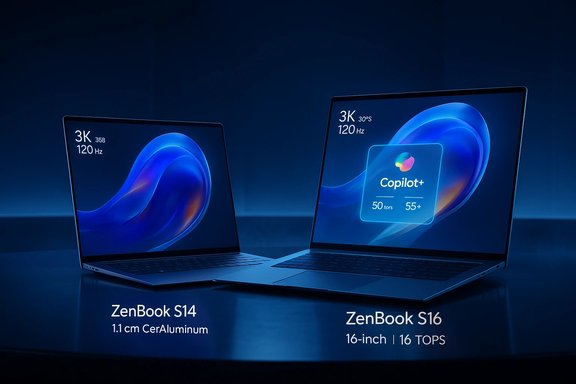
ASUS’s CES refresh treats two of its best-loved ultraportables— the ZenBook S14 and ZenBook S16— to a full generational update: thinner, smarter materials, brighter OLED displays and the very latest AI-capable silicon from Intel and AMD. The S14 moves to Intel’s Core Ultra Series 3 “Panther Lake” family with an on‑chip NPU rated up to 50 TOPS, while the S16 swaps to AMD’s refreshed Ryzen AI 400 (Gorgon Point) silicon with XDNA NPUs rated in the mid‑50s TOPS. Both laptops are explicitly positioned as Copilot+ capable and feature similar 3K 16:10 120 Hz Lumina OLED displays with HDR peaks around 1,100 nits—deliberate moves that aim to balance creative workflows, everyday productivity and on‑device AI features for Windows users.
ASUS unveiled the new ZenBook S14 (UX5406) and ZenBook S16 (UX5606/UM5606) at CES 2026 as part of a broader ZenBook refresh that leans heavily on on‑device AI as a selling point. The S14 is an ultra‑thin 14‑inch model that the company says measures just 1.1 cm and weighs ~1.2 kg (about 2.65–2.76 lbs depending on SKU), while the S16 is a slightly heavier 16‑inch alternative aimed at creators who want a larger canvas without a big weight penalty. Both machines use ASUS’s new “Ceraluminum” lid material and updated ZenBook styling. These announcements arrive at the same time Intel launched Core Ultra Series 3 (Panther Lake) and AMD refreshed its Ryzen AI family (Gorgon Point / Ryzen AI 400 series), so ASUS’s timing ties tightly to the silicon roadmap: Intel for the S14, AMD for the S16. That dual‑vendor approach gives buyers a clear platform choice—Intel’s latest on‑package Arc GPU + NPU or AMD’s Zen‑5‑based APUs with XDNA NPUs—while keeping the rest of the hardware (displays, chassis design, port choices) consistent across both product lines.
Caveat and verification: vendor materials list these security stacks as available on certain SKUs; enterprise or IT buyers should confirm exact SKU configurations (Windows 11 Pro enterprise options, Pluton support, and manageability tooling) for their fleets prior to purchase.
Source: Windows Central https://www.windowscentral.com/hard...freshed-zenbook-s14-and-zenbook-s14-ces-2026/
 Background / Overview
ASUS unveiled the new ZenBook S14 (UX5406) and ZenBook S16 (UX5606/UM5606) at CES 2026 as part of a broader ZenBook refresh that leans heavily on on‑device AI as a selling point. The S14 is an ultra‑thin 14‑inch model that the company says measures just 1.1 cm and weighs ~1.2 kg (about 2.65–2.76 lbs depending on SKU), while the S16 is a slightly heavier 16‑inch alternative aimed at creators who want a larger canvas without a big weight penalty. Both machines use ASUS’s new “Ceraluminum” lid material and updated ZenBook styling. These announcements arrive at the same time Intel launched Core Ultra Series 3 (Panther Lake) and AMD refreshed its Ryzen AI family (Gorgon Point / Ryzen AI 400 series), so ASUS’s timing ties tightly to the silicon roadmap: Intel for the S14, AMD for the S16. That dual‑vendor approach gives buyers a clear platform choice—Intel’s latest on‑package Arc GPU + NPU or AMD’s Zen‑5‑based APUs with XDNA NPUs—while keeping the rest of the hardware (displays, chassis design, port choices) consistent across both product lines. What’s new at a glance
- ZenBook S14 (UX5406): Intel Core Ultra Series 3 (X9/X7 options), Intel NPU up to 50 TOPS, 14" 3K (2880×1800) ASUS Lumina OLED, 120 Hz, 1,100 nits HDR peak, 77 Wh battery, full‑size I/O including 2× Thunderbolt 4 and HDMI 2.1 TMDS, Wi‑Fi 7, 1.1 cm thin, Ceraluminum lid.
- ZenBook S16 (UX5606 / UM5606): AMD Ryzen AI 400 series (Ryzen AI 9/7/5 / HX variants), XDNA NPU up to ~55 TOPS on mainstream SKUs (HX SKUs up to 55+ TOPS in ASUS SKUs), 16" 3K (3,000‑ish) Lumina OLED, 120 Hz, 1,100 nits HDR peak, 83 Wh battery, SD card reader on many SKUs, USB4 Gen3 Type‑C ports, Wi‑Fi 7.
- Shared hardware themes: Copilot+ capability, large high‑quality OLED displays tuned for creators (Pantone‑validated / DisplayHDR True Black 1000 on some panels claimed by ASUS), upgraded cooling for thin chassis (vapor chamber + whisper‑quiet fans), and “AI first” features such as voice print authentication and adaptive dimming.
Design and materials: Ceraluminum and thin‑chassis engineering
ASUS’s headline physical change is the introduction of Ceraluminum, a proprietary ceramic‑aluminum composite the company says combines ceramic’s tactile finish with aluminum’s strength. The material is used on the lid and promoted as both more scratch resistant and eco‑friendlier in manufacture than traditional coatings. Mechanically the S14 and S16 keep a familiar ZenBook silhouette but are refined: CNC‑machined metal bodies, the new EasyLift hinge for ergonomic tilt, and a minimal ZenBook logo treatment on the lid to match ASUS’s A‑series styling language. Why it matters: thinness and premium feel are key buying factors in this segment. ASUS has prioritized cosmetic and tactile improvements that deliver a premium feel without adding mass—useful for mobile creatives and frequent travelers. However, thinness is always a tradeoff against thermal headroom; ASUS claims a larger vapor chamber and redesigned fans in the S14 to let the chip run up to a 28 W CPU TDP in short bursts. Those engineering claims are plausible but await independent verification under sustained workloads.Displays and audio: the Lumina OLED upgrade
Both laptops keep ASUS’s 3K OLED identity with a 16:10 aspect ratio and a fast 120 Hz refresh rate. ASUS is claiming:- 14" S14: 3K (2880×1800), 120 Hz, peak HDR 1,100 nits, Pantone validation, DisplayHDR True Black 1000 on qualifying SKUs.
- 16" S16: 3K (16‑inch), 120 Hz, 1,100 nits HDR peak, touchscreen options, and wide DCI‑P3 coverage.
Processor platforms and on‑device AI: what the numbers mean
This refresh lands when both major x86 vendors have upgraded their mobile AI stacks. It’s essential to treat TOPS figures as marketing shorthand: they describe peak matrix‑multiply throughput for NPUs in idealized conditions and do not map one‑to‑one to real‑world application responsiveness. Still, they are useful orientation metrics for Copilot+‑level features and offline model inference.- Intel Core Ultra Series 3 (Panther Lake): Intel’s CES launch positions Series 3 as the first client platform built on Intel 18A, with a new X‑class (X9/X7) tier that packs up to 16 CPU cores, up to 12 Xe3 iGPU cores and an on‑package NPU rated up to 50 TOPS in top SKUs. Intel’s messaging centers on multithreaded gains, improved integrated graphics, and more NPU budget for local AI features. ASUS’s S14 builds on that—ASUS states the S14 pairs with X9/X7 Series 3 parts and highlights up to 50 TOPS for the NPU.
- AMD Ryzen AI 400 series (Gorgon Point): AMD’s 400‑series refresh increases clock rates and NPU throughput in many SKUs. Coverage from multiple outlets reports XDNA 2 NPUs at up to 55–60 TOPS on certain HX/Max models, with mainstream Ryzen AI 9/7/5 chips commonly quoted around the 50–55 TOPS range; ASUS lists S16 SKUs with AMD XDNA NPUs rated at “55+ TOPS.” AMD’s positioning emphasizes improved multimedia, higher memory bandwidth (LPDDR5X up to higher rates), and better integrated Radeon graphics for mixed creative workloads.
Copilot+ capability and practical AI features
ASUS is explicit that these ZenBooks are Copilot+ capable—meaning they target the higher‑end, on‑device AI features Microsoft has been promoting. Independent material in the conversation around OEM launches and device requirements repeatedly flags ~40 TOPS as a practical threshold for the broad Copilot+ experiences; ASUS’s chosen NPUs (50 TOPS on Intel SKUs and mid‑50s on AMD SKUs) therefore sit comfortably above that bar in marketing terms. That alignment is intentional: OEMs want devices that can run local camera and mic effects, Recall‑style local features, real‑time meeting enhancements and lower‑latency generative tasks without always routing to the cloud. Practical implications for users:- Local, lower‑latency features (background blur, live transcription, camera filters) should be smoother and less battery‑expensive when run on the NPU versus CPU fallback.
- On‑device model compatibility matters—some local LLMs and computer vision models will run well; some high‑capacity models will still require cloud resources.
- NPUs don’t replace GPU/CPU in creative apps for rendering and export workflows; they accelerate inference and certain AI‑augmented effects.
Thermals, battery life and real‑world tradeoffs
ASUS highlights upgraded vapor‑chamber cooling, dual IceBlade fans and an ambient cooling mode with sub‑25 dB operation for the S14; the S16 gets a larger battery (83 Wh) to offset the larger screen. ASUS claims up to 28 W CPU TDP bursts in S14 thanks to the revised thermal solution. Those are credible engineering choices for thin machines, but the key consumer questions remain:- How long will the battery last with a 3K OLED at 120 Hz active and the NPU accelerating background Copilot features?
- How well will the thin chassis sustain multi‑core workloads (video export, model inference loops) without TDP‑driven throttling?
I/O, connectivity and extras
ASUS kept a generous port selection given the thin chassis:- S14: 2× Thunderbolt 4 (USB‑C), 1× USB‑A 3.2 Gen2, HDMI 2.1 TMDS, 3.5 mm combo jack. Wi‑Fi 7 + Bluetooth 5.4. 77 Wh battery.
- S16: USB4 Gen3 Type‑C ports (two), USB‑A 3.2 Gen2, HDMI 2.1, SD 4.0 card reader on most SKUs, Wi‑Fi 7. 83 Wh battery.
Software, security and manageability
ASUS integrates features geared at hybrid work and privacy: Windows Hello IR camera, adaptive dimming and locking, ASUS Voice Print for voice authentication, and Microsoft Pluton support where configured. ASUS also calls out Microsoft Copilot integration and hardware‑level attestations aimed at enterprise buyers.Caveat and verification: vendor materials list these security stacks as available on certain SKUs; enterprise or IT buyers should confirm exact SKU configurations (Windows 11 Pro enterprise options, Pluton support, and manageability tooling) for their fleets prior to purchase.
Pricing and availability — what ASUS didn’t say
ASUS provided release timing and detailed specs at CES, but it conspicuously withheld MSRP and broad availability pricing for many markets. That matters because the industry has already signaled potential price pressure this year due to component constraints (notably DRAM availability). Multiple OEMs warned of upward pricing risks in 2026, and ASUS’s silence on price invites careful consumer scrutiny—particularly for high‑end Copilot+ configurations that carry premium silicon and soldered 32 GB LPDDR5X memory. Buyers should expect premium tiers to be priced above the prior generation, especially in first‑wave SKUs.Strengths — the significant upsides
- Leading‑edge NPUs for Copilot+ work: Both Intel Series 3 (50 TOPS) and AMD Ryzen AI 400 (55+ TOPS in many SKUs) place ASUS’s ZenBooks clearly in the Copilot+‑capable bracket, enabling sensible on‑device AI assistant features without constant cloud roundtrips.
- Industry‑class OLED panels: 3K Lumina OLED at 120 Hz and 1,100 nits HDR peak on both form factors make these machines seriously attractive to content creators and anyone who values color and contrast.
- Balanced chassis engineering: Thin, lightweight, and yet with full‑size ports (S16 adds an SD reader), and improved cooling designs aimed at allowing higher transient TDPs without excessive noise—this is a practical approach to thin‑and‑light performance.
- Platform choice: Intel and AMD options let users choose preferred ecosystems—better Arc iGPU work/cross‑app GPU acceleration on Intel, or AMD’s strong integrated GPU and XDNA NPU synergy on the S16.
Risks and caveats — what to watch closely
- TOPS is not user experience: TOPS numbers are useful for comparing theoretical inference throughput, but they are not a substitute for independent latency and power‑per‑inference testing. Evaluate demoed Copilot+ features in real apps and wait for third‑party reviews that run workloads you care about.
- Battery vs. OLED/refresh tradeoff: A 3K OLED at 120 Hz plus frequent NPU activity will increase power draw relative to a 60 Hz FHD panel. Expect real‑world battery life to vary widely by configuration and use case; vendor claims are best‑case lab figures.
- Thermal sustainment in thin chassis: The S14’s 1.1 cm body leaves little thermal headroom for sustained multi‑hour bursty workloads; if your workflow involves extended renders or long model inference runs, a thicker chassis with more sustained TDP might be a better fit. Validate with long‑duration stress tests.
- Price and upgradeability: Soldered LPDDR5X and integrated storage in many thin laptops mean you’ll likely buy the RAM/storage you need up front. Coupled with potential price inflation, this raises the total cost of ownership for long‑term users.
- Driver and software maturity for NPUs: New NPUs and Arc Xe3‑class graphics need driver maturity to deliver consistent benefits—expect firmware and driver refinements post‑launch. Early adopters often see small quirks until vendors and Microsoft stabilize drivers and Copilot integrations.
How these ZenBooks stack up competitively
ASUS’s refresh is well timed: it marries premium displays and chassis work with the freshly launched silicon from Intel and AMD. That positions the ZenBook S14 and S16 as direct rivals to other premium Windows ultraportables that are also adopting Series 3 or Ryzen AI 400 silicon (examples are laptops from Lenovo, HP, Dell and Samsung that showed Series 3 designs at CES). The S14’s thinness and the S16’s larger‑screen creator focus differentiate them within ASUS’s own portfolio and against other OEMs that either favor Intel or AMD exclusively. But the ultimate competitive test will be value—how ASUS prices these machines relative to equivalently equipped rivals and whether real‑world reviewers find the thermal and battery tradeoffs acceptable.Buying guidance and checklist
- Confirm the exact SKU you plan to buy (CPU part number, NPU TOPS, RAM/SSD capacity). Small SKU differences change NPU figures and battery life materially.
- If Copilot+ local features are critical, target 40+ TOPS NPUs—ASUS’s S14 and S16 SKUs meet that in their premium configurations, per vendor materials.
- Prioritize display choice to match your needs: choose the 3K OLED for color accuracy and contrast; choose lowest refresh or FHD if battery life and outdoor visibility are top concerns.
- If you need sustained workloads (long exports, extended inference), wait for independent thermal/run‑time tests for your exact SKU and configuration.
- Expect to pay a premium for top NPU, 32 GB LPDDR5X and 1 TB SSD configurations; factor that into procurement plans.
Conclusion
ASUS’s ZenBook S14 and S16 refreshes are coherent, practical entries in 2026’s AI‑first laptop wave. They pair premium OLED screens and refined materials with the latest silicon from Intel and AMD to deliver laptops that are both visually compelling and functionally positioned for on‑device AI features. The vendor claims about NPUs, display peak brightness and thinness are consistent with Intel and AMD’s platform launches and ASUS’s product materials, but they remain claims until verified by independent testing across thermal, battery and sustained‑workload scenarios. For buyers who want a thin, bright OLED laptop capable of Copilot+ experiences and offline model acceleration, the new ZenBooks are strong contenders—provided pricing and real‑world endurance align with expectations when those details arrive.Source: Windows Central https://www.windowscentral.com/hard...freshed-zenbook-s14-and-zenbook-s14-ces-2026/
