

AT&T’s latest moves at Mobile World Congress mark a deliberate pivot from traditional connectivity playbooks toward an AI-first network architecture: the carrier is embedding last‑mile fiber and 5G directly into AWS workflows, trialing AI‑native intelligence in the RAN with Ericsson and Intel silicon, and bringing enterprise edge services to market with Microsoft Azure. Taken together, these announcements show AT&T betting that the next growth inflection for telecoms is not just more bits, but tighter integration between transport, radio, and the cloud engines that will run distributed AI — and that doing so will require new operational models, new economics, and new risk management.
AI workloads — from real‑time inference at the edge to large‑model training in hyperscale clouds — change the calculus for networks. Models and datasets are both large and latency‑sensitive; many enterprise AI use cases (agentic AI assistants in retail, factory‑floor inference, robotics coordination) depend on predictable, low‑jitter connectivity and local compute to meet safety and UX constraints. Telcos face pressure to collapse the operational and technical gap between last‑mile access and cloud compute so that enterprises can deploy AI across distributed sites without painful bespoke engineering.
AT&T’s announcements at MWC reflect that strategic imperative: simplify how access is provisioned for cloud‑native AI, open the RAN so AI can optimise radio behavior in real time, and productise an edge offering that ties sensors, cameras, and analytics to a hyperscaler AI stack. These are not isolated product launches; they form a layered playbook — access, RAN, edge — intended to make AT&T’s network a predictable substrate for AI services.
The offering is commercially available in the United States as of March 2, 2026, and AT&T and Microsoft are running proofs‑of‑concept with customers in convenience retail and QSR verticals. The Azure partnership brings the hyperscaler’s analytics and model tooling to the edge pipeline, overlaid atop AT&T’s connectivity and device management capabilities.
That credibility does not remove the need for caution. Demonstrations and lab trials are encouraging, but network‑scale deployments require new governance, rigorous safety and rollback mechanisms for AI features, and contractual clarity around data, SLAs, and vendor responsibilities. Enterprises benefit from simpler cloud‑centric provisioning — but they should evaluate the trade‑off between convenience and vendor dependency, and insist on verifiable, testable guarantees for latency, jitter, and privacy.
Ultimately, the shift that AT&T is pursuing is the logical next step in the telco evolution: from raw pipes to integrated platforms that serve AI. How smoothly that transition proceeds — commercially, operationally, and securely — will depend on the interplay between carriers, hyperscalers, vendors, customers, and regulators over the next 12–36 months. If AT&T and its partners can operationalise the demos, harden the controls, and keep interoperability front and center, the result could be a network architecture that finally meets the real‑time demands of distributed AI. If they fail to do so, the industry risks creating brittle dependencies and accelerating centralisation of control around a few cloud platforms.
AT&T’s MWC updates are a clear signal: telecoms’ next competitive frontier is not purely network capacity, but how networks and clouds are engineered together to deliver predictable, secure, and managed AI experiences at scale. The technical building blocks exist; the urgent work now is to industrialise them with transparency, resilience, and customer protections that match the operational criticality of AI in the enterprise.
Source: RCR Wireless News AT&T combines with AWS in metro, Ericsson in RAN, Azure at edge
 Background: why telcos are redesigning networks for AI
AI workloads — from real‑time inference at the edge to large‑model training in hyperscale clouds — change the calculus for networks. Models and datasets are both large and latency‑sensitive; many enterprise AI use cases (agentic AI assistants in retail, factory‑floor inference, robotics coordination) depend on predictable, low‑jitter connectivity and local compute to meet safety and UX constraints. Telcos face pressure to collapse the operational and technical gap between last‑mile access and cloud compute so that enterprises can deploy AI across distributed sites without painful bespoke engineering.AT&T’s announcements at MWC reflect that strategic imperative: simplify how access is provisioned for cloud‑native AI, open the RAN so AI can optimise radio behavior in real time, and productise an edge offering that ties sensors, cameras, and analytics to a hyperscaler AI stack. These are not isolated product launches; they form a layered playbook — access, RAN, edge — intended to make AT&T’s network a predictable substrate for AI services.
What AT&T announced (the headlines)
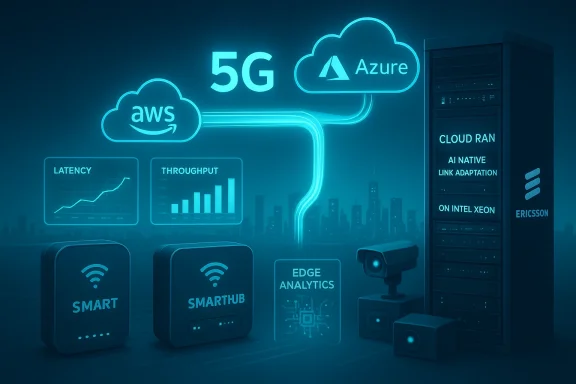
- A preview of AWS Interconnect — last mile, a collaboration that embeds AT&T fiber and 5G FWA directly into AWS environments to reduce latency and collapse provisioning between site and cloud. The preview is slated to be available starting in Q2 2026.
- A live demonstration with Ericsson of an AI‑native Link Adaptation feature running on an Intel Xeon‑6 SoC‑based cloud RAN stack, claiming material efficiency gains versus rule‑based systems and showing portability of AI features across x86 cloud platforms. AT&T and Ericsson positioned the demo as a milestone in moving AI into real‑time RAN operations.
- The availability of Connected Spaces for Enterprise, AT&T’s enterprise edge platform delivered in partnership with Microsoft Azure, which integrates AT&T SmartHub gateways, sensors, cameras, and Azure AI to convert near‑real‑time signals into operational insights for retail, QSRs, hospitality and other verticals. This product is available in the U.S. as of March 2, 2026.
Deep dive: AWS Interconnect — last mile
What it does, technically
AWS Interconnect — last mile is framed as a managed, cloud‑native way to provision AT&T last‑mile connectivity (fiber wavelengths and 5G Fixed Wireless Access) directly into AWS environments so enterprises can treat their access links as part of cloud resource orchestration. The offering is designed for latency‑sensitive, data‑intensive AI workloads — real‑time analytics, online inference, and agentic AI orchestration — where even tens of milliseconds of extra delay can change model behavior or customer experience. AT&T says the service will be available as a preview in Q2 2026.Why it matters
- It reduces operational friction. Enterprises frequently must stitch together ordering, turn‑up, VLANs, and cloud connectivity across multiple providers; embedding access provisioning into the cloud console simplifies lifecycle management and observability.
- It shortens the data path. By bringing the access termination point closer to hypsercaler edge platforms and by providing deterministic metro‑level transport, the architecture reduces latency and variability — a crucial property for closed‑loop AI agents and real‑time inference.
- It monetises metro fiber. AT&T’s investment thesis is explicit: raw bandwidth alone is commoditised; the value is in offering deterministic, integrated connectivity that the cloud platforms and enterprise software stacks can consume as a service.
Technical verification and context
AT&T’s broader optical roadmap buttresses this offering: the operator has demonstrated single‑wavelength experiments at 1.6 Tbps on commercial long‑haul routes, using coherent optics and white‑box switching to condense capacity onto fewer fibers. Those trials were carried out in 2025 and are part of the company’s optics and metro‑capacity narrative; such fiber headroom is a necessary precondition for delivering dense, low‑variance metro interconnects into hyperscaler sites. The 1.6 Tbps milestone has been independently reported and validated by vendor test partners.Commercial and vendor implications
By packaging last‑mile connectivity as a cloud provisionable resource, AT&T and AWS blur the boundary between operator and cloud provider responsibilities. For enterprises this is attractive — simpler procurement and unified visibility — but it shifts dependency to a combined stack that will require cross‑vendor SLAs, joint incident response playbooks, and new revenue‑sharing models. Expect competing carriers to pursue similar tie‑ups with hyperscalers, and for neutral‑host and colocation players to reposition as orchestration partners.Deep dive: AI‑native RAN with Ericsson (and Intel silicon)
The demo and its claims
At MWC AT&T and Ericsson demonstrated an AI‑native link adaptation capability operating on a cloud‑RAN stack using Intel’s Xeon 6 SoC hardware. The feature uses ML models to adjust link parameters — modulation and coding, MCS selection, HARQ configurations — in real time in response to channel state changes, interference, and mobility. The participating teams characterised the demonstration as showing material gains in spectral efficiency and throughput when compared with classical, rule‑based link adaptation. The industry has previously cited up to ~20% throughput improvements from AI‑native link adaptation tests (notably Ericsson’s earlier field work with Bell Canada), and AT&T’s demo was presented as a portability and scale milestone for that class of features.Why moving AI into the RAN matters
Classical RAN control relies on heuristics, lookup tables, and conservative margins because of timing constraints and the physics of wireless links. AI‑native approaches change that by embedding learned models into the baseband or edge‑cloud loop so decisions are data‑driven and adaptive to local propagation conditions. Benefits include:- Better spectral efficiency in contested or non‑stationary channels.
- Improved user throughput and fairness in mixed‑traffic environments.
- Reduced operator OPEX through automation of tuning and anomaly detection.
Portability and silicon choices
A crucial claim from AT&T and Ericsson was portability — the ability to run commercial AI features on commodity x86 SoCs (Intel Xeon 6) rather than being locked into proprietary ASIC stacks. Portability matters because it enables operators to leverage cloud RAN economics, multi‑vendor software innovation, and more modular ops models. Ericsson’s overarching strategy remains mixed: purpose‑built ASICs for peak performance and cloud RAN on general‑purpose compute where flexibility trumps raw efficiency. Intel’s role as a cloud‑CPU silicon partner for these cloud RAN builds is explicitly called out in vendor materials.What’s verified and what needs caution
- Verified: Independent field tests reported by Ericsson and Bell Canada in 2025 showed measurable throughput and spectral efficiency gains from AI‑native link adaptation — figures in the region of up to 20% throughput and ~10% spectral efficiency uplift were reported in those trials. Those prior results provide a credible benchmark for AT&T/Ericsson demonstrations.
- Caution: lab or demonstration gains do not automatically translate to network‑wide yields. Radio networks are heterogeneous, sites differ in load patterns, and AI models can overfit testbeds. Operators need rigorous A/B rollout strategies, robust rollback mechanisms, and ongoing model retraining governance.
Deep dive: Connected Spaces on Azure — enterprise AI at the edge
The product
AT&T’s Connected Spaces for Enterprise combines a Microsoft‑Windows‑based SmartHub gateway, AT&T connectivity and edge management, and Azure AI analytics to deliver near‑real‑time insights from devices, cameras, and sensors. The platform is aimed at distributed, physical footprints — retail, quick‑service restaurants, hospitality — where operational signals (queue length, fridge temperature, equipment uptime, shrink detection) can be turned into automated workflows and alerts.The offering is commercially available in the United States as of March 2, 2026, and AT&T and Microsoft are running proofs‑of‑concept with customers in convenience retail and QSR verticals. The Azure partnership brings the hyperscaler’s analytics and model tooling to the edge pipeline, overlaid atop AT&T’s connectivity and device management capabilities.
Why this matters commercially
- It converts distributed physical signals into monetisable managed services: loss prevention, energy optimisation, predictive maintenance, and store‑level automation.
- It offers a clear enterprise sales motion: AT&T sells connectivity + managed gateway + edge orchestration, while Microsoft competes on analytics and cloud scale. Enterprises that already standardise on Microsoft tooling will find a lower barrier to adoption.
- It exemplifies a telco business model shift: from selling pipes to selling outcomes — and that requires new operational disciplines (device lifecycle, data governance, security at scale).
Security, privacy and governance concerns
Pushing camera and sensor feeds into cloud AI raises obvious privacy risks. The combination of on‑prem edge gateways and cloud analytics gives AT&T and Microsoft the levers to mitigate risk (edge anonymisation, federated learning, encryption in transit and at rest), but customers must demand explicit contracts for data handling, model governance, and breach liability. Regulators will look closely at how video and sensor data are used for behavioural analytics in public or semi‑public spaces.Strategic analysis: what AT&T is trying to achieve
AT&T’s moves are not singular experiments; they form a coherent strategy with three pillars:- Collapse friction between last‑mile connectivity and hyperscaler cloud provisioning so enterprises can consume access as a cloud resource.
- Make the RAN programmable and AI‑capable so radio behaviour is optimized automatically for modern, AI‑sensitive workloads.
- Productise the enterprise edge by pairing AT&T’s field‑level device management with hyperscaler AI to deliver vertical outcomes.
- Differentiated enterprise offerings that are more than connectivity.
- Closer, strategic partnerships with hyperscalers, which can increase carrier relevance inside cloud transaction stacks.
- Operational leverage from software‑defined infrastructure and AI automation in the RAN and transport layers.
Risks, challenges and the hard engineering work ahead
No strategy of this complexity is risk‑free. Below are the key challenges operators and enterprises must confront.- Operational coupling and vendor lock‑in: embedding last‑mile connectivity into AWS provisioning simplifies operations but creates tighter vendor coupling. If enterprises adopt “access as a cloud resource” models, switching costs and interop requirements increase.
- Security and data governance: converging sensor, video, and network telemetry into hyperscaler AI stacks demands end‑to‑end security controls, clear data ownership, and transparent model governance to avoid regulatory and reputational fallout.
- Model safety and explainability in the RAN: AI models that adapt radio behavior in real time must be auditable, explainable, and fail‑safe. Mis‑tuned models could degrade service quality or introduce unfairness (e.g., biased scheduling).
- Economic re‑wiring: the operator’s revenue model shifts from bandwidth to managed edge and outcomes. That requires new sales motions, different SLAs, and measurement frameworks to show ROI to customers in vertical terms.
- Interoperability and standards: industry standardisation (ORAN, 3GPP AI discussions, AI‑RAN alliances) will be critical to prevent fragmenting the market into incompatible vendor silos. AT&T’s emphasis on open architectures and portability is a hedge, but standards work is incomplete and vendor incentives differ.
- Scale and observability: features that work in a demo or in limited city rollouts must prove robust under nationwide traffic patterns, network congestion, and multi‑tenant interference.
Practical guidance for enterprise buyers
If you’re a CIO or network decision‑maker considering an AT&T‑hyperscaler integrated offering, approach with a mix of optimism and practical guardrails:- Prioritise measurable pilots. Start with a handful of sites, define clear KPIs (latency percentiles, inference error rates, operational cost delta), and run A/B tests versus baseline architectures.
- Insist on SI‑agnostic escape clauses. Ask for standardised interconnect options and documented migration paths so you’re not locked into a single cloud + carrier pairing.
- Demand security and data‑use contracts. Require explicit terms for telemetry usage, model retraining, data retention, and third‑party sharing.
- Validate SLAs on jitter and tail latency, not just throughput. AI inference and agentic systems are sensitive to latency tails; demand SLOs that reflect the real needs of models.
- Include governance for AI changes. Any AI that tunes network behavior should be subject to change control, red‑team testing, and observable telemetry for post‑hoc analysis.
What competitors and the broader market are likely to do
AT&T’s moves will accelerate competitive responses:- Other Tier‑1 carriers will deepen their hyperscaler ties (GCP, Azure, AWS) or pursue neutral‑host consortiums to give enterprises provider choice.
- Colocation and interconnection players will reposition as orchestration layers that broker access across carriers and clouds.
- Vendor ecosystems (Ericsson, Nokia, Huawei, Intel, and cloud hyperscalers) will compete on both performance and portability: who can run AI‑native RAN features across diverse silicon with lower power and better outcomes?
- Regulators and standards bodies will increase scrutiny around cross‑provider dependencies and the governance of AI in public infra. Expect more focus on auditability and resilience of AI controllers in critical networks.
Final assessment: a credible play with clear trade‑offs
AT&T’s announcements at MWC are strategically coherent and technically credible: the company has both the optical backbone headroom (1.6 Tbps single‑wavelength trials completed in 2025) and the vendor partnerships (AWS for last‑mile provisioning, Ericsson + Intel for AI‑RAN, Microsoft for enterprise edge) to pursue an integrated AI‑ready network approach. Those facts are independently verifiable through vendor and operator disclosures from the last 12–18 months.That credibility does not remove the need for caution. Demonstrations and lab trials are encouraging, but network‑scale deployments require new governance, rigorous safety and rollback mechanisms for AI features, and contractual clarity around data, SLAs, and vendor responsibilities. Enterprises benefit from simpler cloud‑centric provisioning — but they should evaluate the trade‑off between convenience and vendor dependency, and insist on verifiable, testable guarantees for latency, jitter, and privacy.
Ultimately, the shift that AT&T is pursuing is the logical next step in the telco evolution: from raw pipes to integrated platforms that serve AI. How smoothly that transition proceeds — commercially, operationally, and securely — will depend on the interplay between carriers, hyperscalers, vendors, customers, and regulators over the next 12–36 months. If AT&T and its partners can operationalise the demos, harden the controls, and keep interoperability front and center, the result could be a network architecture that finally meets the real‑time demands of distributed AI. If they fail to do so, the industry risks creating brittle dependencies and accelerating centralisation of control around a few cloud platforms.
AT&T’s MWC updates are a clear signal: telecoms’ next competitive frontier is not purely network capacity, but how networks and clouds are engineered together to deliver predictable, secure, and managed AI experiences at scale. The technical building blocks exist; the urgent work now is to industrialise them with transparency, resilience, and customer protections that match the operational criticality of AI in the enterprise.
Source: RCR Wireless News AT&T combines with AWS in metro, Ericsson in RAN, Azure at edge
