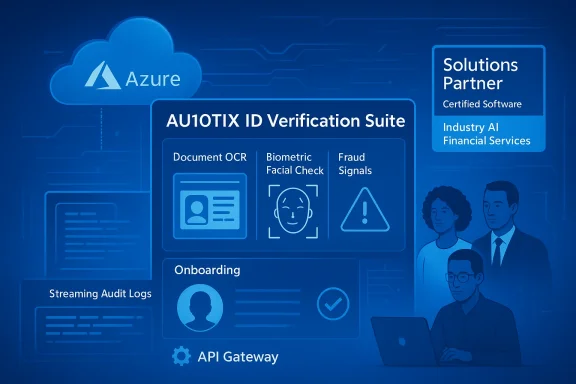
AU10TIX’s elevation to Microsoft’s Solutions Partner with certified software designation for Industry AI — Financial Services marks a significant vendor milestone and a notable signal for banks, fintechs, and compliance teams that rely on identity verification at scale. Announced on March 11, 2026, the designation recognizes the company’s ID Verification Suite for meeting Microsoft’s interoperability and program requirements for certified software, and places AU10TIX among a growing set of ISVs that Microsoft highlights as compatible with Microsoft Cloud ecosystems.
AU10TIX’s announcement on March 11, 2026, states that its ID Verification Suite has earned the Solutions Partner with certified software designation within the Microsoft AI Cloud Partner Program, specifically under the Industry AI – Financial Services track. This is a targeted recognition that Microsoft awards to partner solutions which demonstrate technical interoperability with Microsoft Cloud products (Azure, Microsoft 365, Dynamics 365) and which meet the program’s certification gates for that industry pathway.
The Microsoft AI Cloud Partner Program is Microsoft’s refreshed partner framework that groups competencies, marketplace readiness, and technical validations under outcome-focused solution areas. Within that program, the certified software path is designed to validate software products for marketplace discovery and enterprise procurement by ensuring they meet Microsoft’s interoperability and enterprise-readiness thresholds. Importantly, Microsoft’s program materials and marketplace disclosures make clear that certain aspects of these certified software designations are based on assessment and owner attestation tied to the state of the solution at the time of review.
For AU10TIX this designation is being presented as a market-facing credential: the company’s leadership framed the badge as recognition of technical integration and commitment to building on Microsoft technologies, and Microsoft’s partner program team characterized certifications like this as a mechanism for partners to stand out to customers seeking cloud-ready, Microsoft-integrated solutions.
Yet buyers should not conflate certification with a complete validation of business fit or regulatory compliance. The Microsoft program allows for vendor self-attestation in parts of the certification lifecycle and focuses on interoperability and marketplace readiness rather than being a substitute for independent security audits or regulatory attestations. For regulated financial services, the most prudent path combines the marketing signal from certification with rigorous contractual guarantees, audit evidence, and hands-on pilots.
AI-driven verification is an arms race. As vendors harden detection, fraudsters innovate with generative deepfakes, synthetic identity networks, and mass-automation tooling. The outcome for enterprise buyers will hinge on partners that combine:
For identity vendors, the imperative now is twofold: continue strengthening detection capability and make the business case clear for enterprises that require auditable, regulator-ready verification. For banks and fintechs, the paradox remains: adopt quickly enough to reduce fraud and conversion issues, but demand rigorous governance to avoid regulatory and reputational risks.
Buyers should welcome the certification as a positive indicator, then proceed with a disciplined validation and governance program: verify accuracy across your user populations, confirm data residency and audit postures, and stress-test the vendor’s fraud-detection claims under adversarial conditions. In the ever-shifting identity-fraud landscape, the best defense is a blend of platform trust, transparent metrics, and continual operational rigor — regardless of badges.
Source: Morningstar https://www.morningstar.com/news/pr...-partner-with-certified-software-designation/
 Background and overview
AU10TIX’s announcement on March 11, 2026, states that its ID Verification Suite has earned the Solutions Partner with certified software designation within the Microsoft AI Cloud Partner Program, specifically under the Industry AI – Financial Services track. This is a targeted recognition that Microsoft awards to partner solutions which demonstrate technical interoperability with Microsoft Cloud products (Azure, Microsoft 365, Dynamics 365) and which meet the program’s certification gates for that industry pathway.The Microsoft AI Cloud Partner Program is Microsoft’s refreshed partner framework that groups competencies, marketplace readiness, and technical validations under outcome-focused solution areas. Within that program, the certified software path is designed to validate software products for marketplace discovery and enterprise procurement by ensuring they meet Microsoft’s interoperability and enterprise-readiness thresholds. Importantly, Microsoft’s program materials and marketplace disclosures make clear that certain aspects of these certified software designations are based on assessment and owner attestation tied to the state of the solution at the time of review.
For AU10TIX this designation is being presented as a market-facing credential: the company’s leadership framed the badge as recognition of technical integration and commitment to building on Microsoft technologies, and Microsoft’s partner program team characterized certifications like this as a mechanism for partners to stand out to customers seeking cloud-ready, Microsoft-integrated solutions.
Why this matters: certification, interoperability, and the enterprise buying lens
Earning a Microsoft Solutions Partner certified software badge is not merely ceremonial for many enterprise buyers. For procurement, security, and architecture teams, a certified designation signals several practical points:- Interoperability assurance — The solution has been reviewed for integration points with Microsoft platform services, which shortens technical due diligence when the buyer’s stack already includes Azure, Microsoft 365, or Dynamics 365.
- Marketplace readiness — Certified solutions are typically better positioned in Microsoft’s commercial ecosystem and thus easier to trial, license, and deploy using Microsoft billing and marketplace flows.
- Industry alignment — Because AU10TIX’s award targets Industry AI – Financial Services, it suggests review against industry-specific scenarios (KYC/AML onboarding, fraud detection, regulatory traceability) that matter to banks and regulated fintechs.
AU10TIX: what the company claims and what it sells
AU10TIX is a long-standing identity verification vendor with roots in document authentication and biometrics, and a public profile built on identity automation and fraud analytics. In its March 11, 2026 announcement the company emphasized its ID Verification Suite as the certified product and reiterated several of the firm's commonly stated differentiators:- A portfolio of automated identity verification products that combine document authentication, facial biometric checks, and fraud-intelligence signals.
- A claim of operating the “industry’s only 100% automated global identity management system,” and a history of authenticating billions of identities.
- A cumulative prevention figure referenced in company materials of tens of billions of dollars of identity fraud prevented over the firm’s operating history.
What the ID Verification Suite brings technically
While vendors differ in how they package identity stacks, AU10TIX’s public materials and industry descriptions point to an architecture and feature set that typically includes:- Document ingestion and optical character recognition (OCR) tuned for dozens of ID types and jurisdictions.
- Machine-learning models for document integrity checks and liveness or anti-spoofing checks for face biometric verification.
- Device and transaction risk scoring informed by behavioral, network, and consortium-shared signals.
- Orchestration APIs and SDKs for embedding verification in web and mobile onboarding flows.
- Automated workflows designed to reduce manual review queues and accelerate verification latency.
Strengths: why this designation can be meaningful for customers
There are several concrete benefits and strengths that customers and solution architects should weigh when assessing AU10TIX’s certified software designation.- Faster procurement and testability: A certified marketplace offering can make pilots and procurement simpler for Microsoft-centric buyers, with clearer licensing models and streamlined billing.
- Reduced integration friction: Interoperability validation reduces the engineering lift required to integrate verification flows into Azure-hosted applications or user identity pipelines built on Microsoft services.
- Enterprise-friendly posture: Certification typically requires a vendor to demonstrate baseline enterprise practices around authentication, service configuration, and marketplace packaging, which can reassure InfoSec and procurement stakeholders.
- Industry-specific fit: Being certified in Industry AI – Financial Services indicates that AU10TIX’s workflows and features were mapped against financial-services scenarios (KYC, onboarding, AML screening), which accelerates vendor shortlisting for banks and regulated fintechs.
- Scale and fraud-intelligence signals: AU10TIX’s long-running consortium model and fraud reporting suggest it can bring broader signal coverage to customers that need high-volume verification and mass-attack detection.
Risks, caveats, and what certification does not guarantee
A certified software designation is useful, but it is not a seal that eliminates all buyer risk. Key risks and caveats include:- Self-attested claims: Some certification steps accept vendor self-attestation for functionality or performance. Marketing claims such as “100% automated global identity management” or specific dollar figures in fraud prevented are company-originated metrics and may not have independent third-party verification.
- Dynamic product features: Certification reflects the product at the time of review. If the solution’s architecture, data flows, or control set changes after certification, the certification may not reflect those later modifications.
- Regulatory and privacy nuances: Identity verification in financial services intersects with privacy regimes (GDPR, CCPA/CPRA, sectoral privacy laws) and financial compliance (KYC/AML). A certified software designation confirms interoperability; it does not automatically confirm that a deployment meets a specific regulator’s expectations for data residency, retention, or consent.
- False positives / false negatives in biometric checks: No biometric system is perfect. Enterprise teams should evaluate false-reject and false-accept rates under their user population demographics and failure-mode mitigation (fallback flows, human review).
- Vendor lock-in and data portability: Marketplace-sourced procurement can make onboarding easier but buyers should still demand clear SLAs, exportable audit logs, and data portability to avoid operational lock-in.
- Adversarial and AI arms race: Fraud methods evolve rapidly. A vendor’s historical track record of stopping organized attacks is useful, but buyers should require transparency on model retraining cadence, red-team results, and incident response practices.
Technical implementation considerations for Microsoft-centric environments
For WindowsForum readers working in engineering and security roles, the Microsoft certification implies several practical implementation considerations when integrating AU10TIX’s ID Verification Suite into an Azure-first architecture.Identity and access
- Evaluate how AU10TIX integrates with Microsoft Entra ID / Azure AD for linking verified identities to tenant users or service principals, and whether the solution supports conditional access triggers or user provisioning flows.
- Confirm support for standard identity federation and SSO flows (SAML, OIDC) if you plan to bind verification results to existing authentication pipelines.
Data residency and storage
- Determine where verification artifacts and PII are stored (customer-controlled Azure storage vs. AU10TIX-managed storage). Financial institutions frequently require data residency controls and contractual guarantees around storage location and deletion.
- Ask for encryption-at-rest and in-transit details, key management responsibilities, and Azure Key Vault integration options if you need customer-managed keys.
Logging, auditability, and compliance
- Require audit logs and tamper-evident evidence trails suitable for KYC/AML audits and regulator review. Confirm whether logs can be exported into SIEMs (e.g., Microsoft Sentinel) and whether event schemas align with your logging ingestion tooling.
- Verify retention policies: whether logs and images are retained per regulatory needs, and how deletion requests are handled.
Trust boundaries and zero trust alignment
- Map the solution’s trust boundaries. In a zero-trust architecture, treat verification services as a separate trust domain — demand least-privilege access, network segmentation, and strict API key governance.
- Use Managed Identities or OAuth 2.0 app registrations for service-to-service authentication instead of static secrets, when possible.
Scalability and latency
- Characterize transaction latency for ID verification at peak volumes. For customer-facing onboarding flows, latency directly impacts conversion; confirm SLAs and failover behavior to regional endpoints.
- Clarify global coverage: which ID document types and jurisdictions are supported natively, and whether fallbacks exist for manual review when automated checks fail.
Market and competitive context
AU10TIX operates in a crowded identity verification and fraud-prevention market that includes a range of specialists, from document-centric vendors to biometric-first startups and large data consortiums. The Microsoft certified software designation narrows the procurement decision for customers invested in the Microsoft Cloud, but buyers should still compare:- Detection accuracy and bias metrics across demographic groups.
- Speed and conversion impact in real onboarding flows.
- Pricing models (per-transaction, subscription, tiered) and total cost of ownership when integrated into existing pipelines.
- Consortium signal breadth and the quality of cross-customer fraud intelligence (how many partners, the freshness of signals, and anonymization controls).
Due diligence checklist for procurement teams
When a vendor arrives with a Microsoft certified software designation, procurement and security teams should follow a short, prioritized due-diligence playbook:- Confirm the scope of certification: what product, which release, and the exact date of review.
- Request SOC 2 / ISO 27001 (or comparable) audit reports and inquire about penetration test results and remediation timelines.
- Verify data residency and encryption options, and establish a contract clause for data portability and deletion.
- Run an integration pilot in a test tenant to validate API behavior, latency, and error modes under realistic traffic.
- Validate model performance metrics (FAR/FRR), bias testing reports, and red-team assessments that simulate adversarial fraud scenarios.
Critical analysis: strengths, but also strategic caution
AU10TIX’s Microsoft certified software badge is a meaningful milestone for an ISV focused on identity automation in financial services. It reduces friction for Microsoft-first organizations, signals engineering alignment with Azure paradigms, and can accelerate pilots and procurement discussions. AU10TIX’s experience, scale, and focus on automated orchestration are credible advantages in scenarios where speed and high-volume verification matter.Yet buyers should not conflate certification with a complete validation of business fit or regulatory compliance. The Microsoft program allows for vendor self-attestation in parts of the certification lifecycle and focuses on interoperability and marketplace readiness rather than being a substitute for independent security audits or regulatory attestations. For regulated financial services, the most prudent path combines the marketing signal from certification with rigorous contractual guarantees, audit evidence, and hands-on pilots.
AI-driven verification is an arms race. As vendors harden detection, fraudsters innovate with generative deepfakes, synthetic identity networks, and mass-automation tooling. The outcome for enterprise buyers will hinge on partners that combine:
- Robust model governance and retraining cadence,
- Cross-customer intelligence sharing without exposing customer PII,
- Hybrid human+automation workflows for exceptional cases,
- Transparent metrics that beget regulator confidence.
Practical recommendations for WindowsForum readers and enterprise teams
- If your organization is Azure-first and considering AU10TIX, use the Microsoft certified designation as a starting gate — not the finish line. Prioritize pilot objectives that measure conversion, latency, and error recovery.
- Ask for concrete measures of accuracy (false accept / false reject), particularly on diverse demographics aligned to your user base.
- Demand audit evidence: SOC 2 reports, penetration tests, and verifiable red-team exercises that stress adversarial scenarios relevant to financial services.
- Negotiate contractual terms for data export, model explainability (where appropriate), and a security incident response play that aligns with your internal incident management.
- Build fallback UX: no verification system is flawless. Design onboarding flows that gracefully degrade to secondary verification or human review without punishing legitimate users.
What this means for the industry
Vendor certifications tied to major cloud ecosystems matter because they reduce friction for enterprise cloud adopters and can incentivize tighter technical integration. Microsoft’s push to formalize certified software designations for industry-use cases — including Financial Services AI — is accelerating a vendor market where cloud-native interoperability and marketplace discoverability are increasingly part of procurement decisions.For identity vendors, the imperative now is twofold: continue strengthening detection capability and make the business case clear for enterprises that require auditable, regulator-ready verification. For banks and fintechs, the paradox remains: adopt quickly enough to reduce fraud and conversion issues, but demand rigorous governance to avoid regulatory and reputational risks.
Conclusion
AU10TIX’s March 11, 2026 announcement that its ID Verification Suite earned the Microsoft Solutions Partner with certified software designation for Industry AI – Financial Services is a meaningful market signal for Microsoft-aligned enterprises. The badge indicates interoperable engineering and marketplace readiness that should shorten procurement and simplify some integration tasks. However, it is not a substitute for the detailed audits, pilots, and contractual protections that regulated financial institutions must demand.Buyers should welcome the certification as a positive indicator, then proceed with a disciplined validation and governance program: verify accuracy across your user populations, confirm data residency and audit postures, and stress-test the vendor’s fraud-detection claims under adversarial conditions. In the ever-shifting identity-fraud landscape, the best defense is a blend of platform trust, transparent metrics, and continual operational rigor — regardless of badges.
Source: Morningstar https://www.morningstar.com/news/pr...-partner-with-certified-software-designation/