

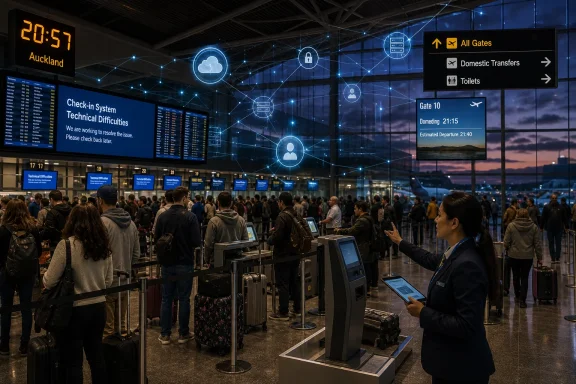
Auckland International Airport’s check-in system suffered technical difficulties on Thursday evening, 1 August 2024, after an external digital system used by the airport failed, causing passenger queues before the issue was resolved shortly before 9pm. The incident was brief, but it exposed a familiar weakness in modern travel: the airport is no longer just runways, gates, and baggage belts, but a chain of software dependencies passengers never see until one breaks. Auckland’s queues cleared, but the lesson should not. A localized check-in glitch is now a public stress test of aviation’s digital plumbing.
By the airport’s account, the problem was not a dramatic cyberattack, a terminal evacuation, or a systemwide aviation failure. It was a technical difficulty in check-in caused by an external digital system the airport relied on. Staff worked through the disruption, passengers queued, and by shortly before 9pm the airport said check-in had returned to normal.
That is the reassuring version, and it is not wrong. For travelers standing in line, the most important fact was that the queue eventually moved. Flights are built around choreography, and when the check-in counter begins working again, the immediate drama fades quickly.
But for anyone who runs systems for a living, the interesting phrase is “external digital system.” It shifts the incident from a simple local glitch to a dependency-management problem. The visible failure happened at Auckland Airport, but the fault reportedly sat somewhere in the technology stack that supports the airport’s check-in operation.
That distinction matters because modern airports have become coordination platforms. They do not merely host airlines; they synchronize airline departure control systems, identity checks, bag-drop infrastructure, kiosks, payment and reservation workflows, border processes, security screening flows, staff communications, and passenger information systems. When one layer stutters, the terminal experiences it as a queue.
Check-in is especially exposed because it is the first high-volume transaction point in the passenger journey. It validates a booking, confirms identity and destination, checks bags, assigns or confirms seats, handles special-service requests, prints tags, and connects the passenger to airline and airport systems. What looks like a clerk tapping at a terminal is actually a negotiation between multiple back-end services.
That is why a small technical fault can scale into a crowd problem. The passenger flow is designed around throughput assumptions: so many people per minute, so many desks or kiosks, so much buffer before boarding. Once the software side of that model slows down, people accumulate physically. A digital bottleneck becomes a queue in a hall.
Auckland Airport’s statement that staff were working to process travelers quickly through departures is the human fallback mode every IT leader recognizes. When automation falters, people absorb the shock. They direct passengers, triage exceptions, calm tempers, and try to keep the operational day from cascading into missed departures.
The trouble is that human effort is a poor substitute for resilient architecture. It is essential in the moment, but it does not erase the question the incident raises: how much of the airport’s passenger flow depends on systems outside the airport’s direct control?
But in aviation technology, third-party dependency is not an exception. It is the model. Airlines, airports, ground handlers, security agencies, reservation platforms, payment networks, and cloud providers all participate in a shared operational fabric. The airport is accountable for the passenger experience, but it may not own every component that creates that experience.
That makes governance harder than old-fashioned infrastructure management. An airport can maintain a terminal, staff counters, and upgrade its local network, yet still be exposed to a provider whose failure affects check-in. Service-level agreements, redundancy designs, incident response playbooks, and escalation paths become just as important as physical capacity.
For WindowsForum readers, this should sound familiar. Enterprises have spent the last decade moving from systems they own to systems they orchestrate. Identity is federated. Email is cloud-hosted. Endpoint security is vendor-managed. Line-of-business apps are SaaS. Backups, telemetry, support desks, and monitoring often involve outside providers. The airport is simply a high-pressure version of the same architecture.
The difference is that an office outage creates tickets; an airport outage creates crowds. The blast radius is visible, emotional, and time-sensitive. A delayed login at a desk can wait. A delayed passenger at check-in is racing a boarding cutoff, a connection, a visa rule, or a family event.
Still, the proximity is hard to ignore as part of the public mood. When users have spent the day seeing cloud productivity tools wobble, an airport check-in failure later that evening fits into a broader narrative: critical services are only as stable as the digital supply chains beneath them. Even when incidents are unrelated, they rhyme.
This is the reputational problem cloud-era infrastructure creates. The more organizations depend on invisible providers, the more every outage looks like part of a pattern. Users do not care which vendor failed. They experience the day as “the systems were down.”
For IT leaders, this is not a reason to retreat from cloud services or third-party platforms. It is a reason to be more honest about dependency. The vendor may own the failed component, but the organization owns the continuity plan, the customer communication, and the recovery experience.
That is particularly true for airports, where passengers cannot route around the problem with much ease. If a streaming service fails, people watch something else. If a messaging app fails, people send an email. If check-in fails at the terminal, the passenger stands in the queue and waits for the machine to come back.
Self-service kiosks, automated bag drops, better routing, and more integrated systems can make airports faster and less painful. They can also reduce manual repetition for staff and give airlines more flexible ways to handle peaks. In a well-designed environment, digital check-in is not a gimmick. It is the mechanism that keeps the terminal from choking.
But modernization changes the failure mode. A traditional counter-heavy model is labor-intensive and slower, but it can sometimes degrade more gracefully. A highly integrated digital model can be wonderfully efficient until a shared dependency fails, at which point multiple lanes of processing may slow at once.
This is the central trade-off for infrastructure operators. Efficiency and resilience are not enemies, but they are not the same goal. A system optimized for normal operations may have little slack when abnormal conditions arrive. A system designed for resilience has redundancy, manual bypass procedures, spare capacity, and staff trained for degraded operations — all of which cost money and complicate the clean efficiency story.
Auckland’s Thursday-night disruption appears to have been resolved quickly, which suggests either the underlying problem was limited or the recovery process worked. But even a short outage is a useful rehearsal. It reveals where passengers accumulate, where communications need to improve, and which dependencies deserve another hard look.
At an airport, the error message is a line of people. It bends around barriers, blocks entrances, slows families with children, and leaves travelers staring at departure boards while time evaporates. The queue becomes the user interface of the outage.
That changes the politics of incident response. A company can publish a status page and ask office users to wait. An airport has to manage bodies in space. It must coordinate with airlines, ground handlers, security screening, border processing, and sometimes police or emergency services if crowds become unsafe.
This is why the airport’s statement about staff working hard is not just public-relations filler. Staff are part of the resilience layer. They smooth panic, identify travelers on imminent departures, route passengers through alternate counters if possible, and prevent a software issue from becoming a crowd-control issue.
But staff cannot compensate indefinitely. The more passenger processing depends on digital orchestration, the more airports need preplanned degraded modes. The question is not whether systems will fail. The question is how ugly the passenger experience becomes while they are failing.
Airlines and airports understand this, which is why they often prioritize passengers by departure time during disruptions. That triage is rational but stressful. Travelers on later flights may see others moved ahead. Travelers on imminent flights may still miss cutoffs if the backlog is large enough. Every exception requires human judgment.
The Auckland incident appears to have cleared without becoming a major prolonged breakdown. That is good news. But the brief nature of the outage should not lead anyone to dismiss it. Resilience engineering treats small incidents as signals, not annoyances.
A small queue can show where a larger queue would form. A short vendor outage can show whether escalation contacts are current. A minor check-in disruption can reveal whether airline staff, airport operations, and public communications are aligned. The value is in studying the near miss before a more serious version arrives.
For passengers, the lesson is blunter. The margin between “normal airport evening” and “will I make my flight?” can be surprisingly thin. Digital systems have made travel smoother when they work, but they have not eliminated the need to arrive with buffer, especially for international flights.
Yet the juxtaposition is useful because it captures the operating environment of 2024: cloud platforms and external digital services are now part of the critical path for ordinary life. Email, collaboration, identity, reservations, airport processing, and customer notifications are not luxury systems. They are operational infrastructure.
This is where the old line between “IT problem” and “real-world problem” has collapsed. A messaging outage can slow a hospital. A security software fault can ground airline operations. A check-in platform issue can fill a terminal. The digital layer is not support infrastructure anymore; it is infrastructure.
For Windows administrators, the parallel is obvious. The health of a tenant, endpoint agent, identity provider, network appliance, or SaaS workflow now has immediate business consequences. The old comfort of saying “the vendor is down” is gone, because users still hold the local IT organization responsible for getting work done.
Airports face the same accountability dynamic at public scale. Passengers bought tickets from airlines and entered a terminal run by the airport. They do not have a contract with the unnamed external digital provider. The brand they remember is the airport, the airline, and the missed or nearly missed flight.
Good outage communication does three things. It tells people what is affected, what they should do now, and when the next update will come. It does not need to reveal sensitive architecture or assign blame before the facts are known. It does need to treat users as people making time-sensitive decisions.
In an airport, communication has to work across channels. Public-address announcements, display boards, airline apps, social media, airport staff, and airline agents should not contradict each other. If passengers in the hall hear one thing while airline apps say another, trust evaporates.
The phrase “technical difficulties” is understandable during an active incident, but it is not sufficient afterward. A post-incident explanation does not need to be forensic, but it should be concrete enough to reassure the public that the operator knows what failed and what will change. “External digital system” is a start. It should not be the end of the learning process.
For enterprise IT, this is familiar territory. The incident review that matters is rarely the one written for public consumption. It is the internal review that maps dependencies, identifies missing telemetry, documents escalation delays, and funds the boring fixes no passenger will ever notice.
Leverage means knowing how the vendor system fails. It means having contractual expectations for uptime, incident notification, support response, and recovery objectives. It means testing fallback procedures rather than discovering them while passengers queue.
It also means designing for partial failure. Can some passengers be processed manually? Can bag tags be issued through an alternate workflow? Can airlines switch counters or systems? Can priority flights be handled through a degraded but functional path? Can staff see enough information to make decisions when the primary interface is impaired?
The answers will vary by airport, airline, and regulatory environment. International travel adds complications that domestic travel may not have, including document checks and destination-entry requirements. But the principle is universal: if a digital dependency is critical enough to stop check-in, it is critical enough to rehearse its failure.
This is where many organizations fall short. They buy resilience on paper but do not practice it in operations. They have incident-response documents but no muscle memory. They have vendor contacts but no escalation drill. They have manual workarounds that technically exist but are too slow, understaffed, or poorly understood to matter during a live incident.
A traveler cannot diagnose an external digital system. They cannot tell whether a check-in kiosk is down because of the airline, airport, network, cloud provider, or identity service. They simply know the counter is not moving fast enough. That asymmetry is why operators must own the experience even when the root cause is upstream.
There is a fairness issue here. Digital transformation often transfers small tasks from staff to passengers in exchange for speed. The passenger accepts that bargain because the process is supposed to be faster. When it fails, the organization cannot behave as though the inconvenience is merely unfortunate. It has to provide support equal to the dependency it created.
This is especially true for less confident travelers: older passengers, families, people with disabilities, international visitors, and those dealing with visas or tight connections. A queue that is annoying for a frequent flyer can be frightening for someone who does not know whether missing a check-in cutoff means losing an expensive trip.
The best airports understand that technology should reduce cognitive load, not increase it. When systems fail, the passenger should see clear instructions, visible staff, and an obvious path forward. The complexity should stay behind the counter.
That is the point. The aviation system has become deeply interconnected, and interconnected systems fail in ways that do not respect organizational boundaries. A component can be small in the architecture diagram and large in passenger impact.
The industry has long understood physical redundancy. Airports plan for backup power, emergency response, runway incidents, weather disruption, and security events. Digital redundancy deserves the same seriousness. Not as a compliance exercise, but as a passenger-flow requirement.
For sysadmins, this is the airport version of a familiar architectural warning: if everything depends on one identity provider, one network path, one vendor console, one update channel, or one SaaS workflow, then that component is not “just IT.” It is a business-critical control point.
The uncomfortable truth is that digital resilience is difficult to sell when everything is working. It looks like extra cost, duplicated capability, and slower procurement. Then the queue forms, and suddenly the business case becomes visible.
The concrete lessons are not exotic. They are the same lessons IT teams learn after every service disruption, made more urgent by the fact that the users are carrying passports and luggage.
 The Outage Was Short, but the Dependency Was the Story
By the airport’s account, the problem was not a dramatic cyberattack, a terminal evacuation, or a systemwide aviation failure. It was a technical difficulty in check-in caused by an external digital system the airport relied on. Staff worked through the disruption, passengers queued, and by shortly before 9pm the airport said check-in had returned to normal.That is the reassuring version, and it is not wrong. For travelers standing in line, the most important fact was that the queue eventually moved. Flights are built around choreography, and when the check-in counter begins working again, the immediate drama fades quickly.
But for anyone who runs systems for a living, the interesting phrase is “external digital system.” It shifts the incident from a simple local glitch to a dependency-management problem. The visible failure happened at Auckland Airport, but the fault reportedly sat somewhere in the technology stack that supports the airport’s check-in operation.
That distinction matters because modern airports have become coordination platforms. They do not merely host airlines; they synchronize airline departure control systems, identity checks, bag-drop infrastructure, kiosks, payment and reservation workflows, border processes, security screening flows, staff communications, and passenger information systems. When one layer stutters, the terminal experiences it as a queue.
Airports Have Become Software Companies With Runways Attached
The popular image of an airport delay is still weather on the radar or a mechanical issue on the tarmac. Those remain real, but the less cinematic delay is increasingly digital. A server, switch, cloud service, authentication provider, local network segment, or vendor-hosted application can now slow down a terminal as effectively as fog.Check-in is especially exposed because it is the first high-volume transaction point in the passenger journey. It validates a booking, confirms identity and destination, checks bags, assigns or confirms seats, handles special-service requests, prints tags, and connects the passenger to airline and airport systems. What looks like a clerk tapping at a terminal is actually a negotiation between multiple back-end services.
That is why a small technical fault can scale into a crowd problem. The passenger flow is designed around throughput assumptions: so many people per minute, so many desks or kiosks, so much buffer before boarding. Once the software side of that model slows down, people accumulate physically. A digital bottleneck becomes a queue in a hall.
Auckland Airport’s statement that staff were working to process travelers quickly through departures is the human fallback mode every IT leader recognizes. When automation falters, people absorb the shock. They direct passengers, triage exceptions, calm tempers, and try to keep the operational day from cascading into missed departures.
The trouble is that human effort is a poor substitute for resilient architecture. It is essential in the moment, but it does not erase the question the incident raises: how much of the airport’s passenger flow depends on systems outside the airport’s direct control?
The “External System” Is Not an Excuse; It Is the Operating Model
There is a temptation to read the external-system detail as blame-shifting. In some contexts, it can be. Organizations often describe failures as vendor issues because it narrows the apparent scope of responsibility.But in aviation technology, third-party dependency is not an exception. It is the model. Airlines, airports, ground handlers, security agencies, reservation platforms, payment networks, and cloud providers all participate in a shared operational fabric. The airport is accountable for the passenger experience, but it may not own every component that creates that experience.
That makes governance harder than old-fashioned infrastructure management. An airport can maintain a terminal, staff counters, and upgrade its local network, yet still be exposed to a provider whose failure affects check-in. Service-level agreements, redundancy designs, incident response playbooks, and escalation paths become just as important as physical capacity.
For WindowsForum readers, this should sound familiar. Enterprises have spent the last decade moving from systems they own to systems they orchestrate. Identity is federated. Email is cloud-hosted. Endpoint security is vendor-managed. Line-of-business apps are SaaS. Backups, telemetry, support desks, and monitoring often involve outside providers. The airport is simply a high-pressure version of the same architecture.
The difference is that an office outage creates tickets; an airport outage creates crowds. The blast radius is visible, emotional, and time-sensitive. A delayed login at a desk can wait. A delayed passenger at check-in is racing a boarding cutoff, a connection, a visa rule, or a family event.
The Timing Made the Incident Feel Larger Than Its Footprint
The RNZ report placed the check-in disruption on the same day New Zealand customers had experienced problems accessing Microsoft 365 services, including Outlook and Teams, earlier on Thursday. Those services were reportedly back online by mid-morning, and the airport did not publicly identify Microsoft as the cause of the evening check-in problem. That distinction is important.Still, the proximity is hard to ignore as part of the public mood. When users have spent the day seeing cloud productivity tools wobble, an airport check-in failure later that evening fits into a broader narrative: critical services are only as stable as the digital supply chains beneath them. Even when incidents are unrelated, they rhyme.
This is the reputational problem cloud-era infrastructure creates. The more organizations depend on invisible providers, the more every outage looks like part of a pattern. Users do not care which vendor failed. They experience the day as “the systems were down.”
For IT leaders, this is not a reason to retreat from cloud services or third-party platforms. It is a reason to be more honest about dependency. The vendor may own the failed component, but the organization owns the continuity plan, the customer communication, and the recovery experience.
That is particularly true for airports, where passengers cannot route around the problem with much ease. If a streaming service fails, people watch something else. If a messaging app fails, people send an email. If check-in fails at the terminal, the passenger stands in the queue and waits for the machine to come back.
Auckland’s Check-In Modernization Raises the Stakes
Auckland Airport has been in the middle of a broader transformation of its terminal operations, including changes to check-in and a move toward more flexible, technology-enabled passenger processing. That modernization is not inherently risky; it is necessary. Airports facing passenger growth, labor constraints, and aging facilities cannot solve every problem by adding more counters.Self-service kiosks, automated bag drops, better routing, and more integrated systems can make airports faster and less painful. They can also reduce manual repetition for staff and give airlines more flexible ways to handle peaks. In a well-designed environment, digital check-in is not a gimmick. It is the mechanism that keeps the terminal from choking.
But modernization changes the failure mode. A traditional counter-heavy model is labor-intensive and slower, but it can sometimes degrade more gracefully. A highly integrated digital model can be wonderfully efficient until a shared dependency fails, at which point multiple lanes of processing may slow at once.
This is the central trade-off for infrastructure operators. Efficiency and resilience are not enemies, but they are not the same goal. A system optimized for normal operations may have little slack when abnormal conditions arrive. A system designed for resilience has redundancy, manual bypass procedures, spare capacity, and staff trained for degraded operations — all of which cost money and complicate the clean efficiency story.
Auckland’s Thursday-night disruption appears to have been resolved quickly, which suggests either the underlying problem was limited or the recovery process worked. But even a short outage is a useful rehearsal. It reveals where passengers accumulate, where communications need to improve, and which dependencies deserve another hard look.
Queues Are the User Interface of Infrastructure Failure
One reason airport IT incidents attract attention is that they convert abstract failure into physical evidence. Most digital outages are invisible to outsiders. A database replica falls behind, an API times out, a certificate expires, a network route flaps. Users may see a spinner or an error message, but the failure remains mostly conceptual.At an airport, the error message is a line of people. It bends around barriers, blocks entrances, slows families with children, and leaves travelers staring at departure boards while time evaporates. The queue becomes the user interface of the outage.
That changes the politics of incident response. A company can publish a status page and ask office users to wait. An airport has to manage bodies in space. It must coordinate with airlines, ground handlers, security screening, border processing, and sometimes police or emergency services if crowds become unsafe.
This is why the airport’s statement about staff working hard is not just public-relations filler. Staff are part of the resilience layer. They smooth panic, identify travelers on imminent departures, route passengers through alternate counters if possible, and prevent a software issue from becoming a crowd-control issue.
But staff cannot compensate indefinitely. The more passenger processing depends on digital orchestration, the more airports need preplanned degraded modes. The question is not whether systems will fail. The question is how ugly the passenger experience becomes while they are failing.
The Real Risk Is Cascading Delay, Not the First Glitch
A check-in problem is rarely isolated in practice, even when the root cause is narrow. Late check-in can delay bag acceptance. Late bag acceptance can delay loading. Delayed loading can hold aircraft at gates. Gate holds can disrupt arrivals, crew scheduling, and onward connections. The initial technical issue may last 30 minutes, but the operational tail can stretch longer.Airlines and airports understand this, which is why they often prioritize passengers by departure time during disruptions. That triage is rational but stressful. Travelers on later flights may see others moved ahead. Travelers on imminent flights may still miss cutoffs if the backlog is large enough. Every exception requires human judgment.
The Auckland incident appears to have cleared without becoming a major prolonged breakdown. That is good news. But the brief nature of the outage should not lead anyone to dismiss it. Resilience engineering treats small incidents as signals, not annoyances.
A small queue can show where a larger queue would form. A short vendor outage can show whether escalation contacts are current. A minor check-in disruption can reveal whether airline staff, airport operations, and public communications are aligned. The value is in studying the near miss before a more serious version arrives.
For passengers, the lesson is blunter. The margin between “normal airport evening” and “will I make my flight?” can be surprisingly thin. Digital systems have made travel smoother when they work, but they have not eliminated the need to arrive with buffer, especially for international flights.
Microsoft 365 Was a Reminder, Even If It Was Not the Cause
The same-day Microsoft 365 issue mentioned in reporting is best treated as context, not causation. There is no public evidence from the airport’s statement that Outlook or Teams caused the check-in disruption. Conflating separate incidents would be sloppy.Yet the juxtaposition is useful because it captures the operating environment of 2024: cloud platforms and external digital services are now part of the critical path for ordinary life. Email, collaboration, identity, reservations, airport processing, and customer notifications are not luxury systems. They are operational infrastructure.
This is where the old line between “IT problem” and “real-world problem” has collapsed. A messaging outage can slow a hospital. A security software fault can ground airline operations. A check-in platform issue can fill a terminal. The digital layer is not support infrastructure anymore; it is infrastructure.
For Windows administrators, the parallel is obvious. The health of a tenant, endpoint agent, identity provider, network appliance, or SaaS workflow now has immediate business consequences. The old comfort of saying “the vendor is down” is gone, because users still hold the local IT organization responsible for getting work done.
Airports face the same accountability dynamic at public scale. Passengers bought tickets from airlines and entered a terminal run by the airport. They do not have a contract with the unnamed external digital provider. The brand they remember is the airport, the airline, and the missed or nearly missed flight.
Communication Is Part of the System, Not a Press Release After It
One encouraging detail in the Auckland report is that the airport provided a clear operational update: the issue had been resolved, check-in had returned to normal, and the queues had cleared. That may sound basic, but basic communication is often the first casualty of technical incidents. Organizations either say too little, speculate too much, or hide behind jargon.Good outage communication does three things. It tells people what is affected, what they should do now, and when the next update will come. It does not need to reveal sensitive architecture or assign blame before the facts are known. It does need to treat users as people making time-sensitive decisions.
In an airport, communication has to work across channels. Public-address announcements, display boards, airline apps, social media, airport staff, and airline agents should not contradict each other. If passengers in the hall hear one thing while airline apps say another, trust evaporates.
The phrase “technical difficulties” is understandable during an active incident, but it is not sufficient afterward. A post-incident explanation does not need to be forensic, but it should be concrete enough to reassure the public that the operator knows what failed and what will change. “External digital system” is a start. It should not be the end of the learning process.
For enterprise IT, this is familiar territory. The incident review that matters is rarely the one written for public consumption. It is the internal review that maps dependencies, identifies missing telemetry, documents escalation delays, and funds the boring fixes no passenger will ever notice.
Vendor Resilience Has to Be Tested Before the Terminal Fills
Third-party systems are not inherently less reliable than in-house systems. In many cases they are more reliable, better monitored, and supported by larger engineering teams than any single airport or airline could maintain. The risk is not outsourcing itself. The risk is outsourcing without operational leverage.Leverage means knowing how the vendor system fails. It means having contractual expectations for uptime, incident notification, support response, and recovery objectives. It means testing fallback procedures rather than discovering them while passengers queue.
It also means designing for partial failure. Can some passengers be processed manually? Can bag tags be issued through an alternate workflow? Can airlines switch counters or systems? Can priority flights be handled through a degraded but functional path? Can staff see enough information to make decisions when the primary interface is impaired?
The answers will vary by airport, airline, and regulatory environment. International travel adds complications that domestic travel may not have, including document checks and destination-entry requirements. But the principle is universal: if a digital dependency is critical enough to stop check-in, it is critical enough to rehearse its failure.
This is where many organizations fall short. They buy resilience on paper but do not practice it in operations. They have incident-response documents but no muscle memory. They have vendor contacts but no escalation drill. They have manual workarounds that technically exist but are too slow, understaffed, or poorly understood to matter during a live incident.
Passengers Should Not Need to Understand the Stack
The airport industry often asks passengers to become more self-sufficient: check in online, use the app, tag the bag, scan the passport, follow the zone, watch the gate, monitor notifications. That can work well when the technology is stable. It becomes aggravating when the system fails and the passenger is left with responsibility but no control.A traveler cannot diagnose an external digital system. They cannot tell whether a check-in kiosk is down because of the airline, airport, network, cloud provider, or identity service. They simply know the counter is not moving fast enough. That asymmetry is why operators must own the experience even when the root cause is upstream.
There is a fairness issue here. Digital transformation often transfers small tasks from staff to passengers in exchange for speed. The passenger accepts that bargain because the process is supposed to be faster. When it fails, the organization cannot behave as though the inconvenience is merely unfortunate. It has to provide support equal to the dependency it created.
This is especially true for less confident travelers: older passengers, families, people with disabilities, international visitors, and those dealing with visas or tight connections. A queue that is annoying for a frequent flyer can be frightening for someone who does not know whether missing a check-in cutoff means losing an expensive trip.
The best airports understand that technology should reduce cognitive load, not increase it. When systems fail, the passenger should see clear instructions, visible staff, and an obvious path forward. The complexity should stay behind the counter.
The Pattern Is Bigger Than Auckland
Auckland is not unique in facing technology-linked travel disruptions. Airports around the world have seen check-in, baggage, airline, security, and network systems become chokepoints. Sometimes the cause is local. Sometimes it is a vendor. Sometimes it is a global platform failure. Sometimes it is a mundane configuration or hardware issue that happens to sit in the wrong place.That is the point. The aviation system has become deeply interconnected, and interconnected systems fail in ways that do not respect organizational boundaries. A component can be small in the architecture diagram and large in passenger impact.
The industry has long understood physical redundancy. Airports plan for backup power, emergency response, runway incidents, weather disruption, and security events. Digital redundancy deserves the same seriousness. Not as a compliance exercise, but as a passenger-flow requirement.
For sysadmins, this is the airport version of a familiar architectural warning: if everything depends on one identity provider, one network path, one vendor console, one update channel, or one SaaS workflow, then that component is not “just IT.” It is a business-critical control point.
The uncomfortable truth is that digital resilience is difficult to sell when everything is working. It looks like extra cost, duplicated capability, and slower procurement. Then the queue forms, and suddenly the business case becomes visible.
Auckland’s Brief Queue Leaves a Longer Checklist
The Auckland incident was resolved, the queues cleared, and Thursday evening did not become a defining airport crisis. That should be acknowledged. But a short failure in a high-dependency environment is still a useful warning, particularly as airports continue to automate more of the passenger journey.The concrete lessons are not exotic. They are the same lessons IT teams learn after every service disruption, made more urgent by the fact that the users are carrying passports and luggage.
- Airports need to treat external digital systems used for check-in as critical infrastructure, not ordinary vendor services.
- Passengers need timely operational guidance during technology disruptions, not vague reassurance after queues have already formed.
- Airlines and airports should rehearse degraded check-in workflows before they are forced to improvise them in a crowded terminal.
- Modernization projects should measure resilience as carefully as they measure speed, capacity, and cost savings.
- Same-day cloud or productivity outages should not be treated as automatic causes, but they should sharpen scrutiny of shared digital dependencies.
- A cleared queue is not the end of an incident; it is the start of the postmortem that determines whether the next queue is smaller.
References
- Primary source: RNZ
Published: 2026-06-21T09:12:07.591659
Delays at Auckland Airport after computer problems | RNZ
A glitch with Auckland International Airport's check-in system on Thursday night has been fixed. www.rnz.co.nz
- Related coverage: eveningreport.nz
- Related coverage: corporate.aucklandairport.co.nz
6.50am: External network outage creating delays for travellers at the international terminal | Auckland Airport
An external network outage is currently impacting the system that manages check-in at the international terminal at Auckland Airport.corporate.aucklandairport.co.nz
- Related coverage: 1news.co.nz
Tech issue resolved at Auckland Airport international check-in
A spokesperson earlier warned the issue was "creating delays and congestion".www.1news.co.nz - Related coverage: tvnz-1-news-prod.cdn.arcpublishing.com
False alarm forces evacuation of Auckland Airport terminal
A 1News staffer who was at the airport at the time said queues for security screening stretched "basically the length of the terminal".tvnz-1-news-prod.cdn.arcpublishing.com - Related coverage: nzherald.co.nz
Auckland Airport blames network congestion for technology problems that led to flight delays - NZ Herald
Auckland Airport is blaming ''extreme'' IT network congestion which led to flight delays after some services were knocked out, including baggage check-in....www.nzherald.co.nz

- Related coverage: comcom.govt.nz
