

Space‑borne mapping is finally being put to work at operational scale: Space Intelligence is harnessing petabytes of optical, radar and LiDAR imagery, commercial and government archives, machine learning models and ecological expertise — and running the whole pipeline on Microsoft’s geospatial and AI stack so that companies, investors and governments can prove whether forests are standing or being cleared. The result is what Space Intelligence calls “audit‑grade” land‑cover and carbon maps that underpin deforestation‑free supply‑chain claims, high‑integrity carbon projects and near‑real‑time monitoring — a potentially decisive advance for nature‑based climate solutions and corporate compliance programs.
Nature‑based solutions (NbS) — protecting, managing and restoring ecosystems such as forests, peatlands and mangroves — are widely recognized as a major lever for climate mitigation and adaptation. Independent assessments estimate that NbS can supply a significant fraction of the emissions reductions needed to keep warming near 1.5°C, with some analyses pointing to up to 30% of near‑term mitigation coming from nature‑based measures. That framing helps explain why high‑fidelity maps and defensible monitoring, reporting and verification (MRV) data are suddenly critical to markets and regulators alike. At the same time, satellite archives have matured: missions like Landsat and Sentinel provide frequent, global optical coverage; radar missions add cloud‑penetrating observations; and airborne or spaceborne LiDAR adds structure and biomass estimates. But raw data are massive, heterogeneous and noisy. Delivering consistent, auditable insights at country or supply‑chain scale requires cloud‑native datasets, standardized formats, provenance controls and model‑ops for repeatable ML processing — exactly the sort of capabilities Microsoft’s Planetary Computer, its Harmonized Landsat‑Sentinel (HLS) collections and Microsoft Foundry (Azure AI Foundry) are designed to offer.
Source: Microsoft Space Intelligence fuels climate action with Microsoft Foundry, Planetary Computer | Microsoft Customer Stories
 Background
Nature‑based solutions (NbS) — protecting, managing and restoring ecosystems such as forests, peatlands and mangroves — are widely recognized as a major lever for climate mitigation and adaptation. Independent assessments estimate that NbS can supply a significant fraction of the emissions reductions needed to keep warming near 1.5°C, with some analyses pointing to up to 30% of near‑term mitigation coming from nature‑based measures. That framing helps explain why high‑fidelity maps and defensible monitoring, reporting and verification (MRV) data are suddenly critical to markets and regulators alike. At the same time, satellite archives have matured: missions like Landsat and Sentinel provide frequent, global optical coverage; radar missions add cloud‑penetrating observations; and airborne or spaceborne LiDAR adds structure and biomass estimates. But raw data are massive, heterogeneous and noisy. Delivering consistent, auditable insights at country or supply‑chain scale requires cloud‑native datasets, standardized formats, provenance controls and model‑ops for repeatable ML processing — exactly the sort of capabilities Microsoft’s Planetary Computer, its Harmonized Landsat‑Sentinel (HLS) collections and Microsoft Foundry (Azure AI Foundry) are designed to offer. How Space Intelligence turns imagery into trustworthy, auditable maps
Space Intelligence’s pitch is straightforward but technically demanding: turn petabytes of multi‑sensor imagery into maps and carbon estimates that are defensible in audits and usable in corporate decision‑making. Their technical and scientific approach can be summarized in three pillars:- Data fusion at scale — ingesting optical (Sentinel/Landsat), radar, and LiDAR, harmonizing formats, applying atmospheric correction and quality masks, then stacking time‑series to reduce cloud noise and reveal change. They leverage cloud‑native collections such as HLS and COG formats to reduce data transfer friction.
- Machine learning + human‑in‑the‑loop — scalable ML models label land cover (forest vs plantation vs regrowth vs cleared land) and detect change; those outputs are then calibrated and validated with local ecological knowledge, field surveys and expert review so the outputs meet auditing standards. Space Intelligence emphasizes local calibration to avoid generic, one‑size‑fits‑all labels.
- Carbon and MRV science — the maps are converted into biomass and carbon estimates using locally tuned allometric models and LiDAR where available. Results are packaged with provenance metadata, time stamps, processing versions and audit artifacts to make them usable for carbon project verification or compliance checks.
What “audit‑grade” means in practice
Audit‑grade is a service promise, not a single metric. In practice it means:- Explicit provenance — every pixel’s source scenes, processing steps, model versions and QA masks are recorded.
- Local validation — sample‑based accuracy assessments against independent field data and high‑resolution imagery.
- Repeatability — the ability to rerun the same analysis with identical inputs and code (important for standards bodies and verifiers).
- Change detectability at operational cadence — near real‑time or frequent monitoring for alerts, rather than retrospective snapshots.
The Microsoft stack: Planetary Computer + Foundry explained
Two Microsoft products are key to the technical story.Microsoft Planetary Computer (data + tooling)
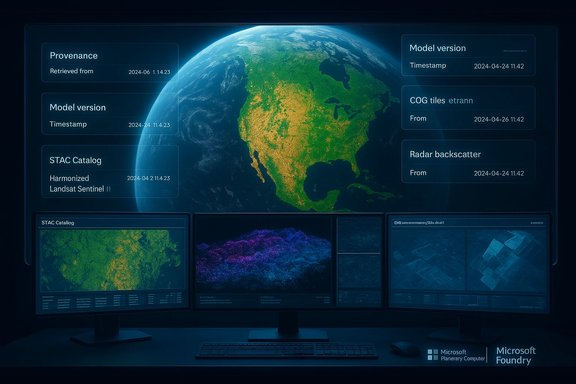
The Planetary Computer is a cloud‑native Earth‑observation data catalog and toolkit that exposes harmonized datasets (including the Harmonized Landsat‑Sentinel HLS collections) as Cloud‑Optimized GeoTIFFs (COGs) and STAC‑indexed assets. It makes large historical and near‑real‑time image archives discoverable, streamable and ready for analysis with common Python geospatial tooling (rasterio, xarray, Dask) and community libraries like pcxarray. That eliminates the bottleneck of copying terabytes and enables analytic pipelines that run in the same Azure regions as the data. Benefits for MRV workflows:- Rapid access to harmonized, atmospherically corrected collections (HLS) with multi‑sensor time‑series.
- STAC metadata and COG storage to support tile‑wise, lazy reads and distributed processing.
- Standardized access patterns and sample notebooks that accelerate reproducible workflows.
Microsoft Foundry (model ops + agent orchestration)
Microsoft Foundry (previously Azure AI Foundry in some documentation) is an orchestration and model‑ops platform for productionizing multi‑agent AI, model routing, tool catalogs and enterprise observability. For nature‑mapping workflows it provides:- A unified environment to host agents or pipelines that combine LLMs (for report drafting or governance), geospatial models and custom tools.
- Monitoring, tracing and governance for production ML — important where auditable decisions and regulatory compliance are required.
- SDKs and connectors that simplify integration between the Planetary Computer datasets, compute instances and enterprise identity/access controls.
Verifying core claims: what the public record supports
Key claim: Nature‑based solutions can deliver a substantial share of near‑term mitigation.- Independent policy analyses and WEF summaries indicate NbS could provide up to ~30% of the mitigation needed to help limit warming to 1.5°C by 2030. That figure is widely cited in policy dialogues and helps justify increased investment in NbS. Verified.
- Space Intelligence publicly states a large and rapidly expanding catalogue (hundreds of millions of hectares, with plans for significant geographic expansion) and has announced Series A funding and partnerships aimed at accelerating coverage. These corporate disclosures are corroborated by press coverage and company blogs showing specific product expansions (e.g., Lens integration, Indonesia reports). Verified by multiple company and press sources; corporate claims about future expansion are plans rather than completed facts.
- This exact phrasing is not a standard global statistic and appears as a rhetorical formulation rather than a precise, globally consistent metric. Global datasets show substantial but variable forest loss: net global forest loss averaged roughly 4.7 million hectares per year in 2010–2020 (FAO/Our World in Data aggregate), with higher gross losses offset by afforestation in some regions. The idea that “we lose 10% every decade” overstates or simplifies a nuanced record of regional differences, attrition of primary forest versus planted forest dynamics, and decadal trends that have shifted over time. Treat this particular claim with caution and prefer published FAO / Global Forest Watch metrics for formal analyses. Caution flagged.
- Microsoft and community tooling documentation (pcxarray, sample notebooks) consistently document that HLS is exposed as COGs and STAC entries, and that co‑located compute patterns reduce egress and improve throughput. These technical facts are verifiable and supported by Microsoft docs and community packages. Verified.
Strengths: what this combination unlocks
- Credible MRV at scale: Combining local validation with cloud‑native time‑series lets developers produce defensible baselines and measurable change detection at national or supply‑chain scales, helping satisfy standards and regulators. Space Intelligence’s emphasis on local calibration is a real differentiator for high‑integrity carbon projects.
- Faster diligence and lower friction for buyers: Corporates needing to show deforestation‑free sourcing or to screen projects can use audit‑grade maps and platform integrations (e.g., Lens) to speed early‑stage diligence. That reduces transaction friction and improves market liquidity for high‑quality credits.
- Operational monitoring and early alerts: Near‑real‑time change detection can be used for compliance (EUDR, supply‑chain traceability) and enforcement — enabling sharper, faster interventions.
- Reproducibility and governance through cloud tooling: Using STAC/COG standards plus Foundry’s model‑ops gives enterprises provenance, policy and observability — essential where legal and investor scrutiny is rising.
Risks and limitations — what organizations must watch
No technological approach is risk‑free. The following are the major caveats and potential failure modes.- Platform dependency and vendor lock‑in. Putting data, pipelines and model ops into a single cloud ecosystem reduces friction but increases dependency. Exit strategies, exportable proofs and local caches for mission‑critical tiles should be part of procurement discussions.
- Costs at scale. Processing petabytes of imagery, running LiDAR fusion and supporting rapid alerts can be expensive. Organizations should budget for compute, storage and egress costs and design pipelines with cost controls (spot instances, lazy evaluation, region co‑location).
- Model bias and ecological nuance. Automated classifiers make mistakes — distinguishing plantation from natural forest, or regrowth from degraded forest, can be context dependent. Space Intelligence’s human‑in‑the‑loop approach mitigates this, but no automated system is infallible. Users must require uncertainty estimates and spot‑check outputs with field data.
- Regulatory and legal complexity. Regulations like the EU Deforestation Regulation (EUDR) and evolving carbon‑market rules demand traceability and specific evidence. Data that lacks sufficient provenance or field validation may not satisfy legal auditors. Procurement should require explicit support for relevant standards and verifier requirements.
- Environmental cost of compute. Large‑scale ML training and repeated global reprocessing have carbon footprints. Teams should adopt efficient architectures, mixed‑precision training, and consider model distillation and targeted processing to reduce compute emissions. Independent verification of emissions impacts is prudent.
- Data completeness and latency. Not all regions have equally rich coverage, and cloud cover or sensor gaps can delay detection. Users must design with guardrails (e.g., complementary radar, local aerial imaging or field verification) where near‑real‑time detection is critical.
Practical checklist for organizations considering audit‑grade mapping
- Define the decision use cases precisely.
- Are maps used for compliance (EUDR) or voluntary carbon sourcing? The evidence requirements differ.
- Specify required geographic scope and temporal cadence.
- National baselines, supply‑chain hotspots or project footprints have different cost profiles.
- Require provenance and repeatability.
- Ask for tile IDs, STAC item IDs, model version numbers, processing scripts and sample accuracy reports.
- Validate with independent field samples.
- Commission or request independent ground‑truthing at representative points before committing to credit purchases.
- Budget for operating costs and exits.
- Include compute, storage, and contingency budgets; insist on exportable snapshots and local caches for mission‑critical assets.
- Include governance and legal review.
- Ensure data flows, identities and contracts meet corporate legal, procurement and audit requirements.
- Insist on uncertainty reporting.
- Outputs should include per‑pixel or per‑polygon confidence metrics and documented error matrices.
Market implications and strategic outlook
The intersection of high‑quality mapping firms like Space Intelligence with hyperscale cloud services and model‑ops platforms signals a new plausibility for large‑scale, auditable NbS deployment. Two broader trends are worth watching:- Corporates will increasingly treat data quality as a risk control, not a nice‑to‑have. As the cost of scrutiny (regulators, buyers, auditors) rises, firms that can demonstrate independent, repeatable evidence will win market access and premium pricing.
- Financialization and insurance innovation will follow data availability. Insurers and investors prefer quantified, auditable risk metrics; improved monitoring reduces counterparty risk and could unlock insurance products and capital flows designed to scale NbS investments. Recent reporting shows both insurer initiatives and investor attention converging on NbS as a deployable asset class.
Critical caveats and unverifiable statements
A handful of claims commonly repeated in PR blur the line between measured fact and rhetorical urgency. Two examples warrant explicit caution:- “Every decade we lose 10% of the world’s forest.” This exact figure is not a standard, globally reported statistic. Global net forest area change varies by decade and region; reputable aggregates (FAO / Our World in Data) report net losses on the order of a few million hectares per year in recent decades, with substantial regional variation. Use headline percentages cautiously and prefer explicit, dated metrics from FAO, Global Forest Watch or peer‑reviewed studies for formal reporting.
- Company roadmaps and expansion plans are forward‑looking. Statements about future geographic coverage, new near‑real‑time products or planned feature rollouts should be treated as company plans unless independently verified by released datasets or completed product pages. Procurement decisions should require demonstrable dataset delivery, not roadmap promises.
What IT teams and sustainability leads should do next
- Treat geospatial MRV as a technical procurement with lifecycle responsibilities: require provenance, replication options and cost controls.
- Pilot early with a clearly bounded area of interest (AOI) to confirm accuracy, costs and workflows before scaling to wide portfolios.
- Insist on open, exportable artifacts: STAC item lists, COGs and reproducible notebooks that allow independent auditors to rerun results.
- Factor in compute emissions in project carbon accounting and consider architectural choices that reduce training and inference footprint.
Conclusion
Space Intelligence’s approach — combining multi‑sensor satellite archives, ML models calibrated with local ecological expertise and packaged with full provenance — exemplifies the practical, data‑driven infrastructure the climate and sustainability economy now demands. When run on cloud platforms that provide standardized data access (Microsoft Planetary Computer) and production model governance (Microsoft Foundry), these workflows become operationally realistic at country and supply‑chain scale. The combination reduces friction for due diligence, strengthens the integrity of carbon and compliance claims, and helps redirect capital into verified conservation outcomes. At the same time, adopting organizations must remain vigilant: verify claims against independent data, demand reproducible provenance, design for exit and cost control, and treat mapped outputs as one element in a broader social, ecological and legal framework for credible NbS. The technology is enabling; the ultimate success of NbS at scale will hinge on governance, finance and the political will to protect and restore natural systems — with high‑quality maps as the indispensable foundation for accountability.Source: Microsoft Space Intelligence fuels climate action with Microsoft Foundry, Planetary Computer | Microsoft Customer Stories
