

SJR’s new GX Manager proves that personalization at scale can be engineered, not just promised, by pairing WPP’s content expertise with Microsoft Foundry and Azure Content Understanding to deliver an enterprise-grade, brand-safe system for AI-powered website personalization.
SJR — WPP’s content-technology agency — has publicly positioned Generative Experience (GX) Manager as a “first-to-market” system that transforms static websites into adaptive, conversion-focused experiences by combining conversation, machine learning, and generative AI. The product surfaced in SJR’s September 2024 announcement and was subsequently profiled by Microsoft as a customer success story after integration with Microsoft Foundry and Azure Content Understanding. The basic problem GX Manager targets is familiar: brands want personalization at scale — content and imagery that adapt instantly to visitor intent, language, and market — but traditional pipelines are manual, slow, and governance-poor. SJR’s approach: avoid a wholesale rewrite of client stacks, keep existing CMS and ingestion points, and augment them with a governed AI pipeline built on Azure services so personalization can be fast, auditable, and brand-compliant. This article summarises SJR’s implementation, verifies the technical underpinnings against Microsoft’s public documentation, and offers a detailed analysis of strengths, limitations, compliance considerations, and operational risks for IT and marketing leaders evaluating similar projects.
Key terms to keep in mind while planning: personalization at scale, AI-powered personalization, enterprise-grade AI, Azure Content Understanding, Microsoft Foundry, retrieval-augmented generation (RAG), brand safety, data governance, serverless containers, and multitenant isolation.
Source: Microsoft SJR modernizes websites with Foundry-powered personalization | Microsoft Customer Stories
 Background / Overview
SJR — WPP’s content-technology agency — has publicly positioned Generative Experience (GX) Manager as a “first-to-market” system that transforms static websites into adaptive, conversion-focused experiences by combining conversation, machine learning, and generative AI. The product surfaced in SJR’s September 2024 announcement and was subsequently profiled by Microsoft as a customer success story after integration with Microsoft Foundry and Azure Content Understanding. The basic problem GX Manager targets is familiar: brands want personalization at scale — content and imagery that adapt instantly to visitor intent, language, and market — but traditional pipelines are manual, slow, and governance-poor. SJR’s approach: avoid a wholesale rewrite of client stacks, keep existing CMS and ingestion points, and augment them with a governed AI pipeline built on Azure services so personalization can be fast, auditable, and brand-compliant. This article summarises SJR’s implementation, verifies the technical underpinnings against Microsoft’s public documentation, and offers a detailed analysis of strengths, limitations, compliance considerations, and operational risks for IT and marketing leaders evaluating similar projects.What SJR built: GX Manager in practical terms
Core goal: personalization without chaos
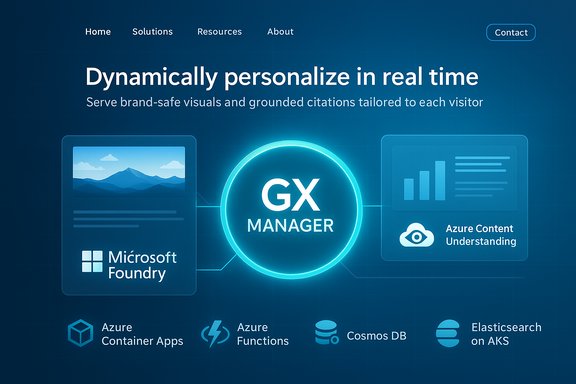
GX Manager’s promise is to deliver context-aware, image-rich personalization that increases conversion by surfacing precisely relevant content to each visitor. Rather than a simple recommendation engine or a generic chatbot, the system is described as an integrated conversational and content-generation front end that blends retrieval, structured metadata, and brand-governed generative responses.Key architectural components (as described by SJR and Microsoft)
- Microsoft Foundry & Azure Content Understanding — used to automate enrichment, metadata extraction, and image matching without rewriting existing scrapers or CMS integrations.
- Azure Container Apps — containerized scrapers and ingestion pipelines run serverless, enabling scale-to-zero economics and faster deployment.
- Azure Functions — orchestration of ingestion, parsing, and enrichment in parallel to reduce latency.
- Azure Cosmos DB — tenant isolation, audit trails, and data residency / GDPR support for brand-level governance.
- Elasticsearch on AKS + RAG (retrieval-augmented generation) — Elasticsearch retrieves relevant text/images from the index on AKS and supplies context to a GPT model hosted via Foundry Tools; the model returns grounded answers and brand-approved visuals.
Microsoft Foundry and Azure Content Understanding: what they actually bring
Foundry & Content Understanding capabilities
Azure Content Understanding (now part of Foundry Tools) is explicitly designed to transform unstructured multimodal assets (text, HTML, images, audio, video, PDFs) into structured outputs and metadata with confidence scores, grounding, and customizable analyzers. Microsoft’s public documentation confirms Content Understanding’s intent as a production-ready tool for field extraction, schema output, and integration into RAG workflows. The service recently reached GA with a documented API version and adds tooling to make extraction repeatable and auditable. Important Content Understanding features relevant to GX Manager:- Multimodal ingestion and extraction (images, HTML, PDFs) so visual assets and copy can be analyzed together.
- Customizable analyzers and schemas that enforce how fields are extracted and formatted for downstream systems.
- Confidence scores and grounding so each field or generated passage can be traced back to source content — a crucial auditability feature for enterprise compliance.
- Responsible AI / content safety mechanisms and limited-access face description features (face description is gated and subject to registration), which highlight Microsoft’s attempt to balance capability and risk.
Why these features matter for enterprise personalization
- Accuracy and traceability: Confidence scores and grounding reduce hallucination risk by showing where each result came from and how confident the system is. This matters in high-stakes verticals where incorrect claims can lead to regulatory trouble.
- Operational speed: Prebuilt analyzers and schema-driven extraction reduce custom engineering required to standardize content for indexing and RAG. SJR credits Content Understanding with cutting processes that once took hours down to seconds. That claim is consistent with the product positioning, though the exact delta will vary by implementation.
The RAG layer: retrieval plus generation, not replacement
Retrieval-augmented generation (RAG) is central to GX Manager’s approach: the system retrieves brand-curated passages and images, then feeds them to a generative model to produce user-facing answers that include inline citations and brand-approved visuals. Microsoft documentation frames RAG as the modern method to reduce hallucination and increase factual relevance by coupling retrieval indices and LLM prompts. Benefits RAG delivers in this pattern:- More accurate, context-aware answers grounded in the brand’s knowledge base.
- Better audit trails (sources retrieved are retained and cited), helping compliance and moderation.
- Extensibility to multi-lingual or multimodal contexts by aligning images and copy in the retrieval step before generation.
Scalability and operations: Container Apps, Functions, and Cosmos DB
Serverless containers and event-driven pipelines
Azure Container Apps provide a managed, serverless container environment with scale-to-zero and pay-per-second billing; it’s designed to host microservices and event-driven workloads without requiring Kubernetes management overhead. Azure Functions complements container apps by orchestrating event flows and background enrichment. Microsoft documentation verifies that both services support scalable, serverless patterns and tight integration for event-driven processes. SJR’s engineering choice: containerize existing scrapers and connectors, run them in Container Apps, and orchestrate with Functions so ingestion and enrichment run in parallel. That combination is explicitly supported by Azure’s product portfolio and is a common pattern for cloud-native, serverless architectures.Data governance and tenant isolation with Cosmos DB
SJR describes Azure Cosmos DB as the secure backbone for isolating brand rules and audit trails. Cosmos DB supports multiple multitenancy models — partition key per tenant, container-per-tenant, database-per-tenant, or account-per-tenant — allowing teams to choose the right balance of isolation, cost, and manageability. Microsoft documentation recommends the account-per-tenant model for the strongest isolation, and Cosmos DB supports customer-managed keys and geographic configuration for data residency and GDPR obligations. These are meaningful capabilities for regulated, global brands.What the results claim — and what can be independently verified
Microsoft’s customer story and SJR’s own statements list measurable outcomes: onboarding time reduced from weeks to hours; error rates decreased after enrichment tuning; improved image accuracy; and stable low latency under load. These are the load-bearing business claims in the story. The core architecture and capabilities described — Foundry, Content Understanding, Container Apps, Functions, Cosmos DB, and RAG — are verifiable through Microsoft’s documentation and third‑party reporting about GX Manager’s launch. Caveat: the exact numerical improvements (e.g., “onboarding time slashed from weeks to hours”) are vendor/customer-provided metrics reported in the Microsoft case study. There is no independent third-party audit of those exact figures publicly available at time of writing, so those specific numbers should be treated as customer-reported outcomes, not independently validated benchmarks. The architectural claims and product capabilities, however, match Microsoft’s public documentation.Strengths: why this matters for enterprise IT and marketing
- Pragmatic integration, not wholesale replacement
SJR’s decision to containerize existing ingestion pipelines and to orchestrate enrichment with Functions is a low-risk integration strategy that preserves the client’s existing CMS and operational controls. This reduces disruption to live sites and supports a faster time-to-value compared with replacing entire stacks. This approach aligns with Azure-specific serverless container design patterns. - Governance and auditability are treated as first-class citizens
Using Content Understanding’s grounding and confidence outputs plus Cosmos DB’s isolation patterns creates auditable chains from source content to AI-generated output. For enterprises bound by compliance and legal oversight, traceability and per-tenant control are essential. Microsoft’s docs explicitly reference grounding and confidence features, and Cosmos DB supports strong isolation models. - Multimodal processing enables richer personalization
Content Understanding was built for multimodal inputs. For brands that rely on imagery (e.g., product photography, talent headshots) as well as copy, automated image matching and metadata generation reduce manual tagging overhead while enabling consistent experiences across locales. - RAG reduces hallucination risk and adds accountability
By anchoring generated responses to retrieved passages and images, GX Manager can present inline citations and source visual assets — a critical capability for maintaining trust and reducing incorrect or out-of-date claims. Microsoft’s RAG guidance emphasizes this as a core benefit. - Cloud-native scale with cost control
Serverless containers and event-driven functions enable automatic scaling during traffic surges (campaign launches, holidays) while remaining cost-efficient in quiet periods. This supports unpredictable marketing spikes without provisioning large, idle capacity. Azure docs for Container Apps and Functions confirm scale-to-zero and event-driven autoscaling features.
Risks, constraints, and unresolved questions
1. Brand-safety and face/visual features come with caveats
Content Understanding provides face description capabilities but Microsoft’s documentation notes these features are limited access and require registration. Face recognition and descriptive tooling is under heavy regulatory and ethical scrutiny in many jurisdictions; the presence of face description in the platform is helpful, but it increases operational and legal complexity for brands that use headshots or identify people in imagery. Enterprises should treat these capabilities as restricted features that require explicit governance and legal review.2. Vendor lock-in and integration trade-offs
SJR’s architecture is tightly coupled to Azure services (Foundry Tools, Container Apps, Functions, Cosmos DB). That offers deep integrations and governance but raises long-term vendor dependence. Organizations that must avoid single-cloud strategies or want to retain portability should weigh the benefits of Azure-integrated features against potential future migration costs or multi-cloud strategies.3. Data residency, privacy, and legal exposure
Although Cosmos DB supports customer-managed keys and account-level isolation, using a retrieval + generative stack means personal or sensitive data can flow into multiple processing stages (ingestion, vectorization, RAG prompt composition, model inference). Enterprises must maintain strict policies for what data is ingested, ensure DPIAs (Data Protection Impact Assessments) for regulated datasets, and configure Content Understanding and Foundry features to honor data residency and consent requirements. Microsoft docs list content safety and compliance capabilities, but legal responsibility for data handling remains with the customer.4. Operational complexity and maintenance overhead
The “wrap, don’t replace” approach reduces initial disruption but preserves complexity: scrapers, ingestion code, index maintenance, model upgrades, and enrichment tuning are ongoing responsibilities. The Microsoft case study repeatedly highlights the importance of tuning and post-processing — “post-processing is everything” — which implies that a non-trivial human-in-the-loop effort is required to maintain quality. Those operational costs need to be budgeted.5. Dependence on model grounding and index quality
RAG’s accuracy is only as good as the retrieval index and the grounding strategy. Poorly structured indices, noisy or stale source content, or improperly set similarity thresholds can lead to misleading output even with grounding in place. Azure guidance recommends careful index design and iterative improvement of analyzers to maintain quality; organizations should plan for index governance workflows, labeling, and continuous monitoring.6. Metrics are customer-reported and may vary
SJR and Microsoft report dramatic operational improvements in the case study. Those claims can be accurate for the specific pilot and client configuration, but they are customer-supplied metrics without independent third-party verification in the public domain. Organizations should treat these as indicative, not guaranteed, and plan pilots to measure their own real-world outcomes.Practical checklist for teams evaluating a GX-style deployment
- Define governance first: catalogue what data types (PII, PHI, IP) will be ingested, and map compliance requirements (GDPR, CCPA, sector rules). Ensure Cosmos DB tenancy model and key management align to those requirements.
- Start with a small, measurable pilot: choose a single brand or site; measure onboarding time, error rates, latency, and conversion lift. Treat SJR’s numbers as a baseline hypothesis, not a guarantee.
- Build robust post-processing and human-in-the-loop review for early releases: tune confidence thresholds, set up annotation/QA workflows for enrichment outputs, and log decisions for auditing.
- Design your index for RAG: choose between Azure AI Search and Elasticsearch based on query patterns, vector search needs, and operational familiarity. Ensure index metadata supports filtering for brand labels and region-specific compliance.
- Lock down image and face handling policies: if using face description or recognition, register required access, define explicit usage policies, and document opt-in/opt-out mechanisms.
- Prepare for model updates: define a schedule and gating procedures for Foundry/LLM version upgrades and monitor for drift or changes in grounding behavior.
Strategic takeaways for CIOs and CMOs
- For marketing leaders, GX Manager-style systems can renew the ROI of corporate websites by turning static pages into dynamic, measurable conversion funnels. The integration of conversational UX and visual personalization addresses today’s rising customer expectation for immediate, individualized answers. The SJR narrative is plausible and consistent with product capabilities from Microsoft.
- For CIOs and security leaders, the Azure Foundry + Content Understanding + Cosmos DB stack provides enterprise features (role-based access control, encryption options, data residency controls) that are essential for regulated enterprises. However, achieving operational safety requires disciplined ingestion policies, model governance, and human oversight. Microsoft’s platform-level features support these requirements, but responsibility for correct configuration and continuous monitoring rests with the implementer.
- For both groups, there’s a clear trade-off between speed-to-market and long-term portability. Tight integration with Azure’s Foundry ecosystem accelerates implementation and governance, but introduces deeper vendor ties that should be acknowledged in procurement and architecture planning.
Conclusion
SJR’s GX Manager — built on Microsoft Foundry and Azure Content Understanding — is a pragmatic, well-architected example of how enterprise-grade personalization can be achieved without dismantling existing CMS stacks. The story’s technical claims align with Microsoft’s documentation: Content Understanding supports multimodal extraction, grounding, and developer-friendly analyzers; Container Apps and Functions enable serverless scale and orchestration; Cosmos DB provides multitenant isolation options suited to regulated deployments; and RAG reduces hallucination risk by coupling retrieval and generation. That said, measured caution is essential. Face/visual features are gated and legally sensitive; operational rigor is required to manage index quality, tuning, and post-processing; and the numerical outcomes in the case study are customer-reported and should be validated in local pilots before being treated as guarantees. For enterprises seeking to modernize their digital front doors, SJR’s example provides a replicable template — but success will depend on governance, observability, and a disciplined approach to human-in-the-loop quality control.Key terms to keep in mind while planning: personalization at scale, AI-powered personalization, enterprise-grade AI, Azure Content Understanding, Microsoft Foundry, retrieval-augmented generation (RAG), brand safety, data governance, serverless containers, and multitenant isolation.
Source: Microsoft SJR modernizes websites with Foundry-powered personalization | Microsoft Customer Stories
