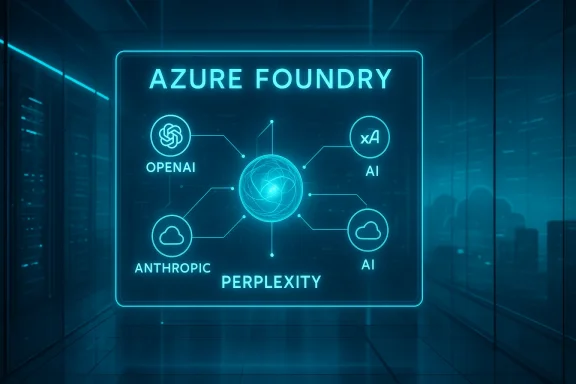
Perplexity’s surprise $750 million commitment to Microsoft’s Azure Foundry marks a clear pivot in the tactics of a fast-growing AI startup: not an abandonment of Amazon Web Services, but a deliberate, high-stakes bet on multicloud flexibility and model diversity as the centrepiece of modern AI infrastructure strategy.
Perplexity — the AI-powered search and agent startup that rose rapidly to prominence over the past two years — is widely reported to have signed a three‑year, $750 million agreement with Microsoft to run workloads and access “frontier” models through Azure’s Foundry platform. Major technology outlets corroborated the core facts of the deal, and Microsoft’s own product roadmap shows Foundry positioned precisely for the kind of multi‑model, agentic deployments Perplexity needs. At the same time, Perplexity remains deeply invested in Amazon Web Services and insists that AWS will continue to be its primary cloud partner even as it expands into Azure.
The announcement arrives against a backdrop of legal and commercial friction between Perplexity and Amazon. In November, Amazon filed suit over Perplexity’s agentic shopping feature — a dispute that highlights how quickly agentic automation has moved from concept to commercial flashpoint. The timing and structure of Perplexity’s Microsoft deal read like a risk‑management play: secure access to a broad set of models and tooling while preserving a working relationship with AWS.
Flag: Some publicly circulated numbers about Perplexity’s valuation and revenue have varied between outlets. Valuation figures and revenue multiples for private AI startups can move rapidly when new funding or commercial partnerships appear; treat valuation figures as indicative rather than definitive unless disclosed by the company itself.
Flag: The legal proceedings and potential court rulings will materially affect the future of agentic features across the ecosystem. Readers should treat legal risk as a first‑order operational constraint when building or deploying agentic products.
For enterprises and builders, Perplexity’s approach highlights both opportunity and obligation. Multicloud model orchestration unlocks superior product design and resilience, but it demands sophisticated cost controls, governance frameworks, and legal foresight. The startup’s maneuver reveals how the next phase of cloud competition will be fought — on model ecosystems, orchestration capability, and the ability to deliver safe, scalable agentic experiences.
As this story unfolds — especially while the legal contest with Amazon proceeds — organizations should watch two things closely: the evolution of cloud model‑marketplace economics, and the emerging legal precedent around agentic automation. Both will shape the rules of engagement for AI product teams for years to come.
Source: Techzine Global Perplexity expands cloud strategy with Azure alongside AWS
 Background
Perplexity — the AI-powered search and agent startup that rose rapidly to prominence over the past two years — is widely reported to have signed a three‑year, $750 million agreement with Microsoft to run workloads and access “frontier” models through Azure’s Foundry platform. Major technology outlets corroborated the core facts of the deal, and Microsoft’s own product roadmap shows Foundry positioned precisely for the kind of multi‑model, agentic deployments Perplexity needs. At the same time, Perplexity remains deeply invested in Amazon Web Services and insists that AWS will continue to be its primary cloud partner even as it expands into Azure.The announcement arrives against a backdrop of legal and commercial friction between Perplexity and Amazon. In November, Amazon filed suit over Perplexity’s agentic shopping feature — a dispute that highlights how quickly agentic automation has moved from concept to commercial flashpoint. The timing and structure of Perplexity’s Microsoft deal read like a risk‑management play: secure access to a broad set of models and tooling while preserving a working relationship with AWS.
Overview: What Azure Foundry brings to the table
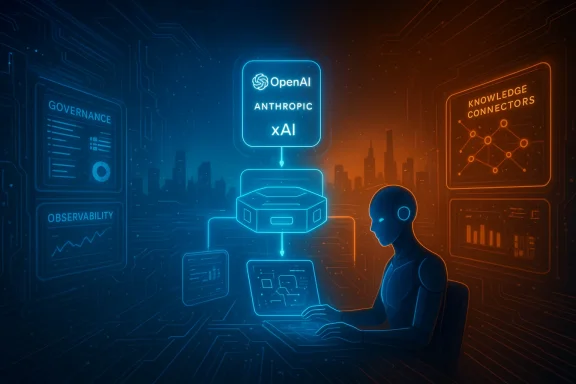
Microsoft built Foundry to be an interoperable AI ecosystem where organizations can select, benchmark, route, and govern multiple large models from different suppliers within a single control plane. The platform emphasizes:- Model choice, offering access to models from multiple providers and families so customers can route requests to the best model for a task.
- Model orchestration, via a model router that automates selection based on cost, latency, or task-specific performance.
- Agent frameworks and tooling, enabling developers to compose autonomous workflows, plug external tools, and deploy agents at scale.
- Enterprise governance, including observability, compliance hooks, centralized identity and access management, and knowledge‑grounding capabilities.
Why Perplexity’s move matters
1. Tactical redundancy against vendor risk
Large cloud commitments are rarely purely technical choices — they’re also insurance policies. Perplexity’s continued reliance on AWS, coupled with this Azure agreement, signals an explicit desire to avoid being held hostage to a single provider’s commercial or legal posture. Given the public legal dispute with Amazon over automated shopping features and Amazon’s dominance in cloud infrastructure, having a high‑capacity alternative reduces operational and strategic risk.2. Access to multiple frontier models without lock‑in
Foundry is designed to let customers access OpenAI, Anthropic, xAI and other frontier models side‑by‑side. For Perplexity, that translates into:- Faster experimentation with models that differ substantially in safety characteristics, latency, or reasoning strengths.
- The ability to route user queries to the model best suited for a given request, improving user experience without re‑architecting systems for each model vendor.
- Reduced commercial friction when a single model provider changes pricing, access policies, or behavior.
3. A signal in the competition among clouds
Cloud competition is increasingly about model ecosystems, not just compute and storage. Microsoft’s pitch has moved from “Azure is great for Windows workloads” to “Azure is the place where you can access a diversity of frontier models and govern them in enterprise settings.” Landing Perplexity — a high‑profile, model‑centric customer that sits between consumers and multiple model suppliers — is a valuable validation for Microsoft’s strategic positioning.Technical implications for Perplexity’s architecture
Perplexity’s product stack has three visible technical priorities: scale, low‑latency retrieval and reasoning, and safe agentic behaviors. Integrating Azure Foundry into a system already anchored in AWS raises practical engineering questions.Multicloud deployment patterns Perplexity is likely to use
- Model service on Azure, retrieval on AWS: Keep heavy retrieval, indexing, and data storage on AWS while routing model inference to Azure Foundry. This reduces data migration while leveraging Foundry’s models.
- Active/passive failover: Run the same workloads in both clouds in a hot/cold configuration so that critical services can fail over quickly if one provider becomes unavailable.
- Federated agent architecture: Agents orchestrate tools and external APIs across clouds, with a central control plane that manages policies and governance.
Foundry features Perplexity will likely exploit
- Model Router — to route queries to the best model for a given task.
- Foundry IQ / knowledge connectors — to ground agent responses in curated sources and enterprise data.
- Agent Service / Tools — for secure, pluggable tool invocation and controlled automation flows.
- Governance and observability — to monitor model behavior, collect telemetry, and maintain compliance with user privacy commitments.
Commercial reality: the numbers and what they mean
A three‑year, $750 million commitment is enormous for a startup and sends several messages simultaneously.- It gives Perplexity headroom to run expensive frontier models in production at scale, which is critical for products that require high‑quality reasoning or long‑context models.
- It is a defensive financial statement: a long‑term commitment signals to model vendors and customers that Perplexity will continue to build substantial traffic, regardless of isolated vendor conflicts.
- The size of the deal raises questions about unit economics — running advanced models at scale is costly, and sustained profitability will depend on both Perplexity’s ability to monetize features and to optimize routing and model usage.
Flag: Some publicly circulated numbers about Perplexity’s valuation and revenue have varied between outlets. Valuation figures and revenue multiples for private AI startups can move rapidly when new funding or commercial partnerships appear; treat valuation figures as indicative rather than definitive unless disclosed by the company itself.
Strategic angles: Microsoft, Perplexity, and the model marketplace
For Microsoft
- This deal reinforces Microsoft’s narrative that Azure is the best home for multi‑model, enterprise‑grade AI.
- It strengthens Microsoft’s leverage in the model market by showing that it can aggregate and deliver competitive families of models within a single platform.
- Microsoft benefits by increasing high‑margin consumption on Azure and by projecting Foundry as the standard for multicloud AI orchestration.
For Perplexity
- The company gains resilience and choice at the model and cloud layers, which is essential for a product that must orchestrate many models and tools for consumers.
- It reduces the risk that a single cloud or model provider can throttle access or otherwise constrain product direction.
- The move may reassure enterprise customers that Perplexity can meet compliance, data residency, and governance requirements across clouds.
For AWS and other model/cloud providers
- Expect AWS to accelerate offerings that compete on model access, developer ergonomics, and governance to retain customers with multicloud footprints.
- The arrangement may intensify vendor competition for startups and scale customers, shifting negotiation dynamics toward model‑access guarantees and multi‑vendor support clauses.
Legal and regulatory shadow: the Amazon dispute and agentic commerce
Perplexity’s expansion into Azure cannot be decoupled from its legal tussle with Amazon over agentic shopping. The core of Amazon’s allegation is that Perplexity’s Comet agent acted in ways that violated Amazon’s terms of service, particularly around automated interactions and account access. Whether that claim succeeds in court remains an open question, but the dispute raises larger issues:- How will courts and regulators treat user‑directed agentic automation that interacts with third‑party platforms?
- Will terms of service and platform protections be interpreted to allow or disallow agentic helpers that execute actions on behalf of users?
- Could cloud or model providers be pulled into legal fights when downstream applications use their models to automate interactions with third‑party services?
Flag: The legal proceedings and potential court rulings will materially affect the future of agentic features across the ecosystem. Readers should treat legal risk as a first‑order operational constraint when building or deploying agentic products.
Risks and downsides of Perplexity’s multicloud strategy
No architecture is risk‑free. Perplexity’s Azure commitment mitigates some dangers but introduces others that are important for practitioners and decision‑makers to understand.- Increased operational complexity: Running production systems across two major cloud providers multiplies the surface area for networking, identity management, monitoring, and incident response.
- Higher hidden costs: Data egress, duplicated storage, cross‑cloud traffic, and redundant telemetry can create non‑linear increases in monthly cloud bills unless carefully architected.
- Latency and user experience: Model routing across clouds could introduce latency, especially for real‑time or interactive features. Edge placement and regional availability become more complex.
- Governance fragmentation: Differing security and compliance primitives between platforms mean governance must be federated or centralized via a cross‑cloud control plane, which itself adds complexity and potential single points of failure.
- Vendor relations and political risk: Public disputes with major platform partners can escalate beyond technical disputes to commercial blacklisting, punitive behaviour, or legislative attention.
- Dependency on third‑party models: Even with multicloud access to different model families, Perplexity remains subject to model vendor policies, rate limits, and behavior changes that can materially alter product quality.
Practical takeaways for IT leaders and practitioners
For WindowsForum readers — many of whom are responsible for building, deploying, and maintaining AI-enabled applications — Perplexity’s deal offers actionable lessons.- Model‑first architecture pays, but model governance must follow: Treat model selection and routing as an explicit architectural layer with monitoring, A/B testing, and rollback capabilities. Implement model‑level SLAs and budget controls.
- Quantify egress and replication costs before committing: Run cost simulations with realistic traffic patterns. Small per‑token differentials compound at scale.
- Use a centralized identity and policy plane: Protect yourself from multi‑cloud drift by centralizing access control, secrets management, and audit trails.
- Design for degraded model performance: Implement graceful degradation paths that fall back to smaller, cheaper models for non‑critical tasks to control costs.
- Plan for legal and compliance contingencies: If your application performs agentic actions on behalf of users, obtain legal review of terms of service interactions and embed transparency features so automated actions are auditable and clearly attributed.
- Benchmark across model families: Don’t assume a single model is best for all tasks. Perplexity’s motivation to access multiple frontier models is an operational lesson: benchmark rigorously and route dynamically.
What this means for the broader AI market
Perplexity’s move is symptomatic of a larger industry transition: AI startups and enterprises are treating model access as a strategic resource, and cloud providers are competing on model ecosystems rather than raw compute alone. A few broader trends are worth noting:- The rise of the model marketplace: Cloud platforms that offer multiple top‑tier model families plus orchestration and governance are more attractive to companies building complex, agentic applications.
- Commoditization of basic compute: As specialized inference hardware proliferates, model selection and data plumbing become the primary differentiators.
- Increased negotiation leverage for customers: Large startups can leverage multicloud alternatives to negotiate model access and pricing, changing the balance of power with model vendors.
- Regulatory attention on agentic automation: Legal disputes — like Amazon’s case — will shape acceptable norms for automation, transparency, and user consent. Expect new guidelines and perhaps statutory rules that address automated agent behavior across platforms.
Conclusion: a pragmatic bet on flexibility over fidelity to a single cloud
Perplexity’s $750 million, three‑year Azure Foundry commitment is a decisive statement: in today’s AI market, flexibility and model choice are strategic assets. The deal hedges legal and commercial risk with a competitor while preserving existing AWS relationships, creating a multicloud posture that prioritizes continuity of service and model diversity.For enterprises and builders, Perplexity’s approach highlights both opportunity and obligation. Multicloud model orchestration unlocks superior product design and resilience, but it demands sophisticated cost controls, governance frameworks, and legal foresight. The startup’s maneuver reveals how the next phase of cloud competition will be fought — on model ecosystems, orchestration capability, and the ability to deliver safe, scalable agentic experiences.
As this story unfolds — especially while the legal contest with Amazon proceeds — organizations should watch two things closely: the evolution of cloud model‑marketplace economics, and the emerging legal precedent around agentic automation. Both will shape the rules of engagement for AI product teams for years to come.
Source: Techzine Global Perplexity expands cloud strategy with Azure alongside AWS