

AI coding tools are not becoming useful simply because their underlying models are improving, according to Augment CEO Scott Perneti. In an interview with Ars Technica, Perneti argued that the differentiator is increasingly the coding “harness”: the system that finds, selects, and feeds relevant project context to a model before it writes or changes code.
That is a notable shift from the familiar chatbot workflow. A developer can paste a file, an error message, and a request into a model, but that leaves the model to operate with a narrow and potentially misleading view of a codebase. A context-rich harness aims to retrieve the surrounding implementation, dependencies, conventions, specifications, and other material needed to make a change safely.
Perneti’s core argument is that AI-assisted development has two inputs: model intelligence and context. Model capability may improve quickly, but it does not remove the need to establish which information matters for a particular task. Getting that context manually consumes tokens, time, and developer attention; getting it wrong can produce plausible code that does not fit the application.
The premise will be familiar to Windows developers and administrators who have seen code assistants generate a syntactically valid PowerShell snippet, C# method, or configuration change that ignores local requirements. A model may know an API well while lacking knowledge of a project’s security rules, build chain, target Windows versions, deployment process, or established error-handling patterns.
That makes retrieval and orchestration more important than a simple “ask the model” interface. The harness has to decide what parts of a repository, documentation set, issue history, and test suite are relevant, then give the model enough information without spending an uncontrolled amount on context tokens.
Perneti framed that as a systems-engineering and cost-management issue. More context is not automatically better if it is irrelevant or expensive, but insufficient context can turn a seemingly capable coding agent into a fast generator of rework.
That distinction matters for organizations evaluating autonomous agent workflows. The immediate value may be in accelerating bounded implementation work: making well-specified changes, tracing behavior across a large repository, drafting tests, or handling repetitive edits. It is less convincing as a replacement for architecture review, product judgment, or accountability for production changes.
Ars Technica’s interview reflects a growing argument among AI coding-tool vendors: better models will matter, but repository awareness, verification, and workflow controls will determine whether those models reduce work rather than create technical debt.
For Windows teams, the practical implication is to evaluate AI coding tools on how they gather context and support review, not just on how impressive a single generated answer looks.
That is a notable shift from the familiar chatbot workflow. A developer can paste a file, an error message, and a request into a model, but that leaves the model to operate with a narrow and potentially misleading view of a codebase. A context-rich harness aims to retrieve the surrounding implementation, dependencies, conventions, specifications, and other material needed to make a change safely.
Perneti’s core argument is that AI-assisted development has two inputs: model intelligence and context. Model capability may improve quickly, but it does not remove the need to establish which information matters for a particular task. Getting that context manually consumes tokens, time, and developer attention; getting it wrong can produce plausible code that does not fit the application.
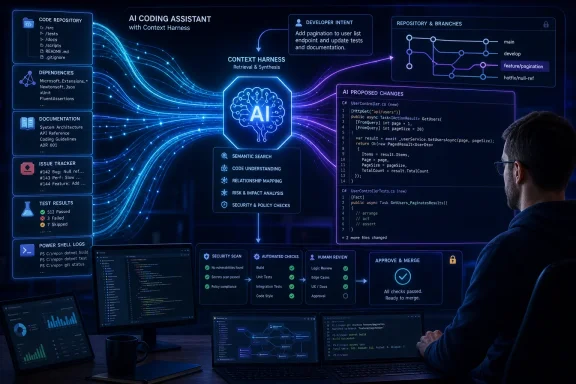 Context is the engineering problem
The premise will be familiar to Windows developers and administrators who have seen code assistants generate a syntactically valid PowerShell snippet, C# method, or configuration change that ignores local requirements. A model may know an API well while lacking knowledge of a project’s security rules, build chain, target Windows versions, deployment process, or established error-handling patterns.That makes retrieval and orchestration more important than a simple “ask the model” interface. The harness has to decide what parts of a repository, documentation set, issue history, and test suite are relevant, then give the model enough information without spending an uncontrolled amount on context tokens.
Perneti framed that as a systems-engineering and cost-management issue. More context is not automatically better if it is irrelevant or expensive, but insufficient context can turn a seemingly capable coding agent into a fast generator of rework.
Agents still need review
The interview also pushed back on the idea that coding agents can be handed broad tasks without supervision. Perneti said humans remain better suited to judgment-heavy work, particularly specification review. In his view, agents may execute well after requirements are clarified, but they are not dependable substitutes for deciding what should be built in the first place.That distinction matters for organizations evaluating autonomous agent workflows. The immediate value may be in accelerating bounded implementation work: making well-specified changes, tracing behavior across a large repository, drafting tests, or handling repetitive edits. It is less convincing as a replacement for architecture review, product judgment, or accountability for production changes.
Ars Technica’s interview reflects a growing argument among AI coding-tool vendors: better models will matter, but repository awareness, verification, and workflow controls will determine whether those models reduce work rather than create technical debt.
For Windows teams, the practical implication is to evaluate AI coding tools on how they gather context and support review, not just on how impressive a single generated answer looks.
References
- Primary source: Ars Technica
Published: 2026-07-20T11:20:10+00:00
Loading…
arstechnica.com