

Fastagger’s Auni app is proof that AI doesn’t need the latest phone or a fat cloud bill to matter — it can live in the palm of a street‑level merchant and turn mobile‑money noise into actionable business intelligence overnight.
Small and micro businesses — from barbershops to neighborhood kiosks — account for the bulk of commerce across Kenya and much of sub‑Saharan Africa. They transact primarily through mobile money rails, keep records on scraps of paper or in SMS receipts, and usually operate on low‑end Android phones with intermittent connectivity. That reality is shaping a distinctly pragmatic branch of applied AI: lightweight, offline, on‑device models tailored to local data and mobile‑money formats.
Fastagger, a Nairobi deep‑tech startup founded in 2019, has made exactly that bet. The company set out to “democratize access to AI” by building a foundation model for financial documents and compressing inference so it can run on four‑gigabyte smartphones — enabling merchants to use an AI assistant without constant internet access or expensive GPUs. The result is Auni: a mobile business‑intelligence assistant designed to read mobile‑money transaction messages, summarize customer behaviour, and automate retention actions like coupons and loyalty outreach.
Other early adopters reported improvements in customer retention actions, simpler coupon management and faster reconciliation for busy merchants. In sectors beyond retail — such as independent pharmacies — complementary Microsoft‑backed initiatives show that AI can also reduce expiry losses, optimize inventory and enable lender‑friendly credit scoring for micro‑retailers. These parallel projects (for example, a Kenyan health‑tech startup working with Microsoft) underscore the diversity of practical use cases for compact AI in local commerce.
But the work is only beginning. Privacy safeguards, transparent scoring for financial services, portability of merchant data, and fraud protections must all be baked into the next wave of deployments. Done correctly, on‑device AI can be the most efficient path to spreading business intelligence to the thousands of micro‑enterprises that fuel Kenya’s economy — and a replicable model for other markets where the device and data environments are far from ideal, yet the need for practical insight is enormous.
Source: Microsoft Source How AI is empowering small business owners in Kenya
 Background
Small and micro businesses — from barbershops to neighborhood kiosks — account for the bulk of commerce across Kenya and much of sub‑Saharan Africa. They transact primarily through mobile money rails, keep records on scraps of paper or in SMS receipts, and usually operate on low‑end Android phones with intermittent connectivity. That reality is shaping a distinctly pragmatic branch of applied AI: lightweight, offline, on‑device models tailored to local data and mobile‑money formats.Fastagger, a Nairobi deep‑tech startup founded in 2019, has made exactly that bet. The company set out to “democratize access to AI” by building a foundation model for financial documents and compressing inference so it can run on four‑gigabyte smartphones — enabling merchants to use an AI assistant without constant internet access or expensive GPUs. The result is Auni: a mobile business‑intelligence assistant designed to read mobile‑money transaction messages, summarize customer behaviour, and automate retention actions like coupons and loyalty outreach.
Overview: From data tagging to an AI on your phone
How Fastagger evolved
Fastagger’s origins are intentionally low‑glamour but strategically important: the founders started by manually tagging data to create high‑quality training sets — hence the name: fast + tagger. That early work proved essential because off‑the‑shelf models trained on Western banking statements and invoices often fail on East African mobile‑money conventions, local languages and the variety of SMS formats generated by M‑PESA and other wallets. Fastagger’s dataset work and document foundation model allowed them to build a compact parsing and analytics system that understands the local transactional idiom.Why mobile money is the “entry point”
Mobile money gives developers a single, ubiquitous signal to work with: merchants receive payment confirmations as SMS or in-app receipts. That makes it possible to extract purchase frequency, average ticket size, top customers, and cash‑flow patterns without instrumenting every till or POS. Fastagger focused on reading those SMS receipts and converting them into the kind of customer‑level intelligence that previously required accounting systems and time‑consuming manual reconciliation. In short: mobile money is a data source millions of small merchants already use — and many still under‑utilize.What Auni actually does — step by step
- Merchant installs Auni (or accesses it through a partner distribution such as the M‑PESA Business ecosystem).
- The app parses incoming mobile‑money SMS or captures transaction logs and extracts structured fields (payer, amount, time, reference).
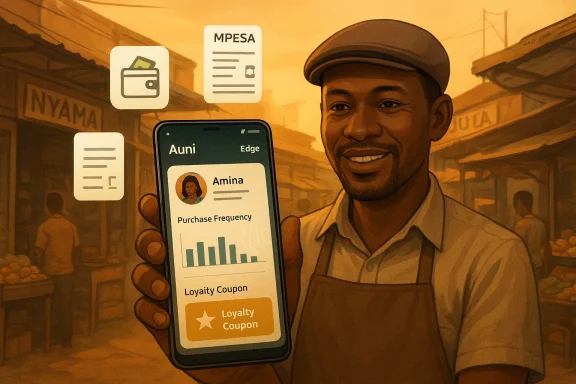
- A compressed on‑device model aggregates transactions into customer profiles, purchase frequency histograms, and basic lifetime‑value estimates.
- The assistant surfaces digestible insights (e.g., “180 loyal customers this month”) and recommends actions — targeted coupons, simple loyalty rules, or suggested reorder levels.
- For merchants who opt in, the platform automates outreach (coupon sends, SMS nudges) and provides simple dashboards for managers.
Technical approach: on‑device engineering and model compression
Low‑memory, high‑impact AI
Fastagger’s design philosophy is one of constraint‑aware engineering. Recognizing that many target users run entry‑level Android phones with around 4GB of RAM and limited data plans, the team focuses on:- Model compression: pruning and quantizing models so inference can run efficiently on CPU or low‑power NPUs.
- Domain specialization: training a foundation model for documents and mobile transaction formats relevant to East Africa to increase accuracy while shrinking model size.
- Edge‑first UX: designing flows that are usable offline and minimize network costs by syncing only aggregated telemetry when connectivity is available.
Why on‑device, not cloud‑only?
On‑device inference reduces latency, lowers recurrent cloud costs for merchants, and mitigates the impact of poor connectivity. It also aligns with affordability: Fastagger’s founders explicitly reasoned that the African market “doesn’t have money for GPU compute,” so the right technical answer is to optimize models to fit the devices already in circulation rather than expect a wholesale hardware upgrade. The result is a system that can behave like “an MBA intern on the phone” for a micro‑enterprise.Partnerships, distribution and scale
Auni’s real breakthrough came through partnerships. Fastagger joined accelerators and partner programmes (Google for Startups, NVIDIA and Microsoft accelerator cohorts) and later integrated with Safaricom’s M‑PESA Business ecosystem. That distribution path — combining startup agility with telco reach and hyperscaler support — enabled rapid onboarding and a compelling go‑to‑market channel for MSMEs.- Safaricom integration: Auni was embedded into the M‑PESA Business app, giving it immediate visibility among merchants that process payments through Kenya’s dominant mobile‑money network. Early deployments reported hundreds to thousands of MSMEs adopting the tool in the weeks after launch.
- Cloud + edge support: Microsoft’s Africa Transformation Office and the NVIDIA GenAI Programme Accelerator provided technical mentorship, Azure AI tools, and cloud credits — not to replace edge inference, but to provide scalable backends for model updates, analytics rollup, and partner icrosoft.com](https://news.microsoft.com/source/e...closing-the-digital-divide/?utm_source=openai))
Real‑world impact: examples and early results
Concrete merchant wins
Fastagger’s founders describe concrete examples that make the case for immediate, tangible value. One barber shop discovered it had about 180 loyal monthly customers after Auni analyzed its transactions — a metric the owner had not tracked. That insight informed staffing and loyalty decisions that would have been impossible without digitized transaction analysis.Other early adopters reported improvements in customer retention actions, simpler coupon management and faster reconciliation for busy merchants. In sectors beyond retail — such as independent pharmacies — complementary Microsoft‑backed initiatives show that AI can also reduce expiry losses, optimize inventory and enable lender‑friendly credit scoring for micro‑retailers. These parallel projects (for example, a Kenyan health‑tech startup working with Microsoft) underscore the diversity of practical use cases for compact AI in local commerce.
Adoption numbers
Different sources offer slightly different adoption figures — a normal pattern for rapidly evolving pilots. Early beta months saw hundreds of MSMEs onboarded through M‑PESA channels, and subsequent expansion has reported thousands (figures like 2,500+ merchants are cited in media and Microsoft write‑ups). Those numbers signal meaningful product‑market fit but also reflect ongoing scaling rather than final national coverage.Benefits for small business owners
AI tools like Auni deliver a cluster of practical benefits that match merchants’ immediate priorities:- Time savings: automated reconciliatt balancing receipts and ledgers.
- Actionable customer intelligence: merchants can identify top purchasers, inactive customers and retention targets.
- Affordable automation: subscriptions reported in press coverage suggest price points well below traditional accounting software, often in the $1–$5 per month range.
- Access to finance signals: structured transaction histories can be transformed into lender‑friendly credit signals or working‑capital products.
- Localized UX: by operating in local languages and formats and working offline, these tools meet users where they are rather than forcing them to change context.
Risks, limitations, and governance questions
The technical elegance of on‑device AI doesn’t eliminate a set of practical and ethical concerns. These must be handled deliberately if the benefits are to scale equitably.Data privacy and consent
Mobile‑money receipts are financial data. Parsing them on device reduces the need to ship raw transaction logs to the cloud, which is a privacy advantage, but there are still data‑sharing flows for analytics and optional automated messaging. Merchants must be given clear, local‑language consent prompts and transparent controls over what is stored, synced, or shared. Kenya has data protection legislation that sets expectations for sensitive financial information; vendors must align with those regulatory obligations.Platform dependency and vendor lock‑in
Embedding AI tools into a telco’s super app (like M‑PESA Business) accelerates reach but creates potential dependencies. If a merchant’s primary access to Auni is through a partner ecosystem, questions arise about portability, migration paths, and the risk of service changes tied to commercial negotiations between vendors and telcos. Product designers should offer exportable reports and open data formats to avoid locking merchants into single vendors.Model bias and accuracy
Local datasets are essential to accuracy, but they also encode local practices and blind spots. Foundation models trained on region‑specific transaction formats can misclassify or miss informal transactions (cash tips, manual ledger entries). Merchants must be able to correct AI outputs easily and see confidence indicators for automated suggestions. Where models are used to underpin lending decisions, governance against discriminatory or opaque scoring is critical.Security and fraud risks
Automating coupon sends, loyalty adjustments, or customer nudges expands the attack surface. Malicious actors could attempt to spoof receipts or manipulate automated incentives if verification is weak. Robust message‑signature checks, server‑side corroboration when necessary, and fraud‑detection heuristics are required to keep merchant trust intact.Sustainability and maintenance
Tiny models still require updates: bug fixes, retraining for new SMS formats, and improvements in natural‑language understanding. Maintaining an infrastructure that supports thousands or millions of devices requires both cloud orchestration and operational funding. That’s why strategic support from hyperscalers and accelerator partners matters, but so does a viable commercial model that keeps costs predictable for low‑revenue merchants.Policy and market recommendations
To maximize impact while reducing risk, stakeholders should consider the following practical steps:- For governments and regulators:
- Create clear, enforceable rules for financial‑data processing, including consent language for mobile‑money analysis.
- Support open standards for transaction exports to prevent vendor lock‑in.
- For telcos and distribution partners:
- Offer merchants an opt‑in audit trail and export function for their data.
- Subsidize basic hardware or provide shared terminals in markets where device ownership is a barrier.
- For startups and vendors:
- Prioritize on‑device privacy‑preserving architectures (differential privacy, edge aggregation).
- Build transparent model cards and user‑facing explanations for AI‑driven recommendations.
- Keep price points predictable and keep basic features available offline.
Broader context: AI that fits the market, not the other way round
Fastagger’s Auni exemplifies a broader design pattern for emergent markets: instead of porting heavyweight Western enterprise tools into constrained environments, build small, local models that solve clearly defined, high‑value problems with the devices and connectivity people already have. This model — edge‑first, data‑sparse, partnership‑driven — is showing results not just in commerce but in healthcare inventory, credit scoring and logistics across Kenya and neighboring markets. Microsoft’s corporate initiatives and accelerator programs are amplifying these efforts by providing cloud credits, technical mentorship and distribution ties — but the day‑to‑day value still hinges on whether a hairdresser or shopkeeper can get a useful insight while serving the next customer.What merchants should know today
- If you use mobile money as your primary payments channel, there are now tools that can analyze transaction SMS and suggest simple actions to grow retention.
- On‑device AI means you can get value without a constant internet connection or expensive hardware upgrades.
- Watch for clear consent dialogs and the ability to export your own data; these are signs of a vendor serious about merchant empowerment rather than vendor lock‑in.
Conclusion
Auni’s rise from a data‑tagging startup to an on‑device AI assistant embedded in a national mobile‑money ecosystem shows a practical, service‑first path for AI in emerging markets. By meeting merchants where they are — on low‑end phones, offline more often than not, and reliant on mobile money — Fastagger has turned a seemingly intractable set of constraints into a product advantage. The technical lessons are clear: compress models, design for offline UX, ground systems in local data, and partner with distribution platforms that already reach small merchants.But the work is only beginning. Privacy safeguards, transparent scoring for financial services, portability of merchant data, and fraud protections must all be baked into the next wave of deployments. Done correctly, on‑device AI can be the most efficient path to spreading business intelligence to the thousands of micro‑enterprises that fuel Kenya’s economy — and a replicable model for other markets where the device and data environments are far from ideal, yet the need for practical insight is enormous.
Source: Microsoft Source How AI is empowering small business owners in Kenya
