

Australia’s compliance software market is being reshaped in 2026 by overlapping privacy, cyber, climate, financial services, workforce, and critical infrastructure obligations that are forcing organisations to replace spreadsheet-era governance with auditable, automated control systems. This is not merely a procurement story about better dashboards. It is a shift in how Australian businesses prove that policies are actually operating inside the business. Compliance is becoming infrastructure.
The uncomfortable lesson for boards is that obligations no longer sit neatly inside legal or risk teams. They now reach into cloud architecture, vendor contracts, identity systems, HR records, incident response, carbon data, and operational resilience planning. A compliance platform that cannot see those systems is not managing compliance; it is managing paperwork.
For years, many Australian organisations treated compliance as a cycle of document updates, annual attestations, internal audits, and frantic evidence collection. That model worked tolerably well when obligations were narrower, audits were periodic, and regulators were willing to accept a persuasive narrative backed by scattered records. It is becoming much less convincing in a world where privacy incidents, cyber failures, supplier outages, and climate disclosures all demand evidence.
The problem is not that businesses lack policies. Most have too many of them. The real problem is that policies often live separately from controls, controls live separately from operational systems, and evidence is reconstructed after the fact by people who remember where things are stored.
That is why compliance management software is moving from a document repository to an operating layer. The best systems link obligations to controls, controls to owners, owners to workflows, and workflows to evidence. In plain English, they help an organisation show not just that it intended to comply, but that the relevant process was working at the relevant time.
This distinction matters because Australian regulators are increasingly focused on accountability and operational proof. A board pack saying “we are compliant” is weaker than a system that can show which control was tested, who approved an exception, what evidence supported it, and whether remediation happened on schedule.
APRA’s CPS 230 operational risk management regime is a useful example. It pushes financial institutions to demonstrate stronger control over operational risks, business continuity, and material service providers. That means compliance teams need current information about suppliers, service dependencies, disruption tolerances, incidents, testing, and remediation. A static register is not enough.
The Security of Critical Infrastructure regime creates a similar pressure for operators in sectors such as energy, water, transport, communications, data storage, and other essential services. These entities need to maintain visibility over cyber incidents, risk management programs, assets, and reporting obligations. Again, the difficult part is not writing down the obligation; it is maintaining a live view across operational environments.
Climate-related financial reporting adds another layer. Mandatory sustainability reporting requires data pipelines, assurance processes, governance statements, and traceable calculations. ESG compliance is therefore becoming less like corporate communications and more like financial controls.
Privacy reform and breach enforcement complete the picture. Organisations need to know what personal information they hold, where it moves, who can access it, how incidents are assessed, and when notification obligations are triggered. That is data governance, security engineering, legal workflow, and audit evidence all braided together.
Email is worse. It is often the shadow workflow behind compliance: requests for evidence, approvals, reminders, escalations, and audit responses. But email is not a control system. It is a conversation archive that becomes searchable only after someone knows what they are looking for.
Disconnected systems create a subtler failure. A risk register may say a control exists, an identity platform may show access patterns, an HR system may show staff movements, and a ticketing system may show remediation status. If those systems do not connect, the compliance team is left stitching together a picture manually.
Modern compliance software attempts to solve this by creating a shared data model. Obligations, controls, risks, incidents, policies, vendors, evidence, and reports become connected objects rather than separate files. That sounds dry, but it changes the operating rhythm of compliance from periodic reconstruction to continuous assurance.
A compliance management system usually focuses on tracking obligations, implementing controls, collecting evidence, and proving adherence to frameworks. A GRC platform is broader, often connecting governance structures, risk taxonomies, enterprise controls, and executive reporting. Audit tools manage audit planning and findings. ESG systems track sustainability data and reporting. Cyber compliance platforms map security controls to frameworks such as the Essential Eight, ISO 27001, CPS 234, and NIST.
In practice, enterprises often need capabilities from several categories. A bank may need APRA control mapping, vendor risk workflows, audit evidence, cyber control testing, and board reporting in one environment. A mining company may need WHS incident capture, contractor credentialing, environmental reporting, and mobile evidence collection from remote sites.
The best architecture does not necessarily mean buying the biggest platform. It means building or configuring a system around the organisation’s actual obligation map. A smaller tool with deep integration into operational systems can outperform a sprawling GRC suite that becomes another manual reporting layer.
This has pushed compliance platforms toward integration with security tooling. Identity providers, endpoint management systems, vulnerability scanners, cloud platforms, SIEM tools, ticketing systems, and backup platforms are increasingly sources of compliance evidence. The control owner should not have to upload screenshots every month if the evidence can be pulled from the system of record.
The convergence also changes who buys the software. Compliance officers still matter, but CISOs, CIOs, risk committees, and boards are now deeply involved. Their priorities are different. They want defensible evidence, current risk indicators, incident traceability, and reports that translate technical controls into governance consequences.
This is where weak implementations fail. If a compliance platform relies entirely on self-attestation, it can become a prettier spreadsheet. If it ingests operational telemetry and links it to obligations, it becomes a management system.
But AI does not remove accountability. A model can suggest that a new regulatory update affects a policy or control, but someone still needs to validate the interpretation. A predictive risk score can highlight deterioration, but management still needs to decide whether to remediate, accept, transfer, or escalate the risk.
The most credible AI use in compliance is therefore assistive rather than autonomous. It reduces the effort required to monitor change, compare obligations, draft first-pass documents, and detect patterns. It should not be treated as a substitute for legal judgment, risk ownership, or security engineering.
For Australian organisations, the governance of AI inside compliance software will itself become a compliance issue. Sensitive regulatory data, personal information, audit evidence, and privileged material cannot be casually fed into opaque systems. Model governance, access control, data residency, logging, and human review need to be designed into the platform.
Risk and control management should support inherent and residual risk ratings, control libraries, testing schedules, exceptions, and remediation. Multi-framework mapping is particularly important because one control may satisfy several obligations. If access reviews support ISO 27001, CPS 234, and internal security policy, the organisation should test once and reuse the evidence.
Incident and issue tracking is another core capability. Compliance incidents, near misses, control failures, privacy events, WHS incidents, supplier failures, and cyber issues need structured workflows. The system should support root-cause analysis, assignment, escalation, deadlines, regulatory notification logic, and closure evidence.
Audit readiness is where the commercial value becomes obvious. A mature system keeps evidence libraries continuously updated, making audits less disruptive. Instead of rebuilding history from email and shared drives, teams can produce a traceable chain of obligation, control, test, evidence, finding, and remediation.
Healthcare and medtech organisations face a different mix. Privacy, clinical governance, cyber risk, patient data, supplier assurance, and audit preparedness dominate. The challenge is not just regulatory complexity, but the sensitivity of the data and the operational consequences of failure.
Mining, energy, and resources companies need compliance systems that understand distributed operations. WHS events, contractor certifications, environmental metrics, equipment checks, site-level controls, and ESG disclosures may originate far from head office. Offline-capable mobile workflows and strong evidence capture are often more important than elegant headquarters dashboards.
Government and public sector organisations tend to prioritise procurement compliance, cyber mandates, records governance, data handling, auditability, and accountability reporting. Retail and e-commerce firms focus on privacy, payments, consumer obligations, supplier governance, and operational controls across digital and physical channels.
Critical infrastructure providers sit at the sharp end of the trend. They need systems that connect cyber resilience, incident reporting, operational risk, physical assets, suppliers, and continuity planning. For them, compliance failure can become a national resilience issue rather than a paperwork problem.
Custom development becomes more compelling when the organisation’s compliance model is specific, complex, or strategically important. If a business operates across several regulatory frameworks, relies on legacy systems, has strict data residency requirements, or needs board reporting that reflects its own governance structure, packaged software may create workarounds that become costly over time.
The strongest case for custom software is not vanity. It is control. The organisation can design obligation mapping around Australian requirements, integrate deeply with ERP, HR, identity, security, and operational platforms, and maintain its own roadmap as regulations change.
That control comes with trade-offs. Custom platforms require stronger discovery, architecture, security design, testing, and long-term maintenance. They also require product discipline. A custom compliance platform that tries to satisfy every stakeholder request can become as bloated and confusing as the enterprise software it was meant to replace.
A basic build might cover obligation registers, policy management, simple workflows, dashboards, and evidence upload. A mid-tier build may add multi-framework mapping, ERP or HRMS integration, automated reporting, vendor workflows, and audit management. An enterprise build may include continuous controls monitoring, AI-assisted regulatory analysis, identity integration, cyber telemetry, mobile field capture, board analytics, and complex permission models.
The more important calculation is risk-adjusted cost. Manual compliance consumes staff time, increases error rates, slows audits, and creates exposure when obligations change faster than processes. Software costs money up front, but manual compliance often hides its cost inside headcount, audit disruption, consulting fees, remediation work, and regulatory risk.
Implementation timelines vary accordingly. A focused platform may take four to six months. A multi-framework enterprise system may take six to nine months. A full GRC-grade platform with deep integrations and AI-assisted features can run nine to eighteen months or longer.
This is why reporting design matters. A dashboard that lists overdue tasks is not the same as a governance report. Boards need trends, risk concentration, material exceptions, remediation status, supplier exposure, control deterioration, incident themes, and the implications of regulatory change.
Compliance software should therefore translate operational data into decision support. If a critical vendor has repeated control failures, the board should see the risk. If a cyber control is failing across multiple business units, the CISO should see the pattern. If new climate reporting obligations require data the company does not yet collect, finance and sustainability teams should know before reporting season.
The value is not simply faster reporting. It is earlier intervention. A live compliance platform gives management a chance to fix weak controls before they become audit findings, breach notifications, or public failures.
This does not mean every organisation needs a giant platform immediately. It does mean that new systems should be designed for change. Regulations will not stand still, and neither will business models, vendor networks, cyber threats, or reporting expectations.
Architecture choices made today will either help or hurt later. A platform with clean data models, strong APIs, role-based access, audit logging, configurable workflows, and multi-framework mapping can adapt. A rigid tool that merely digitises the old spreadsheet process will age quickly.
The Australian market is also likely to become more demanding about data sovereignty and security. Compliance platforms contain sensitive information about controls, incidents, suppliers, vulnerabilities, policies, and governance failures. That makes the platform itself a high-value system requiring careful protection.
The practical lessons are now clear:
The uncomfortable lesson for boards is that obligations no longer sit neatly inside legal or risk teams. They now reach into cloud architecture, vendor contracts, identity systems, HR records, incident response, carbon data, and operational resilience planning. A compliance platform that cannot see those systems is not managing compliance; it is managing paperwork.
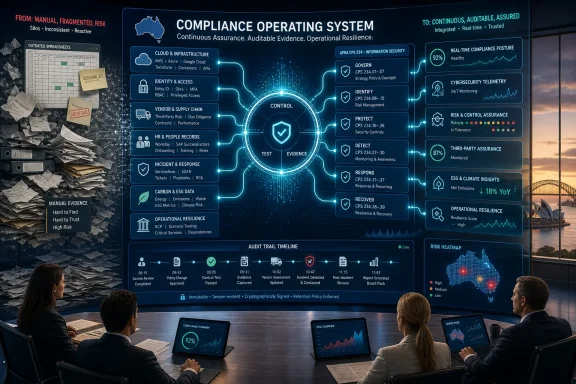 Compliance Has Outgrown the Policy Folder
For years, many Australian organisations treated compliance as a cycle of document updates, annual attestations, internal audits, and frantic evidence collection. That model worked tolerably well when obligations were narrower, audits were periodic, and regulators were willing to accept a persuasive narrative backed by scattered records. It is becoming much less convincing in a world where privacy incidents, cyber failures, supplier outages, and climate disclosures all demand evidence.The problem is not that businesses lack policies. Most have too many of them. The real problem is that policies often live separately from controls, controls live separately from operational systems, and evidence is reconstructed after the fact by people who remember where things are stored.
That is why compliance management software is moving from a document repository to an operating layer. The best systems link obligations to controls, controls to owners, owners to workflows, and workflows to evidence. In plain English, they help an organisation show not just that it intended to comply, but that the relevant process was working at the relevant time.
This distinction matters because Australian regulators are increasingly focused on accountability and operational proof. A board pack saying “we are compliant” is weaker than a system that can show which control was tested, who approved an exception, what evidence supported it, and whether remediation happened on schedule.
The Australian Rulebook Is Becoming a Systems Problem
Australia’s regulatory landscape has become unusually dense because several reform streams are landing at once. Privacy law, cyber obligations, operational resilience, climate reporting, workplace safety, anti-money-laundering reforms, and modern slavery reporting all pull different data from different parts of the enterprise. The cumulative effect is not just more compliance work; it is more coordination work.APRA’s CPS 230 operational risk management regime is a useful example. It pushes financial institutions to demonstrate stronger control over operational risks, business continuity, and material service providers. That means compliance teams need current information about suppliers, service dependencies, disruption tolerances, incidents, testing, and remediation. A static register is not enough.
The Security of Critical Infrastructure regime creates a similar pressure for operators in sectors such as energy, water, transport, communications, data storage, and other essential services. These entities need to maintain visibility over cyber incidents, risk management programs, assets, and reporting obligations. Again, the difficult part is not writing down the obligation; it is maintaining a live view across operational environments.
Climate-related financial reporting adds another layer. Mandatory sustainability reporting requires data pipelines, assurance processes, governance statements, and traceable calculations. ESG compliance is therefore becoming less like corporate communications and more like financial controls.
Privacy reform and breach enforcement complete the picture. Organisations need to know what personal information they hold, where it moves, who can access it, how incidents are assessed, and when notification obligations are triggered. That is data governance, security engineering, legal workflow, and audit evidence all braided together.
The Spreadsheet Was Never Designed for Continuous Assurance
Spreadsheets survive in compliance departments because they are flexible, familiar, and cheap. They are also terrible at proving that a control environment is alive. Version conflicts, manual updates, missing approvals, broken links, and undocumented exceptions are not minor annoyances when the file is supposed to support a regulatory position.Email is worse. It is often the shadow workflow behind compliance: requests for evidence, approvals, reminders, escalations, and audit responses. But email is not a control system. It is a conversation archive that becomes searchable only after someone knows what they are looking for.
Disconnected systems create a subtler failure. A risk register may say a control exists, an identity platform may show access patterns, an HR system may show staff movements, and a ticketing system may show remediation status. If those systems do not connect, the compliance team is left stitching together a picture manually.
Modern compliance software attempts to solve this by creating a shared data model. Obligations, controls, risks, incidents, policies, vendors, evidence, and reports become connected objects rather than separate files. That sounds dry, but it changes the operating rhythm of compliance from periodic reconstruction to continuous assurance.
The New Compliance Stack Looks More Like Risk Operations
The market still uses overlapping labels: compliance management software, GRC platforms, risk management tools, audit management systems, ESG platforms, and cyber compliance products. Buyers should not be distracted by terminology. The important question is what job the system is expected to do.A compliance management system usually focuses on tracking obligations, implementing controls, collecting evidence, and proving adherence to frameworks. A GRC platform is broader, often connecting governance structures, risk taxonomies, enterprise controls, and executive reporting. Audit tools manage audit planning and findings. ESG systems track sustainability data and reporting. Cyber compliance platforms map security controls to frameworks such as the Essential Eight, ISO 27001, CPS 234, and NIST.
In practice, enterprises often need capabilities from several categories. A bank may need APRA control mapping, vendor risk workflows, audit evidence, cyber control testing, and board reporting in one environment. A mining company may need WHS incident capture, contractor credentialing, environmental reporting, and mobile evidence collection from remote sites.
The best architecture does not necessarily mean buying the biggest platform. It means building or configuring a system around the organisation’s actual obligation map. A smaller tool with deep integration into operational systems can outperform a sprawling GRC suite that becomes another manual reporting layer.
Cybersecurity Has Dragged Compliance Into Real Time
Cybersecurity is one reason compliance has become less tolerant of slow reporting cycles. The ACSC Essential Eight, APRA CPS 234, SOCI obligations, ISO 27001 programs, and internal cyber policies all require evidence that technical controls are implemented and maintained. A quarterly meeting cannot prove that patching, access control, backups, logging, and application hardening are working.This has pushed compliance platforms toward integration with security tooling. Identity providers, endpoint management systems, vulnerability scanners, cloud platforms, SIEM tools, ticketing systems, and backup platforms are increasingly sources of compliance evidence. The control owner should not have to upload screenshots every month if the evidence can be pulled from the system of record.
The convergence also changes who buys the software. Compliance officers still matter, but CISOs, CIOs, risk committees, and boards are now deeply involved. Their priorities are different. They want defensible evidence, current risk indicators, incident traceability, and reports that translate technical controls into governance consequences.
This is where weak implementations fail. If a compliance platform relies entirely on self-attestation, it can become a prettier spreadsheet. If it ingests operational telemetry and links it to obligations, it becomes a management system.
AI Is Useful, but It Is Not a Compliance Officer
Artificial intelligence is being folded into compliance platforms quickly, and some of the use cases are sensible. Natural-language processing can help parse regulatory updates. Machine learning can flag anomalous control results. Generative AI can assist with policy drafting, risk narratives, and obligation summaries.But AI does not remove accountability. A model can suggest that a new regulatory update affects a policy or control, but someone still needs to validate the interpretation. A predictive risk score can highlight deterioration, but management still needs to decide whether to remediate, accept, transfer, or escalate the risk.
The most credible AI use in compliance is therefore assistive rather than autonomous. It reduces the effort required to monitor change, compare obligations, draft first-pass documents, and detect patterns. It should not be treated as a substitute for legal judgment, risk ownership, or security engineering.
For Australian organisations, the governance of AI inside compliance software will itself become a compliance issue. Sensitive regulatory data, personal information, audit evidence, and privileged material cannot be casually fed into opaque systems. Model governance, access control, data residency, logging, and human review need to be designed into the platform.
The Features That Matter Are the Ones That Produce Evidence
Feature lists in compliance software tend to blur together, but the useful capabilities are easy to identify because they reduce a real risk or cost. Regulatory change monitoring is valuable when it maps updates to internal obligations and control owners, not when it merely republishes alerts. Policy management is valuable when policies are versioned, approved, attested, and linked to enforceable controls.Risk and control management should support inherent and residual risk ratings, control libraries, testing schedules, exceptions, and remediation. Multi-framework mapping is particularly important because one control may satisfy several obligations. If access reviews support ISO 27001, CPS 234, and internal security policy, the organisation should test once and reuse the evidence.
Incident and issue tracking is another core capability. Compliance incidents, near misses, control failures, privacy events, WHS incidents, supplier failures, and cyber issues need structured workflows. The system should support root-cause analysis, assignment, escalation, deadlines, regulatory notification logic, and closure evidence.
Audit readiness is where the commercial value becomes obvious. A mature system keeps evidence libraries continuously updated, making audits less disruptive. Instead of rebuilding history from email and shared drives, teams can produce a traceable chain of obligation, control, test, evidence, finding, and remediation.
Sector Demand Is Splintering, Not Converging
Australian financial services firms are among the most obvious adopters because APRA regulation creates strong expectations around operational resilience, cyber controls, outsourcing, and accountability. For banks, insurers, superannuation funds, and other regulated entities, compliance software increasingly overlaps with vendor management, business continuity, identity governance, and executive reporting.Healthcare and medtech organisations face a different mix. Privacy, clinical governance, cyber risk, patient data, supplier assurance, and audit preparedness dominate. The challenge is not just regulatory complexity, but the sensitivity of the data and the operational consequences of failure.
Mining, energy, and resources companies need compliance systems that understand distributed operations. WHS events, contractor certifications, environmental metrics, equipment checks, site-level controls, and ESG disclosures may originate far from head office. Offline-capable mobile workflows and strong evidence capture are often more important than elegant headquarters dashboards.
Government and public sector organisations tend to prioritise procurement compliance, cyber mandates, records governance, data handling, auditability, and accountability reporting. Retail and e-commerce firms focus on privacy, payments, consumer obligations, supplier governance, and operational controls across digital and physical channels.
Critical infrastructure providers sit at the sharp end of the trend. They need systems that connect cyber resilience, incident reporting, operational risk, physical assets, suppliers, and continuity planning. For them, compliance failure can become a national resilience issue rather than a paperwork problem.
Custom Software Wins When the Business Is the Exception
The build-versus-buy decision is often framed too simplistically. Off-the-shelf platforms make sense for organisations with standard obligations, limited integration needs, modest custom reporting requirements, and a willingness to adapt processes to the vendor’s model. For smaller organisations, that can be entirely rational.Custom development becomes more compelling when the organisation’s compliance model is specific, complex, or strategically important. If a business operates across several regulatory frameworks, relies on legacy systems, has strict data residency requirements, or needs board reporting that reflects its own governance structure, packaged software may create workarounds that become costly over time.
The strongest case for custom software is not vanity. It is control. The organisation can design obligation mapping around Australian requirements, integrate deeply with ERP, HR, identity, security, and operational platforms, and maintain its own roadmap as regulations change.
That control comes with trade-offs. Custom platforms require stronger discovery, architecture, security design, testing, and long-term maintenance. They also require product discipline. A custom compliance platform that tries to satisfy every stakeholder request can become as bloated and confusing as the enterprise software it was meant to replace.
The Real Cost Is Not the Licence Fee
Custom compliance management software in Australia can range from roughly AUD 70,000 for a focused, single-framework platform to AUD 700,000 or more for an enterprise system with AI features, deep integrations, advanced analytics, and multi-entity governance. Those numbers are only useful as directional markers. The real cost depends on scope, data architecture, integrations, security baseline, workflow complexity, and reporting requirements.A basic build might cover obligation registers, policy management, simple workflows, dashboards, and evidence upload. A mid-tier build may add multi-framework mapping, ERP or HRMS integration, automated reporting, vendor workflows, and audit management. An enterprise build may include continuous controls monitoring, AI-assisted regulatory analysis, identity integration, cyber telemetry, mobile field capture, board analytics, and complex permission models.
The more important calculation is risk-adjusted cost. Manual compliance consumes staff time, increases error rates, slows audits, and creates exposure when obligations change faster than processes. Software costs money up front, but manual compliance often hides its cost inside headcount, audit disruption, consulting fees, remediation work, and regulatory risk.
Implementation timelines vary accordingly. A focused platform may take four to six months. A multi-framework enterprise system may take six to nine months. A full GRC-grade platform with deep integrations and AI-assisted features can run nine to eighteen months or longer.
Boards Want a Governance Signal, Not a Data Dump
The board’s role in compliance has changed because failures are more visible and more consequential. Directors and executives do not need every operational detail, but they do need confidence that the organisation knows its obligations, understands its control gaps, and can respond quickly when something breaks.This is why reporting design matters. A dashboard that lists overdue tasks is not the same as a governance report. Boards need trends, risk concentration, material exceptions, remediation status, supplier exposure, control deterioration, incident themes, and the implications of regulatory change.
Compliance software should therefore translate operational data into decision support. If a critical vendor has repeated control failures, the board should see the risk. If a cyber control is failing across multiple business units, the CISO should see the pattern. If new climate reporting obligations require data the company does not yet collect, finance and sustainability teams should know before reporting season.
The value is not simply faster reporting. It is earlier intervention. A live compliance platform gives management a chance to fix weak controls before they become audit findings, breach notifications, or public failures.
The Australian Compliance Platform Is Becoming a RegTech Operating System
The future of compliance software in Australia is likely to be shaped by five overlapping trends. Continuous controls monitoring will replace periodic testing in higher-maturity organisations. Cybersecurity and compliance platforms will continue to converge around shared evidence. ESG reporting will demand assurance-grade data management. AI will assist with regulatory interpretation and risk detection. Low-code workflow tools will let compliance teams adapt processes without waiting for software release cycles.This does not mean every organisation needs a giant platform immediately. It does mean that new systems should be designed for change. Regulations will not stand still, and neither will business models, vendor networks, cyber threats, or reporting expectations.
Architecture choices made today will either help or hurt later. A platform with clean data models, strong APIs, role-based access, audit logging, configurable workflows, and multi-framework mapping can adapt. A rigid tool that merely digitises the old spreadsheet process will age quickly.
The Australian market is also likely to become more demanding about data sovereignty and security. Compliance platforms contain sensitive information about controls, incidents, suppliers, vulnerabilities, policies, and governance failures. That makes the platform itself a high-value system requiring careful protection.
The Decision Australian Buyers Cannot Avoid
Australian organisations evaluating compliance software should start with the operating problem, not the vendor category. The best platform is the one that reflects how the business is regulated, how it actually works, and where evidence already lives. A compliance transformation that ignores operational systems will end up recreating manual work behind a new interface.The practical lessons are now clear:
- Australian compliance software is moving from document management toward continuous evidence, control monitoring, and operational risk visibility.
- APRA-regulated entities, critical infrastructure operators, healthcare providers, mining companies, retailers, and public sector bodies face different compliance architectures, even when they buy tools with similar labels.
- AI can reduce the burden of regulatory monitoring and risk analysis, but it must remain governed, explainable, and subject to human review.
- Off-the-shelf platforms suit standard requirements, while custom development becomes more attractive when integration depth, Australian regulatory alignment, or board reporting specificity matters.
- The business case should include audit preparation, staff time, regulatory responsiveness, error reduction, and avoided incident costs rather than licence fees alone.
- Compliance platforms should be treated as sensitive enterprise infrastructure because they contain the organisation’s map of obligations, weaknesses, controls, and evidence.
References
- Primary source: appinventiv.com
Published: 2026-06-19T14:30:15.501845
- Related coverage: regulationtomorrow.com
Now in force – APRA CPS 230 Operational Risk Management | Global Regulation Tomorrow
On 1 July 2025, the Australian Prudential Regulation Authority’s (APRA) Prudential Standard (CPS) 230 Operational Risk Management came into force. The aimwww.regulationtomorrow.com - Related coverage: apra.gov.au
Operational risk management | APRA
apra.gov.au
- Related coverage: cisc.gov.au
Cyber and Infrastructure Security Centre Website
Protecting Australia's Cyber and Infrastructure Security.www.cisc.gov.au - Related coverage: oaic.gov.au
Chapter 7: Civil penalties — serious or repeated interference with privacy and other penalty provisions | OAIC
The Commissioner can apply to the Federal Court or Federal Circuit Court for an order that an entity, alleged to have contravened a civil penalty, pay a penalty www.oaic.gov.au
- Related coverage: fortecyberx.au
SOCI Act Cyber Compliance — A Practical Guide for Australian Critical Infrastructure | FORTE/CYBERx
AI-powered decision support for cyber risks, vendor choices, compliance gaps, AI governance and board-ready technology decisions. Turn complex challenges into decision paths, trade-offs and practical plans. fortecyberx.au
- Related coverage: tawcks.com.au
- Related coverage: superannuation.asn.au
