

Australia’s government plans to make large data-centre operators fund new power generation, pay the full cost of grid connections and reduce demand when the electricity system is under pressure. The proposal, announced by Prime Minister Anthony Albanese on July 15, has also prompted environmental groups and the Greens to call for a pause on new approvals until the rules are in force.
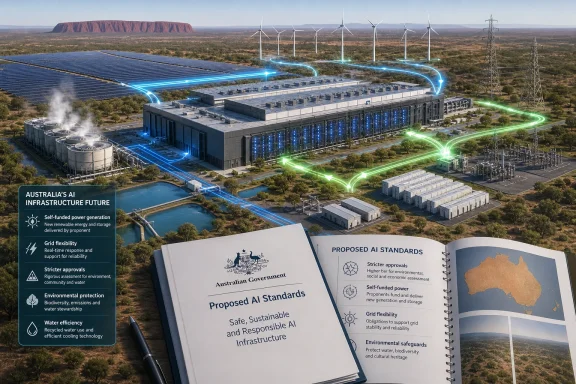
The requirements are proposed Australian Standards for AI, not current law. Per the Prime Minister’s office, the standards would apply legal obligations to large data centres to underwrite their own new power supply, ensure connection costs do not raise consumer energy bills, support grid flexibility and use water efficiently. Operators would also be expected to put as much energy into the grid as they take from it.
The government has established an Office of AI within the Department of the Prime Minister and Cabinet to coordinate the work. Albanese will seek state and territory backing through National Cabinet in August 2026, with legislation expected in early 2027.
The practical change is significant for hyperscale and AI-training facilities. Instead of relying solely on available grid capacity or renewable-energy purchase agreements, developers may need to finance new generation, storage or firming capacity alongside the data centre itself. They could also face location, water-use and demand-response conditions coordinated across federal, state and local governments.
ABC News reported that the proposed standards would cover where centres can be built, their power and water consumption, and extra water infrastructure where required. That could affect expansion plans for cloud providers, colocation operators and enterprises building large private AI clusters in Australia.
For Windows and Azure customers, the immediate impact is indirect: there is no announced change to Microsoft services or customer pricing. However, tougher approval and infrastructure requirements could affect the pace, cost and geography of future Australian cloud and AI capacity.
That is not the Albanese government’s stated position. Its announcement instead promises a “consistent regulatory framework” intended to speed approvals once compliance can be verified. The policy is therefore aimed at making expansion conditional rather than freezing it outright.
Crypto mining is not named as the central target, and claims that it would automatically be covered go beyond the announced detail. But any large facility competing for Australian power and grid connections could face similar economic pressure if the final standards are written broadly.
Operators with Australian expansion plans now need to factor self-funded power, grid and water commitments into projects before the proposed 2027 legislation arrives.
The requirements are proposed Australian Standards for AI, not current law. Per the Prime Minister’s office, the standards would apply legal obligations to large data centres to underwrite their own new power supply, ensure connection costs do not raise consumer energy bills, support grid flexibility and use water efficiently. Operators would also be expected to put as much energy into the grid as they take from it.
The government has established an Office of AI within the Department of the Prime Minister and Cabinet to coordinate the work. Albanese will seek state and territory backing through National Cabinet in August 2026, with legislation expected in early 2027.
 A tougher infrastructure test
The practical change is significant for hyperscale and AI-training facilities. Instead of relying solely on available grid capacity or renewable-energy purchase agreements, developers may need to finance new generation, storage or firming capacity alongside the data centre itself. They could also face location, water-use and demand-response conditions coordinated across federal, state and local governments.ABC News reported that the proposed standards would cover where centres can be built, their power and water consumption, and extra water infrastructure where required. That could affect expansion plans for cloud providers, colocation operators and enterprises building large private AI clusters in Australia.
For Windows and Azure customers, the immediate impact is indirect: there is no announced change to Microsoft services or customer pricing. However, tougher approval and infrastructure requirements could affect the pace, cost and geography of future Australian cloud and AI capacity.
Moratorium remains a demand, not policy
The Guardian reported that community and environmental groups want authorities to stop approving new data centres while the national framework is completed. Greens communications spokesperson Sarah Hanson-Young backed a temporary halt for large projects, citing energy, water, environmental and community impacts.That is not the Albanese government’s stated position. Its announcement instead promises a “consistent regulatory framework” intended to speed approvals once compliance can be verified. The policy is therefore aimed at making expansion conditional rather than freezing it outright.
Crypto mining is not named as the central target, and claims that it would automatically be covered go beyond the announced detail. But any large facility competing for Australian power and grid connections could face similar economic pressure if the final standards are written broadly.
Operators with Australian expansion plans now need to factor self-funded power, grid and water commitments into projects before the proposed 2027 legislation arrives.