

On May 26, 2026, an Australian republished essay argued that the country’s online life is now structurally dependent on a small set of mostly American and Chinese technology companies, and that Australia should treat digital sovereignty as a national policy priority. The provocation is not new, but the timing matters. After the CrowdStrike-triggered Windows outage of July 19, 2024, the case against monoculture stopped sounding like abstract European regulatory theory and started looking like operational common sense.
The strongest version of the argument is not that Australia, Europe, or anyone else can simply unplug from Microsoft, Apple, Google, Amazon, Cloudflare, Nvidia, Samsung, Tencent, Alibaba, and the rest of the platform layer. They cannot, and pretending otherwise turns digital sovereignty into cosplay. The real question is whether democratic countries can build enough technical, legal, and procurement leverage to avoid being governed by someone else’s defaults.
Digital sovereignty sounds grand until you translate it into the banal machinery of modern computing: identity systems, office suites, mobile operating systems, cloud regions, endpoint security agents, content delivery networks, payment rails, model APIs, app stores, device management, browser engines, and collaboration tools. That stack is where sovereignty either exists or does not. A government can pass a law in Canberra, Brussels, or Berlin, but if every department runs on the same foreign cloud, logs in through the same foreign identity provider, stores files in the same foreign productivity suite, and secures endpoints with the same globally updated agent, policy power runs into architectural dependence.
The Australian essay frames this dependence plainly. Most people pick among Apple, Windows, and Android. Much of the public and private internet relies on Amazon Web Services, Microsoft Azure, Cloudflare, Google Cloud, or some combination of them. Devices are overwhelmingly produced by American, Chinese, Korean, Taiwanese, and Japanese supply chains, while the AI assistants now being welded into operating systems and browsers are largely controlled by the same incumbent platforms.
That is not merely a consumer-choice problem. It is a state-capacity problem. When a school, hospital, agency, bank, or airline chooses a cloud service, it is also choosing a jurisdictional exposure, a procurement path, a support dependency, a software update model, a telemetry regime, and a long-term migration cost.
The phrase digital sovereignty is often abused because it can mean too much. Sometimes it means data residency. Sometimes it means domestic ownership. Sometimes it means open standards, local AI capability, public-sector control, or resistance to foreign surveillance. But the useful definition is narrower: a society has digital sovereignty when it can make meaningful choices about the digital systems on which it depends, and when it can exit those systems without catastrophic cost.
By that standard, Australia has less sovereignty than its wealth, technical talent, and public institutions would suggest.
The outage was not, strictly speaking, “a Windows bug.” It was a failure in third-party security software running deep inside Windows environments. But that distinction is only partly comforting. The reason the incident mattered was that one vendor’s bad update could interact with one dominant enterprise operating system in one common security architecture and create a worldwide failure mode.
That is the lesson policymakers should absorb. The danger is not simply foreign ownership, nor even bigness in isolation. The danger is synchronized dependency: many institutions using the same stack, patched in the same way, managed through the same assumptions, and restored through the same narrow channels when something goes wrong.
For Windows administrators, the episode had a brutal clarity. Diversity is expensive before an outage and priceless during one. Having different endpoint protection layers, staged update rings, recovery media, offline credentials, tested rollback procedures, and mixed infrastructure can look inefficient on a spreadsheet. Then a global bad update arrives and the supposedly inefficient organization is the one that still has enough working systems to coordinate its own recovery.
This is where the sovereignty debate becomes practical rather than ideological. A country does not become digitally sovereign by issuing a patriotic cloud strategy and calling it done. It becomes more sovereign by reducing single points of failure, insisting on exit rights, funding alternatives before emergencies, and treating monoculture as a security risk.
Gaia-X is emblematic of both the ambition and the difficulty. Conceived as a European data and cloud infrastructure initiative, it promised a more federated and standards-driven alternative to dependence on US hyperscalers. Yet the initiative has also faced criticism over complexity, slow delivery, and the participation of the very hyperscalers it was supposed to counterbalance. That tension is not a footnote; it is the entire problem in miniature.
The hyperscalers have not ignored sovereignty. They have repackaged it. Microsoft, Amazon, Google, Oracle, and others now sell versions of sovereign cloud, local control, regional compliance, encryption promises, customer-managed keys, local operating partners, and segregated environments. Some of these offerings are genuinely useful. They can give governments and regulated industries better tools than a naive lift-and-shift into global public cloud.
But this is also sovereignty-as-a-service, and the phrase should make procurement officers uneasy. If a vendor defines the architecture, runs the control plane, writes the license terms, owns the roadmap, and prices the exit, the customer may gain compliance features without gaining autonomy. It is possible to buy a more sovereign-looking cage.
Europe’s more interesting moves are therefore not only cloud branding exercises. They include open-source procurement, interoperability rules, antitrust actions, public-sector migration experiments, and attempts to build local AI, semiconductor, and cloud capacity. These efforts are uneven, and some will fail. But their collective effect is to remind vendors that public institutions are not merely enterprise customers; they are constitutional actors with obligations that cannot be reduced to a software subscription.
Australia should study that distinction carefully. The EU is not proving that a mid-sized or regional power can instantly replace American platforms. It is proving that law, procurement, and industrial coordination can change the bargaining position.
The country’s technology policy often oscillates between two unsatisfying modes. One is consumer-protection regulation after harm has occurred, as with privacy, scams, safety, or platform accountability. The other is innovation rhetoric that celebrates startups without changing the procurement and infrastructure environment into which those startups must sell. Neither mode, by itself, builds sovereign capability.
A serious Australian digital sovereignty roadmap would start by mapping dependencies. Which cloud providers host critical public services? Which identity systems authenticate public-sector workers? Which operating systems and mobile platforms dominate frontline services? Which SaaS products hold sensitive records? Which AI systems are being trialed in departments, schools, courts, or health settings? Which vendors have unilateral update authority over critical systems?
That map would be politically uncomfortable because it would show how much public capability is rented. It would also show that “local data centers” are not the same as local control. A US or Chinese-owned platform with an Australian region may improve latency and data residency, but it does not automatically solve questions of legal exposure, vendor lock-in, operational resilience, auditability, or national bargaining power.
The policy goal should not be autarky. Australia is a trading nation with allies, not a sealed computing island. The goal should be optionality: enough domestic and allied capability to say no, enough standards enforcement to switch, enough public expertise to evaluate vendor claims, and enough investment to keep alternatives alive.
That matters because operating systems were already powerful gatekeepers. App stores, default browsers, file formats, identity accounts, cloud backups, and notification systems shape what users can install, see, sync, and abandon. AI assistants deepen that control by learning workflow patterns, indexing local and cloud data, summarizing communications, generating documents, executing actions, and nudging users toward vendor-native services.
For consumers, this may feel convenient. For enterprises and governments, it is a new dependency surface. Once an AI assistant is embedded in the office suite, email client, code editor, endpoint, browser, and device management layer, removing it becomes more than a settings change. It becomes an organizational redesign.
Local AI is not a magic escape hatch, but it is strategically important. Running models on personal devices, private networks, or controlled national infrastructure can reduce reliance on cloud APIs owned by dominant platforms. It can also preserve sensitive data boundaries and support use cases where public-sector accountability requires more than a vendor assurance.
Still, local AI has limits. The most capable frontier models require enormous compute, specialized chips, energy, data pipelines, and engineering talent. Australia cannot casually duplicate the capital expenditure of Microsoft, Google, Amazon, Meta, or OpenAI. But it can decide where smaller, auditable, domain-specific, open, or locally hosted models are good enough — and where dependence on a proprietary black box is unacceptable.
That distinction will matter more than slogans. Digital sovereignty in AI will be won not by pretending every agency needs a national ChatGPT clone, but by defining which decisions, records, workflows, and public services must remain under accountable control.
LibreOffice has been available for decades, but Microsoft Office remains entrenched because compatibility, training, macros, procurement habits, document exchange, and organizational inertia are powerful. Mastodon and PeerTube show that federated social media can work, but network effects still pull many users toward centralized platforms. Bluesky’s AT Protocol tries to separate identity and social graph from platform ownership, but it remains young, contested, and dependent on adoption patterns still being formed.
Open source gives governments something proprietary vendors often resist: inspectability, modifiability, and the possibility of shared maintenance. But software freedom is not the same as institutional capacity. A government that adopts open-source tools without funding support, security review, migration assistance, user training, and upstream contribution may simply shift costs from license fees to overworked IT teams.
The same is true for cloud. An open-source private cloud stack can be more sovereign in theory and more fragile in practice if nobody funds the people who operate it. A sovereign system that cannot patch quickly, scale reliably, or integrate with existing workflows will lose to a proprietary system that can.
This is where procurement becomes destiny. If public tenders demand the lowest short-term cost, familiar file formats, and incumbent certifications, sovereign alternatives will rarely survive. If tenders value interoperability, exit plans, open standards, source availability, local support, staged migration, and resilience testing, the market changes.
Australia does not need to force every council, school, or agency onto the same open-source stack. That would repeat the monoculture mistake under a different flag. It needs to make non-incumbent choices viable enough that public-sector buyers can select them without committing career suicide.
First Nations communities have long argued that data about their peoples, lands, cultures, health, languages, and histories cannot be treated as a neutral resource for extraction. Governance, consent, stewardship, collective benefit, and control matter. Frameworks developed by groups such as Maiam nayri Wingara and Indigenous research data initiatives show that sovereignty can be relational and community-based, not merely centralized and bureaucratic.
That perspective is directly relevant to digital infrastructure. A national data strategy that only asks whether information is stored in Australia may still fail if it ignores who defines access, use, consent, interpretation, and benefit. Local hosting can coexist with extractive governance. A domestic platform can still reproduce the logic of a foreign monopoly if affected communities have no control over the data that describes them.
For Australia, this is not a symbolic add-on. It is a chance to build a more sophisticated sovereignty model than the one currently sold by cloud vendors. The question should not only be “Which country owns the server?” It should also be “Which community governs the data, who can contest its use, who benefits from the analysis, and what obligations survive beyond the contract?”
This matters especially as AI systems ingest public records, research datasets, cultural materials, geospatial data, and administrative histories. If AI policy treats data as raw fuel, it will collide with Indigenous sovereignty and public trust. If it treats data as governed material with rights, obligations, and context, Australia could build a model worth exporting.
Some of this will be valuable. A blanket rejection of hyperscalers would be reckless, especially for smaller agencies and businesses that benefit from world-class security tooling, uptime engineering, and scale. The point is not to caricature big tech as useless or malicious. The point is to recognize that vendor incentives and public sovereignty only partially overlap.
A hyperscaler wants customers to feel in control while remaining on the platform. A state wants enough control to leave, regulate, audit, diversify, and override. Those are different objectives. The conflict may be polite, heavily lawyered, and hidden inside procurement language, but it is real.
The same is true for AI. Vendors will promise that their assistants respect enterprise boundaries, follow compliance rules, and keep data within approved regions. Those promises matter, but they do not answer deeper questions about model behavior, dependency, auditability, training data, future pricing, unilateral feature changes, or the effects of embedding one company’s assistant into the daily routines of public administration.
Australia should therefore evaluate sovereignty claims with operational tests, not marketing terms. Can the customer export data in usable formats? Can workloads move to another provider without rewriting the organization? Can updates be staged and refused? Can logs be independently audited? Can the public sector inspect enough of the system to assign responsibility? Can essential services keep running if a vendor account, region, model, or update pipeline fails?
If the answer is no, the service may be compliant. It may even be excellent. But it is not sovereign in any meaningful sense.
They see it when a Microsoft 365 outage becomes a business-continuity event. They see it when Entra ID, formerly Azure Active Directory, becomes the front door to everything. They see it when a browser policy change breaks line-of-business workflows, when an endpoint security update bricks machines, when a SaaS vendor changes licensing, when a compliance setting requires a higher subscription tier, or when a cloud region outage reveals that “multi-region” was more aspirational than real.
Enterprise IT already practices small-scale sovereignty through boring controls. It keeps offline admin credentials. It maintains tested backups. It stages patches. It avoids letting one identity provider become the only recovery path. It documents manual procedures. It runs tabletop exercises. It asks whether a vendor’s export button produces data that can actually be restored somewhere else.
The policy world should learn from that discipline. Sovereignty is not a flag planted on a data center. It is a set of failure modes that have been anticipated and reduced.
There is also a Windows-specific lesson. Microsoft’s ecosystem is not going away, and for many organizations it remains the rational default. Windows, Microsoft 365, Azure, Intune, Defender, Entra, and Copilot form a deeply integrated enterprise platform that can be more secure and manageable than many improvised alternatives. But integration has a shadow: the more Microsoft becomes the operating environment for work itself, the more important it is that organizations preserve leverage.
That leverage can mean hybrid identity, multi-cloud backups, non-Microsoft recovery channels, open document policies, alternative endpoint tools, independent logging, Linux or macOS capability where appropriate, and staff who understand the underlying protocols rather than only the admin portal. It can also mean insisting that Copilot and other AI features are adopted deliberately, not absorbed because the licensing bundle made them appear inevitable.
The better path is selective sovereignty. Australia should identify the systems where autonomy matters most: government identity, health data, emergency services, electoral systems, education records, critical infrastructure operations, public archives, national research data, and sensitive AI workloads. It should then decide which of those require local operation, which require allied diversification, which require open standards, and which can safely remain on global platforms with stronger contractual controls.
This requires money, but not only money. It requires procurement reform, because buyers follow incentives. It requires technical leadership inside government, because agencies cannot negotiate effectively with vendors they do not understand. It requires support for local companies without confusing “Australian-owned” with “automatically better.” It requires migration funding, because switching costs are real and pretending otherwise guarantees failure.
It also requires a more mature public conversation about trade-offs. Sovereign alternatives may cost more upfront. They may lag in polish. They may require retraining. They may produce awkward periods of coexistence with incumbent platforms. That is not evidence the project is doomed; it is evidence that dependence has been subsidized by years of convenience.
The test should be resilience and leverage, not purity. If Australia can negotiate harder with hyperscalers because credible alternatives exist, that is a sovereignty gain. If public agencies can move workloads without panic, that is a sovereignty gain. If Indigenous communities control data governance rather than merely being promised local storage, that is a sovereignty gain. If a future bad update affects one slice of infrastructure rather than the whole country’s operational nervous system, that is a sovereignty gain.
The strongest version of the argument is not that Australia, Europe, or anyone else can simply unplug from Microsoft, Apple, Google, Amazon, Cloudflare, Nvidia, Samsung, Tencent, Alibaba, and the rest of the platform layer. They cannot, and pretending otherwise turns digital sovereignty into cosplay. The real question is whether democratic countries can build enough technical, legal, and procurement leverage to avoid being governed by someone else’s defaults.
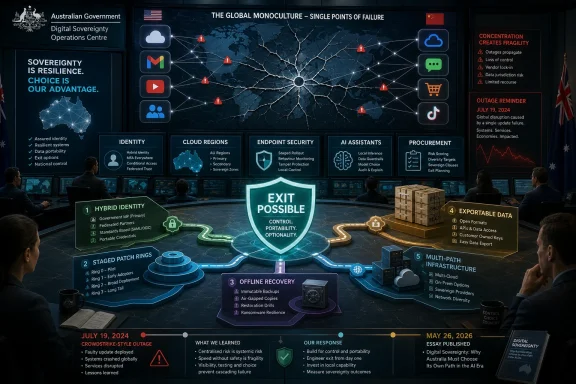 The Cloud Is Someone Else’s Industrial Policy
Digital sovereignty sounds grand until you translate it into the banal machinery of modern computing: identity systems, office suites, mobile operating systems, cloud regions, endpoint security agents, content delivery networks, payment rails, model APIs, app stores, device management, browser engines, and collaboration tools. That stack is where sovereignty either exists or does not. A government can pass a law in Canberra, Brussels, or Berlin, but if every department runs on the same foreign cloud, logs in through the same foreign identity provider, stores files in the same foreign productivity suite, and secures endpoints with the same globally updated agent, policy power runs into architectural dependence.The Australian essay frames this dependence plainly. Most people pick among Apple, Windows, and Android. Much of the public and private internet relies on Amazon Web Services, Microsoft Azure, Cloudflare, Google Cloud, or some combination of them. Devices are overwhelmingly produced by American, Chinese, Korean, Taiwanese, and Japanese supply chains, while the AI assistants now being welded into operating systems and browsers are largely controlled by the same incumbent platforms.
That is not merely a consumer-choice problem. It is a state-capacity problem. When a school, hospital, agency, bank, or airline chooses a cloud service, it is also choosing a jurisdictional exposure, a procurement path, a support dependency, a software update model, a telemetry regime, and a long-term migration cost.
The phrase digital sovereignty is often abused because it can mean too much. Sometimes it means data residency. Sometimes it means domestic ownership. Sometimes it means open standards, local AI capability, public-sector control, or resistance to foreign surveillance. But the useful definition is narrower: a society has digital sovereignty when it can make meaningful choices about the digital systems on which it depends, and when it can exit those systems without catastrophic cost.
By that standard, Australia has less sovereignty than its wealth, technical talent, and public institutions would suggest.
CrowdStrike Turned a Policy Slogan Into a Systems Diagram
The July 2024 CrowdStrike incident remains the cleanest recent illustration of what digital concentration does to operational risk. A faulty update to CrowdStrike Falcon Sensor caused widespread crashes on Windows systems, grounding flights, disrupting hospitals, affecting media organizations, and forcing IT teams into manual recovery work at a global scale. Microsoft later said roughly 8.5 million Windows devices were affected, a small fraction of the global Windows estate but an enormous number of machines in the wrong places at the wrong time.The outage was not, strictly speaking, “a Windows bug.” It was a failure in third-party security software running deep inside Windows environments. But that distinction is only partly comforting. The reason the incident mattered was that one vendor’s bad update could interact with one dominant enterprise operating system in one common security architecture and create a worldwide failure mode.
That is the lesson policymakers should absorb. The danger is not simply foreign ownership, nor even bigness in isolation. The danger is synchronized dependency: many institutions using the same stack, patched in the same way, managed through the same assumptions, and restored through the same narrow channels when something goes wrong.
For Windows administrators, the episode had a brutal clarity. Diversity is expensive before an outage and priceless during one. Having different endpoint protection layers, staged update rings, recovery media, offline credentials, tested rollback procedures, and mixed infrastructure can look inefficient on a spreadsheet. Then a global bad update arrives and the supposedly inefficient organization is the one that still has enough working systems to coordinate its own recovery.
This is where the sovereignty debate becomes practical rather than ideological. A country does not become digitally sovereign by issuing a patriotic cloud strategy and calling it done. It becomes more sovereign by reducing single points of failure, insisting on exit rights, funding alternatives before emergencies, and treating monoculture as a security risk.
Europe Is Not Escaping Big Tech, but It Is Changing the Terms
The European Union has become the default case study because it has spent years turning digital sovereignty from a slogan into a policy program. The EU’s approach blends regulation, industrial strategy, procurement pressure, open-source advocacy, cloud initiatives, privacy rules, AI governance, and competition enforcement. It is messy, slow, and often compromised, but it has forced the conversation onto terrain that large platforms cannot fully control.Gaia-X is emblematic of both the ambition and the difficulty. Conceived as a European data and cloud infrastructure initiative, it promised a more federated and standards-driven alternative to dependence on US hyperscalers. Yet the initiative has also faced criticism over complexity, slow delivery, and the participation of the very hyperscalers it was supposed to counterbalance. That tension is not a footnote; it is the entire problem in miniature.
The hyperscalers have not ignored sovereignty. They have repackaged it. Microsoft, Amazon, Google, Oracle, and others now sell versions of sovereign cloud, local control, regional compliance, encryption promises, customer-managed keys, local operating partners, and segregated environments. Some of these offerings are genuinely useful. They can give governments and regulated industries better tools than a naive lift-and-shift into global public cloud.
But this is also sovereignty-as-a-service, and the phrase should make procurement officers uneasy. If a vendor defines the architecture, runs the control plane, writes the license terms, owns the roadmap, and prices the exit, the customer may gain compliance features without gaining autonomy. It is possible to buy a more sovereign-looking cage.
Europe’s more interesting moves are therefore not only cloud branding exercises. They include open-source procurement, interoperability rules, antitrust actions, public-sector migration experiments, and attempts to build local AI, semiconductor, and cloud capacity. These efforts are uneven, and some will fail. But their collective effect is to remind vendors that public institutions are not merely enterprise customers; they are constitutional actors with obligations that cannot be reduced to a software subscription.
Australia should study that distinction carefully. The EU is not proving that a mid-sized or regional power can instantly replace American platforms. It is proving that law, procurement, and industrial coordination can change the bargaining position.
Australia’s Problem Is Not a Lack of Talent
Australia is not technologically helpless. The national mythology around Wi-Fi, with the CSIRO’s research and patent history, is often overused, but it points to something real: publicly funded research can produce global infrastructure. Australia has universities, cybersecurity expertise, quantum computing capability, satellite ambitions, strong public institutions, and a sophisticated enterprise IT sector. The missing piece is not talent. It is coordination at the scale of dependency.The country’s technology policy often oscillates between two unsatisfying modes. One is consumer-protection regulation after harm has occurred, as with privacy, scams, safety, or platform accountability. The other is innovation rhetoric that celebrates startups without changing the procurement and infrastructure environment into which those startups must sell. Neither mode, by itself, builds sovereign capability.
A serious Australian digital sovereignty roadmap would start by mapping dependencies. Which cloud providers host critical public services? Which identity systems authenticate public-sector workers? Which operating systems and mobile platforms dominate frontline services? Which SaaS products hold sensitive records? Which AI systems are being trialed in departments, schools, courts, or health settings? Which vendors have unilateral update authority over critical systems?
That map would be politically uncomfortable because it would show how much public capability is rented. It would also show that “local data centers” are not the same as local control. A US or Chinese-owned platform with an Australian region may improve latency and data residency, but it does not automatically solve questions of legal exposure, vendor lock-in, operational resilience, auditability, or national bargaining power.
The policy goal should not be autarky. Australia is a trading nation with allies, not a sealed computing island. The goal should be optionality: enough domestic and allied capability to say no, enough standards enforcement to switch, enough public expertise to evaluate vendor claims, and enough investment to keep alternatives alive.
AI Makes the Lock-In Problem More Intimate
The digital sovereignty debate becomes sharper when AI moves from web apps into operating systems. Microsoft’s Copilot, Google’s Gemini, Apple’s intelligence features, OpenAI integrations, Samsung’s AI services, and a growing field of local and cloud-hosted models are changing the interface layer itself. The assistant is becoming the mediator between the user and the machine.That matters because operating systems were already powerful gatekeepers. App stores, default browsers, file formats, identity accounts, cloud backups, and notification systems shape what users can install, see, sync, and abandon. AI assistants deepen that control by learning workflow patterns, indexing local and cloud data, summarizing communications, generating documents, executing actions, and nudging users toward vendor-native services.
For consumers, this may feel convenient. For enterprises and governments, it is a new dependency surface. Once an AI assistant is embedded in the office suite, email client, code editor, endpoint, browser, and device management layer, removing it becomes more than a settings change. It becomes an organizational redesign.
Local AI is not a magic escape hatch, but it is strategically important. Running models on personal devices, private networks, or controlled national infrastructure can reduce reliance on cloud APIs owned by dominant platforms. It can also preserve sensitive data boundaries and support use cases where public-sector accountability requires more than a vendor assurance.
Still, local AI has limits. The most capable frontier models require enormous compute, specialized chips, energy, data pipelines, and engineering talent. Australia cannot casually duplicate the capital expenditure of Microsoft, Google, Amazon, Meta, or OpenAI. But it can decide where smaller, auditable, domain-specific, open, or locally hosted models are good enough — and where dependence on a proprietary black box is unacceptable.
That distinction will matter more than slogans. Digital sovereignty in AI will be won not by pretending every agency needs a national ChatGPT clone, but by defining which decisions, records, workflows, and public services must remain under accountable control.
Open Source Is Necessary, but It Is Not a Procurement Strategy by Itself
The Australian essay rightly points to alternatives that already exist: LibreOffice, Mastodon, PeerTube, Bluesky’s AT Protocol ecosystem, local AI models, and federated services. These tools matter because they demonstrate that the internet does not have to be organized around a handful of vertically integrated platforms. They also expose the hardest problem in digital sovereignty: the alternative can exist and still lose.LibreOffice has been available for decades, but Microsoft Office remains entrenched because compatibility, training, macros, procurement habits, document exchange, and organizational inertia are powerful. Mastodon and PeerTube show that federated social media can work, but network effects still pull many users toward centralized platforms. Bluesky’s AT Protocol tries to separate identity and social graph from platform ownership, but it remains young, contested, and dependent on adoption patterns still being formed.
Open source gives governments something proprietary vendors often resist: inspectability, modifiability, and the possibility of shared maintenance. But software freedom is not the same as institutional capacity. A government that adopts open-source tools without funding support, security review, migration assistance, user training, and upstream contribution may simply shift costs from license fees to overworked IT teams.
The same is true for cloud. An open-source private cloud stack can be more sovereign in theory and more fragile in practice if nobody funds the people who operate it. A sovereign system that cannot patch quickly, scale reliably, or integrate with existing workflows will lose to a proprietary system that can.
This is where procurement becomes destiny. If public tenders demand the lowest short-term cost, familiar file formats, and incumbent certifications, sovereign alternatives will rarely survive. If tenders value interoperability, exit plans, open standards, source availability, local support, staged migration, and resilience testing, the market changes.
Australia does not need to force every council, school, or agency onto the same open-source stack. That would repeat the monoculture mistake under a different flag. It needs to make non-incumbent choices viable enough that public-sector buyers can select them without committing career suicide.
Indigenous Data Sovereignty Should Not Be an Afterthought
One of the more important elements in the Australian essay is its turn toward First Nations data sovereignty. In technology policy, “sovereignty” is often treated as a state-only concept: national borders, national clouds, national laws. Indigenous data sovereignty complicates that frame in a necessary way.First Nations communities have long argued that data about their peoples, lands, cultures, health, languages, and histories cannot be treated as a neutral resource for extraction. Governance, consent, stewardship, collective benefit, and control matter. Frameworks developed by groups such as Maiam nayri Wingara and Indigenous research data initiatives show that sovereignty can be relational and community-based, not merely centralized and bureaucratic.
That perspective is directly relevant to digital infrastructure. A national data strategy that only asks whether information is stored in Australia may still fail if it ignores who defines access, use, consent, interpretation, and benefit. Local hosting can coexist with extractive governance. A domestic platform can still reproduce the logic of a foreign monopoly if affected communities have no control over the data that describes them.
For Australia, this is not a symbolic add-on. It is a chance to build a more sophisticated sovereignty model than the one currently sold by cloud vendors. The question should not only be “Which country owns the server?” It should also be “Which community governs the data, who can contest its use, who benefits from the analysis, and what obligations survive beyond the contract?”
This matters especially as AI systems ingest public records, research datasets, cultural materials, geospatial data, and administrative histories. If AI policy treats data as raw fuel, it will collide with Indigenous sovereignty and public trust. If it treats data as governed material with rights, obligations, and context, Australia could build a model worth exporting.
Big Tech Will Sell the Vocabulary Back to Us
The most predictable next phase is that every major platform will become fluent in sovereignty language. They already are. Customers will hear about sovereign regions, trusted clouds, confidential computing, local partners, data boundary commitments, air-gapped environments, government-grade AI, customer-controlled encryption, and compliance dashboards.Some of this will be valuable. A blanket rejection of hyperscalers would be reckless, especially for smaller agencies and businesses that benefit from world-class security tooling, uptime engineering, and scale. The point is not to caricature big tech as useless or malicious. The point is to recognize that vendor incentives and public sovereignty only partially overlap.
A hyperscaler wants customers to feel in control while remaining on the platform. A state wants enough control to leave, regulate, audit, diversify, and override. Those are different objectives. The conflict may be polite, heavily lawyered, and hidden inside procurement language, but it is real.
The same is true for AI. Vendors will promise that their assistants respect enterprise boundaries, follow compliance rules, and keep data within approved regions. Those promises matter, but they do not answer deeper questions about model behavior, dependency, auditability, training data, future pricing, unilateral feature changes, or the effects of embedding one company’s assistant into the daily routines of public administration.
Australia should therefore evaluate sovereignty claims with operational tests, not marketing terms. Can the customer export data in usable formats? Can workloads move to another provider without rewriting the organization? Can updates be staged and refused? Can logs be independently audited? Can the public sector inspect enough of the system to assign responsibility? Can essential services keep running if a vendor account, region, model, or update pipeline fails?
If the answer is no, the service may be compliant. It may even be excellent. But it is not sovereign in any meaningful sense.
Windows Administrators Already Know the Shape of the Answer
For readers of WindowsForum, the sovereignty debate may sound like a policy fight happening far above the rack, the endpoint, and the help desk. It is not. Sysadmins have lived the consequences of platform concentration for years.They see it when a Microsoft 365 outage becomes a business-continuity event. They see it when Entra ID, formerly Azure Active Directory, becomes the front door to everything. They see it when a browser policy change breaks line-of-business workflows, when an endpoint security update bricks machines, when a SaaS vendor changes licensing, when a compliance setting requires a higher subscription tier, or when a cloud region outage reveals that “multi-region” was more aspirational than real.
Enterprise IT already practices small-scale sovereignty through boring controls. It keeps offline admin credentials. It maintains tested backups. It stages patches. It avoids letting one identity provider become the only recovery path. It documents manual procedures. It runs tabletop exercises. It asks whether a vendor’s export button produces data that can actually be restored somewhere else.
The policy world should learn from that discipline. Sovereignty is not a flag planted on a data center. It is a set of failure modes that have been anticipated and reduced.
There is also a Windows-specific lesson. Microsoft’s ecosystem is not going away, and for many organizations it remains the rational default. Windows, Microsoft 365, Azure, Intune, Defender, Entra, and Copilot form a deeply integrated enterprise platform that can be more secure and manageable than many improvised alternatives. But integration has a shadow: the more Microsoft becomes the operating environment for work itself, the more important it is that organizations preserve leverage.
That leverage can mean hybrid identity, multi-cloud backups, non-Microsoft recovery channels, open document policies, alternative endpoint tools, independent logging, Linux or macOS capability where appropriate, and staff who understand the underlying protocols rather than only the admin portal. It can also mean insisting that Copilot and other AI features are adopted deliberately, not absorbed because the licensing bundle made them appear inevitable.
Australia Needs a Roadmap With Teeth
A serious Australian roadmap would avoid two traps. The first is nationalism without engineering, where leaders announce sovereign capability without funding the infrastructure, standards, and people required to make it real. The second is neoliberal fatalism, where officials decide that because global platforms are efficient, dependence is simply the cost of modernity.The better path is selective sovereignty. Australia should identify the systems where autonomy matters most: government identity, health data, emergency services, electoral systems, education records, critical infrastructure operations, public archives, national research data, and sensitive AI workloads. It should then decide which of those require local operation, which require allied diversification, which require open standards, and which can safely remain on global platforms with stronger contractual controls.
This requires money, but not only money. It requires procurement reform, because buyers follow incentives. It requires technical leadership inside government, because agencies cannot negotiate effectively with vendors they do not understand. It requires support for local companies without confusing “Australian-owned” with “automatically better.” It requires migration funding, because switching costs are real and pretending otherwise guarantees failure.
It also requires a more mature public conversation about trade-offs. Sovereign alternatives may cost more upfront. They may lag in polish. They may require retraining. They may produce awkward periods of coexistence with incumbent platforms. That is not evidence the project is doomed; it is evidence that dependence has been subsidized by years of convenience.
The test should be resilience and leverage, not purity. If Australia can negotiate harder with hyperscalers because credible alternatives exist, that is a sovereignty gain. If public agencies can move workloads without panic, that is a sovereignty gain. If Indigenous communities control data governance rather than merely being promised local storage, that is a sovereignty gain. If a future bad update affects one slice of infrastructure rather than the whole country’s operational nervous system, that is a sovereignty gain.
The Sovereignty Test Starts With the Next Procurement Cycle
The path forward is less glamorous than a moonshot and more consequential than another discussion paper. Australia’s next digital sovereignty moves will be visible in procurement templates, architecture reviews, AI pilots, cloud exit clauses, open-source support contracts, and the willingness of public agencies to pay for resilience before the incident report demands it.- Australia should treat concentrated digital dependency as an operational risk, not merely a competition or privacy issue.
- Local data residency should not be confused with local control, especially when the platform, roadmap, and control plane remain foreign-owned.
- Public-sector buyers should require credible exit plans, open standards, staged update controls, and usable data portability as ordinary procurement conditions.
- Open-source and federated alternatives need funding, support, training, and institutional adoption pathways if they are to compete with incumbent platforms.
- Indigenous data sovereignty should shape national digital policy rather than sit beside it as a specialist concern.
- AI assistants embedded into operating systems and office suites should be evaluated as infrastructure dependencies, not treated as productivity features that arrive by default.
References
- Primary source: Startup Daily
Published: 2026-05-26T02:30:08.455250
Nearly everything we use online is owned by big tech - here's why we need to reclaim our digital sovereignty
Big tech monopolies shouldn't dictate Australia's digital policy. Here's what we need to change, writes Ashwin Nagappa and Daniel Angus.www.startupdaily.net - Related coverage: tech.eu
Europe builds Microsoft-alternative ‘Euro-Office’ to reclaim digital sovereignty - Tech.eu
The open-source initiative promises seamless document compatibility, transparent governance, and reduced dependency on non-European platforms.tech.eu - Related coverage: axios.com
CrowdStrike outage: CEO says nearly all Window sensors back online
The worst of last week's global IT outage, which affected banks and hospitals, may now be over.www.axios.com
- Related coverage: cloudinfraatlas.eu
Cloud Infra Atlas — European Alternatives to US Big Tech
Replace US tech with European alternatives. 120+ GDPR-compliant, sovereign SaaS and cloud products across 20 categories. www.cloudinfraatlas.eu
