

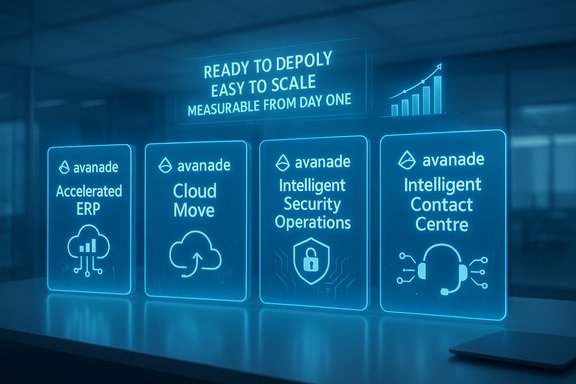
Avanade’s new pre‑packaged Microsoft solutions are a clear pivot from bespoke consulting toward repeatable, outcome‑driven products designed to speed migrations, cut cloud waste and surface operational improvements for midmarket and enterprise customers. The initial portfolio — Avanade Accelerated ERP, Avanade Cloud Move (paired with the new self‑service ANALYZE tool), Avanade Intelligent Security Operations and Avanade Intelligent Contact Centre — is purpose‑built to be ready to deploy, easy to scale and measurable from day one, according to Avanade’s public announcement and contemporaneous industry coverage.
Avanade frames the offering as the work of a newly formed, internal product team called Avanade Go, led by Fabio Hasegawa, that will productize and scale Microsoft‑powered solutions developed from Avanade’s delivery IP and frameworks. The rollout is initially focused on the UK, US, Canada and Australia with rapid expansion planned. The company positions the suite to address three converging market pressures: AI adoption, cloud migration (especially to Azure), and rising scrutiny over cloud economics. This announcement matters because it signals a strategic move by a large Microsoft‑centric systems integrator to meet buyers where they are: midmarket customers and larger clients who want faster results with less procurement and delivery friction. Avanade’s messaging stresses speed, predictable pricing and measurable outcomes — hallmarks of a productized services play.
If you run Azure and Microsoft workloads, Avanade’s packaged approach deserves a spot on your procurement shortlist — but only after the recommended due diligence steps are completed. When paired with a robust PoV, audit‑grade reporting and clear governance, these packages can accelerate outcomes. When adopted with insufficient verification, they risk delivering nominal improvements that do not translate to the promised net savings.
Avanade’s productization effort reflects a broader market shift: services firms are packaging IP to reduce friction and demonstrate measurable impact quickly. For IT leaders, the opportunity is to use these productized offerings as informed instruments — not magic bullets — by anchoring decisions in auditable telemetry, conservative costing and clear governance that ensures any automated action is reversible and accountable.
Source: CustomerThink Avanade Unveils New Suite of Microsoft Solutions to Supercharge Business Growth and Optimize Cloud Costs | CustomerThink
 Background / Overview
Avanade frames the offering as the work of a newly formed, internal product team called Avanade Go, led by Fabio Hasegawa, that will productize and scale Microsoft‑powered solutions developed from Avanade’s delivery IP and frameworks. The rollout is initially focused on the UK, US, Canada and Australia with rapid expansion planned. The company positions the suite to address three converging market pressures: AI adoption, cloud migration (especially to Azure), and rising scrutiny over cloud economics. This announcement matters because it signals a strategic move by a large Microsoft‑centric systems integrator to meet buyers where they are: midmarket customers and larger clients who want faster results with less procurement and delivery friction. Avanade’s messaging stresses speed, predictable pricing and measurable outcomes — hallmarks of a productized services play.What’s in the package: product-by-product breakdown
Avanade Accelerated ERP
- Purpose: shorten ERP modernization timelines using Microsoft Dynamics 365 with pre‑configured templates and delivery accelerators.
- Target: organizations that need faster, lower‑risk ERP implementations while preserving essential domain processes.
- Value: reduced project duration and implementation uncertainty, faster realization of benefits such as better inventory, finance and supply‑chain controls.
Avanade Cloud Move
- Purpose: migrate servers and workloads to Microsoft Azure and make workloads AI‑ready, with cost governance integrated via ANALYZE.
- Claim: migration playbooks combined with continuous cost optimization to free budget for innovation.
- Notable: promoted as a secure, Microsoft‑aligned path to cloud modernization.
Avanade Intelligent Security Operations
- Purpose: packaged Security Operations Center (SOC) capabilities that leverage Microsoft security telemetry and automation to shorten detection and response times.
- Appeal: teams gain a managed, repeatable approach to SOC operations without building from scratch.
Avanade Intelligent Contact Centre
- Purpose: AI‑powered contact centre built on Microsoft technologies (Dynamics 365 + Microsoft AI services).
- Benefit: faster time‑to‑production for virtual agents, omnichannel routing and agent assist features that aim to lift customer satisfaction and agent productivity.
Deep dive: ANALYZE — the free, self‑service cloud cost tool
ANALYZE is the most tactically interesting element of the suite because it functions both as a lead generator and a practical FinOps entry point for customers. Avanade describes ANALYZE as a fully automated, self‑service tool that scans:- Microsoft Azure consumption and topology,
- Microsoft 365 licence usage,
- Microsoft Dynamics 365 footprints,
Why ANALYZE matters
- It lowers the barrier to entry for FinOps by providing a no‑cost diagnostic, which is especially attractive to midmarket clients that lack skilled FinOps teams.
- The tool’s scope (Azure + M365 + Dynamics) aligns with the most common Microsoft‑centric estates, making recommendations highly actionable for organizations standardized on Microsoft.
- By coupling migration services with an integrated cost‑optimization intake, Avanade reduces the perceived risk of moving to Azure, a common blocker for cloud migrations.
What remains unclear (and why it matters)
- The precise mechanics of ANALYZE — which APIs it calls, how it attributes multi‑subscription costs, and whether recommendations are advisory only or can be executed automatically — are not disclosed in headline materials. These are critical governance questions for buyers who require auditable change controls and role‑based approvals.
- The 20% average and “up to 50%” figures are vendor‑reported. They are plausible outcomes from rightsizing compute, deleting idle resources, and rationalizing licenses, but they should be treated as directional. Buyers should request reconciled before/after billing and a binding proof‑of‑value (PoV).
Verification & cross‑checking of key claims
To ensure the announcement’s most important claims are grounded, the following verifications were performed against independent sources:- Avanade’s product names, the Avanade Go team, and launch markets (UK, US, Canada, Australia) are consistently reported across mainstream industry outlets and trade press.
- The ANALYZE performance claims (20% average, up to 50%) and adoption (“over 100 customers”) appear in multiple reports that are re‑publishing Avanade’s release; these are company‑sourced figures and should be validated via PoV in customer environments.
- Avanade’s corporate scale statements (trusted by over 7,000 clients worldwide and a long history as a top Microsoft SI) and its record of Microsoft partner awards were verified through Avanade’s own public pages and partner materials (LinkedIn/company profiles and Accenture/partner pages). These confirm Avanade’s scale and deep Microsoft alignment, which underpins the credibility of a Microsoft‑centric productization strategy.
Strategic implications for buyers and the market
Strengths and opportunities
- Speed to value: Pre‑packaged accelerators reduce project discovery and configuration time, which can materially shorten ERP and cloud migration timelines.
- Platform alignment: Deep Avanade–Microsoft integration reduces technical risk for Azure and Dynamics customers and may simplify licensing/consumption conversations.
- FinOps funnel: ANALYZE acts as a low‑friction FinOps intake that can reveal near‑term opportunities to fund innovation or migration by recovering wasted spend.
- Midmarket fit: Midmarket organizations often lack the budget or talent for bespoke programs; repeatable packages with standard operational patterns are a better commercial fit.
Commercial and go‑to‑market implications
- Offering a free diagnostic converts interest into measurable discussions faster; vendors that can prove savings via PoV secure higher conversion rates.
- Packaging migration + cost optimization + security + contact centre addresses multiple buyer pain points across the transformation lifecycle, enabling Avanade to sell an integrated roadmap rather than isolated projects.
Competitive context
- The push to productize services is industry‑wide: global SIs, specialized FinOps vendors and cloud management platform (CMP) providers are all productizing IP. Avanade’s competitive advantage is its Microsoft focus and history of Dynamics/Azure engagements. Buyers will still compare specialized FinOps tooling and independent audits — not only vendor‑bundled diagnostics.
Risks, caveats and governance considerations
Potential buyers must evaluate a number of operational and contract risks when engaging with pre‑packaged transformation offers:- Vendor‑reported savings: Treat headline percentages as directional until validated. Require a PoV that compares actual bills before and after adjustments and accounts for any partner fees or marketplace charges.
- Allocation across billing constructs: Multi‑tenant accounts, nested EA/CSP billing and Azure reservations can obscure whether savings are real or simply shifted between billing profiles. Confirm how ANALYZE attributes and reports cost allocation.
- Automated change control: If recommendations are applied automatically, buyers must insist on human‑in‑the‑loop approval gates, audit logs, rollback plans, and a clear SLA for any performance regressions.
- ERP package fit: Accelerated ERP reduces delivery time only if the customer’s processes align with the package. Complex, highly customized processes can reintroduce schedule and scope risk.
- Third‑party dependencies: Verify marketplace SKUs, any additional paid software components, and how these affect overall TCO. Marketplace billing can count toward consumption commitments and alter discount trajectories.
- Data privacy / tenant access: Any self‑service diagnostic that reads tenant telemetry must have clear terms about data use, retention and handover. Insist on a binding data‑handover clause and the ability to export raw telemetry for internal audit.
Practical due‑diligence checklist for procurement teams
- Run a 60–90 day PoV using the organization’s own billing and telemetry (not anonymized benchmarks). Demand reconciled net savings shown against historical spend.
- Confirm ANALYZE’s technical inputs: which Azure APIs, billing endpoints and Microsoft Graph telemetry it reads, and whether it supports multiple subscription/billing profiles.
- Define governance artifacts: approval gates, decision logs, RBAC for execution, rollback plans, and a contract clause for exit/data handover.
- Require a SKU/feature coverage matrix for the solution: which Azure services, reserved SKUs, Azure Marketplace items, and Dynamics/365 licensing scenarios are supported.
- Ask for an auditable before/after billing report and the raw telemetry export to validate claimed savings.
Technical considerations for implementation teams
Integration and telemetry
- A credible cost‑analysis tool must reconcile cost and usage by resource ID, namespace, tag set and billing tag; ask whether ANALYZE preserves full resource IDs and timestamps required for audit. If the tool relies on sampled telemetry or heuristics, that affects confidence in savings estimates.
Automation vs advisory mode
- Determine whether ANALYZE’s recommendations are advisory or can be implemented automatically. If automatic, require sandbox validation, change windows, and pre‑approval controls. If advisory, clarify handoff and expected implementation timelines.
Licensing arbitrage
- License optimization often requires mapping seat usage (M365/Dynamics) and rightsizing or consolidating entitlements. Confirm whether ANALYZE includes license optimization logic and whether it models switching from legacy models (EA/CSP) to modern subscriptions.
Commercial models and procurement tips
- Understand the commercial mechanics: the ANALYZE intake may be free, but implementation, migration, and managed services are likely billable. Confirm net‑savings sharing, if any, and total cost of migration including egress, re‑architecture and marketplace charges.
- For ERP packages, require a scope matrix that maps package features to your business processes and flags required customizations and their cost/time impact.
Competitive landscape: who else does this?
The market for cloud cost optimization and packaged Microsoft solutions is crowded. Key alternatives include:- Specialist FinOps platforms and tools that offer continuous reservation management, anomaly detection and governance.
- Other global SIs and consultancies that have productized Microsoft accelerators and migration factories.
- Managed service providers offering Azure migration factories and ongoing cost governance.
Recommended evaluation path for IT leaders
- Start with the free ANALYZE intake to map immediate opportunities and validate the tool’s granularity against your billing data.
- If ANALYZE finds material opportunity (>10% projected net savings), request a binding PoV contract that guarantees a measurable outcome and includes raw billing reconciliation.
- Confirm governance, execution scope and automation modes before any recommendation is enacted. Require a documented rollback plan and SLAs.
- For ERP and contact centre projects, map package features to business processes and reserve change‑management budget; acceleration is real but only when customization needs are modest.
Final assessment: strengths, limits and realistic expectations
Avanade’s new suite is a pragmatic play that matches market demand for faster, less risky digital transformation: productized ERP, a migration path to Azure with an embedded cost diagnostic, packaged security operations and an AI contact centre. The ANALYZE tool is the strategic linchpin — a free, low‑friction entry point to surface actionable savings and to fund modernization work through reinvested cloud budget. Industry coverage and Avanade’s corporate profile corroborate the offering and the initial market positioning. However, buyers should apply conservative scrutiny. The headline savings figures (20% average, up to 50%) and the “over 100 customers” adoption statistic are company‑reported metrics that require proof in your environment. Governance, billing attribution and marketplace billing details matter — they determine whether savings are real and repeatable or merely reallocated across billing constructs. Insist on PoVs that reconcile bills and preserve raw telemetry for audit.If you run Azure and Microsoft workloads, Avanade’s packaged approach deserves a spot on your procurement shortlist — but only after the recommended due diligence steps are completed. When paired with a robust PoV, audit‑grade reporting and clear governance, these packages can accelerate outcomes. When adopted with insufficient verification, they risk delivering nominal improvements that do not translate to the promised net savings.
Avanade’s productization effort reflects a broader market shift: services firms are packaging IP to reduce friction and demonstrate measurable impact quickly. For IT leaders, the opportunity is to use these productized offerings as informed instruments — not magic bullets — by anchoring decisions in auditable telemetry, conservative costing and clear governance that ensures any automated action is reversible and accountable.
Source: CustomerThink Avanade Unveils New Suite of Microsoft Solutions to Supercharge Business Growth and Optimize Cloud Costs | CustomerThink
