

AVEVA’s recognition as Microsoft’s 2025 Manufacturing Partner of the Year underscores a strategic milestone for industrial software vendors that have bet on hyperscale cloud, unified analytics and generative AI to modernize factory floors and plant operations.
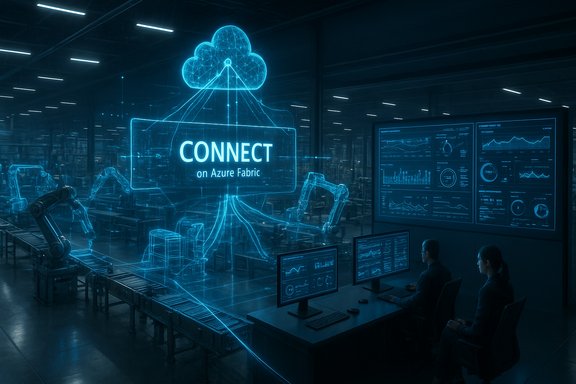
AVEVA announced on November 12, 2025 that it has been named the 2025 Microsoft Manufacturing Partner of the Year, citing joint work with Microsoft to deliver AI‑powered, real‑time data insights across manufacturing operations through solutions built on Microsoft Azure, Microsoft Fabric and generative AI technologies — with the company’s industrial intelligence platform CONNECT called out as a flagship example. Microsoft’s Partner of the Year Awards are an annual program that recognizes partners who demonstrate technical excellence and measurable customer outcomes across Microsoft Cloud technologies. The 2025 awards cycle drew a significant field of submissions — Microsoft reports more than 4,600 nominations from roughly 100 countries and regions, and the winners were announced in the lead-up to Microsoft Ignite in San Francisco (November 18–21, 2025). AVEVA’s announcement has been republished by multiple outlets and syndicated press channels, echoing the core message: AVEVA and Microsoft are delivering joint, platform‑aligned solutions that bridge OT (operational technology) telemetry and enterprise analytics to accelerate digital twin, predictive maintenance and supply‑chain visibility initiatives.
Source: Content Media Solution Industry Kudos: AVEVA Wins 2025 Microsoft Manufacturing Partner of the Year for Exceptional Contributions - Content Media Solution
 Background
AVEVA announced on November 12, 2025 that it has been named the 2025 Microsoft Manufacturing Partner of the Year, citing joint work with Microsoft to deliver AI‑powered, real‑time data insights across manufacturing operations through solutions built on Microsoft Azure, Microsoft Fabric and generative AI technologies — with the company’s industrial intelligence platform CONNECT called out as a flagship example. Microsoft’s Partner of the Year Awards are an annual program that recognizes partners who demonstrate technical excellence and measurable customer outcomes across Microsoft Cloud technologies. The 2025 awards cycle drew a significant field of submissions — Microsoft reports more than 4,600 nominations from roughly 100 countries and regions, and the winners were announced in the lead-up to Microsoft Ignite in San Francisco (November 18–21, 2025). AVEVA’s announcement has been republished by multiple outlets and syndicated press channels, echoing the core message: AVEVA and Microsoft are delivering joint, platform‑aligned solutions that bridge OT (operational technology) telemetry and enterprise analytics to accelerate digital twin, predictive maintenance and supply‑chain visibility initiatives.Why this matters: the signal behind the award
Winning Microsoft’s Manufacturing Partner of the Year is more than a marketing trophy — it’s a commercial signal with practical implications for buyers, integrators and IT leaders.- Platform alignment: Award winners typically demonstrate deep integration with Microsoft platform primitives (Azure compute and services, Fabric/OneLake for unified data, Entra/Azure AD for identity). This reduces integration friction for enterprises that already standardize on Microsoft stacks and increases the partner’s co‑sell visibility inside Microsoft field teams.
- Repeatability and engineering discipline: Judges prize solutions that are production‑grade — not one‑off proofs. The award indicates AVEVA submitted a judged entry that showed repeatable, engineered solutions (data pipelines, AI governance, model lifecycle and observability) rather than purely conceptual demos.
- Ecosystem momentum: AVEVA’s recognition fits a broader market pattern in 2025: industrial ISVs packaging OT/IT integration, digital twins and agentic AI workflows for frontline teams while partnering closely with hyperscalers and data platform vendors. That ecosystem approach shortens procurement cycles for customers who want standardized, supported stacks.
What AVEVA and Microsoft are claiming
AVEVA’s public statement emphasizes several core themes:- CONNECT as a cloud‑native industrial intelligence platform built on Microsoft Azure and integrated with Microsoft Fabric to unify asset models, time‑series telemetry and analytics in one interface.
- AI‑powered real‑time insights for operations teams, combining AVEVA domain expertise with Microsoft’s cloud and generative AI capabilities (Azure AI primitives, Fabric data fabrics, managed LLM services).
- Joint go‑to‑market and Cloud for Manufacturing participation, positioning AVEVA as a strategic Microsoft partner for customers seeking OT/IT convergence and sustainability gains.
Technical reality check: what’s verifiable and what’s not
Public materials confirm several technical facts that procurement teams should care about:- CONNECT’s Azure foundation and Fabric integration: AVEVA product pages and the company announcement state CONNECT is built on Azure and designed to leverage Fabric/OneLake for unified analytics — a claim corroborated by joint demos and product briefings. This validates the platform‑level alignment that the award recognizes.
- OT→IT data flow pattern is standard: The architecture AVEVA describes — edge/plant collectors feeding a PI/PI Data Infrastructure, hybrid replication and cloud‑facing APIs, then surfacing asset models and telemetry in CONNECT — matches well‑established hybrid architectures used in modern industrial digitalization projects.
- Measured customer outcomes and KPIs. The public announcement repeats outcome claims (efficiency, sustainability and collaboration benefits) but does not include audited KPI metrics (percent throughput improvement, MTTR reduction, CO2 reductions). Those details are typically provided in case studies or contractual evidence and are absent from the headline release. Treat these as credible vendor claims but request evidence.
- Deployment specifics and controls. The press release does not disclose exact customer architectures: data residency choices, network isolation and egress controls, which LLMs or model hosting options are used in production, or how retrieval‑augmented generation (RAG) is implemented at scale. These are procurement‑critical items that buyers must demand in technical exhibits.
- Cost and consumption profile. Generative AI workloads can produce highly variable inference and storage costs. The press release does not provide FinOps models or consumption guarantees; ask for those before committing to large rollouts.
CONNECT, Fabric, and the industrial data fabric: how the pieces fit
The simplified data flow
- Edge/plant sources (PLCs, DCS, OPC UA servers) feed time‑series into AVEVA PI collectors or PI Data Infrastructure.
- The PI Data Infrastructure provides hybrid replication to the cloud and authoritative time‑series APIs for analytics.
- Engineering content (P&IDs, asset metadata, maintenance records) is imported into an Asset Information Management model.
- CONNECT presents a unified visualization and AI orchestration layer on top of Azure, joining semantic asset models to live telemetry for dashboards, digital twins and AI assistants.
Why Fabric / OneLake matters
Using Microsoft Fabric (and its OneLake data lake) as the enterprise fabric allows operational telemetry, event logs and engineering documents to be unified with enterprise BI and analytics tooling. For manufacturers, that matters because it:- Enables cross‑site correlation and enterprise planning.
- Simplifies building RAG grounding layers for copilots and assistants.
- Allows standard Microsoft governance tools (Purview, Entra) to be applied across data flows.
Strengths: why buyers should pay attention
- Deep industrial domain expertise. AVEVA has decades of industrial software experience (PI Systems, MES, control room products). That domain knowledge shortens the path to useful operator experiences and contextualized analytics.
- Platform productization. Packaging telemetry, digital twin models and AI assistants into a managed platform reduces bespoke integration work and increases repeatability across sites. This improves the chance of moving from pilots to scaled production.
- Hyperscaler support and co‑sell. A recognized Microsoft partner is more likely to get field introductions and co‑sell support, accelerating procurement and engagement for customers standardized on Azure. The Partner of the Year badge is a practical GTM accelerator.
Risks and gaps buyers must manage
- Data sovereignty, privacy and regulatory compliance. Industrial data may be sensitive. Ensure contracts specify regional hosting options, encryption standards, subprocessor lists, and documented deletion/export controls. Public award announcements rarely include these contractual details; they must be negotiated.
- Model governance and hallucinations. Industrial assistants can produce plausible but incorrect outputs. Unchecked hallucination risk can be dangerous in operations. Require model‑risk management artifacts: model cards, red‑team test results, continuous evaluation dashboards and rollback playbooks.
- Cost unpredictability. Generative models and retrieval systems can cause runaway cloud spend without FinOps guardrails. Negotiate consumption caps, alerts and cost‑allocation mechanisms.
- Lock‑in and portability. Even if marketed as “neutral,” platform implementations can create lock‑in through proprietary connectors, fine‑tuned models and bespoke digital twin schemas. Insist on portability guarantees for data and export of trained artifacts.
Practical procurement checklist — what to demand before you sign
- Architecture diagrams with clear data flows, network boundaries and isolation controls.
- Model governance dossier: model cards, training data provenance, red‑team results, drift detection thresholds and retraining cadence.
- Observability and auditing details: telemetry captured, retention windows, runbook for incidents and evidence collection.
- SLAs and remediation commitments for availability, data breaches and model failures.
- FinOps plan: predictable pricing bands, consumption quotas, hard caps and cost‑reporting dashboards.
- Data sovereignty clauses and a documented data deletion/export process.
- IP and portability terms for fine‑tuned models, bespoke connectors and digital twin schemas.
- Pilot plan with explicit acceptance criteria (accuracy thresholds, MTTR targets, throughput improvements), a timeline, and named reference customers for validation.
A recommended pilot sequence for manufacturing customers
- Step 1: Choose a narrowly scoped, high‑value workflow (predictive maintenance on a critical asset, first‑time‑fix for maintenance tickets, or production plan vs. execution reconciliation).
- Step 2: Ground the pilot in authoritative backends (ERP/PLM/MES and PI historian) to avoid noisy retrieval sources.
- Step 3: Define acceptance metrics and an operational readiness checklist (operator training, incident playbooks, model governance gates).
- Step 4: Run independent security and privacy penetration tests and model safety reviews before expanding.
- Step 5: Validate commercial terms (SLAs, FinOps caps) and negotiate export/portability commitments for pilot artifacts.
What to ask AVEVA (technical and contractual questions)
- Which exact Azure regions and residency options will be offered for our deployment?
- Which LLMs and model hosting options are used in production? Are models fine‑tuned on customer data, and if so, who owns the resulting model artifacts?
- How is retrieval configured and filtered (source prioritization, vector store governance) to reduce hallucination risk?
- What telemetry is collected for model observability, and how long is it retained?
- What FinOps controls, quotas and cost alerts are included by contract?
- Can we get named reference customers with comparable scope and measurable KPIs?
Broader industry context: why partners are essential in 2025
Microsoft’s partner awards in 2025 highlight a market reality: hyperscaler primitives alone are not enough to industrialize AI. Partners provide three indispensable capabilities:- Field‑tested connectors and accelerators that translate platform APIs into industrial workflows.
- Vertical expertise (manufacturing, energy, pharma) that ensures analytics and AI are applied with domain rigor.
- Delivery and change management at scale — transforming experiments into productized services.
Critique: what the award shows — and what it doesn’t
The award validates AVEVA’s engineering investment and Microsoft alignment: it is evidence that AVEVA demonstrated a repeatable, Azure‑native solution in a competitive field. That is meaningful for customers seeking a vendor that can scale digital twins and agentic workflows across sites. However, the award announcement — as issued publicly — deliberately omits granular operational data that matters most to enterprise buyers: concrete KPIs, named customer references attesting to production results, and detailed architecture/guardrail documentation. Those omissions are normal for press releases, but they make it essential for procurement teams to demand documentary proof before expanding rollouts.Bottom line for IT and manufacturing leaders
AVEVA’s Microsoft Manufacturing Partner of the Year award is a credible industry credential that reinforces the company’s Azure‑native product strategy and hyperscaler partnerships. For decision‑makers, the award should act as:- A shortlist accelerator — it’s reasonable to include AVEVA in RFPs and technical evaluations if your enterprise is Azure‑centric.
- A due diligence trigger — do not accept the award in lieu of evidence; require KPIs, reference site visits, security and governance artifacts, and a bounded pilot with acceptance criteria.
- A governance red flag — insist on model governance, FinOps controls and contractual portability guarantees before entering multi‑site or mission‑critical engagements.
Conclusion
The 2025 Microsoft Manufacturing Partner of the Year award recognizes AVEVA’s progress in productizing industrial intelligence on top of Microsoft’s cloud and AI primitives. The recognition is an important market signal: AVEVA has demonstrated platform alignment, domain depth and a repeatable product approach that can help manufacturers move pilots into production. That said, the public announcement is a high‑level validation rather than a technical guarantee. Organizations evaluating AVEVA should treat the award as a starting point for a detailed technical and contractual inquiry: ask for measurable outcomes, security and residency controls, model governance artifacts and explicit FinOps protections. With those safeguards in place, the AVEVA + Microsoft combination can offer a powerful foundation for smarter, more sustainable manufacturing — but the operational work to convert a press release into measurable value still belongs to buyers, vendors and integrators working together.Source: Content Media Solution Industry Kudos: AVEVA Wins 2025 Microsoft Manufacturing Partner of the Year for Exceptional Contributions - Content Media Solution
