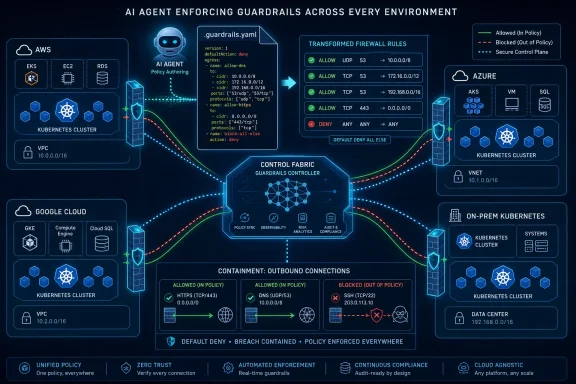
Aviatrix announced on June 4, 2026, from San Jose, California, that it has integrated its Cloud Native Security Fabric with Microsoft Agent Control Specification to enforce AI agent policies at the network layer across AWS, Azure, Google Cloud, and on-premises Kubernetes environments. The move is less about adding another guardrail than about admitting that guardrails inside an agent runtime are not enough. If AI agents are going to make decisions, call tools, use credentials, and move across infrastructure, security policy has to survive outside the agent’s own blast radius. Aviatrix is betting that the network is where that survival begins.
The central claim behind the Aviatrix-Microsoft integration is simple: an agent should not be the final authority on whether its own behavior is safe. That sounds obvious when stated plainly, but much of the early enterprise conversation around agent security has leaned heavily on runtime controls, SDK hooks, model filters, and orchestration-layer permissions. Those controls matter, but they live dangerously close to the thing they are supposed to restrain.
Microsoft’s Agent Control Specification is designed to create a common policy language for AI agents. In practical terms, that means a shared
Aviatrix is extending that idea into the network. Its integration translates the same policy file into firewall rules and pushes enforcement through its Cloud Native Security Fabric. The agent runtime may still consult the policy, but the outbound connection is also checked by infrastructure the agent does not control.
That distinction matters because agents are not conventional applications with predictable execution paths. They infer, plan, retry, chain tools together, and sometimes respond to hostile instructions embedded in data they are asked to process. A traditional app can misbehave because of a bug; an agent can misbehave because it has been persuaded that misbehavior is part of the task.
Aviatrix gives Microsoft a useful proof point because it is not merely enforcing policy inside Microsoft’s own agent stack. The integration is described as working across AKS, EKS, GKE, and on-premises Kubernetes, with support for frameworks including Strands, LangChain, AutoGen, and other conformant runtimes. That breadth is the point: a standard becomes more credible when it can leave home.
For Aviatrix, the calculation is just as clear. The company has spent years positioning itself around multicloud networking and security, and AI agents give that pitch new urgency. If the agent era creates a fresh class of unpredictable east-west and outbound traffic, then the vendor that can map policy to real workload communication paths has a story CISOs will at least want to hear.
There is also a useful asymmetry in the marketing. Microsoft can say it is creating an open control plane. Aviatrix can say it is enforcing that control plane where agents cannot rewrite the rules. Each side gets to claim the higher ground without pretending the other layer is sufficient by itself.
That is the uncomfortable part of agent security. The agent runtime is both the theater of action and the enforcement venue. If the runtime is deceived, misconfigured, or compromised, the policy may still exist as text while the system’s actual behavior drifts away from it.
Network enforcement does not solve every problem. It will not tell whether a generated report is misleading, whether a tool call is logically justified, or whether a response contains sensitive information already retrieved legitimately. But it can answer a harder-edged question: is this workload allowed to connect to that destination at all?
That is why Aviatrix’s move is meaningful. It does not try to make the network smarter than the agent. It makes the network less trusting than the agent. In security architecture, that is often the difference between an elegant policy and a defensible one.
That is important because AI agent governance is at risk of becoming a paperwork exercise. A company can say an agent is allowed to access only approved tools, but unless those permissions map to enforceable controls across the runtime, identity layer, network, and data plane, the statement is aspirational. The more clouds and clusters involved, the easier it becomes for policy intent to fragment.
Aviatrix’s integration aims to collapse at least part of that gap. One workflow deploys the agent into a Kubernetes environment. A second workflow translates the Agent Control Specification policy into firewall rules. The Aviatrix controller then reconciles those rules and applies them across the customer’s cloud estate.
This is the kind of plumbing that sounds boring until it is missing. In a single-cloud prototype, a developer can manually bind an agent to a few services and call the result “controlled.” In a production estate spanning AWS, Azure, Google Cloud, and private infrastructure, manual equivalence is where governance goes to die.
Agents make that sprawl more dangerous because they can become connective tissue across systems that were never designed to be jointly automated. An agent that summarizes tickets, queries a database, calls a deployment tool, and posts to a collaboration platform may traverse more trust boundaries in one task than a legacy service touches in a week. If those boundaries are enforced differently in each environment, the weakest environment becomes the practical policy.
Aviatrix is trying to sell consistency as risk reduction. The same agent policy can be interpreted by the application layer and the network layer, then applied across supported clouds and Kubernetes platforms. The sales pitch is not that multicloud becomes simple. It is that AI agent controls stop being rewritten every time the deployment target changes.
That is a real operational problem. Security teams already struggle to answer basic questions such as which workloads can talk to which services, which identities are attached to which automations, and which paths exist between development and production. Agentic systems add a new layer of delegated action on top of that uncertainty.
But bluntness can be a feature. A runtime control may decide whether an agent is allowed to use a particular tool for a particular purpose. A network control can decide that the agent is never allowed to reach a production database, an external endpoint, or an internal administrative service. The first judgment is contextual. The second is structural.
Good agent security needs both. The runtime should understand the agent’s planned action. The network should enforce hard outer boundaries that remain true even when the plan is wrong. In mature environments, the network layer becomes the seatbelt, not the driver.
That analogy also reveals the limitation. A seatbelt does not prevent bad driving, and network controls do not prevent bad reasoning. They reduce the consequences of failure. For a technology category built around autonomous action, reducing consequences may be the most practical first win.
The company has said the integration was validated end-to-end first on Amazon EKS. That is a smart proof point because it demonstrates Microsoft’s specification outside Microsoft’s own cloud, but it also underlines how much validation remains for complex real-world estates. Enterprises will want to test behavior across multiple clusters, overlapping policies, hybrid routes, service meshes, proxy layers, and existing cloud-native firewall constructs.
The reference implementation is expected to help developers experiment with the model. That matters because specifications become real when engineers can clone, deploy, break, and inspect them. A press release can describe a control plane; a working repository reveals the seams.
Security teams should be especially interested in reconciliation behavior. Translating policy into firewall rules is one thing. Keeping those rules accurate as agents, clusters, identities, and destinations change is the harder long-term problem. Drift is where beautiful architectures become incident reports.
A single policy file gives security and compliance teams a clearer artifact to review. Network-layer enforcement gives them a second place to verify that declared intent became operational control. If that chain is visible, versioned, and exportable, it becomes useful far beyond the AI platform team.
This is where the announcement intersects with a broader enterprise anxiety. Companies are moving from experimental agents to agents embedded in workflows that touch customer records, financial systems, developer environments, and operational tooling. The governance question is no longer “did we tell the agent to behave?” It is “can we demonstrate that the agent could not exceed its authority?”
That demonstration will become more important as auditors, insurers, and regulators catch up. AI agent incidents are unlikely to be judged only by whether the model behaved strangely. They will be judged by whether the organization placed reasonable technical limits around delegated machine action.
A shared policy format can reduce that fragmentation, but only if vendors implement it in ways that are interoperable enough to matter. That is why Aviatrix’s participation is more than a partner-logo exercise. It tests whether the policy language can be interpreted outside the runtime and applied by infrastructure that was not built by the same vendor.
Still, standards do not enforce themselves. Anyone who has lived through security compliance knows that a standard can become a checkbox, a translation layer, or a genuine operating model depending on how it is implemented. The danger for Agent Control Specification is that vendors claim compatibility while enforcing only the parts that fit their products.
That is the procurement question customers should ask early. Does this integration merely read the policy file, or does it preserve the policy’s intent across environments? What happens when a rule cannot be expressed cleanly as a network control? How are conflicts handled between runtime permissions and infrastructure restrictions? The answers will determine whether this becomes a durable security pattern or a useful demo.
Microsoft’s broader AI agent strategy is not confined to one product surface. The company is pushing agent governance through developer tooling, cloud platforms, Windows isolation work, Entra-connected identity models, and enterprise management concepts. Agent Control Specification fits that larger movement by creating a policy language that can travel beyond one runtime.
For Microsoft-centric organizations, the Aviatrix announcement is a reminder that agent governance will not live solely in Microsoft 365 admin centers or Azure portals. Many of the agents that matter will run near data, automation systems, internal APIs, and cloud-native workloads outside the Windows estate. The policy architecture will need to follow them.
That creates both opportunity and tension for IT teams. Windows administrators understand centralized policy better than most communities in technology. But agent workloads will often be built by developers using fast-moving frameworks, deployed into Kubernetes, and connected to services that traditional endpoint tools never see. The skills overlap, but the control points are changing.
Once agents take action, the old separation between application security and infrastructure security weakens. Tool calls become network paths. Model decisions become API requests. Prompt injection becomes an access-control problem. A compromised workflow can become a lateral movement story.
That is why network architecture is reentering the conversation. The network is not glamorous, and in cloud environments it is often hidden behind abstractions, managed services, and platform defaults. But when the question is whether an autonomous workload can reach a sensitive system, the network becomes concrete again.
The best version of this approach would make agent containment a normal part of workload design. Developers would define intended capabilities in policy. Security teams would review and approve them. Infrastructure would enforce them. Observability tools would show whether runtime behavior matched declared intent. That is the model enterprises should be pushing toward, whether Aviatrix becomes their chosen mechanism or not.
A credible system should fail closed where possible. It should make exceptions visible. It should distinguish between policy intent, translated network rules, and observed traffic. It should give security teams enough context to understand whether a blocked connection represents an attack, a bug, or an outdated policy.
It should also be boring to operate. That may be the hardest requirement. Security products that require constant expert tuning often decay into shelfware or are bypassed by teams under delivery pressure. If agent containment becomes another high-friction gate, developers will route around it, especially during the experimental phase of AI adoption.
The integration’s GitHub Actions-based workflow suggests Aviatrix understands that adoption has to fit into existing delivery habits. But enterprise reality is messier than a reference implementation. The organizations most in need of consistent agent controls are often the ones with the most inconsistent infrastructure.
The answer cannot be to remove autonomy entirely. If an agent can only follow a fixed script, it is just automation wearing a new label. The answer is to narrow the world in which autonomy operates. Agents can be flexible inside a boundary, but the boundary itself must be enforced by systems that do not share the agent’s incentives, context, or vulnerabilities.
That is the strongest version of the Aviatrix argument. The network layer is not where intelligence lives. It is where consequence is bounded. An agent may reason incorrectly, but it should not be able to convert that reasoning into unrestricted network access.
This is also why enterprises should resist vendor claims that any single layer “solves” agent security. Runtime guardrails, identity controls, secrets management, sandboxing, network policy, observability, and human approval all play different roles. The practical question is not which layer wins. It is whether the failure of one layer leaves the others intact.
The direction is hard to ignore because agent security is moving from theory into deployment. Companies are no longer merely asking whether employees can use chatbots. They are asking whether AI systems can take actions in software delivery, operations, customer support, finance, security triage, and data analysis. Each of those actions creates an access question.
Aviatrix is trying to occupy the space where access becomes traffic. Microsoft is trying to make the policy portable enough that the ecosystem can rally around it. Customers should welcome both moves while maintaining healthy skepticism about how much is implemented today versus promised by architecture diagrams.
The good news is that the industry is finally talking about agents as workloads, not magic. Workloads need identity. Workloads need policy. Workloads need network boundaries. Workloads need logs. The sooner AI agents are treated with that same operational seriousness, the fewer surprises enterprises will face when autonomous systems begin touching production.
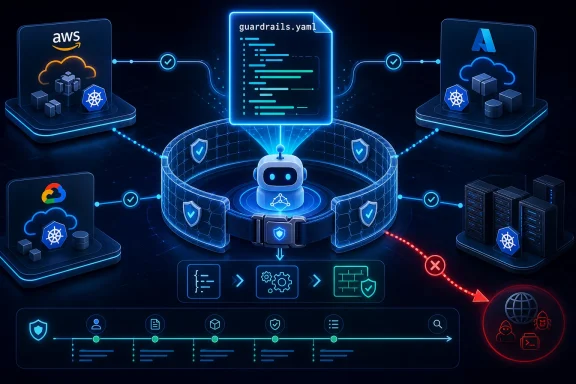 The Guardrail Moves Out of the Agent’s Head
The central claim behind the Aviatrix-Microsoft integration is simple: an agent should not be the final authority on whether its own behavior is safe. That sounds obvious when stated plainly, but much of the early enterprise conversation around agent security has leaned heavily on runtime controls, SDK hooks, model filters, and orchestration-layer permissions. Those controls matter, but they live dangerously close to the thing they are supposed to restrain.Microsoft’s Agent Control Specification is designed to create a common policy language for AI agents. In practical terms, that means a shared
.guardrails.yaml file can describe what an agent may do, which tools it may call, which models it may access, and what boundaries should shape its behavior. The specification’s promise is portability: write the policy once and apply it across conformant agent frameworks rather than rebuilding governance for every stack.Aviatrix is extending that idea into the network. Its integration translates the same policy file into firewall rules and pushes enforcement through its Cloud Native Security Fabric. The agent runtime may still consult the policy, but the outbound connection is also checked by infrastructure the agent does not control.
That distinction matters because agents are not conventional applications with predictable execution paths. They infer, plan, retry, chain tools together, and sometimes respond to hostile instructions embedded in data they are asked to process. A traditional app can misbehave because of a bug; an agent can misbehave because it has been persuaded that misbehavior is part of the task.
Microsoft Wants a Standard, Aviatrix Wants the Enforcement Layer
Microsoft’s role here is to make Agent Control Specification look less like another Azure feature and more like a plausible ecosystem standard. That is a politically important posture. Enterprises already have too many AI control planes, too many model gateways, and too many framework-specific safety systems. A security model that works only inside one vendor’s cloud is not much of a model for the companies actually deploying workloads across several clouds.Aviatrix gives Microsoft a useful proof point because it is not merely enforcing policy inside Microsoft’s own agent stack. The integration is described as working across AKS, EKS, GKE, and on-premises Kubernetes, with support for frameworks including Strands, LangChain, AutoGen, and other conformant runtimes. That breadth is the point: a standard becomes more credible when it can leave home.
For Aviatrix, the calculation is just as clear. The company has spent years positioning itself around multicloud networking and security, and AI agents give that pitch new urgency. If the agent era creates a fresh class of unpredictable east-west and outbound traffic, then the vendor that can map policy to real workload communication paths has a story CISOs will at least want to hear.
There is also a useful asymmetry in the marketing. Microsoft can say it is creating an open control plane. Aviatrix can say it is enforcing that control plane where agents cannot rewrite the rules. Each side gets to claim the higher ground without pretending the other layer is sufficient by itself.
The Runtime Was Never Going to Be Enough
Runtime guardrails are necessary, but they are not a security perimeter. They can intercept tool calls, inspect prompts, evaluate responses, and block obvious policy violations. They can also provide the hooks that make agent behavior observable and auditable. But they sit in a place where implementation bugs, framework differences, prompt injection, credential leakage, and compromised dependencies all converge.That is the uncomfortable part of agent security. The agent runtime is both the theater of action and the enforcement venue. If the runtime is deceived, misconfigured, or compromised, the policy may still exist as text while the system’s actual behavior drifts away from it.
Network enforcement does not solve every problem. It will not tell whether a generated report is misleading, whether a tool call is logically justified, or whether a response contains sensitive information already retrieved legitimately. But it can answer a harder-edged question: is this workload allowed to connect to that destination at all?
That is why Aviatrix’s move is meaningful. It does not try to make the network smarter than the agent. It makes the network less trusting than the agent. In security architecture, that is often the difference between an elegant policy and a defensible one.
A Single Policy File Is a Governance Pitch, Not Just a Developer Convenience
The humble.guardrails.yaml file is doing a lot of symbolic work in this announcement. To developers, it suggests something familiar: declarative configuration checked into source control, reviewed in pull requests, and deployed through automation. To security teams, it suggests a single artifact that can be audited, versioned, and reconciled against actual infrastructure behavior.That is important because AI agent governance is at risk of becoming a paperwork exercise. A company can say an agent is allowed to access only approved tools, but unless those permissions map to enforceable controls across the runtime, identity layer, network, and data plane, the statement is aspirational. The more clouds and clusters involved, the easier it becomes for policy intent to fragment.
Aviatrix’s integration aims to collapse at least part of that gap. One workflow deploys the agent into a Kubernetes environment. A second workflow translates the Agent Control Specification policy into firewall rules. The Aviatrix controller then reconciles those rules and applies them across the customer’s cloud estate.
This is the kind of plumbing that sounds boring until it is missing. In a single-cloud prototype, a developer can manually bind an agent to a few services and call the result “controlled.” In a production estate spanning AWS, Azure, Google Cloud, and private infrastructure, manual equivalence is where governance goes to die.
Multicloud Is Where Agent Security Gets Messy First
The announcement’s cross-cloud emphasis is not incidental. Most large companies do not live inside a pristine single-vendor architecture. They have inherited workloads, regional cloud preferences, merger debris, platform teams with different standards, and business units that adopted AI tools before central IT finished writing the policy.Agents make that sprawl more dangerous because they can become connective tissue across systems that were never designed to be jointly automated. An agent that summarizes tickets, queries a database, calls a deployment tool, and posts to a collaboration platform may traverse more trust boundaries in one task than a legacy service touches in a week. If those boundaries are enforced differently in each environment, the weakest environment becomes the practical policy.
Aviatrix is trying to sell consistency as risk reduction. The same agent policy can be interpreted by the application layer and the network layer, then applied across supported clouds and Kubernetes platforms. The sales pitch is not that multicloud becomes simple. It is that AI agent controls stop being rewritten every time the deployment target changes.
That is a real operational problem. Security teams already struggle to answer basic questions such as which workloads can talk to which services, which identities are attached to which automations, and which paths exist between development and production. Agentic systems add a new layer of delegated action on top of that uncertainty.
The Network Layer Is a Crude Instrument, and That Is Part of Its Value
There is a temptation to dismiss network controls as too blunt for AI agents. Agents operate at the level of tasks, intentions, tool semantics, and contextual judgment. A firewall rule operates at the level of destinations, ports, protocols, and flows. The mismatch is obvious.But bluntness can be a feature. A runtime control may decide whether an agent is allowed to use a particular tool for a particular purpose. A network control can decide that the agent is never allowed to reach a production database, an external endpoint, or an internal administrative service. The first judgment is contextual. The second is structural.
Good agent security needs both. The runtime should understand the agent’s planned action. The network should enforce hard outer boundaries that remain true even when the plan is wrong. In mature environments, the network layer becomes the seatbelt, not the driver.
That analogy also reveals the limitation. A seatbelt does not prevent bad driving, and network controls do not prevent bad reasoning. They reduce the consequences of failure. For a technology category built around autonomous action, reducing consequences may be the most practical first win.
The Early Access Label Should Keep Expectations Grounded
Aviatrix says the integration is available through its early access program and included in existing customer subscriptions at no additional cost. That is welcome, but it also means customers should treat the release as an emerging implementation rather than a finished industry settlement. Standards work and production security rarely mature at the same pace.The company has said the integration was validated end-to-end first on Amazon EKS. That is a smart proof point because it demonstrates Microsoft’s specification outside Microsoft’s own cloud, but it also underlines how much validation remains for complex real-world estates. Enterprises will want to test behavior across multiple clusters, overlapping policies, hybrid routes, service meshes, proxy layers, and existing cloud-native firewall constructs.
The reference implementation is expected to help developers experiment with the model. That matters because specifications become real when engineers can clone, deploy, break, and inspect them. A press release can describe a control plane; a working repository reveals the seams.
Security teams should be especially interested in reconciliation behavior. Translating policy into firewall rules is one thing. Keeping those rules accurate as agents, clusters, identities, and destinations change is the harder long-term problem. Drift is where beautiful architectures become incident reports.
The Audit Trail May Be the Sleeper Feature
The most immediate appeal of this integration may not be containment. It may be auditability. Regulated organizations do not merely need to restrict agents; they need to prove what restrictions existed, when they changed, and how they mapped to actual infrastructure.A single policy file gives security and compliance teams a clearer artifact to review. Network-layer enforcement gives them a second place to verify that declared intent became operational control. If that chain is visible, versioned, and exportable, it becomes useful far beyond the AI platform team.
This is where the announcement intersects with a broader enterprise anxiety. Companies are moving from experimental agents to agents embedded in workflows that touch customer records, financial systems, developer environments, and operational tooling. The governance question is no longer “did we tell the agent to behave?” It is “can we demonstrate that the agent could not exceed its authority?”
That demonstration will become more important as auditors, insurers, and regulators catch up. AI agent incidents are unlikely to be judged only by whether the model behaved strangely. They will be judged by whether the organization placed reasonable technical limits around delegated machine action.
Open Standards Are Not Magic, but They Change the Procurement Conversation
Microsoft’s framing of Agent Control Specification as an open standard is strategically important. Enterprises dislike being trapped between incompatible control systems, and AI infrastructure is already fragmenting quickly. Every agent framework, model platform, orchestration layer, and cloud vendor has an incentive to define its own governance surface.A shared policy format can reduce that fragmentation, but only if vendors implement it in ways that are interoperable enough to matter. That is why Aviatrix’s participation is more than a partner-logo exercise. It tests whether the policy language can be interpreted outside the runtime and applied by infrastructure that was not built by the same vendor.
Still, standards do not enforce themselves. Anyone who has lived through security compliance knows that a standard can become a checkbox, a translation layer, or a genuine operating model depending on how it is implemented. The danger for Agent Control Specification is that vendors claim compatibility while enforcing only the parts that fit their products.
That is the procurement question customers should ask early. Does this integration merely read the policy file, or does it preserve the policy’s intent across environments? What happens when a rule cannot be expressed cleanly as a network control? How are conflicts handled between runtime permissions and infrastructure restrictions? The answers will determine whether this becomes a durable security pattern or a useful demo.
Windows Shops Should Read This as an Enterprise Control Story
At first glance, this may look distant from the Windows world. The named deployment targets are Kubernetes environments and public clouds, not Windows desktops or traditional Active Directory estates. But WindowsForum readers should recognize the pattern immediately: identity, policy, endpoint control, and network enforcement are converging around autonomous software.Microsoft’s broader AI agent strategy is not confined to one product surface. The company is pushing agent governance through developer tooling, cloud platforms, Windows isolation work, Entra-connected identity models, and enterprise management concepts. Agent Control Specification fits that larger movement by creating a policy language that can travel beyond one runtime.
For Microsoft-centric organizations, the Aviatrix announcement is a reminder that agent governance will not live solely in Microsoft 365 admin centers or Azure portals. Many of the agents that matter will run near data, automation systems, internal APIs, and cloud-native workloads outside the Windows estate. The policy architecture will need to follow them.
That creates both opportunity and tension for IT teams. Windows administrators understand centralized policy better than most communities in technology. But agent workloads will often be built by developers using fast-moving frameworks, deployed into Kubernetes, and connected to services that traditional endpoint tools never see. The skills overlap, but the control points are changing.
Agent Containment Is Becoming a Network Architecture Problem
Aviatrix’s language around containment is notable because it shifts the AI security conversation away from model behavior alone. For much of the generative AI era, safety discussion centered on outputs: hallucinations, harmful content, bias, data leakage, and prompt injection. Agents force a different emphasis because they do not just produce text. They do things.Once agents take action, the old separation between application security and infrastructure security weakens. Tool calls become network paths. Model decisions become API requests. Prompt injection becomes an access-control problem. A compromised workflow can become a lateral movement story.
That is why network architecture is reentering the conversation. The network is not glamorous, and in cloud environments it is often hidden behind abstractions, managed services, and platform defaults. But when the question is whether an autonomous workload can reach a sensitive system, the network becomes concrete again.
The best version of this approach would make agent containment a normal part of workload design. Developers would define intended capabilities in policy. Security teams would review and approve them. Infrastructure would enforce them. Observability tools would show whether runtime behavior matched declared intent. That is the model enterprises should be pushing toward, whether Aviatrix becomes their chosen mechanism or not.
The Real Test Is Failure
Every security architecture sounds strongest when everything is working as designed. AI agents, unfortunately, are interesting precisely because they may not. The real test of Aviatrix’s integration will be what happens when an agent receives hostile input, a tool is misconfigured, a policy is incomplete, a destination changes, or an operator deploys a new agent without understanding the controls.A credible system should fail closed where possible. It should make exceptions visible. It should distinguish between policy intent, translated network rules, and observed traffic. It should give security teams enough context to understand whether a blocked connection represents an attack, a bug, or an outdated policy.
It should also be boring to operate. That may be the hardest requirement. Security products that require constant expert tuning often decay into shelfware or are bypassed by teams under delivery pressure. If agent containment becomes another high-friction gate, developers will route around it, especially during the experimental phase of AI adoption.
The integration’s GitHub Actions-based workflow suggests Aviatrix understands that adoption has to fit into existing delivery habits. But enterprise reality is messier than a reference implementation. The organizations most in need of consistent agent controls are often the ones with the most inconsistent infrastructure.
The Price of Autonomy Is External Constraint
There is a philosophical shift underneath this announcement. For decades, enterprise automation was largely deterministic: scripts, jobs, pipelines, scheduled tasks, and services that followed known paths. AI agents introduce a different contract. They are valuable because they can adapt, but that adaptability makes them harder to predict.The answer cannot be to remove autonomy entirely. If an agent can only follow a fixed script, it is just automation wearing a new label. The answer is to narrow the world in which autonomy operates. Agents can be flexible inside a boundary, but the boundary itself must be enforced by systems that do not share the agent’s incentives, context, or vulnerabilities.
That is the strongest version of the Aviatrix argument. The network layer is not where intelligence lives. It is where consequence is bounded. An agent may reason incorrectly, but it should not be able to convert that reasoning into unrestricted network access.
This is also why enterprises should resist vendor claims that any single layer “solves” agent security. Runtime guardrails, identity controls, secrets management, sandboxing, network policy, observability, and human approval all play different roles. The practical question is not which layer wins. It is whether the failure of one layer leaves the others intact.
The Announcement Is Early, but the Direction Is Hard to Ignore
For now, Aviatrix’s integration is an early access offering tied to an emerging Microsoft specification. It should be evaluated carefully, tested aggressively, and compared against existing controls in cloud firewalls, service meshes, Kubernetes network policies, zero-trust platforms, and API gateways. The fact that it is early does not make it unimportant.The direction is hard to ignore because agent security is moving from theory into deployment. Companies are no longer merely asking whether employees can use chatbots. They are asking whether AI systems can take actions in software delivery, operations, customer support, finance, security triage, and data analysis. Each of those actions creates an access question.
Aviatrix is trying to occupy the space where access becomes traffic. Microsoft is trying to make the policy portable enough that the ecosystem can rally around it. Customers should welcome both moves while maintaining healthy skepticism about how much is implemented today versus promised by architecture diagrams.
The good news is that the industry is finally talking about agents as workloads, not magic. Workloads need identity. Workloads need policy. Workloads need network boundaries. Workloads need logs. The sooner AI agents are treated with that same operational seriousness, the fewer surprises enterprises will face when autonomous systems begin touching production.
The Practical Reading for Cloud and Security Teams
Aviatrix’s announcement should not send administrators rushing to redesign their AI infrastructure overnight. It should, however, sharpen the checklist for anyone allowing agents near real systems. The useful question is not whether an agent has a policy file. The useful question is whether that policy is enforced outside the agent’s own runtime and across every environment where the agent can act.- Agent policies should be treated as deployable security artifacts, not informal developer guidance.
- Runtime guardrails should be paired with infrastructure controls that survive prompt injection, framework bugs, and compromised dependencies.
- Multicloud agent deployments need one auditable policy model, or security teams will spend their time reconciling inconsistent controls after the fact.
- Network enforcement is not a complete agent security strategy, but it is a necessary containment layer for outbound access and lateral movement risk.
- Early access implementations should be tested for drift, conflict handling, logging quality, and failure behavior before they are trusted in production.
- Microsoft’s Agent Control Specification becomes more credible if vendors can enforce it outside Microsoft’s own platforms and without collapsing into proprietary extensions.
References
- Primary source: SecurityBrief New Zealand
Published: 2026-06-09T22:30:08.918514
Aviatrix adds Microsoft agent security across clouds
Security teams may get a single set of controls for AI agents across clouds as Aviatrix enforces Microsoft policy rules at network level. securitybrief.co.nz
- Related coverage: globenewswire.com
Aviatrix Extends Microsoft Agent Control Specification to
The Aviatrix Cloud Native Security Fabric is among the first cross-cloud, multi-framework enforcement substrates for the Microsoft Agent Control...www.globenewswire.com - Official source: opensource.microsoft.com
Introducing the Agent Governance Toolkit: Open-source runtime security for AI agents | Microsoft Open Source Blog
Discover how the Microsoft Agent Governance Toolkit brings policy, identity, and reliability to autonomous AI agent systems.opensource.microsoft.com - Official source: learn.microsoft.com
Guardrails and controls overview in Microsoft Foundry - Microsoft Foundry | Microsoft Learn
Learn about safety and security guardrails that can be applied to models and agents in Microsoft Foundry, including risks, intervention points, and response actions.learn.microsoft.com - Related coverage: aviatrix.ai
AI-powered Aviatrix Secure Network Supervisor agent teams with Microsoft Security Copilot to resolve VPN issues in real time, reduce operational burden, and improve business continuity
Aviatrix® today announced its inclusion in the Microsoft Security Store Partner Ecosystem. Aviatrix was selected based on their proven experience with Microsoft Security technologies, willingness to explore and provide feedback on cutting edge functionality, and close relationship with...aviatrix.ai - Related coverage: techcrunch.com
Microsoft offers devs a better way to control AI agent behavior | TechCrunch
The specification lets developer, compliance, and security teams define their own policies for agents to follow in portable policy files.techcrunch.com
- Official source: blogs.windows.com
Windows platform security for AI agents
Making Windows the trustworthy OS for agents AI agents are no longer just answering questions, they are taking actions across systems with increasing autonomy. As they become persistent participants in how software runs, they introduce new rblogs.windows.com - Related coverage: siliconangle.com
Aviatrix launches AI agent containment platform for cloud workloads - SiliconANGLE
Aviatrix launches AI agent containment platform for cloud workloads - SiliconANGLE siliconangle.com
- Related coverage: aviatrix.com
- Related coverage: pages.aviatrix.com
- Official source: microsoft.com
- Related coverage: oracle.github.io