

Cloud infrastructure decisions used to be simple: pick the vendor with the biggest footprint and the longest track record. Today that rule no longer suffices. Enterprises must weigh not just raw scale but service depth, pricing models, hybrid tooling, and AI-readiness—and that calculus plays out differently for Amazon Web Services (AWS), Microsoft Azure, and Google Cloud Platform (GCP). The overview that follows synthesizes recent reporting and vendor documentation, summarizes the Tech Times comparison the reader provided, and then—critically—evaluates where each provider is strongest, where risk lives, and how teams should choose for the long term. rview
Cloud infrastructure is the collection of compute, storage, networking, and managed platform services that let organizations run applications without owning and operating datacenters. These foundational layers determine how easily workloads scale, how tightly they integrate with existing enterprise systems, and how predictable costs will be over time. The familiar trio—AWS, Azure, and Google Cloud—offer the same core capabilities under different trade-offs: breadth of services, surface area for optimization, licensing and licensing discounts, and specializations such as AI or enterprise systems integration. The Tech Times primer the user supplied captures these themes succinctly: choices often reduce to existing platform investments (favoring Azure), maturity and ecosystem (favoring AWS), or data/AI-first design (favoring Google Cloud).
Before we dig into nuance, two facts matter for every decision:
Be cautious about claims of “vendor neutrality”: while Kubernetes and cloud-native patterns improve portability, differences in networking, IAM models, and managed service semantics still require work during migration.
Whatever you choose, treat it as a multi-year operating decision:
Conclusion
Choosing between AWS, Azure, and Google Cloud has never been more nuanced. Each provider offers unique advantages—service breadth (AWS), enterprise integration (Azure), and data/AI specialization (Google Cloud). A disciplined decision framework that combines technical fit, operational readiness, and honest TCO modeling will serve technology leaders far better than headline market share or feature lists alone. Start with a realistic inventory, run focused proofs, and prioritize governance; that combination, not vendor rhetoric, determines which cloud wins for your workloads.
Source: Tech Times Cloud Infrastructure Comparison: AWS vs Azure vs Google Cloud
Cloud infrastructure is the collection of compute, storage, networking, and managed platform services that let organizations run applications without owning and operating datacenters. These foundational layers determine how easily workloads scale, how tightly they integrate with existing enterprise systems, and how predictable costs will be over time. The familiar trio—AWS, Azure, and Google Cloud—offer the same core capabilities under different trade-offs: breadth of services, surface area for optimization, licensing and licensing discounts, and specializations such as AI or enterprise systems integration. The Tech Times primer the user supplied captures these themes succinctly: choices often reduce to existing platform investments (favoring Azure), maturity and ecosystem (favoring AWS), or data/AI-first design (favoring Google Cloud).
Before we dig into nuance, two facts matter for every decision:
- Cloud is not just technology—it's an operating model. Success depends as much on governance, cost controls, and personnel skills as it does on raw feature lists.
- Architecture beats vendor claims. Multi-zone and multi-region designs, sensible data partitioning, and observability will usually have more impact on uptime and cost than small SLA differences.
 Market leadership and ecosystem
Who leads—and why it matters
Market telemetry for the last several quarters shows the three hyperscalers controlling the lion’s share of cloud infrastructure spending. Recent industry tallies put the combined share of AWS, Azure, and Google Cloud in the low-to-mid 60% range of global infrastructure spend, with AWS remaining the largest single vendor by revenue while Azure and Google Cloud close the gap via faster percentage growth in many quarters. These market trends matter because provider scale drives partner ecosystems, enterprise contracts, and the depth of managed services available for niche workloads.Ecosystem breadth and partner networks
- AWS: Known for the broadest service catalog and an extensive third-party marketplace. Its longevity created patterns and prescriptive solutions that enterprises and vendors have adopted widely.
- Azure: Leverages Microsoft’s enterprise relationships and licensing constructs; hybrid and identity integrations make it compelling for Windows-first shops. Microsoft’s investment in cloud regions and government/vertical-specific offerings has narrowed the operational gap with AWS.
- Google Cloud: Smaller overall share but strong in data platforms, analytics, and Kubernetes/native workflows—areas that attract AI and analytics-first adopters. Google emphasizes networking performance and high-throughput data services.
Core services: compute, storage, and networking
Compute: instance variety and purchasing models
All three providers provide instance families optimized for general purpose, compute-heavy, memory-intensive, or accelerated workloads. The differences show up in the granularity of instance types, specialized silicon, and purchasing flexibility.- AWS: EC2 offers the deepest set of instance families and the most purchasing constructs (On‑Demand, Reserved Instances, Convertible/Standard RIs historically, and Savings Plans), enabling fine-grained cost optimizations when an organization can forecast usage. Savings Plans offer flexible cost reduction when you commit to a spend level rather than specific instance types.
- Azure: Virtual Machines mirror common instance classes but emphasize integration with Windows tooling and licensing—this is where Azure Hybrid Benefit delivers material savings for organizations that bring existing Windows Server or SQL Server licenses. Azure’s enterprise agreement constructs and reserved capacity options are competitive with AWS for predictable workloads.
- Google Cloud: Compute Engine focuses on performance and simplicity for sustained workloads, with sustained use discounts (automatic reductions for continuous usage) and committed use discounts that reward explicit multi‑year commitments. These discounts are particularly effective for containerized or long-running compute loads.
Storage: object, block, and tiering
All three provide durable object storage (S3, Azure Blob, Cloud Storage), block volumes and managed file services, and tiering for archival use-cases. Differences appear in ecosystem integrations (e.g., native lifecycle policies, encryption-by-default choices, or built-in analytics) and pricing details for infrequent access or retrieval latency.- AWS S3: Mature lifecycle and access management tooling; huge ecosystem of S3-first applications.
- Azure Blob Storage: Deep integration with Microsoft data services and Azure AD for identity. Azure typically bundles features that simplify Windows-centric migrations.
- Google Cloud Storage: Strong performance on networked data flows and an emphasis on analytics pipelines (BigQuery/Vertex AI integration).
Networking and global backbone
Providers have spent heavily on global fiber, edge locations, and peering. For many latency-sensitive and distributed applications, the difference between providers is practical rather than binary—peering relationships, regional POP density, and CDN footprints will determine user experience. Google stresses WAN performance and a horizontally scaled backbone, AWS emphasizes Local Zones and a dense edge footprint, and Azure highlights enterprise-region density and government cloud zones.Global reach, reliability, and availability
Geographic coverage is a defensible proxy for choice when latency, data residency, or regulated workloads are primary concerns. All three operate dozens of public regions and multiple availability zones within each region; their footprints continue to expand.- AWS publicly lists dozens of regions and more than a hundred availability zones, and it also offers Local Zones and Wavelength locations for low-latency edge workloads. Global infrastructure detail from AWS remains the standard reference for exact counts.
- Microsoft reports an industry-leading regional count and an aggressive expansion plan in both commercial and government clouds; Microsoft’s own infrastructure statements emphasize the number of regions, datacenters, and edge sites.
- Google Cloud publishes its regional map and product availability per region; its network investments are frequently cited as a differentiator for high-throughput services.
Pricing and cost management
Cost is where decisions get messy. Each vendor offers on-demand pricing, discounts for commitments, and specialized programs—but the details matter.- AWS: Offers granular purchasing options including On‑Demand, Savings Plans, and Reserved Instances. Savings Plans are flexible and apply broadly; Reserved Instances can be used for capacity guarantees. The AWS billing model is highly tunable but can be complex to optimize.
- Azur reserved capacity and adds Azure Hybrid Benefit**, which allows customers with eligible Windows Server and SQL Server licenses to move workloads to Azure at lower incremental compute costs—often a decisive saving for Microsoft-centric enterprises. Azure also provides reserved VM instances and spot/eviction-pricing equivalents.
- Google Cloud: Uses sustained use discounts (automatic reductions for continuous usage) and committed use discounts (explicit one- or three-year commitments) to simplify savings. Google’s discounts can be especially economical for predictable, long-running workloads and container-native consumption patterns.
- Rightsize compute, remove idle resources, and prefer serverless or managed services for variable workloads.
- Minimize cross-region data egress and duplicate storage.
- Automate shutdown of nonproduction environments.
Security, compliance, and governance
Every major provider implements a shared responsibility model: cloud vendors secure the physical infrastructure and host-level services while customers are responsible for identity, configuration, data protection, and application-layer security. That shared-responsibility framing is universal, but operational differences and native tooling affect how easy it is to meet governance requirements.- AWS details an infrastructure/guest responsibility split and offers a large partner ecosystem for security tooling.
- Azure integrates deeply with Microsoft Entra (identity), Defender for Cloud, and compliance tooling that enterprises often already use, making audit-readiness smoother for Microsoft shops.
- Google Cloud emphasizes secure defaults and zero-trust features, with strong controls for service accounts and workload identity.
Hybrid and multi-cloud: tools and real-world patterns
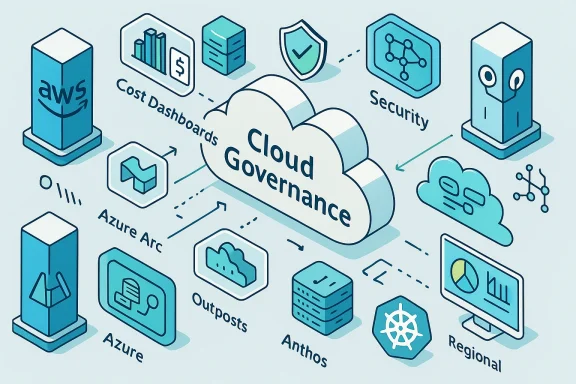
Hybrid and multi-cloud strategies are a mainstream reality for many enterprises; the hyperscalers responded with product portfolios designed to manage hybrid assets and multi-cloud clusters.- Azure: Azure Arc and Azure Stack enable consistent management across on-premises and public cloud resources, letting teams use Azure control planes, policy, and security tooling for non-Azure resources. This makes Azure an obvious option for organizations standardizing on Microsoft management tooling.
- AWS: AWS Outposts extends AWS infrastructure and APIs into customer data centers as a managed service, enabling low-latency local compute while preserving a single AWS operational model. Outposts is a fit when you want the full AWS API surface on-prem and are willing to accept vendor-managed hardware in your facility.
- Google Cloud: Anthos provides a Kubernetes-centric multi-cloud control plane that spans Google Cloud, AWS, Azure, and on-prem clusters—appealing for container-first organizations that want a common operational layer across providers. Anthos shines when the organization standardizes on Kubernetes for portability.
Where each provider shines — critical analysis
Amazon Web Services (AWS)
Strengths:- Breadth and maturity: AWS’s catalog is unmatched and yields many turnkey managed services for edge cases and niche enterprise needs.
- Marketplace and partner ecosystem: There’s rarely a vendor or tool that doesn’t have an AWS-ready deployment. This reduces integration friction.
- Complexity and billing opacity: AWS’s flexibility can cause billing surprises without strong governance and tagging. Savings Plans and RIs are powerful but require forecasting and discipline.
- Enterprise identity and Windows integration: For shops that rely heavily on Windows licensing and Active Directory, AWS requires additional work and licensing management compared with Azure.
Microsoft Azure
Strengths:- Enterprise affinity: Azure’s integration with Windows Server, SQL Server, Microsoft 365, and Entra makes migration and identity governance smoother for existing Microsoft customers. Azure Hybrid Benefit can materially lower TCO for Windows workloads.
- Hybrid-first tools: Azure Arc and Azure Stack are mature options for hybrid models, making Azure compelling for regulated public sector and large enterprise customers.
- Perceived regional capacity issues: In fast-growing markets, Azure has at times constrained capacity for certain VM SKUs, which can force cross-region deployments. This is operationally visible and a practical concern for capacity planning.
- Licensing complexity and competitive friction: Microsoft’s licensing terms influence multi-cloud economics—organizations should model these carefully, and regulatory scrutiny in some markets has emerged around the competitive effect.
Google Cloud Platform (GCP)
Strengths:- Data and AI-first capabilities: BigQuery, Vertex AI, and Google’s networking backbone make GCP a compelling platform for analytics- and ML-centric workloads. Google’s committed and sustained discount model rewards long-running, containerized workloads.
- Container-native philosophy: GKE and Anthos are strong choices for teams tbernetes and want portability across clouds.
- Smaller enterprise footprint: Google Cloud still lags in overall market share and, for some enterprise buyers, in the breadth of legacy managed services and partner solutions available by default. Market momentum is improving, but be realistic about where vendor support and third-party integrations are already established.
Practical decision framework: how to run a rigorous cloud infrastructure comparison
- Inventory current estate and technical debt.
- Catalog apps, dependencies, data residency constraints, and Windows/SQL licensing positions.
- Map workloads to cloud strengths.
- Identndows‑centric, which are container/AI pipelines, and which are latency-sensitive.
- Do a two‑axis evaluation: technical fit vs operational fit.
- Technical fit: service capability, compliance, region availability.
- Operational fit: team skills, existing contracts, partner network, and procurement processes.
- Model real TCO, not list price.
- Include license impacts (Azure Hybrid Benefit), discount programs (Savings Plans, Committed Use), and
- Run a proof-of-concept with production-mirroring scale.
- Validate performance, identity flows, backup/DR, and the real cost for data egress and managed services.
- Decide on a target operating model.
- Single-cloud standardization for simplicity, or multi-cloud/hybrid for strategic flexibility—document the governance and observability requirements accordingly.
Migration complexity, lock-in, and vendor risk
Switching providers is possible but can be expensive when applications use highly managed, proprietary services (managed databases, proprietary serverless runtimes, or platform-specific agent tooling). The Tech Times synopsis is correct: moving between AWS and Azure is feasible but depends on how many proprietary services you’ve consumed and how tightly integrated licensing is. In practical terms, migrations are a mixture of replatforming (lift-and-shift with block storage/VMs) and refactoring (replacing managed services with cross-cloud alternatives such as Kubernetes + open-source databases). Expect the highest lift for stateful, data-heavy, and tightly integrated SaaS transformations.Be cautious about claims of “vendor neutrality”: while Kubernetes and cloud-native patterns improve portability, differences in networking, IAM models, and managed service semantics still require work during migration.
Governance and operational controls you must plan for
- Tagging and billing discipline (automated enforcement).
tion and least-privilege role design. - Cross-account/tenant networking and secure service connectivity.
- Observability and incident playbooks that work across providers.
FAQs — concise answers
- Can a business switch from AWS to Azure or vice versa?
- Yes, but complexity varies. The effort grows with the number of proprietary services used and the depth of license integration. Plan for refactoring, not just lift-and-shift.
- Is multi-cloud always better?
- No. Multi-cloud increases resilience and feature choice at the cost of operational overhead. It’s beneficial only when there’s a clear business driver—contractual, regulatory, or technical.
- Do smaller teams need a full comparison?
- Often not. Smaller teams should pick the platform that best matches existing skills and toolchains; over-optimizing for tiny price differences typically wastes time.
Final verdict: choose with an operating plan, not just a checklist
The single best piece of advice is practical: pick the provider that minimizes the work required to operate reliably and cost-effectively while leaving room to evolve. For most Microsoft-first enterprises, Azure will reduce migration friction and licensing cost—especially for Windows and SQL Server workloads. For organizations seeking the broadest managed-service catalog and partner ecosystem, AWS continues to offer the most options and operational patterns. For AI, analytics, and container-native strategies, Google Cloud remains the natural first choice.Whatever you choose, treat it as a multi-year operating decision:
- Invest in governance, cost controls, and automation from day one.
- Design for failure—multi-zone and region-aware architectures will protect you more than any provider marketing slide.
- Revisit vendor economics annually; the hyperscale landscape evolves fast and discount programs, capacity, and regional availability change the sweet spot over time.
Conclusion
Choosing between AWS, Azure, and Google Cloud has never been more nuanced. Each provider offers unique advantages—service breadth (AWS), enterprise integration (Azure), and data/AI specialization (Google Cloud). A disciplined decision framework that combines technical fit, operational readiness, and honest TCO modeling will serve technology leaders far better than headline market share or feature lists alone. Start with a realistic inventory, run focused proofs, and prioritize governance; that combination, not vendor rhetoric, determines which cloud wins for your workloads.
Source: Tech Times Cloud Infrastructure Comparison: AWS vs Azure vs Google Cloud
