

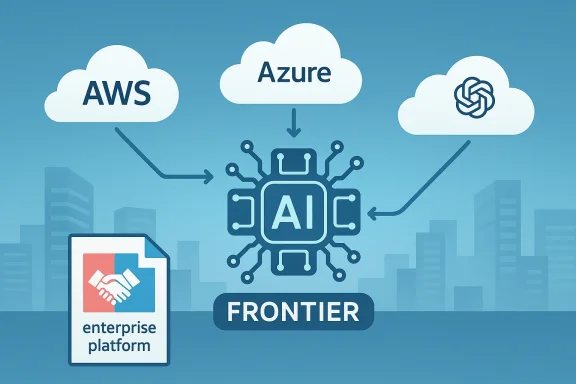
The reported standoff between Microsoft, OpenAI, and Amazon is less a sudden explosion than the latest flashpoint in a partnership that has been steadily changing shape for more than a year. According to reporting cited by the Financial Times and subsequent coverage, Microsoft is weighing whether OpenAI’s plan to use Amazon Web Services as the cloud distributor for its Frontier enterprise platform may violate the companies’ revised terms, particularly if Azure exclusivity still applies to certain classes of model access. What makes this dispute so combustible is not just the money involved, but the ambiguity: in the post-exclusive era of OpenAI infrastructure, the line between “API products,” “non-API products,” and agentic enterprise services is now commercially meaningful and legally consequential. (tomshardware.com)
Background — full context
For most of the public life of the Microsoft-OpenAI relationship, the narrative was straightforward: Microsoft wrote large checks, OpenAI got capital and compute, and Azure became the default cloud home for OpenAI’s commercial model access. That arrangement gave Microsoft a strategic advantage in the AI race, because the most sought-after frontier models were tightly integrated into its cloud and productivity ecosystem. OpenAI, in return, gained access to a hyperscale infrastructure partner and a distribution channel that could push its models into enterprise workflows at a remarkable pace. (techcrunch.com)But the exclusivity story began to soften once OpenAI’s infrastructure needs outgrew a single-provider model. By early 2025, reporting indicated Microsoft was no longer OpenAI’s exclusive cloud provider, even as Azure remained central to the partnership. The shift mattered because it introduced a new reality: OpenAI could diversify compute, but not necessarily redesign every product relationship in the same way. In other words, the company was gaining operational flexibility while still living inside a contract structure that preserved Microsoft’s leverage over certain deployment paths. (techcrunch.com)
That tension became much more visible after the later Amazon-OpenAI arrangements. Coverage in late 2025 and early 2026 described a major AWS partnership that expanded OpenAI’s ability to use Amazon’s infrastructure, and more recent reporting says AWS was chosen as the supplier for Frontier, OpenAI’s enterprise agent platform. The reported sticking point is not simply that OpenAI is working with AWS; it is that Microsoft believes the specific form of that collaboration may cross the boundary of the revised OpenAI-Microsoft agreement. The dispute appears to hinge on whether Frontier is treated as an API product, a non-API product, or something in between. (tomshardware.com)
At a strategic level, this is exactly the kind of conflict that emerges when infrastructure contracts overlap with product definitions. Cloud agreements are often written to govern categories of access, not just named products. That means if OpenAI launches a new enterprise platform that combines agent orchestration, memory, content access, and model serving, each functional layer can become relevant to exclusivity language. The result is a legal and business puzzle, not merely a rival-vendor dispute. (tomshardware.com)
The broader industry context makes the tension even sharper. Microsoft has continued to diversify its own AI alliances, including a prominent partnership with Anthropic and Nvidia in 2025, which signaled that it was no longer relying solely on OpenAI for its AI future. OpenAI, meanwhile, has also expanded its infrastructure relationships and capital backing, giving it more negotiating room than it had in the era when Microsoft’s checks and Azure’s compute were the dominant lifelines. The old dependency model is gone, but the residue of exclusivity remains. (apnews.com)
What the reported dispute is actually about
The most important detail in the current controversy is that it does not appear to be a simple “Microsoft versus Amazon” cloud war. It is a contract interpretation fight wrapped around an enterprise AI product launch. Microsoft’s concern, according to reporting summarized by multiple outlets, is that Frontier may be functioning as a way to route OpenAI model access through AWS in a manner that still competes with or bypasses the Azure-only obligations Microsoft believes remain in force. (tomshardware.com)The legal question is about categories, not slogans
In cloud and AI agreements, terms like API, runtime, distribution, hosting, stateful, and stateless are not technical trivia. They can define who gets to sell what, where, and under which platform. One recent analysis of the dispute suggested the underlying argument may come down to a technical distinction between stateless model access and stateful enterprise workflows. That distinction matters because a product that is more than “just API access” may fall outside older exclusivity language, even if it is powered by the same underlying models. (tomshardware.com)Frontier may be the perfect gray-zone product
Enterprise AI agent platforms blur traditional cloud categories by design. They typically manage memory, orchestration, tool use, retrieval, permissions, and business context, not just inference calls. If Frontier is meant to help organizations build and operate AI agents, then it is not merely a model endpoint. That makes it commercially attractive and legally messy at the same time, because the platform may be closer to a full-stack application environment than a plain model API. (infoq.com)Microsoft’s leverage has changed, but not disappeared
The reported assumption inside Microsoft is not that OpenAI must remain fully captive. Rather, it seems to be that OpenAI can diversify capacity without undermining the specific Azure protections Microsoft negotiated for its most valuable AI products. That means Microsoft may be willing to tolerate some degree of multi-cloud architecture while resisting what it sees as a precedent-setting exception. The real fear is not one product; it is the erosion of the contract’s boundary conditions. (techcrunch.com)Amazon’s role is commercially powerful
From Amazon’s perspective, being the AWS distributor for Frontier is not just about hosting workloads; it is about becoming a preferred route into enterprise AI adoption. If AWS can position itself as the operational backbone for OpenAI’s enterprise agents, it gains both cloud revenue and strategic validation. In a market where cloud providers compete as much on ecosystem prestige as on raw infrastructure, that kind of placement matters a great deal. (infoq.com)Why Azure exclusivity became such a big issue
The original Microsoft-OpenAI bargain was never only about compute. It was also about branding, distribution, and perceived ownership of the most valuable layer of generative AI. Azure was the infrastructure underpinning the OpenAI story, and Microsoft could present itself as the indispensable enabler of frontier intelligence. That helped both companies for a time, but it also created a legal and strategic trap: every new OpenAI product had to be measured against the old promise of exclusivity. (techcrunch.com)Exclusivity in cloud is rarely absolute
Cloud exclusivity often has carve-outs, exceptions, and product-specific definitions. Companies negotiate around model access, inference, training, hosting, and customer-facing distribution. When OpenAI’s business was smaller, those distinctions may have mattered less operationally. Now they matter enormously, because even a narrowly scoped carve-out can influence billions of dollars in cloud spend. (oecd.org)OpenAI’s growth forced a rebalancing
OpenAI’s compute requirements have become so large that a single-provider model is no longer practical. That is why the company has been associated with multiple infrastructure relationships over time. Once the company became more than a research lab and more than a single product company, it needed a more flexible supply chain. The issue is that flexibility and exclusivity are often in direct tension. (cnbc.com)Microsoft also needed flexibility
Microsoft is not standing still while OpenAI broadens its options. Its partnership with Anthropic and Nvidia showed that Azure itself is being positioned as a broader AI platform rather than just an OpenAI hosting layer. That broader posture gives Microsoft a fallback path, but it also makes it more likely the company will defend the specific rights it still has with OpenAI. In short, Microsoft is diversifying because it must, and litigating because it can. (apnews.com)The bargaining power has become more balanced
A few years ago, Microsoft likely had the stronger hand because OpenAI needed scale, money, and enterprise distribution. Today, OpenAI has major commercial momentum and multiple infrastructure options, while Microsoft has to justify why certain OpenAI products still belong inside Azure’s protected zone. The result is a more equal but also more adversarial relationship. (techcrunch.com)Frontier as a product category
If the entire dispute had to be summarized in one phrase, it would be this: Frontier is not “just another model API.” That may be the key reason the AWS arrangement is controversial. Enterprise agent systems are built to operate in a much richer environment than a standard request-response model endpoint, and that creates room for different interpretations of the contract. (infoq.com)Agent platforms are infrastructure plus software
An enterprise AI agent platform typically combines several layers:- model access
- memory management
- workflow orchestration
- tool integrations
- permission controls
- retrieval over enterprise content
- auditability and governance
- deployment and scaling tools
“Stateful” versus “stateless” is not a trivial distinction
A stateless API may be easy to classify under a cloud contract. A stateful enterprise service, by contrast, can look more like a full application platform. If Frontier is built around persistent context, long-running enterprise tasks, or coordinated multi-agent behavior, Microsoft may argue it is effectively a service that should remain subject to Azure protections. The other side will likely argue that the product is a separate class of offering with different distribution rights. (tomshardware.com)Why this matters for enterprise buyers
Customers rarely care about the contract theory, but they care deeply about continuity and platform stability. If the dispute leads to delayed launches, restricted access, or forced migration between clouds, enterprise buyers may treat the product as risky until the legal dust settles. That can slow adoption even when the underlying technology is compelling. (infoq.com)The market signal is bigger than Frontier
Regardless of the outcome, the message to the market is unmistakable: AI model providers and cloud vendors are now negotiating not just for compute, but for control over how enterprise AI is packaged and monetized. Frontier is a case study in how quickly a product can become a contract test. (oecd.org)The economics behind the fight
This dispute is happening because the stakes are enormous. Cloud distribution rights, model access rights, and enterprise AI platform placements can each affect future revenue streams that are worth far more than the initial investment headlines imply. When OpenAI’s infrastructure and product strategy shifted, the economics of the Microsoft relationship shifted with it. (forbes.com)Cloud revenue is the real prize
For Microsoft, the value of Azure exclusivity is not symbolic; it is recurring revenue. If OpenAI workloads route through Azure, Microsoft captures compute, services, and ecosystem leverage. For AWS, winning Frontier distribution is equally attractive because it validates AWS as a preferred destination for premium AI workloads. Both companies are chasing the same thing: long-term platform gravity. (forbes.com)OpenAI wants optionality
OpenAI’s strategy appears to be centered on reducing single-vendor dependence without losing access to the best terms from any one vendor. That is classic platform bargaining behavior: diversify enough to avoid lock-in, but not so much that you lose strategic leverage. The problem is that the more sophisticated the product portfolio becomes, the harder it is to preserve clean contractual walls. (cnbc.com)Amazon has a validation problem and a growth problem
AWS remains one of the dominant cloud providers, but the AI narrative has not always favored it as strongly as it has favored Microsoft’s OpenAI tie-up. A major OpenAI product channel running through AWS helps Amazon close that narrative gap. It also gives AWS a way to show that its cloud is not just capable of running AI workloads, but central to the next generation of enterprise AI workflows. (forbes.com)Negotiation may be more likely than litigation
Although Microsoft is reportedly considering legal action, the same reporting says the companies are trying to resolve the issue through talks before any launch. That makes sense: lawsuits are expensive, public, and slow, while both sides have incentives to preserve some version of the relationship. A negotiated carve-out would be less dramatic than a courtroom battle, but it would still signal that the old exclusivity model has been definitively reworked. (tomshardware.com)How the Microsoft-OpenAI relationship reached this point
It is easy to tell this story as a betrayal narrative, but that would be too simplistic. The Microsoft-OpenAI alliance evolved because both sides needed more than the original arrangement could provide. As OpenAI scaled and Microsoft’s AI ambitions widened, the partnership became less like a marriage and more like a negotiated interdependence. (techcrunch.com)Early funding created early leverage
Microsoft’s original investments in OpenAI established trust, dependency, and strategic alignment. Those early checks helped OpenAI survive its growth phase, while Microsoft gained privileged access to the company’s most important technology. That mutual benefit is still the foundation of the relationship, even if the balance has shifted. (techcrunch.com)Expansion created friction
The more successful OpenAI became, the harder it was to fit inside a single cloud relationship. The company needed more capacity, more customers, and more deployment freedom. What had once looked like a clean strategic alignment became a complex set of overlapping commercial priorities. (cnbc.com)Microsoft’s own AI portfolio changed
Microsoft’s partnership with Anthropic and Nvidia is important because it shows the company is building a broader AI infrastructure strategy. That reduces its dependence on OpenAI, but it also means Microsoft is more alert to any erosion in the remaining protections it still has. If OpenAI can freely route valuable enterprise services through AWS, then Microsoft’s own multi-vendor positioning becomes a defensive necessity rather than a choice. (apnews.com)Trust is no longer the main mechanism
In the early days, the relationship may have been anchored by shared vision and mutual urgency. Today it is anchored by contracts, carve-outs, and infrastructure economics. That does not mean the partnership is broken; it means it has matured into a standard high-stakes commercial alliance where trust is important but enforceable language is decisive. (oecd.org)What this means for enterprise AI customers
Most enterprise customers will not spend much time parsing Microsoft’s contractual objections. They will care about whether Frontier launches on time, how reliably it runs, and whether it integrates cleanly into existing cloud estates. Still, the dispute has real downstream implications for buyers. (tomshardware.com)Procurement teams may get more cautious
If a flagship AI product is wrapped in a legal or commercial dispute, procurement teams may delay commitments until the provider stack is clearer. That is especially true for regulated industries that require stable support, predictable SLAs, and clear data residency assurances. (oecd.org)Multi-cloud AI could become the norm faster
Ironically, the dispute may accelerate the very outcome all the parties are already moving toward: a multi-cloud AI market where no single vendor controls the entire stack. If Microsoft, Amazon, and OpenAI all keep testing the boundaries of exclusivity, enterprise buyers will normalize the idea that AI platforms can span more than one cloud by design. (techcrunch.com)Product packaging will matter more than model quality
The underlying models may be impressive, but customers increasingly buy the packaging: governance, integration, persistence, observability, and compliance. Frontier is significant because it sits in that packaging layer. That means the commercial winner may be the provider that best marries model quality with operational ease and contractual clarity. (infoq.com)Pricing may reflect the dispute
When legal uncertainty enters a launch, vendors sometimes adjust pricing, bundling, or launch timing to protect margins or preserve flexibility. Even if customers never see the contractual details, they may feel the effects in offers, availability, or roadmap shifts. (tomshardware.com)Strengths and Opportunities
The obvious strength of the reported AWS-Frontier arrangement is that it gives OpenAI a way to expand enterprise reach without being confined to a single infrastructure story. That kind of flexibility can improve resilience, speed up deployment, and reduce bottlenecks. It also gives Amazon a premium AI showcase that could enhance AWS’s strategic standing in a market where visibility matters almost as much as raw capacity. (infoq.com)Potential advantages
- More compute diversity for OpenAI.
- Broader enterprise distribution for Frontier.
- Stronger AWS credibility in frontier AI.
- Reduced single-vendor dependency.
- Better negotiating leverage for OpenAI in future contracts.
- Greater resilience against cloud bottlenecks.
- Clearer product segmentation if the contract is properly defined.
- More competition among cloud vendors, which could improve pricing and service quality. (techcrunch.com)
Why this could be good for the market
A more plural cloud environment can prevent any one provider from locking up the future of enterprise AI. That helps customers, encourages innovation, and reduces the systemic risk of overdependence on one stack. It also gives the market a healthier contest of architectures rather than a winner-take-all model monopoly. (oecd.org)Risks and Concerns
The downside is equally clear: whenever a major AI deal triggers a contract dispute, launch schedules, customer confidence, and partner relations can all take a hit. If Microsoft believes Frontier routes around its Azure rights, it may respond aggressively to protect precedent, and that can become messy very quickly. (tomshardware.com)Key risks
- Delayed launch timing
- Potential litigation costs
- Damaged Microsoft-OpenAI trust
- Confusion for enterprise buyers
- Contract precedent that limits future flexibility
- Reputational damage if terms appear inconsistent
- Internal fragmentation across product and legal teams
- A prolonged ambiguity around what counts as an exclusive product (tomshardware.com)
The biggest concern: ambiguity
The greatest danger is not necessarily a court case. It is prolonged ambiguity about what OpenAI can sell where, through whom, and under which cloud. That kind of uncertainty can distort product planning and make every future launch a negotiation exercise. (tomshardware.com)Another concern: strategic overreaction
Microsoft could overstate the threat if it sees Frontier as a symbolic challenge rather than a narrowly scoped product exception. Likewise, OpenAI and Amazon could underestimate how jealously Microsoft will defend contract language that preserves Azure’s strategic value. In a three-way dispute like this, misreading the other side’s incentives is often the fastest path to escalation. (tomshardware.com)What to Watch Next
The key question is whether the companies can settle the issue without turning it into a public legal contest. If they do, the resolution will likely reveal a lot about how they are now classifying OpenAI products across cloud environments. If they do not, the lawsuit itself could become a landmark case for AI distribution rights. (tomshardware.com)The main signals to follow
- whether Frontier launches on schedule
- whether Microsoft issues a formal legal claim
- whether OpenAI and Amazon modify the distribution model
- whether Azure retains exclusive rights for certain OpenAI APIs
- whether the parties publish a clarifying statement
- whether enterprise customers receive different cloud routing options
- whether other OpenAI products face similar scrutiny
- whether Microsoft broadens its own non-OpenAI AI partnerships further (tomshardware.com)
Why the launch details matter
How Frontier is technically deployed will likely determine whether the dispute becomes a legal precedent or a negotiated footnote. If it is packaged as a non-API enterprise service, Microsoft may have a harder time claiming a breach. If it resembles routed model access under another cloud brand, Microsoft’s case becomes stronger. (tomshardware.com)Why the wording of any new agreement will matter
A future clarification could redraw the lines around API products, non-API products, and third-party cloud distribution. Even a few carefully chosen words may determine whether OpenAI can continue broadening its cloud footprint without triggering more conflict. This is the kind of dispute where legal drafting is every bit as important as technical architecture. (infoq.com)OpenAI, Microsoft, and Amazon are now negotiating the future of AI infrastructure through both contracts and product design, and that is why this dispute matters far beyond one launch. Frontier is not just another service; it is a test of whether the era of AI exclusivity can survive the era of multi-cloud enterprise platforms. However the disagreement is resolved, the outcome will likely shape how model companies, cloud providers, and enterprise customers think about distribution rights for the next generation of AI systems.
Source: digitaltoday.co.kr Microsoft considers legal action over OpenAI-Amazon collaboration
Last edited:
