

Amazon’s control plane hiccup last month was small in code and huge in consequence: an automated DNS-management race condition inside Amazon DynamoDB created an empty DNS record for the service’s regional endpoint, leaving thousands of services unable to resolve a key API hostname and setting off a 15‑hour cascade of failures that underlined how modern internet resilience is now inseparable from hyperscaler design choices.
The incident began in the AWS US‑EAST‑1 (Northern Virginia) region, long the company’s most heavily used and consequential hub for control‑plane functions. AWS engineers traced the proximate symptom to DNS resolution failures for the DynamoDB regional API endpoint — essentially, clients could not translate the service’s hostname into the IP addresses they needed to connect. That faulty DNS state persisted long enough that throttles, backlogs and dependent control‑plane subsystems extended the outage’s visible effects well beyond the initial repair window. This was not an isolated PR headline. Analysts and cyber‑risk modelers estimated the event affected thousands of organisations and generated insured‑loss scenarios ranging from tens of millions to several hundred million dollars, numbers that reflect the systemic exposure created when a keystone managed primitive fails. The Trinidad & Tobago Newsday column that first drew attention to the human‑readable narrative of this failure framed the problem around one core question: why did a DNS failure at a single cloud provider ripple globally? The column noted the market concentration in hyperscalers and the fragility that follows when many eggs sit in just a few baskets.
Two amplification effects made the outage worse:
Policy options include mandating stronger transparency, encouraging interoperability standards for control planes, and supporting sovereign or regional alternatives for critical public‑sector workloads. But policy alone will not deliver technical resilience; it must be combined with standards, contractual incentives and practical engineering requirements.
This episode should be a clear call to action: resilience is a design choice, and in the face of concentrated infrastructure, choosing to invest in resilient architecture is a strategic decision every organisation must make.
Source: Trinidad and Tobago Newsday When the cloud bursts - Trinidad and Tobago Newsday
 Background / Overview
The incident began in the AWS US‑EAST‑1 (Northern Virginia) region, long the company’s most heavily used and consequential hub for control‑plane functions. AWS engineers traced the proximate symptom to DNS resolution failures for the DynamoDB regional API endpoint — essentially, clients could not translate the service’s hostname into the IP addresses they needed to connect. That faulty DNS state persisted long enough that throttles, backlogs and dependent control‑plane subsystems extended the outage’s visible effects well beyond the initial repair window. This was not an isolated PR headline. Analysts and cyber‑risk modelers estimated the event affected thousands of organisations and generated insured‑loss scenarios ranging from tens of millions to several hundred million dollars, numbers that reflect the systemic exposure created when a keystone managed primitive fails. The Trinidad & Tobago Newsday column that first drew attention to the human‑readable narrative of this failure framed the problem around one core question: why did a DNS failure at a single cloud provider ripple globally? The column noted the market concentration in hyperscalers and the fragility that follows when many eggs sit in just a few baskets.What actually failed: the technical anatomy
DNS, automation and a latent race condition
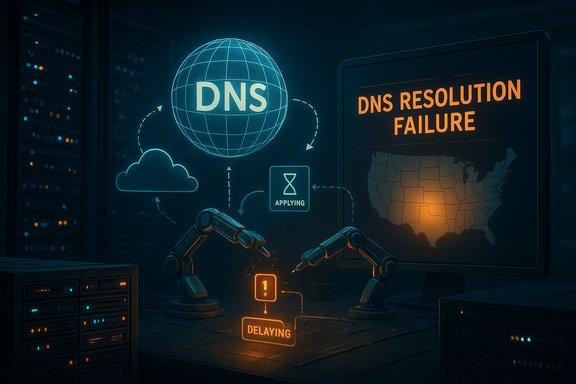
At a technical level the incident boiled down to a latent race condition inside DynamoDB’s DNS management automation. Two automated components that manage DNS state — a planning component that generates DNS plans and enactors that apply those plans — raced under unusual timing conditions. One enactor experienced delays and retried updates while another applied a newer plan; the interaction produced an incorrect empty DNS record for the regional endpoint dynamodb.us‑east‑1.amazonaws.com. Because this hostname is widely used by AWS services and customer SDKs, the incorrect record effectively made the database unreachable even when its underlying compute and storage were intact. AWS’s own post‑incident communication describes this sequence in detail. Independent technical summaries and reporting reached the same conclusion: this was not a network cut or malicious attack, but a subtle orchestration bug in an automated control plane. Journalists and engineering outlets emphasised that DNS in cloud platforms is more than “the internet’s phonebook” — it is integral to service discovery, SDK behavior, authorization handshakes and internal health checks. When that foundation wobbles, many otherwise healthy layers above it become non‑functional.Why a single DNS mis‑state causes broad, visible outages
DynamoDB is a high‑throughput managed NoSQL service used for session tokens, feature flags, small stores of state and other high‑frequency operations. Many distributed systems treat it as a cheap, always‑available primitive; when that primitive is unreachable at name‑resolution time, authentication flows stall, control‑plane subsystems (like EC2 instance launch orchestration) can fail to progress, and monitoring/health‑check mechanisms return anomalous states that cascade across the platform.Two amplification effects made the outage worse:
- Retry storms: client SDKs and services designed to be robust under transient network faults can generate massive retries when they fail to connect, amplifying load on already strained subsystems.
- Backlog and throttling: to prevent uncontrolled load, clouds throttle operations and drain work queues — a safe approach but one that extends the perceived outage as asynchronous work is processed.
Who and what were affected
The outage was concentrated in one region but had global reach. Public outage trackers logged millions of user reports in hours; major consumer and business apps experienced interruptions ranging from login failures to full service unavailability. CyberCube’s modelling—used by insurers and re/insurance analysts—estimated the disruption affected over 2,000 large organisations and roughly 70,000 organisations in total, yielding an insured‑loss range of about US$38 million to US$581 million depending on scenario assumptions. These industry figures have been widely cited in insurance and trade press since the event. Examples reported across the media and operators’ status pages included social apps, gaming backends, fintech endpoints, e‑commerce functions and even some government portals. The breadth of visible disruption illustrated a practical truth: the internet’s user‑facing availability is often controlled by a surprisingly small set of internal cloud primitives.Market structure and the central paradox of hyperscalers
Hyperscalers deliver unprecedented scale, feature velocity and a pay‑as‑you‑go model that lets startups and enterprises move fast. But that same scale concentrates dependencies. Market analyses for 2024–2025 show the “big three” — Amazon Web Services, Microsoft Azure and Google Cloud — together control a dominant share of the global public cloud infrastructure market, with AWS holding roughly a third, Microsoft the mid‑twenties range and Google in the low‑teens (numbers vary slightly by quarter and analyst methodology). Those shares explain why a region‑level AWS control‑plane fault can have outsized global effects. Meredith Whittaker, president of Signal, framed the problem bluntly: these platforms are not merely “renting a server” — they are leasing access to planet‑spanning, capital‑intensive systems that few organisations could replicate. Her public thread made the point that even privacy‑focused providers like Signal rely on hyperscalers for global scale precisely because building comparable infrastructure is prohibitively expensive and talent‑intensive. That tension—convenience versus concentration—lies at the heart of the debate that followed the outage.The Azure follow‑on: another control‑plane lesson
Less than two weeks after the AWS event, Microsoft suffered its own high‑visibility outage linked to Azure Front Door and an inadvertent configuration change that affected routing, DNS and authentication for Microsoft services — including Microsoft 365, Xbox/Xbox Live and Minecraft sign‑ins. Microsoft’s mitigation involved freezing further Azure Front Door changes and deploying a rollback to a last‑known‑good configuration while rerouting traffic through healthy nodes. The proximate triggers differ from AWS’s DNS race condition, but the operational pattern is similar: control‑plane mistakes and configuration errors can quickly become user‑facing outages at scale. Those two incidents, in close succession, forced a wider audience to confront a simple truth: the cloud’s convenience has a cost. The tools that make global scale trivial for developers — managed identity, global edge routing, and platform DNS — are the same tools whose failure can be systemic.Strengths exposed by the incident
- Rapid detection and staged mitigation: hyperscalers run mature incident response playbooks and large SRE teams; the AWS and Microsoft mitigations show the operational muscle these firms bring to bear when things go wrong. Recovery was staged and observable, with progressive restoration rather than brittle “all or nothing” rollbacks.
- Transparency in post‑incident detail: AWS published a technical post‑incident analysis describing the root cause and the automation sequence that triggered the empty DNS record. That level of technical disclosure—especially about control‑plane internals—is valuable for customers, auditors and competitors to understand failure modes.
- Scale and economics remain compelling: hyperscalers still provide capabilities (global edge, managed security, specialized hardware for AI) that no single enterprise can realistically reproduce, which explains the continued adoption despite systemic risks.
Risks and unresolved problems
- Control‑plane single points of failure: DNS, global routing fabrics and managed identity services are part of the critical path for many applications. When they fail, redundancy at the application layer may not help if the management plane itself is impaired.
- Default region coupling: many services default to large regions (like us‑east‑1) for feature completeness; that centrality increases systemic risk and creates concentration hotspots.
- Economic and contractual misalignment: SLAs typically offer service credits that rarely cover consequential business losses. Even where compensatory mechanisms exist, indirect customers — those who consume services through resellers and SaaS vendors — may have limited recourse. This creates a mismatch between economic exposure and contractual protection.
- Insurance uncertainty: preliminary insured‑loss ranges are wide, and while insurers model such events, aggregated exposure to cloud outages introduces correlated risk that could stress cyber insurance portfolios if incidents become more frequent or severe. CyberCube’s initial range (US$38M–US$581M) reflects model uncertainty and tail risk.
Practical lessons for Windows admins, IT leaders and platform engineers
Building complete, continent‑spanning, hyperscaler‑free infrastructure is unrealistic for most organisations. But there are concrete, pragmatic moves teams can take now to reduce the blast radius when control‑plane failures occur:- Map dependencies.
- Audit every service and process that uses a hyperscaler primitive (DynamoDB, managed identity, Azure Front Door, certificate issuance) and identify single points of failure.
- Harden DNS and service discovery.
- Don't assume a single DNS lookup equals reliability: add local caching strategies, resilient resolver configurations, and health‑checked fallback endpoints where possible.
- Design graceful degradation.
- Ensure login paths, payment fallbacks and customer‑facing features degrade to a read‑only or cached mode that preserves core user tasks when backend primitives are unavailable.
- Implement staged failover and realistic drills.
- Automate failovers that are compatibility‑tested, and rehearse scenarios that affect control and management planes — not just compute outages.
- Negotiate practical SLOs and portability clauses.
- Put contractual portability and runbook commitments into procurement contracts and insist on transparent post‑incident reports as part of SLA governance.
- Consider incremental multicloud for critical control paths.
- True multicloud across every workload is expensive and complex; instead, target multicloud or multi‑region redundancy for the most critical control‑plane functions (e.g., identity, session stores).
- Plan for operational transparency with insurers.
- Make loss scenarios computable for insurers and ensure policies reflect correlated cloud exposure; coordinate with risk managers and legal teams to make claims processes clearer.
Tactical options: architectures and patterns that help
- Use circuit breakers and bulkheading to limit retry amplification.
- Cache session tokens and non‑sensitive configuration operatively so short DNS blips do not immediately lock out users.
- Introduce principle of least dependency—avoid putting non‑essential features on single cloud primitives.
- Implement canaryed control‑plane changes and delay‑stagger rollouts across distinct management domains.
- For critical identity paths, consider fallback token validation and offline grace windows where compliance permits.
Governance, regulation and the long view
The October incidents changed the conversation: resilience is no longer merely a technical attribute but a cross‑disciplinary governance issue. Boards, regulators and procurement teams now face hard questions about strategic reliance on a small number of hyperscalers. Market regulators in some countries are already assessing whether hyperscaler concentration constitutes a systemic risk warranting special oversight.Policy options include mandating stronger transparency, encouraging interoperability standards for control planes, and supporting sovereign or regional alternatives for critical public‑sector workloads. But policy alone will not deliver technical resilience; it must be combined with standards, contractual incentives and practical engineering requirements.
Final analysis and recommended next steps
The two high‑profile outages in October were different in cause but identical in lesson: control‑plane failures scale extraordinarily fast in a world where distributed systems rely on a handful of shared, global primitives. The good news is that many mitigations are practical and testable:- Start with dependency maps and prioritize the most business‑critical flows.
- Treat DNS and control planes as first‑class failure modes in incident planning.
- Negotiate SLAs and portability clauses that reflect real economic exposure.
- Run realistic failure drills that include management‑plane outages, not just compute failures.
This episode should be a clear call to action: resilience is a design choice, and in the face of concentrated infrastructure, choosing to invest in resilient architecture is a strategic decision every organisation must make.
Source: Trinidad and Tobago Newsday When the cloud bursts - Trinidad and Tobago Newsday
