

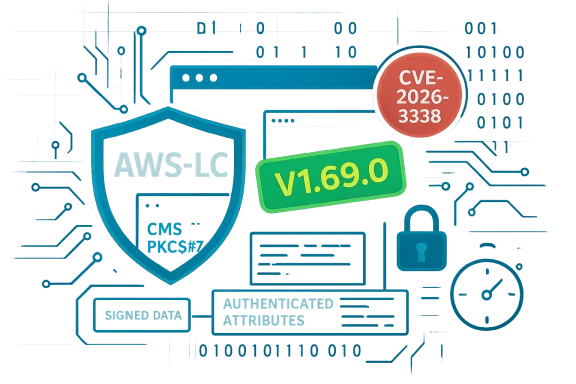
AWS‑LC, Amazon’s open‑source cryptographic library, received an emergency set of patches in early March 2026 after researchers disclosed a pair of PKCS#7/CMS verification flaws and an AES‑CCM timing issue. One of those defects, tracked as CVE‑2026‑3338, is a signature validation bypass in the library’s PKCS7_verify() code path that can allow specially crafted PKCS#7 objects to be accepted even when their signatures or authenticated attributes are not properly validated. The project release that closes these issues is aws‑lc v1.69.0; all consumers — direct or indirect — who use affected versions should treat this as a high‑urgency supply‑chain patch and plan rebuilds, redeployments, and forensics where appropriate.
PKCS#7 (the original name) and CMS (Cryptographic Message Syntax) are widely used standards for encapsulating signed and/or encrypted data. They appear in S/MIME email, software/package signing formats that embed CMS blobs, certificate provisioning flows, and a variety of archival and message formats. A failure inside a library’s PKCS7_verify() routine can therefore affect a broad surface: mail clients, update systems, enrollI/CD artifact validators — anywhere a PKCS#7 signature or a certificate chain is trusted by the caller.
Amazon’s bulletin and the public advisories group three related issues under a single disclosure: two PKCS7 verification bypasses (CVE‑2026‑3336 and CVE‑2026‑3338) and an AES‑CCM timing side channel (CVE‑2026‑3337). The maintainers released those fixes in AWS‑LC v1.69.0 and updated wrapped packages (aws‑lc‑sys, FIPS packages) to match. The practical remediation is to update to the patched releases and rebuild any statically linked artifacts.
Strengths of the response:
Recommended detection steps:
Source: MSRC Security Update Guide - Microsoft Security Response Center
 Background / Overview
PKCS#7 (the original name) and CMS (Cryptographic Message Syntax) are widely used standards for encapsulating signed and/or encrypted data. They appear in S/MIME email, software/package signing formats that embed CMS blobs, certificate provisioning flows, and a variety of archival and message formats. A failure inside a library’s PKCS7_verify() routine can therefore affect a broad surface: mail clients, update systems, enrollI/CD artifact validators — anywhere a PKCS#7 signature or a certificate chain is trusted by the caller.Amazon’s bulletin and the public advisories group three related issues under a single disclosure: two PKCS7 verification bypasses (CVE‑2026‑3336 and CVE‑2026‑3338) and an AES‑CCM timing side channel (CVE‑2026‑3337). The maintainers released those fixes in AWS‑LC v1.69.0 and updated wrapped packages (aws‑lc‑sys, FIPS packages) to match. The practical remediation is to update to the patched releases and rebuild any statically linked artifacts.
What CVE‑2026‑3338 is — technical summary
The observable failure mode
CVE‑2026‑3338 is described in public vulnerability records as an improper signature validation in PKCS7_verify() that is triggered for PKCS#7 objects using authenticated attributes. In short: under particular combinations of signer information and authenticated attributes, PKCS7_verify() may treat a signer’s signature as valid even when the actual cryptographic signature verification or the authenticated‑attribute semantics have not been properly enforced. This allows an unauthenticated attacker who can supply crafted PKCS#7 objects to create payloads that will be accepted by vulnerable consumers.How PKCS#7 verification normally works (brief)
A robust PKCS#7/CMS verification routine typically does the following for each SignerInfo:- Parse the signerInfo structure and extract the signature algorithm and signature bytes.
- Determine the data that was signed (either the raw content or the signedAttributes canonicalization).
- Verify the cryptographic signature over that data using the signer's public key.
- Validate the signer’s certificate chain — ensure the signer's certificateanchor, and check revocation as policy requires.
- Ensure authenticated attributes (if present) are processed per spec: the signedAttributes are themselves the thing that gets signed, and their presence/format must influence canonicalization and verification.
Relationship to CVE‑2026‑3336
CVE‑2026‑3336 — the companion PKCS7 chain validation bypass — is a different but related logic flaw in PKCS7_verify() that reportedly caused certificate chain validation to be bypassed for all but the final signer in multi‑signer objects; that is, the library sometimes verified only the final signer’s chain and inadvertently skipped others. CVE‑2026‑3338 complements that by focusing on the signature verification step itself (particularly when authenticated attributes are present). Together they form a class of PKCS#7/CMS parsing and verification mistakes that result in silent success — the API returns “verified” while some signer checks were not actually performed.Where this matters: practical attack surface
The abstract cryptography failure is only as dangerous as the contexts that rely on PKCS#7 semantics. The most likely and immediate impact vectors include:- S/MIME and document signing: malformed signed messages or attachments that mail clients trust as valid.
- Package and update verification: signed update artifacts that appear to verify correctly, potentially allowing malicious updates to be accepted.
- Certificate enrollment & provisioning flows (SCEP and similar): attacker-supplied PKCS#7 blobs used during automated device enrollment that could install attacker‑controlled credentials or CAs.
- Artifact repositories and CI/CD pipelines: build artifacts or provenance metadata that include CMS blobs and are validated by tooling that links against AWS‑LC.
- Appliances and embedded systems that parse PKCS#7 for configuration or trust anchors: limited‑margin systems where static linking is common and updates are slow.
What the maintainers and AWS have done
Amazon and the aws‑lc maintainers released a point update, v1.69.0, that patches the PKCS7 verification logic and addresses the timing side‑channel in AES‑CCM verification. The release notes and security bulletin explicitly call out fixes to ensure all signer certificate chains are verified and to correct signature/authenticated‑attribute handling; wrapped packages (aws‑lc‑sys, FIPS) were released alongside the main library to aid downstream consumers. Public vulnerability trackers and advisories now list CVE‑2026‑3336, CVE‑2026‑3337, and CVE‑2026‑3338 together.Strengths of the response:
- Coordinated disclpatched release make remediation tractable for downstream maintainers.
- Matching wrapped and FIPS artifacts reduce friction for language ecosystems and regulated customers.
- Advisory credits outside researchers and flags rebuild requirements for statically linked binaries — a practical and Limitations / remaining concerns:
- There is no simple configuration workaround; the only reliable mitigation is applying the patch and rebuilding or replries. That makes operational urgency high for teams with static linking, embedded devices, or slow patch pipelines.
- Supply‑chain blindness: many vendors vendor‑ship or statically link crypto libraries; without SBOMs these vulnerable instances can persist for months.
Detection and forensic guidance
Detecting exploitation of this class of bug is inherently challenging because the library may return a successful verification result while skipping internal checks. That makes pd instrumented verification crucial.Recommended detection steps:
- Instrument verification paths to log per‑signer verification outcomes and the presence/absence of authenticated attributes. Do not rely solely on a single boolean “verified” flag.
- Add canonical CMS/PKCS#7 test vectors that include:
- Single and multi‑signer payloads.
- Variations with and withoututes.
- Detached signatures and embedded certificate chains with missing intermediates.
- Fuzz PKCS7_verify() inputs and run negative tests that assert failure on malformed or inconsistent signer blocks.
- For artifact repositories and distribution systems: re‑verify signed artifacts that were validated during the window when vulnerable AWS‑LC versions were in use.
- Isolate affected systems that perform PKCS#7 verification on untrusted inputs.
- Capture relevant signed objects, logs, and network captures for offline analysis.
- Re‑verify all artifacts accepted during the exposure window using the patched verification logic.
- If you find artifacts been accepted, rotate or revoke signing keys and reissue certificates where feasible.
- Notify partners and customers if externally distributed signed artifacts may have been impacted.
Remediation checklist — immediate and prioritized
- Inventory: find everywhere AWS‑LC appears in your environment (binaries, containers, language wrappers, vendor firmware).manifests, container images, package locks, and linked native modules. Don’t forget language wrappers (Rust’s aws‑lc‑sys, native Python wheels, Java native agents).
- Patch the library: upgrade to aws‑lc v1.69.0 (and matching aws‑lc‑sys, FIPS packages) wherever AWS‑LC is used directly. Rebuild affected consumers.
- Rebuild statically linked artifacts: if applications were statically linked with vulnerable versions, replacing system packages ld and redeploy.
- Validate and test: run unit and integration tests that exercise the preS#7 permutations. Add tests for multi‑signer payloads and authenticated attributes.
- Instrument and log per‑signer verification outcomes to improve post‑incident forensics.
- Contact vendors: if vendor appliances or firmware may include AWS‑LC, request proof of patching or a fixed release schedule.
- For any sated during the vulnerable period, re‑verify with patched logic and consider rolling or revoking signing keys if suspicious acceptance patterns are found.
Risk assessment: who should panic (and who should act quickly)
High priority:- Organizations that validate code, packages, or updates with CMS/PKCS#7 semantics.
- Mail and document processing systems that consume S/MIME signatures.
- Certificate enrollment and device provisioning infrastructures that accept PKCS#7 blobs from untrusted parties.
- CI/CD pipelines and artifact repositories that call into native verification code or vendor tools using AWS‑LC.
- Systems that use AWS‑LC only for TLS (risk is lower if PKCS#7/CMS verification isn’t used, but be cautious: libraries expose multiple APIs and bundling can be non‑obvious.
- Applications that never perform any CMS/PKCS#7 processing and use AWS‑LC only indirectly in non‑verification code paths — though SBOM discipline is still important.
Why these bugs happen (short, technical explainer)
CMS/PKCS#7 verification combines parsing complexity with subtle cryptographic semantics:- Authenticated attributes are the data that is signed when they are present; incorrect canonicalization or mixing of “signed content” vs “raw content” can make a verifier check the wrong data.
- Multi‑signer objects introduce state‑machine complexity — loops that process signers must maintain per‑signer context (cert chains, revocation, attribute presence). Off‑by‑one errors or incorrect early returns can result in skipping checks for some signers.
- Legacy interpretation differences across implementations mean that extreme test cases (combinations of authenticated attributes, embedded cert sets, missing intermediates) are often not exercised in standard unit tests.
Critical analysis — strengths, shortcomings, and future hardening
Strengths- AWS and the maintainers produced a targeted point release and updated wrapped packages, which reduces friction for downstream consumers and FIPS customers. This is the right operational response for a library fix.
- The advisory credits external res multiple CVE identifiers that clarify the scope of the disclosure. That transparency aids downstream triage and vendor coordination.
- No workaround: because the fix requires code changes and rebuiat rely on static linking or embed the library into firmware face operationally difficult remediation timelines.
- Supply‑chain inertia: vendors who ship device images, SDKs, or appliances that include older AWS‑LC versions may not be quickly. Without SBOMs and an aggressive rebuild policy, vulnerable artifacts will persist.
- Detection blind spots: because the API surface returns a boolean, applications without per‑signer logging will be blind to acceptance of malformed PKCS#7 gging and verification hygiene is non‑trivial in large legacy systems.
- Treat cryptographic libraries as high‑impact dependencies in your CI/CD lifecycle: automated rebuilds and staged rollouts should be standard when cryptography components change.
- Add comprehensive PKCS#7/CMS test harnesses that include negative test vectors and malformed inputs.
- Maintain SBOMs for images and binarieutomatic when critical crypto CVEs are published.
If you can’t patch immediately — pragmatic mitigations
There is no perfect stopgap for CVE‑2026‑3338, but if immediate patching is impossible:- Isolate and restrict the services that accept PKCS#7 objects from untrusted sources. Add rate limits and stricter ingress controls to reduce exposure windows.
- Introduce secondary verification where practical: for critical artifacts, validate signatures using a hardened secondary verifier (even if that adds latency).
- Increase logging and monitoring for unexpected signer sets, unusual authenticated attribute patterns, or otherwise anomalous PKCS#7 messages.
- For managed services: verify with your provider whether they use an affected version internally and whether they will update; do not assume all managed servist because they are managed.
Final takeaways — what every WindowsForum reader should do this week
- Inventory now. Use SBOMs, package manifests, image scans, and binary inspections to find any AWS‑LC usage in your environment. Focus on signing/enrollment flows, mail processing, package validevices.
- Patch and rebuild. Upgrade to aws‑lc v1.69.0 and matching wrapped and FIPS packages, then rebuild statically linked apps and container images. Don’t rely on system package updates alone if you ship static binaries.
- Improve test coverage and logging. Add negative PKCS#7 test vectors and per‑signer verification logging to critical verification paths.
- Communicate with vendors. Ask appliance and firmware vendors for CVE mapping and fixed release timelines if their products might include AWS‑LC.
- Assume worst for any signed artifact validated during the vulnerable window: re‑verify with the patched library and consider kedetect anomalous acceptance.
Source: MSRC Security Update Guide - Microsoft Security Response Center
