

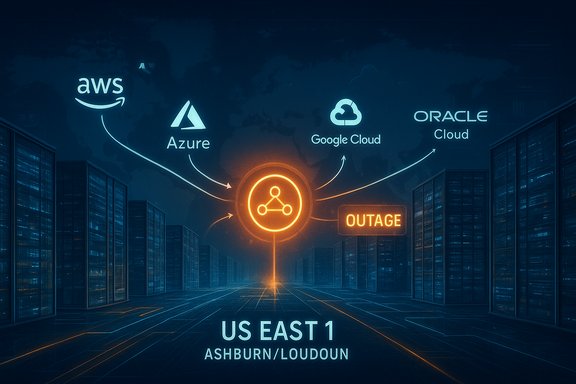
Monday’s Amazon Web Services outage — a region‑level failure in the US‑EAST‑1 cluster that cascaded into a 15‑hour disruption for hundreds of consumer apps, enterprise services and even parts of Amazon itself — was not an isolated prank of distributed systems; it was a public demonstration of how the modern internet and critical services are concentrated in a handful of commercial data centres and proprietary control planes, and of how brittle that concentration can be when a core control function fails.
Northern Virginia’s data centre corridor — the so‑called “Data Center Alley” clustered around Ashburn and Loudoun County — has long been one of the densest collections of web infrastructure on the planet. Over time hyperscale cloud providers turned those facilities into global nerves: they co‑locate compute, networking and control‑plane services that thousands of apps assume will always exist and always respond. That architectural reality is why a single region’s internal DNS and control‑plane failures can produce outages felt across continents.
The October incident exposed three linked facts that every IT leader should accept as part of the new normal:
But several widely repeated claims require careful qualification:
Key operational measures:
Policy levers to consider:
The right response mixes immediate engineering changes — multi‑region architectures, rigorous failover drills, portable deployment practices — with strategic policy: invest in interoperability, fund federated public infrastructure for critical functions, and set procurement rules that treat resilience and portability as primary dimensions of security. Only by combining operational discipline with sober, long‑term infrastructure planning can we transform acute warning shots into durable improvements in how the internet and public services are built and governed.
Source: The Guardian The Guardian view on the cloud crash: an outage that showed who really runs the internet | Editorial
 Background
Northern Virginia’s data centre corridor — the so‑called “Data Center Alley” clustered around Ashburn and Loudoun County — has long been one of the densest collections of web infrastructure on the planet. Over time hyperscale cloud providers turned those facilities into global nerves: they co‑locate compute, networking and control‑plane services that thousands of apps assume will always exist and always respond. That architectural reality is why a single region’s internal DNS and control‑plane failures can produce outages felt across continents.The October incident exposed three linked facts that every IT leader should accept as part of the new normal:
- Cloud concentration. The biggest hyperscalers control a majority share of global cloud infrastructure spending, which amplifies the blast radius when one of them has a major outage.
- Control‑plane fragility. Failures in orchestration, monitoring or DNS — not only physical power or fibre cuts — can cascade into systemic failures.
- Policy and sovereignty implications. When governments, schools and critical services run on foreign‑owned platforms, outages become geopolitical as well as technical problems.
What happened (technical overview)
Timeline and technical fault
- The incident began in the pre‑dawn hours local (U.S. East) time and unfolded as elevated API error rates and DNS resolution failures affecting a core managed database API in the US‑EAST‑1 region.
- AWS status updates described the proximate symptom as DNS resolution problems for a regional DynamoDB endpoint and an “underlying internal subsystem” used to monitor the health of network load balancers.
- Engineers moved through the typical incident cycle — identify, mitigate, observe recovery — and reported mitigations in stages. Operational control‑plane functions were restored ahead of full service catch‑up; some services continued to process backlogs for hours thereafter.
- Widely used consumer and enterprise apps (social platforms, games, payment apps, educational platforms and parts of retail infrastructure) experienced authentication failures, timeouts and inability to access stored state while the control plane was degraded.
Why a DNS/control‑plane failure is so damaging
DNS and region‑level control APIs are not just auxiliary services; they are the internet’s address book and traffic director. Modern cloud applications rely on:- Dynamic provisioning (create an instance / server, register it with load balancers)
- Managed databases with regional endpoints
- Identity and token issuance via control‑plane APIs
The market context: why the outage reverberated
The cloud market is dominated by a small set of hyperscalers whose combined share of global cloud infrastructure spending is substantial. That concentration delivers undeniable benefits — economies of scale, rapid innovation and consumption‑based pricing — but it also creates systemic risk.- The “big three” cloud providers — the largest hyperscalers — account for a dominant share of worldwide infrastructure spend, meaning a significant portion of the web relies indirectly on a single vendor’s regional health and control plane.
- For many software vendors and enterprises, using managed platform features (fully managed databases, global identity, proprietary developer tooling) accelerates delivery but increases vendor lock‑in. Migration costs grow, and multi‑provider fallback becomes technically and economically expensive.
Sovereignty, resilience and the EuroStack debate
The political reading of this outage is straightforward: the digital backbone underlying critical public services is increasingly operated on platforms that national governments do not own or control. That raises questions of digital sovereignty and strategic resilience.- Some policy thinkers have argued that cloud computing today plays the strategic role once held by national power grids. If that analogy is accepted, the policy options include national or regional sovereign clouds, federated architectures, and regulatory measures to reduce dependency.
- There are active programs and policy proposals that respond to that risk by promoting a “third way”: federated, open, interoperable stacks that allow public administrations and industry to avoid complete dependence on foreign proprietary platforms.
- European initiatives that promote federated data governance and sovereign infrastructure argue for a layered, cooperative approach to reconstructing a public digital stack that supports public services and industrial strategy.
Where the Guardian’s editorial is right — and where claims need caution
The recent editorial headline that the outage “showed who really runs the internet” captures the fundamental political and infrastructural truth: private hyperscalers run major arteries of global digital commerce, communications and public services.But several widely repeated claims require careful qualification:
- Statements that a single region handles “70% of the world’s internet traffic” are often repeated but imprecise. Northern Virginia (the Dulles/Ashburn corridor) is a major hub with enormous peering density and many critical facilities, yet assigning a precise global percentage to a single region is inherently hard and often based on inconsistent measurements. Treat such precise numeric claims as approximations rather than definitive metrics.
- Calls for instant reshoring of cloud services to sovereign datacentres underestimate the engineering and capital intensity of cloud infrastructure. Sovereign capability must be realistic about the cost of scale, the pace of innovation and the realities of global supply chains for chips, networking gear and advanced cooling and power systems.
- The assertion that every country should own its stack is a policy choice, not an immediate technical necessity. What is required — and more feasible in many cases — is federated resilience: guaranteed escape hatches, multi‑region failover, cross‑vendor redundancy and legally enforceable SLAs for services underpinning critical functions.
The practical reality for IT teams: resilience without going all sovereign
For most organisations — especially small and medium enterprises — building a private sovereign cloud is neither practical nor necessary. There are concrete steps that materially reduce risk and improve resilience.Key operational measures:
- Design for multi‑region redundancy within the same provider to reduce single‑region blast radius.
- Invest in multi‑cloud or multi‑provider patterns for mission‑critical functions (identity, payments, core APIs), acknowledging the added cost and overhead.
- Use robust caching and eventual‑consistency strategies so that transient control‑plane errors degrade gracefully rather than fail catastrophically.
- Implement circuit breakers and delay/load‑shedding strategies to avoid cascading retries that make recovery slower.
- Practice runbooks and regular chaos testing to verify failover procedures and the limits of your recovery time objectives (RTOs).
- Multi‑region active/active or active/passive deployments for core services.
- Local, durable caches and read‑through caches for authentication and user session state.
- Portable infrastructure as code and CI/CD pipelines that allow migration of workloads between providers with tested playbooks.
- De‑coupled, service‑oriented systems that can operate in degraded mode; avoid single points where the app cannot render any useful output without the managed database or token server.
For public policy: options that balance sovereignty and efficiency
Governments and public agencies should treat the outage as a catalyst to revisit procurement, resilience mandates and strategic investment.Policy levers to consider:
- Establish resilience minimums for vendors used by critical infrastructure: mandatory multi‑region failover and audited disaster recovery plans.
- Fund federated public digital infrastructure for core civic services (identity, registries, edu and public health) that mandates portability and open standards.
- Build public procurement frameworks that reward portability, open APIs, and vendor cooperation for cross‑jurisdictional failover.
- Support edge and regional cloud investments that reduce single‑point concentration of control plane functions.
- Invest in federated compute and data commons for non‑commodity workloads (public sector data, essential services) where sovereignty and legal jurisdiction matter.
- Encourage domestic and regional industry partnerships to create viable alternatives for secure, regulated workloads — with clear economic and innovation incentives.
- Ensure that sovereign or regional cloud projects are built to interoperate rather than replicate the proprietary lock‑in patterns they aim to escape.
Economic and strategic trade‑offs
There is no free lunch. Building sovereignty involves substantial public spending and a long runway. The hyperscalers offer scale, global networking and an ecosystem of managed services that are difficult to replicate quickly.- Cost: multiple providers and multi‑region deployments increase operational expense and complexity.
- Talent: managing hybrid, multi‑cloud setups requires skilled architects and platform engineers.
- Innovation: hyperscalers frequently lead in services that accelerate product development (serverless, managed AI model infra). Recreating those services in sovereign stacks risks slower product development unless public and private players co‑invest aggressively.
Vendor responses and market consequences
Expect short‑term vendor reaction and longer‑term strategic shifts:- Hyperscalers will emphasise improved turbomachinery of operational tooling, transparency of incidents and expanded cross‑region guarantees — and they will pitch more managed resilience features.
- Customers will accelerate adoption of multi‑cloud management platforms and third‑party disaster‑recovery services designed to decrease failover time.
- Market newcomers and specialised “neoclouds” focusing on GPU/AI workloads or sovereign hosting may find fresh demand from risk‑sensitive customers.
Concrete checklist for organisations (practical, prioritized)
- Inventory dependencies: identify which external managed services are single‑points of failure.
- Define tiering: classify services by business criticality and apply stricter resilience for Tier‑1 functions.
- Test failover: schedule regular, automated drills for cross‑region and cross‑cloud failovers.
- Prepare degraded mode UX: ensure user experience degrades predictably (read‑only mode, cached content) rather than failing completely.
- Negotiate SLAs: ensure contracts for critical workloads include meaningful performance and recovery commitments, with technical verification rights.
- Plan for post‑incident reconciliation: create backfill and reconciliation procedures for transactions lost during outage windows.
Long game: what governments should do next
- Draft resilience‑first procurement rules for national systems and public services.
- Sponsor federated public infrastructure projects that focus on interoperability and portability rather than purely national ownership.
- Invest in skills and standards to make multi‑cloud resilience practical for public bodies.
- Consider targeted investments in regional compute for sensitive workloads — identity systems, national registries, electoral infrastructure — where legal jurisdiction and continuity are non‑negotiable.
Risks to watch
- Over‑reaction risk: states or enterprises may attempt to retreat into full self‑sufficiency, creating expensive, underutilised silos that stifle innovation.
- Under‑investment risk: doing nothing leaves critical systems exposed to repeating incidents and the attendant social and economic costs.
- Fragmentation risk: poorly coordinated “national cloud” efforts that don’t prioritise interoperability will simply reproduce vendor lock‑in under new labels.
Conclusion
Monday’s outage was both a technical incident and a geopolitical symptom. It demonstrated how single‑region control‑plane failures ripple through dependent services and how modern society’s reliance on managed cloud primitives increases systemic exposure to outages. The choice for governments and enterprises is not between total dependence and isolation; it is between passive risk acceptance and active resilience design.The right response mixes immediate engineering changes — multi‑region architectures, rigorous failover drills, portable deployment practices — with strategic policy: invest in interoperability, fund federated public infrastructure for critical functions, and set procurement rules that treat resilience and portability as primary dimensions of security. Only by combining operational discipline with sober, long‑term infrastructure planning can we transform acute warning shots into durable improvements in how the internet and public services are built and governed.
Source: The Guardian The Guardian view on the cloud crash: an outage that showed who really runs the internet | Editorial
