

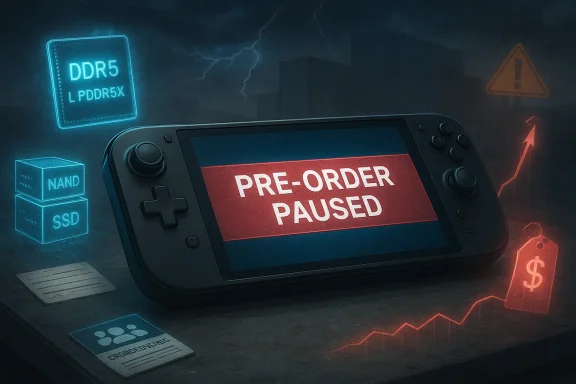
The cancellation of Ayaneo’s Next 2 pre-order window is a stark reminder that the current memory and storage crisis is no longer an abstract industry talking point. What began as an ambitious, ultra-premium Windows 11 handheld project has run headfirst into component pricing that can overwhelm even niche hardware makers. In Ayaneo’s case, the company now says selling the flagship model is “no longer sustainable,” with the highest configuration reportedly pushed to around $8,000 before the pause. (tomshardware.com)
Ayaneo has spent years carving out a distinct identity in the Windows handheld market by doing what bigger OEMs often avoid: chasing highly specialized form factors, extravagant specs, and premium materials even when the market is tiny. The original Ayaneo Next planted that flag in 2022, while the newer Next II / Next 2 has been positioned as the company’s futuristic follow-up, with large grips, premium controls, and a “flagship” identity built around performance rather than affordability. (store.ayaneo.com)
The Next 2 is powered by AMD’s Ryzen AI Max family, also known under the Strix Halo umbrella, which is not a conventional handheld chip. It is a much larger, more ambitious platform than the familiar Ryzen Z-series processors used in mainstream handhelds, and it can be paired with as much as 128GB of unified LPDDR5X memory. That kind of configuration is impressive on paper, but it is also exactly the sort of system that becomes brutally sensitive to supply-chain shocks. (ayaneo.com)
Ayaneo originally took the Next 2 to Indiegogo with a starting price of $1,799 for the 32GB/1TB model and a top-end price of $4,299 for the fully loaded version. That alone placed the handheld far above mass-market rivals such as the Steam Deck, ROG Ally family, and Legion Go lineup. Yet Ayaneo was aiming for a different audience entirely: buyers who want the most possible power in a Windows portable, not the best price-to-performance ratio. (tomshardware.com)
That strategy has always carried risk, because crowdfunding and small-volume hardware launches depend on a delicate balance between estimated bill of materials and final retail price. When memory and storage markets tighten, low-volume makers have the least room to absorb shocks. Ayaneo’s own wording makes clear that it expected some margin pressure, but not a situation where the cost base would climb to roughly twice the planned selling price.
That matters because the Next 2 is not built around commodity parts in the way a typical handheld is. Its use of high-capacity unified memory is central to the product’s pitch, and that memory is exactly what has been punished by the global shortage. In practical terms, Ayaneo is being hit by the same supply issues that are starting to spill into PCs, laptops, mini PCs, and even enterprise systems. (tomshardware.com)
The memory issue is especially painful because unified memory is not a feature Ayaneo can simply remove without compromising the product identity. The Strix Halo platform is built to benefit from large memory pools, and the higher-end configurations are effectively selling that capability as part of the premium promise. If memory prices rise, the device’s value proposition does not degrade gracefully; it collapses quickly. That is the core business problem here. (tomshardware.com)
That same reporting also highlighted a key structural issue: demand from AI infrastructure is consuming a huge share of memory supply, especially for server-grade and high-bandwidth configurations. The result is a supply squeeze that is rippling outward into products that were never meant to compete directly with data-center hardware. In other words, the AI boom is now taxing consumer hardware economics. (tomshardware.com)
That is why the current crisis is so disruptive for the handheld segment. These devices rely on a tight integration of processor, memory, thermals, and battery capacity. If one of those pillars becomes much more expensive, the entire product stack becomes harder to price without losing money or sacrificing features. That is a much bigger problem for niche brands than for giant PC OEMs. (tomshardware.com)
The crucial reassurance for current backers is that existing pre-orders will still be honored. That reduces the risk of the pause being interpreted as a full cancellation, and it suggests Ayaneo is trying to preserve trust with the crowdfunding audience that supports its more experimental products. For a brand that depends heavily on enthusiast goodwill, that distinction is vital.
Ayaneo’s own corporate messaging reinforces that interpretation. In January and February 2026, the company repeatedly acknowledged that the global storage market was causing serious planning problems and that some products would need pricing adjustments or even removal from sale. The Next 2 appears to be the most visible casualty of that wider stress.
That design ambition is part of the appeal, but it also narrows the buyer pool dramatically. Once a handheld crosses into four-figure territory, the market stops behaving like consumer electronics and starts behaving like enthusiast desktop hardware. Customers begin comparing it with gaming laptops, mini PCs, and even compact workstations rather than with other handhelds. (tomshardware.com)
This is why the configuration with 128GB of memory is especially vulnerable. It is a halo product inside a halo product, and its audience is tiny even under ideal conditions. Once pricing crosses into the $8,000 neighborhood, the unit becomes less a commercial device and more a statement piece. That may be fine for a prototype, but not for a sustainable retail line. (tomshardware.com)
That leaves companies like Ayaneo in a difficult position. To stand out, they need to push specs, size, and differentiation. But the more they push into the premium edge, the more vulnerable they become to volatile bill-of-materials costs. The market rewards innovation, but it punishes overreach when supply chains become unstable. (tomshardware.com)
This is especially relevant for brands that can rely on smaller memory footprints, standardized parts, or simpler cooling systems. Those products may not be as flashy, but they are less exposed to the exact cost spiral now hurting Ayaneo. In a market where buyers can already choose between Windows, Linux-based, and console-like handheld experiences, reliability of supply could become a competitive advantage. (tomshardware.com)
The reason is simple: if memory costs keep rising, every category that depends heavily on DRAM gets squeezed. Laptops, mini PCs, workstations, and even prebuilt desktops all become harder to price competitively. Ayaneo’s predicament is merely the most extreme and visible version of a broader phenomenon. (tomshardware.com)
The lesson for enterprise buyers is even simpler: locking procurement decisions too early in a volatile market can be dangerous. Vendors may not be able to hold pricing, and some may respond by changing configurations, delaying launches, or stripping included memory entirely. The supply chain is dictating product strategy again. (tomshardware.com)
If the device does return, Ayaneo may need to do one or more of the following: simplify the SKU lineup, lean harder into the lower-memory configuration, adjust pricing upward, or bundle the handheld into a more limited preorder window. Each of those options comes with trade-offs, but all of them are easier than selling a flagship handheld at a loss. (tomshardware.com)
Source: XDA Rising memory costs forced the cancellation of this Windows 11 Handheld
 Background
Ayaneo has spent years carving out a distinct identity in the Windows handheld market by doing what bigger OEMs often avoid: chasing highly specialized form factors, extravagant specs, and premium materials even when the market is tiny. The original Ayaneo Next planted that flag in 2022, while the newer Next II / Next 2 has been positioned as the company’s futuristic follow-up, with large grips, premium controls, and a “flagship” identity built around performance rather than affordability. (store.ayaneo.com)The Next 2 is powered by AMD’s Ryzen AI Max family, also known under the Strix Halo umbrella, which is not a conventional handheld chip. It is a much larger, more ambitious platform than the familiar Ryzen Z-series processors used in mainstream handhelds, and it can be paired with as much as 128GB of unified LPDDR5X memory. That kind of configuration is impressive on paper, but it is also exactly the sort of system that becomes brutally sensitive to supply-chain shocks. (ayaneo.com)
Ayaneo originally took the Next 2 to Indiegogo with a starting price of $1,799 for the 32GB/1TB model and a top-end price of $4,299 for the fully loaded version. That alone placed the handheld far above mass-market rivals such as the Steam Deck, ROG Ally family, and Legion Go lineup. Yet Ayaneo was aiming for a different audience entirely: buyers who want the most possible power in a Windows portable, not the best price-to-performance ratio. (tomshardware.com)
That strategy has always carried risk, because crowdfunding and small-volume hardware launches depend on a delicate balance between estimated bill of materials and final retail price. When memory and storage markets tighten, low-volume makers have the least room to absorb shocks. Ayaneo’s own wording makes clear that it expected some margin pressure, but not a situation where the cost base would climb to roughly twice the planned selling price.
The Pricing Shock
The headline number that forced attention here is not just “higher costs,” but the scale of the jump. Ayaneo’s Next 2 entered the market with a premium price structure already stretching from $1,799 to $4,299, depending on the configuration. But according to the company’s statement, the cost of the product has now climbed so sharply that continuing sales would effectively mean selling at a loss the company cannot justify. (tomshardware.com)That matters because the Next 2 is not built around commodity parts in the way a typical handheld is. Its use of high-capacity unified memory is central to the product’s pitch, and that memory is exactly what has been punished by the global shortage. In practical terms, Ayaneo is being hit by the same supply issues that are starting to spill into PCs, laptops, mini PCs, and even enterprise systems. (tomshardware.com)
Why This Device Is So Expensive to Build
The Next 2’s flagship configuration is an unusually dense bundle of costly parts. It combines a high-end AMD APU, 128GB of LPDDR5X, a 2TB SSD, a 9.06-inch 2K OLED panel, a 116Wh battery, and extensive cooling hardware. Each of those items is relatively expensive on its own; together, they create a machine whose economics are far more fragile than a conventional gaming handheld. (tomshardware.com)The memory issue is especially painful because unified memory is not a feature Ayaneo can simply remove without compromising the product identity. The Strix Halo platform is built to benefit from large memory pools, and the higher-end configurations are effectively selling that capability as part of the premium promise. If memory prices rise, the device’s value proposition does not degrade gracefully; it collapses quickly. That is the core business problem here. (tomshardware.com)
- Initial base pricing started at $1,799.
- The flagship version reached $4,299 before the latest shock.
- Ayaneo says costs have climbed to nearly double its target.
- The top model was pushed toward an estimated $8,000 range.
- Existing pre-orders will still be fulfilled. (tomshardware.com)
The Memory Market Problem
Ayaneo’s decision does not exist in isolation. The broader DRAM and NAND market has been under severe pressure, with analysts and industry trackers warning that costs could rise dramatically through 2026. Tom’s Hardware reported in November 2025 that DRAM prices had already risen by around 50% year to date, with further jumps expected into late 2025 and early 2026. (tomshardware.com)That same reporting also highlighted a key structural issue: demand from AI infrastructure is consuming a huge share of memory supply, especially for server-grade and high-bandwidth configurations. The result is a supply squeeze that is rippling outward into products that were never meant to compete directly with data-center hardware. In other words, the AI boom is now taxing consumer hardware economics. (tomshardware.com)
Why LPDDR5X Is a Big Deal
LPDDR5X is not just another interchangeable memory category. It is the kind of power-efficient, high-bandwidth memory used in premium mobile and compact systems, which makes it especially relevant for handhelds and thin devices. When that class of memory gets more expensive, small manufacturers have very few substitutes that preserve the same performance envelope and battery behavior. (tomshardware.com)That is why the current crisis is so disruptive for the handheld segment. These devices rely on a tight integration of processor, memory, thermals, and battery capacity. If one of those pillars becomes much more expensive, the entire product stack becomes harder to price without losing money or sacrificing features. That is a much bigger problem for niche brands than for giant PC OEMs. (tomshardware.com)
- DRAM prices have been rising rapidly.
- AI-related demand is contributing to supply pressure.
- LPDDR5X is especially important for handheld and mobile designs.
- Small vendors have limited purchasing leverage.
- Premium handhelds are therefore among the most exposed products. (tomshardware.com)
Ayaneo’s Official Response
Ayaneo’s message is notable not only for what it says, but for what it implies about the company’s expectations. The company said that even before launch, storage prices had been rising for months, and it believed the situation might have peaked. Instead, costs kept climbing faster than anticipated, forcing the company to pause new sales of the Next 2.The crucial reassurance for current backers is that existing pre-orders will still be honored. That reduces the risk of the pause being interpreted as a full cancellation, and it suggests Ayaneo is trying to preserve trust with the crowdfunding audience that supports its more experimental products. For a brand that depends heavily on enthusiast goodwill, that distinction is vital.
What “Paused” Means in Practice
A temporary pause is not the same as a product cancellation, but in the hardware world it often signals a serious reset. It usually means one of three things: the vendor waits for parts pricing to normalize, retools the configuration mix, or relaunches the product at a materially higher price. Ayaneo is clearly hoping for the first outcome, though the current market makes that look optimistic. The pause buys time, but not certainty.Ayaneo’s own corporate messaging reinforces that interpretation. In January and February 2026, the company repeatedly acknowledged that the global storage market was causing serious planning problems and that some products would need pricing adjustments or even removal from sale. The Next 2 appears to be the most visible casualty of that wider stress.
- Existing orders remain valid.
- New orders are suspended for now.
- Ayaneo frames the move as temporary.
- A future relaunch depends on component pricing.
- The company is trying to preserve backer confidence.
Why the Next 2 Is So Hard to Retail
The Next 2 is not a normal handheld because it is not trying to be normal. It features a 9.06-inch 2K OLED display, a 165Hz refresh rate, a 116Wh battery, dual-fan cooling, and premium controls including Hall-effect inputs and touchpads. This is closer to a boutique portable workstation-gaming hybrid than to a mass-market console replacement. (tomshardware.com)That design ambition is part of the appeal, but it also narrows the buyer pool dramatically. Once a handheld crosses into four-figure territory, the market stops behaving like consumer electronics and starts behaving like enthusiast desktop hardware. Customers begin comparing it with gaming laptops, mini PCs, and even compact workstations rather than with other handhelds. (tomshardware.com)
The Trade-Off Between Performance and Reach
The Next 2’s problem is not that it lacks merit. It is that its merit depends on a performance stack that is expensive to assemble and difficult to price safely in volatile markets. The more premium the hardware becomes, the more the product depends on stable component pricing, and the current cycle is doing the opposite. (tomshardware.com)This is why the configuration with 128GB of memory is especially vulnerable. It is a halo product inside a halo product, and its audience is tiny even under ideal conditions. Once pricing crosses into the $8,000 neighborhood, the unit becomes less a commercial device and more a statement piece. That may be fine for a prototype, but not for a sustainable retail line. (tomshardware.com)
- Large OLED panel increases cost.
- Massive battery adds engineering complexity.
- High-capacity memory is now a major liability.
- The premium audience is small by design.
- Pricing elasticity is extremely limited. (tomshardware.com)
The Bigger Windows Handheld Market
Ayaneo’s move lands in a handheld market that is already getting more crowded and more segmented. Valve, Asus, Lenovo, MSI, and others have helped turn Windows handhelds from experiments into a recognizable category, but most of the category’s growth has come from devices aimed at the mid-premium range rather than the ultra-luxury tier. (tomshardware.com)That leaves companies like Ayaneo in a difficult position. To stand out, they need to push specs, size, and differentiation. But the more they push into the premium edge, the more vulnerable they become to volatile bill-of-materials costs. The market rewards innovation, but it punishes overreach when supply chains become unstable. (tomshardware.com)
Competitive Implications for Rivals
For competitors, the Next 2 pause is both a warning and a chance. It warns that premium handheld pricing may now be entering a phase where memory-heavy models become harder to justify. At the same time, it gives rivals room to position lower-cost or better-balanced handhelds as safer purchases. (tomshardware.com)This is especially relevant for brands that can rely on smaller memory footprints, standardized parts, or simpler cooling systems. Those products may not be as flashy, but they are less exposed to the exact cost spiral now hurting Ayaneo. In a market where buyers can already choose between Windows, Linux-based, and console-like handheld experiences, reliability of supply could become a competitive advantage. (tomshardware.com)
- Mid-range handhelds may gain appeal.
- Ultra-premium models face pricing risk.
- Smaller memory configurations look safer.
- Stable supply could become a selling point.
- Differentiation will increasingly depend on software and ergonomics. (tomshardware.com)
Enterprise Lessons Hidden in a Consumer Story
Although the Next 2 is a consumer-facing product, its pricing collapse has enterprise lessons. IDC warned in late 2025 that the PC market could contract in 2026, while average PC acquisition costs might rise by 4% to 8% depending on how severe the shortage becomes. That is not just bad news for gamers; it affects procurement teams, channel partners, and system integrators. (tomshardware.com)The reason is simple: if memory costs keep rising, every category that depends heavily on DRAM gets squeezed. Laptops, mini PCs, workstations, and even prebuilt desktops all become harder to price competitively. Ayaneo’s predicament is merely the most extreme and visible version of a broader phenomenon. (tomshardware.com)
What Smaller Vendors Must Learn
Smaller manufacturers should treat this moment as a case study in pricing discipline. When a product depends on expensive memory or storage, the gap between planned launch pricing and actual launch pricing can close faster than expected. In that environment, pre-orders become a liability if the company cannot protect margins or rework the SKU structure.The lesson for enterprise buyers is even simpler: locking procurement decisions too early in a volatile market can be dangerous. Vendors may not be able to hold pricing, and some may respond by changing configurations, delaying launches, or stripping included memory entirely. The supply chain is dictating product strategy again. (tomshardware.com)
- Procurement costs may rise across categories.
- High-memory SKUs are most exposed.
- Pre-orders become riskier in volatile markets.
- Supply shortages can reshape product roadmaps.
- Vendors may relaunch with altered specifications. (tomshardware.com)
Strengths and Opportunities
Despite the headline shock, the Next 2 still demonstrates why Ayaneo has become such an influential enthusiast brand. It is bold, technically ambitious, and willing to serve a market that the biggest OEMs often ignore. If the component picture improves, the device could return as one of the most distinctive Windows handhelds on the market. (tomshardware.com)- High-end differentiation remains a real selling point.
- The Strix Halo platform gives the handheld rare performance potential.
- The 116Wh battery is unusually large for the category.
- The 9.06-inch OLED screen makes the device stand out immediately.
- Ayaneo has an established enthusiast audience.
- Existing backers are being preserved, which may protect trust.
- A later relaunch could benefit if memory prices stabilize. (tomshardware.com)
Risks and Concerns
The largest risk is obvious: if memory and storage prices remain elevated, the Next 2 could remain paused indefinitely, or return at a price that makes the original audience evaporate. At that point, the issue is not merely component inflation but product-market fit. A handheld that costs several thousand dollars has to justify itself against a laptop, a small desktop, or a gaming tower. (tomshardware.com)- The pause could become a long delay.
- Pricing might rise beyond the original audience.
- Crowdfunding trust could erode if timelines slip.
- Premium handhelds are vulnerable to comparison with laptops.
- Component volatility could force future SKU cuts.
- Small-volume makers have limited leverage with suppliers.
- Excessive specs can become a liability when costs rise.
Looking Ahead
The immediate question is whether component prices ease enough to let the Next 2 resume pre-orders at something close to the original structure. The more likely short-term outcome, however, is a period of waiting while Ayaneo watches the memory market and reassesses whether a relaunch can work without gutting margins. There is no easy path back to the launch pricing story now.If the device does return, Ayaneo may need to do one or more of the following: simplify the SKU lineup, lean harder into the lower-memory configuration, adjust pricing upward, or bundle the handheld into a more limited preorder window. Each of those options comes with trade-offs, but all of them are easier than selling a flagship handheld at a loss. (tomshardware.com)
What to Watch Next
- Whether Ayaneo gives a firm timetable for reopening sales.
- Whether the company revises the Next 2 configuration lineup.
- Whether memory prices cool enough to restore margin safety.
- Whether other handheld makers follow with their own price changes.
- Whether premium Windows handheld launches become less aggressive. (tomshardware.com)
Source: XDA Rising memory costs forced the cancellation of this Windows 11 Handheld
Last edited:
