

Microsoft certification exams such as AZ-400 and AZ-500 remain among the most practical ways to validate real-world Azure skills, but the modern preparation landscape is changing fast. Microsoft now emphasizes practice assessments, official study guides, and role-based readiness resources as the safest path to exam success, while warning that practice questions are not a replacement for hands-on experience. That makes the choice of preparation materials especially important for candidates who want to pass legitimately and build skills that actually transfer to the job.
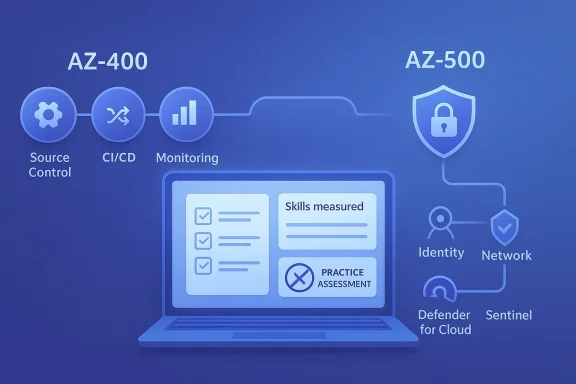
Microsoft’s certification ecosystem has matured into a role-based model that maps exam content directly to job responsibilities. For AZ-400, the focus is on designing and implementing Microsoft DevOps solutions, with an emphasis on pipelines, source control, collaboration, security, and monitoring. For AZ-500, the emphasis is on Azure security engineering, including identity, network, compute, storage, and security operations across cloud and hybrid environments.
That matters because the value proposition is no longer just “I passed an exam.” Microsoft’s own descriptions frame these credentials as proof that a candidate can operate in a particular role, not merely memorize terminology. In other words, the credential is strongest when it reflects practical fluency, not just recall.
The best preparation strategy has also evolved. Microsoft recommends starting with the Skills measured section, then using official practice assessments and training resources to identify knowledge gaps. The company explicitly states that practice assessments are designed to show the style, wording, and difficulty of questions, but they are not the exam itself and not a substitute for experience with Microsoft products.
That creates a tension in the prep market. Candidates often want efficient shortcuts, while employers want durable skills. The broader industry has responded with everything from books and labs to third-party question banks, but Microsoft’s own guidance points candidates back toward structured practice, exam-readiness videos, and official documentation as the anchor resources.
The BBN Times article’s core argument is easy to understand: certifications matter, and good study resources matter even more. But the key question is not whether resources help; it is whether they help candidates become competent, ethical, and job-ready. That distinction is especially important for AZ-400 and AZ-500, where the exam outcomes are closely tied to real operational work.
AZ-500, by contrast, sits at the intersection of cloud engineering and security operations. Microsoft’s current study guide frames the role as one responsible for managing posture, implementing threat protection, and identifying vulnerabilities across Azure and hybrid environments. That breadth makes the certification especially relevant for organizations that need security practitioners who can work inside the platform rather than merely around it.
It also explains why Microsoft’s study guides matter so much. When the exam outline says “skills at a glance,” candidates can map each objective to a real work scenario instead of treating it like a vocabulary quiz. That makes preparation more durable and reduces the likelihood of passing by accident.
The practical advantage is obvious: the official materials are synchronized with the exam blueprint. Microsoft’s guidance explicitly says the best preparation starts with the Skills measured section. That gives candidates a direct checklist for study, rather than forcing them to reverse-engineer the exam from rumor or community guesswork.
The caveat is just as important. Microsoft is explicit that these assessments are not the real exam, not a length model, and not a proxy for true field experience. Candidates who mistake exposure for mastery may feel prepared without actually being prepared. That is the classic false confidence problem in certification training.
A well-built prep plan should therefore look something like this:
That is why the wording around “dumps” deserves caution. In the broad marketplace, people use the term in very different ways, and not all of them imply ethical or legitimate study aids. The safest interpretation is that candidates should use only lawful, high-quality practice questions that reinforce understanding instead of encouraging rote memorization. Microsoft’s own guidance strongly supports that philosophy.
Candidates should ask a simple question before using any third-party study asset: does this resource help me understand the objective, or does it merely help me guess the answer? If it is the latter, it may be a liability rather than an asset. That distinction becomes even more important for AZ-500, where scenario interpretation and control selection matter.
The current skills outline places heavy emphasis on build and release pipelines, which makes sense because DevOps value is most visible when software delivery becomes reliable and repeatable. Microsoft also calls out source control, security and compliance planning, and instrumentation. In practical terms, this is a systems-thinking exam, not a single-tool exam.
Microsoft also notes that the exam content can include features that are generally available and, in some cases, preview features if they are commonly used. That is another reason candidates need to study current materials rather than stale blog posts. Yesterday’s exam prep can become tomorrow’s trap.
A strong AZ-400 study plan should include:
The exam also reflects Microsoft’s current security stack, including Microsoft Defender for Cloud and Microsoft Sentinel. Candidates who understand those tools in context are better positioned to reason through practical scenarios. That is especially true in environments where security has to span Azure, multi-cloud, and hybrid estates.
That is why lab work matters. You can read about access control all day, but until you configure roles, test privilege elevation, and observe audit behavior, the concepts remain abstract. Security engineering is a practice, not a memory test.
This is where the certification market can become confused. Some candidates want a shortcut, while some vendors market speed as the ultimate goal. Yet the long-term return on a certification depends on whether the candidate can actually do the work afterward. Passing is not the same as performing.
Employers also benefit from this approach, because it produces certified staff who are more likely to understand operational nuance. That matters in DevOps, where poor pipeline design can create outages, and in security, where shallow knowledge can lead to weak posture and brittle controls.
The enterprise value goes beyond recruitment. Certifications also help with team structuring, training roadmaps, and role-based development. A manager can use them as one input among many when planning promotions, project staffing, or security baseline improvements.
That is why the best employers look for a blend of certification, hands-on experience, and problem-solving evidence. Microsoft’s own exam prep materials support this broader approach by repeatedly steering candidates toward experience and practice rather than passive review. That is the model the market should follow.
Candidates should also understand that certification is a career investment, not a one-week sprint. AZ-400 and AZ-500 both reward depth, and depth takes time. Microsoft’s own prep guidance implies as much by encouraging practice, review, and experience with the product set.
The good news is that Microsoft has made more preparation material free and accessible than in the past, especially through Learn. The challenge is discipline: candidates must use these resources consistently rather than jumping from one noisy source to another.
Another concern is that candidates may underestimate how current these exams are. Both AZ-400 and AZ-500 evolve with platform changes, and Microsoft updates the skills outlines accordingly. Studying old materials can lead to avoidable gaps, especially in areas like security controls, pipelines, and monitoring.
For the market, the likely direction is even more emphasis on applied knowledge. As cloud platforms become more dynamic and security expectations rise, certs like AZ-400 and AZ-500 will remain useful precisely because they force candidates to engage with real-world operational problems. The strongest prep strategies will therefore be the ones that combine official guidance, hands-on labs, and disciplined self-assessment.
Source: BBN Times Mastering Microsoft Certification Exams with Reliable Preparation Resources
 Background
Microsoft’s certification ecosystem has matured into a role-based model that maps exam content directly to job responsibilities. For AZ-400, the focus is on designing and implementing Microsoft DevOps solutions, with an emphasis on pipelines, source control, collaboration, security, and monitoring. For AZ-500, the emphasis is on Azure security engineering, including identity, network, compute, storage, and security operations across cloud and hybrid environments.That matters because the value proposition is no longer just “I passed an exam.” Microsoft’s own descriptions frame these credentials as proof that a candidate can operate in a particular role, not merely memorize terminology. In other words, the credential is strongest when it reflects practical fluency, not just recall.
The best preparation strategy has also evolved. Microsoft recommends starting with the Skills measured section, then using official practice assessments and training resources to identify knowledge gaps. The company explicitly states that practice assessments are designed to show the style, wording, and difficulty of questions, but they are not the exam itself and not a substitute for experience with Microsoft products.
That creates a tension in the prep market. Candidates often want efficient shortcuts, while employers want durable skills. The broader industry has responded with everything from books and labs to third-party question banks, but Microsoft’s own guidance points candidates back toward structured practice, exam-readiness videos, and official documentation as the anchor resources.
The BBN Times article’s core argument is easy to understand: certifications matter, and good study resources matter even more. But the key question is not whether resources help; it is whether they help candidates become competent, ethical, and job-ready. That distinction is especially important for AZ-400 and AZ-500, where the exam outcomes are closely tied to real operational work.
Why AZ-400 and AZ-500 Still Carry Weight
AZ-400 remains one of the most strategic certifications for professionals working around CI/CD, release management, observability, and DevOps culture. Microsoft describes the DevOps engineer as someone who works across people, processes, and products to enable continuous delivery of value. That definition is important because it highlights that the exam is not just about tooling; it is about operating effectively across teams.AZ-500, by contrast, sits at the intersection of cloud engineering and security operations. Microsoft’s current study guide frames the role as one responsible for managing posture, implementing threat protection, and identifying vulnerabilities across Azure and hybrid environments. That breadth makes the certification especially relevant for organizations that need security practitioners who can work inside the platform rather than merely around it.
Role Alignment Matters More Than Ever
The industry has largely shifted away from generic “cloud expert” branding and toward role precision. That is a good thing, because an Azure DevOps Engineer and an Azure Security Engineer solve very different problems, even if both live in the same cloud ecosystem. The certifications reflect that specialization and therefore carry more market value when aligned to actual duties.It also explains why Microsoft’s study guides matter so much. When the exam outline says “skills at a glance,” candidates can map each objective to a real work scenario instead of treating it like a vocabulary quiz. That makes preparation more durable and reduces the likelihood of passing by accident.
- AZ-400 is centered on DevOps delivery, automation, and pipeline design.
- AZ-500 is centered on identity, protection, monitoring, and response.
- Both exams reward practical Azure experience, not just note-taking.
- The strongest candidates treat the exam as a validation of existing competence.
- The weakest candidates often treat it as a memorization challenge.
The Real Value of Microsoft’s Official Prep Path
Microsoft’s official prep framework has become more sophisticated, and that is a useful signal for candidates. The company now highlights exam prep videos, practice assessments, and exam readiness content as part of a broader support stack. Microsoft also makes clear that these resources are available from the exam details pages where offered, which reduces ambiguity and keeps candidates inside the official learning ecosystem.The practical advantage is obvious: the official materials are synchronized with the exam blueprint. Microsoft’s guidance explicitly says the best preparation starts with the Skills measured section. That gives candidates a direct checklist for study, rather than forcing them to reverse-engineer the exam from rumor or community guesswork.
Why Practice Assessments Matter
Practice Assessments are useful because they show the shape of the exam experience. Microsoft says they help candidates assess readiness, identify knowledge gaps, and better understand style and difficulty. That makes them especially helpful in the final phase of study, when candidates need feedback more than theory.The caveat is just as important. Microsoft is explicit that these assessments are not the real exam, not a length model, and not a proxy for true field experience. Candidates who mistake exposure for mastery may feel prepared without actually being prepared. That is the classic false confidence problem in certification training.
A well-built prep plan should therefore look something like this:
- Review the official exam skills outline.
- Study the related Microsoft Learn documentation.
- Take hands-on labs or build a sandbox.
- Use practice assessments to expose weak spots.
- Re-study weak areas and retest yourself.
Where Third-Party Resources Fit In
Third-party resources still have a place in the certification market, but their role should be clearly defined. They can help with pacing, pattern recognition, and repetition, but they should never replace the official blueprint or hands-on experience. The danger is not merely academic; if a candidate relies on brittle material, they may pass a test while failing the actual job. That is a problem for both the candidate and the employer.That is why the wording around “dumps” deserves caution. In the broad marketplace, people use the term in very different ways, and not all of them imply ethical or legitimate study aids. The safest interpretation is that candidates should use only lawful, high-quality practice questions that reinforce understanding instead of encouraging rote memorization. Microsoft’s own guidance strongly supports that philosophy.
The Ethical Line
The ethical line is not hard to understand, but it is often crossed in practice. A legitimate practice question helps you think, reason, and identify gaps. A bad question bank tries to simulate memory rather than competence, which is a poor foundation for professional certification.Candidates should ask a simple question before using any third-party study asset: does this resource help me understand the objective, or does it merely help me guess the answer? If it is the latter, it may be a liability rather than an asset. That distinction becomes even more important for AZ-500, where scenario interpretation and control selection matter.
- Use third-party material to reinforce, not replace, official study.
- Prefer resources that explain why an answer is correct.
- Avoid anything that encourages blind memorization.
- Validate all claims against Microsoft Learn.
- Treat any exam-like content as practice, not prophecy.
Preparing for AZ-400 the Right Way
AZ-400 is not an entry-level exam, and Microsoft’s description makes that clear. The role expects prior Azure administration or development experience, plus familiarity with both GitHub and Azure DevOps solutions. That means candidates who jump in too early often struggle not because the material is impossible, but because they lack context.The current skills outline places heavy emphasis on build and release pipelines, which makes sense because DevOps value is most visible when software delivery becomes reliable and repeatable. Microsoft also calls out source control, security and compliance planning, and instrumentation. In practical terms, this is a systems-thinking exam, not a single-tool exam.
What Candidates Need to Know
Candidates should expect questions that move across the software delivery lifecycle, from planning and branching strategy to deployment governance and telemetry. That means reading docs alone is insufficient; you need to have built, broken, and fixed pipelines in real environments. Hands-on muscle memory is the edge here.Microsoft also notes that the exam content can include features that are generally available and, in some cases, preview features if they are commonly used. That is another reason candidates need to study current materials rather than stale blog posts. Yesterday’s exam prep can become tomorrow’s trap.
A strong AZ-400 study plan should include:
- Source control strategy design
- Pipeline creation and troubleshooting
- Artifact and dependency management
- Secure release design
- Monitoring and feedback loops
- Cross-team communication practices
Preparing for AZ-500 the Right Way
AZ-500 has become even more relevant as organizations confront cloud misconfiguration, identity sprawl, and increasingly complex compliance demands. Microsoft’s latest exam guide emphasizes security across identity and access, networking, compute, storage, databases, and security operations. That scope reflects the reality of modern cloud defense, where security must be embedded rather than added later.The exam also reflects Microsoft’s current security stack, including Microsoft Defender for Cloud and Microsoft Sentinel. Candidates who understand those tools in context are better positioned to reason through practical scenarios. That is especially true in environments where security has to span Azure, multi-cloud, and hybrid estates.
Identity Is the Center of Gravity
Identity is not just one domain among many; it is the control plane of cloud security. Microsoft’s AZ-500 guide highlights Azure role assignments, custom roles, and Microsoft Entra Privileged Identity Management, which tells you where the exam expects candidates to focus. If you do not understand identity governance, the rest of the security stack becomes much harder to secure.That is why lab work matters. You can read about access control all day, but until you configure roles, test privilege elevation, and observe audit behavior, the concepts remain abstract. Security engineering is a practice, not a memory test.
- Secure identity first, because everything else depends on it.
- Learn how Defender for Cloud frames posture and recommendations.
- Understand network segmentation and exposure management.
- Practice storage and data protection scenarios.
- Review Sentinel workflows and response logic.
Practice Assessments vs. Memorization Culture
Microsoft’s official guidance is a quiet rebuke to the memorization culture that still surrounds certification. The company says practice assessments help candidates identify gaps and understand style, but they are not a substitute for training or product experience. That wording is deliberate: Microsoft wants people who can operate technology, not just recognize answer patterns.This is where the certification market can become confused. Some candidates want a shortcut, while some vendors market speed as the ultimate goal. Yet the long-term return on a certification depends on whether the candidate can actually do the work afterward. Passing is not the same as performing.
A Better Mindset
The better mindset is to treat practice questions as a diagnostic tool. If you miss a question, that is not a failure; it is a clue about where your understanding is thin. In that sense, the exam prep process becomes a learning loop rather than a one-time event.Employers also benefit from this approach, because it produces certified staff who are more likely to understand operational nuance. That matters in DevOps, where poor pipeline design can create outages, and in security, where shallow knowledge can lead to weak posture and brittle controls.
- Think in terms of diagnosis, not recall.
- Use misses to guide study sessions.
- Build a note system for weak objectives.
- Recreate scenarios in a lab environment.
- Retest after remediation, not before.
Enterprise Impact: Why Employers Care
From the employer’s perspective, certifications help reduce ambiguity in hiring and internal mobility. A candidate who passes AZ-400 signals familiarity with DevOps pipelines, automation, and team collaboration, while a candidate who passes AZ-500 signals readiness for cloud security responsibilities. That is useful in an environment where job titles can be vague but operational needs are specific.The enterprise value goes beyond recruitment. Certifications also help with team structuring, training roadmaps, and role-based development. A manager can use them as one input among many when planning promotions, project staffing, or security baseline improvements.
Skills Validation vs. Skills Creation
It is important, though, not to confuse validation with creation. Certifications confirm a baseline; they do not create expertise from nothing. Organizations that hire or promote based solely on a badge may overestimate the depth of a person’s skill.That is why the best employers look for a blend of certification, hands-on experience, and problem-solving evidence. Microsoft’s own exam prep materials support this broader approach by repeatedly steering candidates toward experience and practice rather than passive review. That is the model the market should follow.
- Better role fit for DevOps and security teams
- Faster hiring signal for cloud-focused roles
- More structured internal upskilling
- Clearer promotion frameworks
- Stronger alignment between learning and work output
Consumer Impact: What Candidates Need to Understand
For individual candidates, the certification market can be noisy and intimidating. There are countless prep products, conflicting opinions, and pressure to pass quickly. Microsoft’s latest guidance helps cut through that noise by making the exam blueprint, readiness resources, and practice assessments more visible and more central.Candidates should also understand that certification is a career investment, not a one-week sprint. AZ-400 and AZ-500 both reward depth, and depth takes time. Microsoft’s own prep guidance implies as much by encouraging practice, review, and experience with the product set.
Time, Money, and Return on Effort
From a consumer standpoint, the biggest question is return on effort. Study time, lab time, practice time, and exam fees all add up, so candidates need a preparation plan that is efficient without being shallow. The goal is not simply to spend less time; it is to spend time in the right places. That distinction saves both money and frustration.The good news is that Microsoft has made more preparation material free and accessible than in the past, especially through Learn. The challenge is discipline: candidates must use these resources consistently rather than jumping from one noisy source to another.
- Focus on structured study blocks.
- Track progress against the official skills outline.
- Use practice assessments to measure improvement.
- Budget for labs and exam fees early.
- Prioritize understanding over shortcuts.
Strengths and Opportunities
The strongest argument for the Microsoft certification path is that it rewards meaningful competence. Candidates who use official tools, labs, and guided practice can build both a credential and a stronger professional foundation. That dual payoff is what keeps Azure certifications relevant in a crowded market.- Role-based alignment makes the certifications easier to map to jobs.
- Official practice assessments provide realistic readiness checks.
- Study guides reduce ambiguity about what to learn.
- AZ-400 offers a strong path into DevOps engineering roles.
- AZ-500 supports security career growth in cloud and hybrid environments.
- Hands-on labs build durable skills beyond the exam.
- Microsoft Learn offers a unified prep ecosystem that is easier to trust.
Risks and Concerns
The biggest risk is overreliance on shortcuts. If a candidate leans too heavily on question banks or memorized patterns, they may pass without developing the judgment needed on the job. Microsoft’s own warnings about practice assessments being non-equivalent to the exam should be taken seriously, not treated as fine print.Another concern is that candidates may underestimate how current these exams are. Both AZ-400 and AZ-500 evolve with platform changes, and Microsoft updates the skills outlines accordingly. Studying old materials can lead to avoidable gaps, especially in areas like security controls, pipelines, and monitoring.
- Memorization can create false confidence.
- Outdated prep materials can mislead candidates.
- Weak hands-on experience can undermine real-world performance.
- Third-party content may vary widely in quality.
- Poor time management can create avoidable exam stress.
- Misreading a role-based exam can lead to ineffective study plans.
- Ethical concerns arise when study tools blur into answer leakage.
Looking Ahead
Microsoft is clearly steering certification candidates toward a more structured, more integrated prep model. The combination of study guides, practice assessments, exam readiness videos, and official role pages suggests a mature ecosystem that favors actual skill development. That should be good news for candidates willing to do the work.For the market, the likely direction is even more emphasis on applied knowledge. As cloud platforms become more dynamic and security expectations rise, certs like AZ-400 and AZ-500 will remain useful precisely because they force candidates to engage with real-world operational problems. The strongest prep strategies will therefore be the ones that combine official guidance, hands-on labs, and disciplined self-assessment.
What Candidates Should Watch Next
- Updates to the Skills measured pages for both exams
- New Microsoft Learn practice assessments and readiness content
- Changes in exam formatting, question styles, or support resources
- Shifts in Azure DevOps and Azure security tooling
- The continuing role of hands-on labs in certification success
Source: BBN Times Mastering Microsoft Certification Exams with Reliable Preparation Resources
