

Microsoft’s Azure DevOps Engineer Expert certification is an expert-level credential for developers and infrastructure administrators who pass Exam AZ-400 after earning an Azure Administrator Associate or Azure Developer Associate certification, with the exam’s English skills outline updated on April 24, 2026. That dry sentence is the whole story and also not nearly enough of it. AZ-400 is less a trophy for memorizing Azure DevOps menus than a test of whether a candidate understands how modern software delivery actually works inside Microsoft-centered organizations. The credential matters because enterprise DevOps has become less about heroic pipeline hacking and more about governing delivery systems that can survive security audits, platform sprawl, and impatient business units.
For years, “DevOps engineer” was one of those job titles that meant everything and nothing. In one company, it meant the person who fixed Jenkins. In another, it meant the Kubernetes whisperer. In a Microsoft-heavy enterprise, it often meant the engineer who could translate between developers, infrastructure teams, security reviewers, project managers, and the executive who wanted release velocity without production incidents.
The Azure DevOps Engineer Expert certification is Microsoft’s attempt to pin that role to a measurable job profile. The certification sits under Microsoft Certified: DevOps Engineer Expert, and its required exam is AZ-400: Designing and Implementing Microsoft DevOps Solutions. Candidates must already hold either Azure Administrator Associate or Azure Developer Associate, which is Microsoft’s way of saying that DevOps is not supposed to be a beginner’s entry point into Azure.
That prerequisite is more than bureaucratic gatekeeping. AZ-400 assumes the candidate can reason from both sides of the wall DevOps was invented to demolish. You need enough administration knowledge to understand identity, environments, monitoring, cost, infrastructure-as-code, and production constraints. You need enough development knowledge to understand source control, branching, builds, tests, package versioning, deployment strategies, and application telemetry.
The result is a certification that reflects how Microsoft sees the modern enterprise delivery chain. Azure DevOps is still in the name of the ecosystem, but the exam is no longer merely about Azure DevOps Server nostalgia or clicking through Azure Pipelines screens. It now explicitly spans GitHub, Azure DevOps, Microsoft Defender for Cloud, Azure Monitor, Application Insights, Azure Key Vault, Bicep, Azure Resource Manager, and the practices that stitch those tools into a governed delivery system.
This weighting tells candidates what Microsoft thinks separates an aspirational DevOps résumé from an operational DevOps practitioner. The exam expects you to understand package management, testing strategy, YAML pipelines, runners and agents, deployment approaches, infrastructure-as-code, pipeline maintenance, approvals, dependencies, artifacts, and release gates. That is the machinery by which organizations turn code into business value without turning production into a smoking crater.
The pipeline focus also explains why candidates who try to pass AZ-400 by reading documentation alone often struggle. You can memorize the difference between blue-green, canary, ring, and progressive exposure deployments, but the exam is interested in when one of those patterns fits an operational problem. You can read about variables and templates, but that is different from designing reusable YAML that works across teams without leaking secrets or breaking every time a repository layout changes.
This is where AZ-400 distinguishes itself from many cloud certification exams that can feel like catalog quizzes. Microsoft is asking for architectural judgment. The candidate must know not only that GitHub Actions and Azure Pipelines exist, but how to select an automation model, design runner or agent infrastructure, control cost, preserve maintainability, manage connectivity, and integrate repositories with pipeline execution.
The certification is therefore at its strongest when treated as a forcing function for practice. Build a repository. Create a YAML pipeline. Package an artifact. Deploy to a test environment. Break the deployment. Add approval gates. Introduce secrets. Move those secrets into Key Vault. Add telemetry. Watch the pipeline fail because a test is flaky, then decide whether the right fix is technical, organizational, or procedural. That loop teaches what the certification is really measuring.
That matters because Microsoft’s enterprise DevOps strategy has become a two-platform story. Azure DevOps remains deeply entrenched in many organizations, especially where Azure Boards and Azure Pipelines are already embedded in delivery workflows. GitHub, meanwhile, has become the developer collaboration layer Microsoft wants to standardize across open source, inner source, security scanning, and AI-assisted development.
AZ-400 candidates therefore need to understand the practical difference between an Azure DevOps-centric shop and a GitHub-centric shop. Branch policies in Azure Repos are not the same operational surface as branch protection rules in GitHub. Azure Pipelines service connections have a different management model from GitHub authentication flows using GitHub Apps, tokens, or OpenID Connect. GitHub Advanced Security has its own vocabulary around CodeQL, secret scanning, dependency alerts, and repository-level enablement.
This duality makes the exam harder but more realistic. Many enterprises are not clean greenfield environments. They have legacy repos, classic release pipelines, new YAML templates, GitHub organizations, Azure DevOps projects, self-hosted agents, private package feeds, and security teams pushing for centralized visibility. A useful DevOps engineer is the person who can make that mess safer and more repeatable.
The trap is assuming that “Microsoft DevOps” means “Azure DevOps only.” That may have been a defensible shortcut years ago. It is no longer a safe exam strategy, and it is certainly not a safe career strategy.
The exam’s security domain is not merely about permissions. It includes authentication and authorization, Microsoft Entra service principals, managed identities, Azure DevOps service connections, personal access tokens, GitHub Apps, GitHub tokens, Azure Key Vault, secretless authentication patterns, secure files, dependency scanning, code scanning, secret scanning, licensing checks, container scanning, Defender for Cloud DevOps Security, GitHub Advanced Security, and integration between GitHub Advanced Security and Defender for Cloud.
That is a long inventory, but the point is simple: modern DevOps engineers are now part of the software supply chain security apparatus. They may not be security engineers by title, but they design the paths through which code, secrets, identities, containers, dependencies, packages, and infrastructure definitions move. If those paths are sloppy, the organization inherits risk at machine speed.
This is where the certification’s practical value becomes obvious. A release pipeline that can deploy ten times a day is not impressive if it sprays privileged tokens through logs. A repository strategy is not mature if a deleted secret remains recoverable in Git history. A package feed is not enterprise-ready if dependency provenance and versioning are afterthoughts. A deployment environment is not governed if approvals exist only in someone’s memory.
AZ-400 rewards the candidate who sees security as a design constraint rather than a cleanup phase. It is not enough to know how to make a pipeline run. You need to know how to make it run with the least necessary privilege, auditable access, protected branches, controlled secrets, scanning hooks, and a recovery path when something goes wrong.
Candidates are expected to understand Azure Resource Manager templates, Bicep, desired state configuration approaches, Azure Machine Configuration, Azure Automation State Configuration, and Azure Deployment Environments. Terraform is often part of the real-world conversation, even when Microsoft’s own stack receives the exam emphasis. The bigger point is not the syntax of a template language. It is whether infrastructure changes are versioned, reviewed, tested, deployed, monitored, and repeatable.
This is the enterprise compromise DevOps has been moving toward. Developers want self-service. Operations wants consistency. Security wants policy enforcement. Finance wants cost control. Executives want faster delivery. IaC, when done properly, gives each constituency a partial win by making infrastructure changes inspectable before they become production facts.
But IaC also raises the bar for DevOps engineers. A candidate must know how infrastructure definitions interact with source control strategy, environment promotion, approvals, secrets, policy, and rollback. A broken YAML pipeline is annoying; a broken infrastructure deployment can be a business incident. The certification’s focus on deployment resiliency, hotfix paths, dependency ordering, and downtime minimization reflects that reality.
The useful AZ-400 candidate is therefore not the person who can generate a Bicep file from memory. It is the person who can decide how that file should be stored, reviewed, tested, parameterized, secured, deployed, observed, and retired.
The exam expects candidates to configure Azure Monitor and Azure Monitor Logs, collect telemetry with Application Insights and related Azure insights tools, monitor GitHub and pipeline events, configure alerts, inspect infrastructure performance indicators, analyze application performance, work with distributed tracing, and use basic Kusto Query Language. This is not full-time SRE depth, but it is enough to establish whether a candidate understands the operating loop.
The connection between pipelines and observability is especially important. If a release causes latency to spike, error rates to climb, or a dependency to fail, the delivery system should make that visible quickly. If flaky tests are increasing pipeline duration or reducing confidence, the team needs metrics rather than vibes. If lead time and recovery time are executive-level concerns, DevOps engineers need dashboards that map technical activity to delivery performance.
In this sense, instrumentation is the exam’s antidote to theater. It is easy to perform DevOps by adopting rituals: stand-ups, pull requests, YAML files, deployment boards, and chat notifications. It is harder to prove that changes are flowing faster, failures are detected sooner, recovery is improving, and releases are becoming safer. AZ-400 leans toward the latter.
For candidates, this means Azure Monitor and Application Insights should not be treated as afterthoughts during study. Knowing how to deploy is only part of the story. Knowing how to observe the consequences of deployment is what turns automation into engineering.
The administrator path gives candidates grounding in identity, governance, networking, compute, storage, monitoring, and operational management. The developer path gives candidates grounding in application services, authentication, data services, messaging, containers, and application integration. Either route can work, but the strongest candidates usually have exposure to both.
That dual fluency matters because DevOps work often happens in the seams. A deployment fails because an identity cannot access a resource. A pipeline hangs because a self-hosted agent lacks network reachability. A release strategy looks elegant until database migrations enter the picture. A container deployment passes tests but fails under real traffic because observability was bolted on too late.
Candidates coming from development should spend extra time on Azure administration concepts, permissions, managed identities, monitoring, and infrastructure deployment. Candidates coming from infrastructure should spend extra time on Git workflows, branching strategies, tests, package feeds, semantic versioning, and developer collaboration patterns. AZ-400 is not trying to turn every admin into a senior developer or every developer into a cloud architect. It is trying to verify that both can operate across the delivery system.
That is why hands-on practice is not optional. If your study plan does not include GitHub, Azure DevOps, Azure Pipelines, GitHub Actions, Key Vault, Azure Monitor, and at least one real deployment target, it is probably too shallow.
A practical study plan starts with a simple application and a repository. The application does not need to be impressive. It needs enough structure to support builds, tests, packages, deployment, configuration, secrets, and telemetry. From there, the candidate should implement branching rules, pull request checks, pipeline triggers, reusable YAML, artifacts, package feeds, deployment environments, approvals, and rollback thinking.
Then the system should be made more realistic. Add a database migration step. Add a staging slot or staged environment. Add Key Vault-backed secrets. Add a container build and scanning stage. Add monitoring and an alert. Add a release note generation step. Add branch protection or branch policies. Add a failing test and decide whether the pipeline should block. Add a manual approval and then ask whether that approval is governance or bureaucracy.
Microsoft Learn’s free learning paths are useful, and the official practice assessment can expose weak spots. But candidates should be wary of third-party “exam dumps” or any preparation product that promises pattern recognition over skill. Besides the ethical and legal issues, dumps are a poor fit for a role-based exam that changes as the platform changes.
A four-to-eight-week study window may be realistic for candidates already working in Azure and familiar with CI/CD. For candidates new to pipelines, GitHub, or Azure operations, that timeline is optimistic. The certification is expert-level not because every individual concept is impossibly deep, but because the exam expects breadth, integration, and judgment under scenario pressure.
Salary ranges for Azure DevOps engineers in the United States are often cited around the low six figures to the mid-six figures, with senior enterprise specialists earning more. In India, ranges are frequently discussed in lakhs per annum, with significant variation by city, employer, product maturity, and candidate experience. Those numbers can be directionally useful, but they are not promises attached to a badge.
Certifications influence hiring most when they confirm experience the candidate can already demonstrate. A résumé that says “AZ-400” and then describes production pipelines, deployment strategies, GitHub Advanced Security rollout, Azure Monitor dashboards, and IaC governance is credible. A résumé that says “AZ-400” with no delivery history reads like a training artifact.
The certification may matter more in some environments than others. Microsoft partners, consulting firms, public-sector contractors, regulated industries, and large enterprises with formal competency frameworks often value Microsoft credentials because they simplify vendor selection, staffing, compliance narratives, and partner requirements. Startups and engineering-led product companies may care less about the badge and more about demonstrable systems experience.
The best way to understand the career value of AZ-400 is to stop treating it as a salary multiplier and start treating it as a market signal. It tells employers that a candidate has studied the Microsoft delivery stack, understands the contours of enterprise DevOps, and has passed a role-based exam with prerequisites. It does not prove that the candidate can handle a 2 a.m. rollback, negotiate with security, redesign a brittle monorepo strategy, or explain deployment risk to a vice president.
If your organization runs heavily on Azure, Microsoft Entra ID, GitHub Enterprise, Azure DevOps, Defender for Cloud, Azure Monitor, AKS, App Service, and Microsoft 365 integration, AZ-400 is the obvious fit. It aligns with the tools, governance patterns, and identity fabric already present in the environment. For consultants serving Microsoft-centric enterprises, it can also reinforce credibility with clients who expect Microsoft certification language.
If your organization runs primarily on AWS, the AWS Certified DevOps Engineer – Professional credential may map more directly to day-to-day responsibilities. It will emphasize AWS-native services, operational patterns, deployment automation, monitoring, resilience, and security through that ecosystem’s lens. For multi-cloud engineers, holding both can make sense, but only if the certifications reflect real project exposure rather than credential collecting.
The uncomfortable truth is that DevOps principles travel better than DevOps tooling. Source control discipline, automated testing, artifact management, environment promotion, secure secrets handling, observability, incident response, and deployment strategy are not Azure-only ideas. What changes across ecosystems is the implementation surface: identity model, pipeline service, registry, policy engine, monitoring stack, and managed compute targets.
AZ-400 is therefore most valuable when it deepens transferable thinking rather than narrowing the candidate into Microsoft tool trivia. A strong Azure DevOps engineer should be able to explain why a canary deployment matters even outside Azure. A weak one can only recite which menu enables it.
Annual renewal is also a reminder that the platform does not stand still. The AZ-400 skills outline was updated on April 24, 2026, and Microsoft’s exam pages note that exams are periodically revised to reflect skills required for the role. Localized versions may lag behind the English update schedule, which matters for candidates planning in languages other than English.
The renewal model is sensible because DevOps tooling changes at a faster cadence than traditional infrastructure exams. GitHub security features evolve. Azure DevOps capabilities shift. Defender for Cloud integrations expand. Authentication patterns move away from long-lived secrets toward federated identity. Classic pipelines give way to YAML. Observability and software supply chain expectations become stricter.
But renewal should not be confused with mastery maintenance. Passing a renewal assessment keeps the certification active. It does not guarantee that the engineer has kept pace with production realities. The real renewal happens in code reviews, incident retrospectives, pipeline migrations, security reviews, and deployment failures that force better design.
For working professionals, that means the certification should be part of a maintenance loop: read the updated skills outline, compare it with your actual environment, identify gaps, and build or refactor something. The exam renewal may be free. Staying professionally current is not.
That is good news for the credential’s credibility. It means AZ-400 is less likely to reward candidates who only know buzzwords and more likely to reward candidates who have designed or operated delivery systems. It also means the certification is not a casual add-on for someone who has never touched Azure DevOps or GitHub in anger.
For WindowsForum readers, especially sysadmins moving toward platform engineering or developers moving toward delivery ownership, the signal is clear:
Source: The European Business Review Azure DevOps Certification: Skills, Exam Guide & Career Scope
 Microsoft Turns DevOps Into an Operating Model
For years, “DevOps engineer” was one of those job titles that meant everything and nothing. In one company, it meant the person who fixed Jenkins. In another, it meant the Kubernetes whisperer. In a Microsoft-heavy enterprise, it often meant the engineer who could translate between developers, infrastructure teams, security reviewers, project managers, and the executive who wanted release velocity without production incidents.The Azure DevOps Engineer Expert certification is Microsoft’s attempt to pin that role to a measurable job profile. The certification sits under Microsoft Certified: DevOps Engineer Expert, and its required exam is AZ-400: Designing and Implementing Microsoft DevOps Solutions. Candidates must already hold either Azure Administrator Associate or Azure Developer Associate, which is Microsoft’s way of saying that DevOps is not supposed to be a beginner’s entry point into Azure.
That prerequisite is more than bureaucratic gatekeeping. AZ-400 assumes the candidate can reason from both sides of the wall DevOps was invented to demolish. You need enough administration knowledge to understand identity, environments, monitoring, cost, infrastructure-as-code, and production constraints. You need enough development knowledge to understand source control, branching, builds, tests, package versioning, deployment strategies, and application telemetry.
The result is a certification that reflects how Microsoft sees the modern enterprise delivery chain. Azure DevOps is still in the name of the ecosystem, but the exam is no longer merely about Azure DevOps Server nostalgia or clicking through Azure Pipelines screens. It now explicitly spans GitHub, Azure DevOps, Microsoft Defender for Cloud, Azure Monitor, Application Insights, Azure Key Vault, Bicep, Azure Resource Manager, and the practices that stitch those tools into a governed delivery system.
The Exam Is Really About Pipelines, Not Slogans
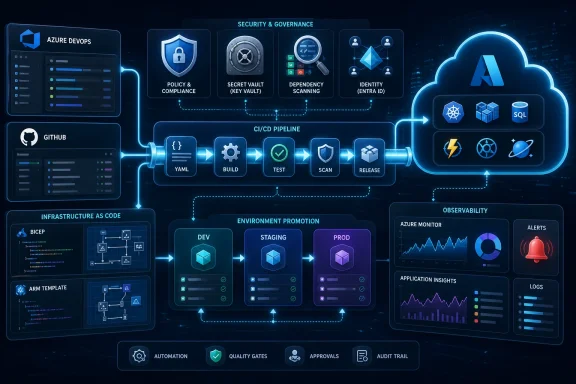
The most revealing number in the AZ-400 blueprint is the weighting of build and release pipelines. As of the April 24, 2026 skills outline, “design and implement build and release pipelines” accounts for 50 to 55 percent of the exam. That is not a side topic. It is the center of gravity.This weighting tells candidates what Microsoft thinks separates an aspirational DevOps résumé from an operational DevOps practitioner. The exam expects you to understand package management, testing strategy, YAML pipelines, runners and agents, deployment approaches, infrastructure-as-code, pipeline maintenance, approvals, dependencies, artifacts, and release gates. That is the machinery by which organizations turn code into business value without turning production into a smoking crater.
The pipeline focus also explains why candidates who try to pass AZ-400 by reading documentation alone often struggle. You can memorize the difference between blue-green, canary, ring, and progressive exposure deployments, but the exam is interested in when one of those patterns fits an operational problem. You can read about variables and templates, but that is different from designing reusable YAML that works across teams without leaking secrets or breaking every time a repository layout changes.
This is where AZ-400 distinguishes itself from many cloud certification exams that can feel like catalog quizzes. Microsoft is asking for architectural judgment. The candidate must know not only that GitHub Actions and Azure Pipelines exist, but how to select an automation model, design runner or agent infrastructure, control cost, preserve maintainability, manage connectivity, and integrate repositories with pipeline execution.
The certification is therefore at its strongest when treated as a forcing function for practice. Build a repository. Create a YAML pipeline. Package an artifact. Deploy to a test environment. Break the deployment. Add approval gates. Introduce secrets. Move those secrets into Key Vault. Add telemetry. Watch the pipeline fail because a test is flaky, then decide whether the right fix is technical, organizational, or procedural. That loop teaches what the certification is really measuring.
GitHub Is No Longer the Side Door
One of the most important shifts in the current AZ-400 story is the degree to which GitHub has become a first-class part of Microsoft’s DevOps worldview. The exam still covers Azure DevOps services, including Azure Boards, Azure Repos, Azure Pipelines, Azure Artifacts, and Azure DevOps permissions. But GitHub is now woven through the blueprint in source control, work tracking, collaboration, authentication, security scanning, repository protection, and pipeline automation.That matters because Microsoft’s enterprise DevOps strategy has become a two-platform story. Azure DevOps remains deeply entrenched in many organizations, especially where Azure Boards and Azure Pipelines are already embedded in delivery workflows. GitHub, meanwhile, has become the developer collaboration layer Microsoft wants to standardize across open source, inner source, security scanning, and AI-assisted development.
AZ-400 candidates therefore need to understand the practical difference between an Azure DevOps-centric shop and a GitHub-centric shop. Branch policies in Azure Repos are not the same operational surface as branch protection rules in GitHub. Azure Pipelines service connections have a different management model from GitHub authentication flows using GitHub Apps, tokens, or OpenID Connect. GitHub Advanced Security has its own vocabulary around CodeQL, secret scanning, dependency alerts, and repository-level enablement.
This duality makes the exam harder but more realistic. Many enterprises are not clean greenfield environments. They have legacy repos, classic release pipelines, new YAML templates, GitHub organizations, Azure DevOps projects, self-hosted agents, private package feeds, and security teams pushing for centralized visibility. A useful DevOps engineer is the person who can make that mess safer and more repeatable.
The trap is assuming that “Microsoft DevOps” means “Azure DevOps only.” That may have been a defensible shortcut years ago. It is no longer a safe exam strategy, and it is certainly not a safe career strategy.
Security Has Moved From Gatekeeper to Pipeline Ingredient
The old caricature of enterprise security was the late-stage approval meeting: developers built, operations deployed, and security arrived near the end to say no. AZ-400 reflects a more modern, and frankly more demanding, model. Security and compliance are expected to be designed into the delivery system itself.The exam’s security domain is not merely about permissions. It includes authentication and authorization, Microsoft Entra service principals, managed identities, Azure DevOps service connections, personal access tokens, GitHub Apps, GitHub tokens, Azure Key Vault, secretless authentication patterns, secure files, dependency scanning, code scanning, secret scanning, licensing checks, container scanning, Defender for Cloud DevOps Security, GitHub Advanced Security, and integration between GitHub Advanced Security and Defender for Cloud.
That is a long inventory, but the point is simple: modern DevOps engineers are now part of the software supply chain security apparatus. They may not be security engineers by title, but they design the paths through which code, secrets, identities, containers, dependencies, packages, and infrastructure definitions move. If those paths are sloppy, the organization inherits risk at machine speed.
This is where the certification’s practical value becomes obvious. A release pipeline that can deploy ten times a day is not impressive if it sprays privileged tokens through logs. A repository strategy is not mature if a deleted secret remains recoverable in Git history. A package feed is not enterprise-ready if dependency provenance and versioning are afterthoughts. A deployment environment is not governed if approvals exist only in someone’s memory.
AZ-400 rewards the candidate who sees security as a design constraint rather than a cleanup phase. It is not enough to know how to make a pipeline run. You need to know how to make it run with the least necessary privilege, auditable access, protected branches, controlled secrets, scanning hooks, and a recovery path when something goes wrong.
Infrastructure-as-Code Becomes the Enterprise Compromise
Infrastructure-as-code is one of those ideas that sounds clean in conference talks and becomes complicated the moment it meets a real estate of subscriptions, resource groups, naming standards, policy assignments, and budget owners. AZ-400 does not treat IaC as a fashionable add-on. It places it inside the pipeline-heavy heart of the exam.Candidates are expected to understand Azure Resource Manager templates, Bicep, desired state configuration approaches, Azure Machine Configuration, Azure Automation State Configuration, and Azure Deployment Environments. Terraform is often part of the real-world conversation, even when Microsoft’s own stack receives the exam emphasis. The bigger point is not the syntax of a template language. It is whether infrastructure changes are versioned, reviewed, tested, deployed, monitored, and repeatable.
This is the enterprise compromise DevOps has been moving toward. Developers want self-service. Operations wants consistency. Security wants policy enforcement. Finance wants cost control. Executives want faster delivery. IaC, when done properly, gives each constituency a partial win by making infrastructure changes inspectable before they become production facts.
But IaC also raises the bar for DevOps engineers. A candidate must know how infrastructure definitions interact with source control strategy, environment promotion, approvals, secrets, policy, and rollback. A broken YAML pipeline is annoying; a broken infrastructure deployment can be a business incident. The certification’s focus on deployment resiliency, hotfix paths, dependency ordering, and downtime minimization reflects that reality.
The useful AZ-400 candidate is therefore not the person who can generate a Bicep file from memory. It is the person who can decide how that file should be stored, reviewed, tested, parameterized, secured, deployed, observed, and retired.
Observability Is the Exam’s Quiet Reality Check
Instrumentation is the smallest weighted domain in AZ-400, at 5 to 10 percent, but it is one of the clearest signs that Microsoft is testing for an end-to-end delivery mindset. A DevOps engineer who cannot see what happens after deployment has only automated half the job. Shipping is not the finish line; feedback is.The exam expects candidates to configure Azure Monitor and Azure Monitor Logs, collect telemetry with Application Insights and related Azure insights tools, monitor GitHub and pipeline events, configure alerts, inspect infrastructure performance indicators, analyze application performance, work with distributed tracing, and use basic Kusto Query Language. This is not full-time SRE depth, but it is enough to establish whether a candidate understands the operating loop.
The connection between pipelines and observability is especially important. If a release causes latency to spike, error rates to climb, or a dependency to fail, the delivery system should make that visible quickly. If flaky tests are increasing pipeline duration or reducing confidence, the team needs metrics rather than vibes. If lead time and recovery time are executive-level concerns, DevOps engineers need dashboards that map technical activity to delivery performance.
In this sense, instrumentation is the exam’s antidote to theater. It is easy to perform DevOps by adopting rituals: stand-ups, pull requests, YAML files, deployment boards, and chat notifications. It is harder to prove that changes are flowing faster, failures are detected sooner, recovery is improving, and releases are becoming safer. AZ-400 leans toward the latter.
For candidates, this means Azure Monitor and Application Insights should not be treated as afterthoughts during study. Knowing how to deploy is only part of the story. Knowing how to observe the consequences of deployment is what turns automation into engineering.
The Prerequisite Is a Signal, Not a Formality
Microsoft’s requirement that candidates hold Azure Administrator Associate or Azure Developer Associate before earning DevOps Engineer Expert is sometimes treated as an administrative hurdle. It is better understood as a signal about the expected operating altitude. AZ-400 is not designed to teach Azure from zero.The administrator path gives candidates grounding in identity, governance, networking, compute, storage, monitoring, and operational management. The developer path gives candidates grounding in application services, authentication, data services, messaging, containers, and application integration. Either route can work, but the strongest candidates usually have exposure to both.
That dual fluency matters because DevOps work often happens in the seams. A deployment fails because an identity cannot access a resource. A pipeline hangs because a self-hosted agent lacks network reachability. A release strategy looks elegant until database migrations enter the picture. A container deployment passes tests but fails under real traffic because observability was bolted on too late.
Candidates coming from development should spend extra time on Azure administration concepts, permissions, managed identities, monitoring, and infrastructure deployment. Candidates coming from infrastructure should spend extra time on Git workflows, branching strategies, tests, package feeds, semantic versioning, and developer collaboration patterns. AZ-400 is not trying to turn every admin into a senior developer or every developer into a cloud architect. It is trying to verify that both can operate across the delivery system.
That is why hands-on practice is not optional. If your study plan does not include GitHub, Azure DevOps, Azure Pipelines, GitHub Actions, Key Vault, Azure Monitor, and at least one real deployment target, it is probably too shallow.
The Study Plan Should Build a Delivery System, Not a Binder
The worst way to prepare for AZ-400 is to collect study links until the browser collapses under its own tabs. The better way is to build a small but complete software delivery system and then map each exam objective onto it. The exam is broad enough that passive reading will produce recognition, not competence.A practical study plan starts with a simple application and a repository. The application does not need to be impressive. It needs enough structure to support builds, tests, packages, deployment, configuration, secrets, and telemetry. From there, the candidate should implement branching rules, pull request checks, pipeline triggers, reusable YAML, artifacts, package feeds, deployment environments, approvals, and rollback thinking.
Then the system should be made more realistic. Add a database migration step. Add a staging slot or staged environment. Add Key Vault-backed secrets. Add a container build and scanning stage. Add monitoring and an alert. Add a release note generation step. Add branch protection or branch policies. Add a failing test and decide whether the pipeline should block. Add a manual approval and then ask whether that approval is governance or bureaucracy.
Microsoft Learn’s free learning paths are useful, and the official practice assessment can expose weak spots. But candidates should be wary of third-party “exam dumps” or any preparation product that promises pattern recognition over skill. Besides the ethical and legal issues, dumps are a poor fit for a role-based exam that changes as the platform changes.
A four-to-eight-week study window may be realistic for candidates already working in Azure and familiar with CI/CD. For candidates new to pipelines, GitHub, or Azure operations, that timeline is optimistic. The certification is expert-level not because every individual concept is impossibly deep, but because the exam expects breadth, integration, and judgment under scenario pressure.
Salary Claims Need More Skepticism Than Certification Vendors Provide
The European Business Review article that prompted this discussion repeats a familiar certification-market claim: Azure DevOps certification can open doors to high-paying roles such as DevOps engineer, release engineer, platform engineer, site reliability engineer, and cloud solutions architect. That is broadly plausible. It is also where candidates should keep their skepticism switched on.Salary ranges for Azure DevOps engineers in the United States are often cited around the low six figures to the mid-six figures, with senior enterprise specialists earning more. In India, ranges are frequently discussed in lakhs per annum, with significant variation by city, employer, product maturity, and candidate experience. Those numbers can be directionally useful, but they are not promises attached to a badge.
Certifications influence hiring most when they confirm experience the candidate can already demonstrate. A résumé that says “AZ-400” and then describes production pipelines, deployment strategies, GitHub Advanced Security rollout, Azure Monitor dashboards, and IaC governance is credible. A résumé that says “AZ-400” with no delivery history reads like a training artifact.
The certification may matter more in some environments than others. Microsoft partners, consulting firms, public-sector contractors, regulated industries, and large enterprises with formal competency frameworks often value Microsoft credentials because they simplify vendor selection, staffing, compliance narratives, and partner requirements. Startups and engineering-led product companies may care less about the badge and more about demonstrable systems experience.
The best way to understand the career value of AZ-400 is to stop treating it as a salary multiplier and start treating it as a market signal. It tells employers that a candidate has studied the Microsoft delivery stack, understands the contours of enterprise DevOps, and has passed a role-based exam with prerequisites. It does not prove that the candidate can handle a 2 a.m. rollback, negotiate with security, redesign a brittle monorepo strategy, or explain deployment risk to a vice president.
Azure DevOps Versus AWS DevOps Is the Wrong First Question
The article’s comparison between Azure DevOps certification and AWS DevOps certification is useful but incomplete. Candidates often ask which cloud DevOps credential is “better,” as if the labor market were a leaderboard. The better question is which ecosystem your current or target employers actually use.If your organization runs heavily on Azure, Microsoft Entra ID, GitHub Enterprise, Azure DevOps, Defender for Cloud, Azure Monitor, AKS, App Service, and Microsoft 365 integration, AZ-400 is the obvious fit. It aligns with the tools, governance patterns, and identity fabric already present in the environment. For consultants serving Microsoft-centric enterprises, it can also reinforce credibility with clients who expect Microsoft certification language.
If your organization runs primarily on AWS, the AWS Certified DevOps Engineer – Professional credential may map more directly to day-to-day responsibilities. It will emphasize AWS-native services, operational patterns, deployment automation, monitoring, resilience, and security through that ecosystem’s lens. For multi-cloud engineers, holding both can make sense, but only if the certifications reflect real project exposure rather than credential collecting.
The uncomfortable truth is that DevOps principles travel better than DevOps tooling. Source control discipline, automated testing, artifact management, environment promotion, secure secrets handling, observability, incident response, and deployment strategy are not Azure-only ideas. What changes across ecosystems is the implementation surface: identity model, pipeline service, registry, policy engine, monitoring stack, and managed compute targets.
AZ-400 is therefore most valuable when it deepens transferable thinking rather than narrowing the candidate into Microsoft tool trivia. A strong Azure DevOps engineer should be able to explain why a canary deployment matters even outside Azure. A weak one can only recite which menu enables it.
Renewal Keeps the Badge Current, but Not the Engineer
Microsoft associate, expert, and specialty certifications expire annually, and renewal is handled through a free online assessment on Microsoft Learn. This is one of the more candidate-friendly parts of Microsoft’s certification program. It lowers the financial friction of staying current and recognizes that cloud role credentials age quickly.Annual renewal is also a reminder that the platform does not stand still. The AZ-400 skills outline was updated on April 24, 2026, and Microsoft’s exam pages note that exams are periodically revised to reflect skills required for the role. Localized versions may lag behind the English update schedule, which matters for candidates planning in languages other than English.
The renewal model is sensible because DevOps tooling changes at a faster cadence than traditional infrastructure exams. GitHub security features evolve. Azure DevOps capabilities shift. Defender for Cloud integrations expand. Authentication patterns move away from long-lived secrets toward federated identity. Classic pipelines give way to YAML. Observability and software supply chain expectations become stricter.
But renewal should not be confused with mastery maintenance. Passing a renewal assessment keeps the certification active. It does not guarantee that the engineer has kept pace with production realities. The real renewal happens in code reviews, incident retrospectives, pipeline migrations, security reviews, and deployment failures that force better design.
For working professionals, that means the certification should be part of a maintenance loop: read the updated skills outline, compare it with your actual environment, identify gaps, and build or refactor something. The exam renewal may be free. Staying professionally current is not.
The April 2026 Blueprint Makes the Credential Harder to Fake
The current AZ-400 outline is not revolutionary, but its details make the certification harder to bluff. Microsoft has tightened the exam around the real pressure points of enterprise delivery: pipeline complexity, GitHub integration, security scanning, identity choices, secretless authentication, deployment resilience, IaC governance, telemetry, and measurable flow of work.That is good news for the credential’s credibility. It means AZ-400 is less likely to reward candidates who only know buzzwords and more likely to reward candidates who have designed or operated delivery systems. It also means the certification is not a casual add-on for someone who has never touched Azure DevOps or GitHub in anger.
For WindowsForum readers, especially sysadmins moving toward platform engineering or developers moving toward delivery ownership, the signal is clear:
- The AZ-400 exam is the required exam for Microsoft Certified: DevOps Engineer Expert, and the certification also requires Azure Administrator Associate or Azure Developer Associate.
- The current English skills outline took effect on April 24, 2026, so candidates should study from the latest Microsoft Learn guide rather than older blog posts or courseware.
- Build and release pipelines dominate the exam, accounting for roughly half of the measured skills.
- GitHub and Azure DevOps both matter, and candidates should be comfortable moving between their concepts rather than treating one as optional.
- Security, secrets, identity, scanning, and observability are now part of the DevOps engineer’s expected delivery responsibilities.
- The certification can strengthen a career case, but it pays off best when paired with demonstrable production experience.
Source: The European Business Review Azure DevOps Certification: Skills, Exam Guide & Career Scope
