

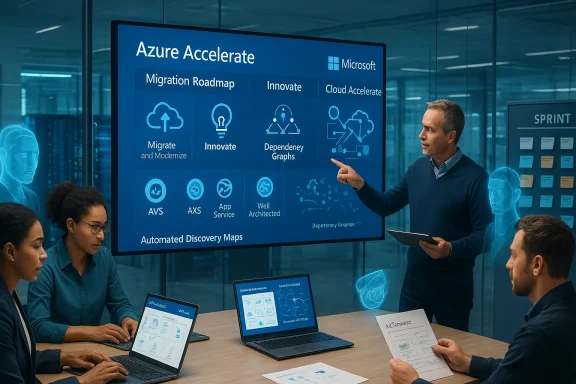
Microsoft's latest set of Azure offerings—rebranded and expanded into Azure Migrate and Modernize, Azure Innovate, and the new Cloud Accelerate Factory (now folded into the broader Azure Accelerate umbrella)—represents a strategic push to remove friction from cloud migrations and speed real-world deployments by combining tooling, partner funding, Microsoft-led engineering assistance, and new partner incentives. These moves pack automated assessment and migration tooling together with zero-cost, Microsoft-delivered deployment assistance for more than 30 Azure services, deeper partner funding for smaller engagements, and increased payouts for high-value scenarios such as Azure VMware Solution (AVS). The changes are designed to shorten planning cycles, reduce implementation risk, and redirect partner and customer engineering effort toward modernization and AI-driven value.
Source: BetaNews https://betanews.com/article/new-azure-offerings-help-speed-cloud-migration/]
 Background
Why migration still matters — and where it breaks down
Cloud migration remains a top strategic initiative for enterprises because it enables scalability, cost optimization, and access to cloud-native services such as managed databases, analytics, and AI. But migrations are frequently delayed or costlier than planned due to three recurring problems: incomplete discovery and dependency mapping, uncertain total cost of ownership (TCO) and business case, and delivery resource constraints when executing repeatable tasks like landing zone setup or basic rehosting. Microsoft’s expanded programs aim to address each of these pain points by combining automated tooling with funded partner engagements and Microsoft engineers who can handle routine deployment tasks.From AMMP to Azure Migrate and Modernize
The Azure Migration and Modernization Program (AMMP), an earlier Microsoft initiative to help customers plan and execute migrations, has been reworked and rebranded as Azure Migrate and Modernize. The new incarnation expands capability coverage—adding support for large and complex workloads such as HPC, Oracle, SAP, and even mainframe migration patterns—and promises deeper partner incentives and automated assessment and planning flows. Microsoft positions this as a more comprehensive, partner-scalable program for both lift-and-shift and modernization projects.What Microsoft announced (the pieces and how they fit)
Azure Migrate and Modernize — tooling and expanded workload coverage
Azure Migrate continues as Microsoft’s primary discovery, assessment, and migration control plane, but the offering has been bolstered with features aimed at reducing friction:- Automated discovery and dependency mapping for servers and databases.
- Business case analysis and sustainability insights in the migration business case.
- Expanded workload support (Linux, Oracle, SAP, HPC, mainframes).
- Integration with Azure frameworks like the Cloud Adoption Framework (CAF) and the Azure Well-Architected Framework (WAF).
Azure Innovate — innovation and AI-first modernization
Azure Innovate is a complementary program that targets customers who are beyond simple rehosting and need help infusing AI, advanced analytics, or cloud-native architectures into their applications. It provides guided assistance for:- Pilots and proofs-of-concept (PoCs) for AI and analytics.
- Application modernization assessments and developer skilling.
- Assistance deploying custom copilots and AI agents that work with a customer’s data.
Cloud Accelerate Factory — Microsoft-led, zero-cost deployment assistance
The most operationally significant new capability is Cloud Accelerate Factory, described as a zero-cost deployment benefit available through Azure Innovate and Azure Migrate and Modernize (and later integrated under Azure Accelerate). The Factory’s scope:- Microsoft experts deliver hands-on deployment assistance for more than 30 Azure services, operating in a joint-delivery model with an Azure partner.
- Activities covered include landing zone creation, infrastructure migrations (VMs, databases), application replatforming to PaaS, Azure Virtual Desktop migrations, and basic security enablement.
- The Factory aims to offload predictable, repeatable delivery tasks from partners and customers, enabling them to focus internal resources on higher-value design, custom integration, and business logic modernization.
Azure Accelerate — a single front door
To simplify engagement, Microsoft consolidated Azure Migrate and Modernize, Azure Innovate, and Cloud Accelerate Factory under a unified marketing and delivery umbrella called Azure Accelerate. Azure Accelerate packages tooling, funding, the Cloud Accelerate Factory benefit, and partner pathways into a single program intended to make it easier for customers and partners to nominate projects, secure funding, and receive hands-on support. The two-phase delivery model (planning phase then delivery/implementation) is a central pattern in Azure Accelerate.Why this matters to enterprise IT and partners
Faster time-to-value with reduced risk
Combining automated assessment tooling with Microsoft-led deployment assistance can shorten project timelines from months to weeks for common scenarios. The Factory model separates predictable delivery work from custom development tasks, which allows organizations to scale more quickly while leveraging Microsoft’s accumulated best practices. For teams constrained by capacity, the result is faster rollouts with a lower risk of misconfiguration.Lowered entry barriers for SMBs and small projects
A deliberate change in the partner design is the expansion of incentives and smaller engagement sizes targeted at the SMB segment. Microsoft added an SMB pathway to make it simpler for smaller partners to qualify for the programs and to access funding and Factory assistance for smaller projects. This is significant because historically, many incentive and funded programs favored large enterprise deals; opening up smaller engagement sizes enlarges the addressable market for partners and reduces friction for SMB customers to start a migration.Financial levers — credits and partner payouts
Azure Accelerate pairs technical assistance with financial levers:- Funded assessments and Azure credits to reduce upfront risk for customers.
- Expanded partner incentives, including enhanced payouts for Azure VMware Solution (AVS) migrations.
- For specific AVS partner-led engagement tiers, Microsoft has publicly stated increased incentive payouts up to USD $175,000 for qualifying scenarios—illustrating how Microsoft is financially underwriting migration economics for partners who bring customers to Azure. These payouts are tiered, subject to customer eligibility (planned incremental Azure consumption, AVS consumption thresholds), and governed by program rules. Partners and customers must verify current eligibility criteria and caps in Partner Center or with their Microsoft account team.
Technical and operational detail: what Cloud Accelerate Factory can actually do
Services and patterns supported
Cloud Accelerate Factory documentation and partner materials list the kinds of deployments the Factory can assist with:- Infrastructure and database migration (Windows, Linux, SQL Server, OSS databases).
- Modernization of databases to Azure PaaS offerings without heavy refactoring.
- App platform migrations (rehosting to App Service, containerization and AKS).
- Deployment of Azure Virtual Desktop and desktop virtualization migrations.
- Security baseline enablement using Defender for Cloud and Well-Architected patterns.
- Landing zone creation and governance guardrails to make the environment secure and repeatable.
Delivery model and lifecycle
Cloud Accelerate Factory follows a sprint-based, joint-delivery model:- Nomination and planning: customer or partner nominates the project via Azure Accelerate.
- Assessment and scoping: use Azure Migrate and other tools to build a migration plan and estimate costs and timelines.
- Factory delivery sprints: Microsoft engineers (Factory team) perform predictable deployment tasks in collaboration with the partner.
- Handover and knowledge transfer: partner or customer resumes ownership for custom work, optimization, and long-term operations.
Limitations and conditions
Important practical limitations to recognize:- “Zero-cost” assistance requires eligibility confirmation: not every candidate project will automatically receive Factory delivery. There are caps and regional availability constraints.
- Factory assistance is meant for repeatable, supported scenarios. Highly bespoke or legacy, poorly documented applications may still require extensive custom engineering outside Factory scope.
- Partner-led payouts and credits are contingent on meeting Microsoft’s consumption and AVS thresholds; payouts are post-sales and subject to validation.
- Availability of certain services or specialized expertise (HPC, mainframe migrations) may be regionally limited and dependent on partner skills.
Strategic implications and analysis
Strengths: what Microsoft gets right
- End-to-end approach: By combining assessment tooling, delivery assistance, funding, and partner incentives, Microsoft addresses both technical and commercial migration blockers in one program. This one-stop-shop approach simplifies procurement and project initiation and is well-aligned with enterprise buying patterns.
- Operational leverage: The Factory model centralizes repeatable technical tasks and scales best-practice deployments, which reduces marginal delivery costs and helps maintain consistent quality across partners.
- Market expansion: Opening up smaller engagement sizes and adding SMB pathways expands Microsoft’s reach and allows partners to monetize a broader set of customers.
- Focus on modernization and AI: Tying migration programs to AI modernization and co-building AI copilots gives Microsoft a stronger value proposition than mere rehosting—migration becomes an enabler for AI-driven transformation.
Risks and trade-offs
- Dependency on partner experience and governance: While Factory teams handle routine deployments, partners retain project ownership. If governance and knowledge transfer are weak, organizations may inherit brittle environments or miss optimization opportunities.
- Eligibility friction and regional constraints: The “zero-cost” label can be misleading if projects do not meet eligibility criteria. Customers could be disappointed if expectations are set without confirming conditions, language support, or regional availability.
- Vendor lock-in and cost trajectory: Microsoft’s enhanced credits and incentives are powerful short-term accelerators, but organizations must plan for steady-state costs and vendor lock-in impacts after promotional credits or funded assistance conclude.
- Scale of complexity: Complex legacy apps, mainframe replatforms, and highly regulated workloads still require deep, bespoke engineering work; Factory assistance may provide the baseline but not the entire solution.
Practical guidance: how enterprises should approach Azure Accelerate and Cloud Accelerate Factory
1. Validate eligibility early
Before assuming free deployment assistance, check regional availability, workload support, and qualification criteria with your Microsoft account team or Azure partner. Confirm that your project fits Factory-supported scenarios.2. Use tooling to build a realistic business case
Run Azure Migrate assessments to get TCO, performance sizing, and sustainability comparisons. Use the business-case outputs to decide what to rehost, refactor, or retire. Don’t skip dependency mapping—hidden interdependencies cause the majority of migration delays.3. Align partner incentives with long-term outcomes
If a partner is pursuing AVS or other incentive-rich scenarios, ensure the migration plan includes steady-state cost optimization and governance to avoid surprises when helper credits and payouts end. Use the funding and credits to pay for modernization that will reduce long-term operational costs.4. Preserve governance and automation
Ask the Factory team for automated landing-zone artifacts, IaC (infrastructure-as-code) templates, and documented runbooks during handover. These deliverables are critical for maintainability and secure operations after the Factory engagement ends.5. Treat modernization as the goal, not migration alone
Use Azure Innovate capabilities and PoCs to identify AI and analytics opportunities that can justify modernization costs. Migration should be a step toward a cloud-native architecture that enables measurable business outcomes such as faster analytics, improved uptime, or new product features.Partner view: what this means for service providers
New avenues for partner growth
- Partners can nominate a wider range of projects, including smaller SMB deals, and benefit from both Microsoft funding and Factory-delivered capacity for predictable work.
- Joint delivery with Factory teams lets partners focus on higher-value engineering and proprietary IP, while Microsoft handles repeatable setup tasks.
Operational and commercial steps for partners
- Align competencies and obtain Azure Solutions Partner designations for SMB pathways.
- Review the Factory collection and POE (proof-of-execution) materials to understand the delivery model and handover expectations.
- Nominate projects early through Partner Center to secure funding and Factory capacity.
- Build repeatable delivery accelerators and verticalized playbooks that complement Factory standardizations.
Realistic expectations and how to measure success
Short-term metrics
- Time to first workload cutover (weeks vs months).
- Number of landing zones deployed and validated against Well-Architected Framework checks.
- Partner deployment days reduced by Factory assistance.
Mid- to long-term metrics
- Steady-state monthly Azure consumption vs projected TCO.
- Application performance and availability improvements.
- Business outcomes from AI/analytics pilots (e.g., reduced processing time, increase in automation-driven revenue).
- Reduction in operational toil through IaC, automated monitoring, and security posture improvements.
Final assessment: a practical accelerator, not a panacea
Microsoft’s restructured migration offerings—Azure Migrate and Modernize, Azure Innovate, and Cloud Accelerate Factory, consolidated under Azure Accelerate—represent a notable shift from pure tooling toward joint commercial and operational acceleration. The use of Microsoft engineers to deliver predictable deployment tasks, paired with partner incentives and funded assessments, materially reduces common friction points that stall cloud migrations. For enterprises and partners with straightforward or mid-range complexity workloads, the Factory model can shave weeks off delivery timelines and reduce budget uncertainty. However, the programs are not a universal cure. Eligibility constraints, regional availability, and the intrinsic complexity of legacy systems mean that careful scoping, realistic expectations, and rigorous governance are still essential. Organizations should treat the Factory as a strategic lever—one that accelerates repeatable best-practice deployments—but not as a replacement for solid architecture, security, and cost-management planning.What to do next (action checklist)
- Request an Azure Migrate assessment to establish baseline readiness and a business case.
- Talk to your Microsoft account team or partner about Azure Accelerate and the Cloud Accelerate Factory to understand eligibility and regional availability.
- If migrating VMware workloads, evaluate AVS incentives and credit offers carefully and model steady-state costs post-migration.
- Insist on IaC templates and a documented handover from any Microsoft Factory engagement to preserve long-term manageability.
- Use Azure Innovate to scope AI pilots that can demonstrate measurable business value after migration.
Source: BetaNews https://betanews.com/article/new-azure-offerings-help-speed-cloud-migration/]
