

Microsoft and 3M have announced a July 15 partnership that puts an unglamorous AI data-center problem in focus: fiber connectors that need cleaning before they can be deployed at scale.
Azure will become the first publicly announced hyperscale cloud provider to deploy 3M’s Expanded Beam Optical (EBO) technology in its cloud and AI infrastructure, according to the companies’ joint announcement. The hardware is designed to make dense fiber connections more tolerant of dust and routine handling, reducing the inspection and cleaning work associated with conventional physical-contact connectors.
Traditional fiber connections rely on polished fiber end faces meeting directly. Contamination can interrupt the optical path, forcing technicians to inspect, clean and reconnect ports. That is manageable in a modest server room, but it becomes an operational drag when a large GPU cluster involves extensive high-speed optical cabling.
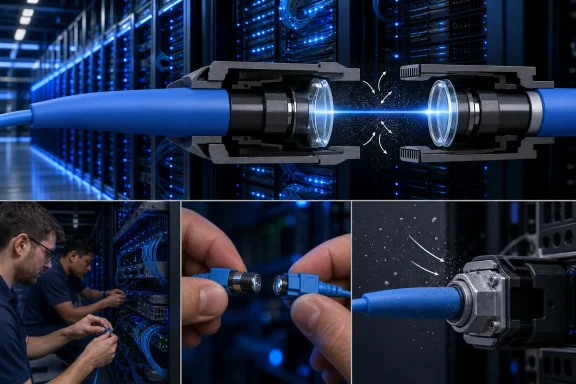
3M’s EBO approach uses collimating optics to expand the light beam across a small air gap rather than requiring direct fiber-to-fiber contact. The company says this makes the interface less sensitive to dust and debris. Its EBO ferrule documentation also describes a genderless design intended to simplify installation and inventory compared with systems requiring distinct mating ends.
Microsoft said its early EBO deployments have shown potential to shorten network deployment timelines in some environments while maintaining signal performance under normal data-center conditions, including dust exposure and frequent handling. Neither company disclosed the number of Azure facilities involved, deployment dates, capacity additions, or financial terms.
That restraint matters. This is not a new Azure product, region, GPU SKU, networking feature or API. Customers should not expect a portal change or a direct service announcement as a result of the deal.
3M says it is also increasing EBO production capacity and helped establish an Expanded Beam Optical Multi-Source Agreement intended to support broader interoperability. That standardization effort is significant because large cloud operators generally want alternatives to single-supplier infrastructure components.
EBO will not replace every fiber connector. The technology’s purpose is to address high-volume, contamination-sensitive deployment environments rather than serve as a universal answer for all optical transport needs. The announcement also does not establish that other hyperscalers will adopt the format.
For Azure customers, the practical outcome is unchanged today: EBO is back-end infrastructure, with any benefit appearing only if it helps Microsoft expand and maintain AI capacity faster.
Azure will become the first publicly announced hyperscale cloud provider to deploy 3M’s Expanded Beam Optical (EBO) technology in its cloud and AI infrastructure, according to the companies’ joint announcement. The hardware is designed to make dense fiber connections more tolerant of dust and routine handling, reducing the inspection and cleaning work associated with conventional physical-contact connectors.
 A physical-layer fix for AI buildouts
Traditional fiber connections rely on polished fiber end faces meeting directly. Contamination can interrupt the optical path, forcing technicians to inspect, clean and reconnect ports. That is manageable in a modest server room, but it becomes an operational drag when a large GPU cluster involves extensive high-speed optical cabling.3M’s EBO approach uses collimating optics to expand the light beam across a small air gap rather than requiring direct fiber-to-fiber contact. The company says this makes the interface less sensitive to dust and debris. Its EBO ferrule documentation also describes a genderless design intended to simplify installation and inventory compared with systems requiring distinct mating ends.
Microsoft said its early EBO deployments have shown potential to shorten network deployment timelines in some environments while maintaining signal performance under normal data-center conditions, including dust exposure and frequent handling. Neither company disclosed the number of Azure facilities involved, deployment dates, capacity additions, or financial terms.
That restraint matters. This is not a new Azure product, region, GPU SKU, networking feature or API. Customers should not expect a portal change or a direct service announcement as a result of the deal.
Why it matters to Azure users
The potential value is indirect: reducing physical installation and maintenance friction could help Microsoft bring AI-network infrastructure online more quickly. As GPU clusters grow, the network fabric connecting accelerators can require vast numbers of optical links. A connector that avoids frequent cleaning and inspection is a small component-level improvement, but it can become meaningful when repeated across a hyperscale deployment.3M says it is also increasing EBO production capacity and helped establish an Expanded Beam Optical Multi-Source Agreement intended to support broader interoperability. That standardization effort is significant because large cloud operators generally want alternatives to single-supplier infrastructure components.
EBO will not replace every fiber connector. The technology’s purpose is to address high-volume, contamination-sensitive deployment environments rather than serve as a universal answer for all optical transport needs. The announcement also does not establish that other hyperscalers will adopt the format.
The other half of the partnership
The agreement runs both ways. 3M plans to use Microsoft AI and digital products across customer service, finance, sales and marketing. Per Microsoft’s announcement, an initial project pairs Microsoft engineers with 3M’s Global Business Services group on an AI-assisted order-management workflow covering tasks such as credit checks, delinquency assessments and system updates, with human approvals and monitoring controls.For Azure customers, the practical outcome is unchanged today: EBO is back-end infrastructure, with any benefit appearing only if it helps Microsoft expand and maintain AI capacity faster.
References
- Primary source: Tech Times
Published: 2026-07-18T14:03:59+00:00
Loading…
www.techtimes.com - Related coverage: storagereview.com
Loading…
www.storagereview.com - Related coverage: marketchameleon.com
Loading…
marketchameleon.com - Related coverage: cyberogz.com
Loading…
cyberogz.com - Related coverage: telecompaper.com
Loading…
www.telecompaper.com - Related coverage: multimedia.3m.com
Loading…
multimedia.3m.com