

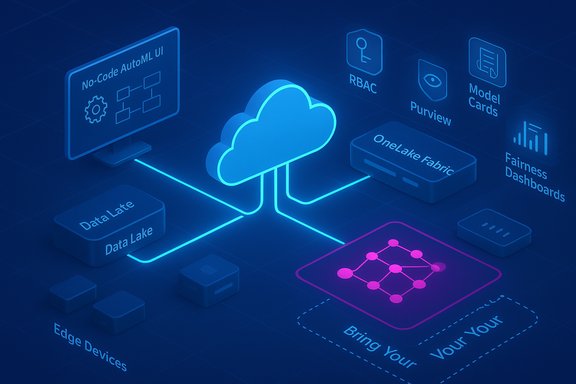
Microsoft’s latest expansion of the Azure AI platform is another clear signal that the company is aggressively bundling machine learning, data analytics, and enterprise governance into a single cloud-first toolkit aimed at speeding adoption while lowering operational friction for IT and data teams. The update ties deeper AutoML and MLOps workflows into Microsoft Fabric and Azure Machine Learning, adds richer dataset management and lineage, extends enterprise-grade agent and runtime options, and doubles down on responsible AI guardrails — all designed to shorten time-to-value for production AI.
Background
Microsoft has been evolving Azure AI into an integrated stack for several years: Azure Machine Learning, Azure AI Studio, Azure OpenAI Service, and the newer “Foundry” constructs are intended to cover the full lifecycle from data ingestion, model development, and explainability to secure deployment and monitoring. Recent releases bundle no-code tooling, model playgrounds, expanded model catalogs and GPU-accelerated VM offerings to tackle everything from research workloads to real-time inference at scale. These changes reflect a strategy to democratize AI while also catering to large enterprises with strict compliance and governance needs. Microsoft’s positioning is consistent with public messaging on responsible AI and enterprise readiness: the company continues to push for built-in explainability, fairness tooling, and network isolation features alongside high-performance compute options and low-latency hosting. Independent reporting and Microsoft’s own blogs reinforce the idea that Azure’s evolution is focused on enabling practical, auditable AI in regulated industries.What’s new — feature-by-feature
1. Expanded AutoML and No-code Experiences
- The platform extends AutoML beyond tabular data to include text and image tasks through a no-code UI and SDK, with automated preprocessing, feature engineering, and hyperparameter tuning that aim to accelerate prototyping for non-ML specialists. This lowers the barrier for business analysts to produce models without deep data-science expertise.
2. Richer dataset management, lineage and OneLake/Fabric integrations
- Azure’s dataset tooling now emphasizes large-scale cleaning, dataset registries, versioning, and lineage tracking, plus tighter interoperability with Azure Data Lake, Microsoft Fabric, and OneLake. These features help prevent the common “works in dev, fails in production” problem by ensuring reproducibility and auditable data provenance.
3. MLOps, MLflow support and CI/CD integration
- Deeper MLOps support now includes MLflow integration for experiment tracking and model registry, managed endpoints with controlled rollouts, ONNX runtime acceleration, and seamless CI/CD pipelines through Azure DevOps extensions. These additions are built to make productionization predictable and repeatable.
4. Model interpretability, fairness, and responsible AI tooling
- New built-in explainability features — model cards, local/global explanations, integrated fairness checks (including Fairlearn support) and dashboards — are now part of the lifecycle tools to support governance and regulatory requirements. Microsoft’s array of Responsible AI features and content-safety services are woven into model workflows to help teams surface bias and problematic outputs earlier.
5. Expanded model catalog and customization (Azure AI Foundry)
- Azure has widened its model portfolio — including multimodal and specialized LLMs — and introduced tools for customization, distillation, and reinforcement fine-tuning. A code-first distillation workflow and Stored Completions API let organizations create smaller, more efficient versions of large models for cost-sensitive or on-device scenarios.
6. Enterprise agent services, Magma orchestration and “Bring Your VNet”
- The Azure AI Agent Service and orchestration layer (sometimes referenced as Magma) enable enterprises to create and coordinate multiple task-oriented agents. Critically, Microsoft has added “Bring Your VNet” support so agent workflows and data flows can execute entirely inside a customer-controlled virtual network, minimizing exposure to the public internet.
7. New compute and edge options
- Microsoft has upgraded instance types and introduced AI-tuned VMs leveraging NVIDIA’s Blackwell architecture for heavy training workloads, and improved Azure Local / edge capabilities for processing where data is produced. These options target high-throughput training and low-latency inference at the edge.
8. Industry-specific models and partner ecosystems
- Microsoft and its partners are rolling out verticalized models (healthcare imaging, finance, manufacturing) and marketplace offers to reduce integration work. The platform’s integration with partners such as Databricks, Statsig, and specialized ISVs helps enterprises pick pre-built solutions for domain-specific needs.
Responsible AI: practical guardrails baked in
Microsoft is making responsible AI a central selling point. The platform blends technical features (bias detection, content-safety checks, explainability dashboards) with governance constructs (data zones, private VNet operation, RBAC, and Purview integration). These elements are intended to give security and legal teams the audit tea leaves they need without obstructing developer workflows. Caveat: while the tooling surfaces explainability metrics and bias indicators, the interpretation and remediation of fairness issues typically require human judgment and context-specific policy decisions. Built-in tooling reduces friction, but it is not a substitute for governance processes, legal review, and external audits in high-risk domains.Cross-checks and verification
Multiple independent sources corroborate the central thrust of Microsoft’s announcements: improved AutoML/no-code experiences, deeper MLOps and dataset governance, expanded model catalogs, and stronger responsible AI features. Microsoft’s public developer blogs and product pages document no-code AutoML and Responsible AI dashboards, while independent reporting and analyst coverage highlight Azure’s consolidation strategy and new enterprise features. Specific claims that originate in early previews or third-party summaries should be treated cautiously. For example, internal summaries that give precise numeric improvements for a model (e.g., exact hallucination reduction percentages or accuracy leaps for versions like “GPT‑4.5”) were present in some briefing material, but those performance figures are often benchmark-dependent and should be verified against Microsoft’s formal release notes and independent benchmark studies before being treated as definitive.Industry impact: where this matters most
Healthcare
- Faster model iteration and validated dataset lineage helps clinical research and imaging pipelines move from experimentation to regulated deployment. Industry-focused LLMs and imaging models can speed radiology workflows and clinical documentation — provided privacy and PHI safeguards are configured correctly.
Finance
- The combination of explainability tools, model cards, and VNet isolation addresses core regulatory concerns in risk scoring and fraud detection. MLOps pipelines and MLflow integration make it easier to audit model drift and rollback problematic models.
Retail and Manufacturing
- Edge inference, industry models for inventory and predictive maintenance, and tighter integration with Dynamics/Power Platform give retailers and manufacturers practical routes to embed AI in operational workflows. Copilot integrations and agent services help automate routine decisions and accelerate front-line productivity.
Strengths: what Microsoft did well
- Integrated lifecycle: Microsoft maps data ingestion to model governance and monitoring in a unified environment, which reduces toolchain friction for enterprise teams.
- Enterprise controls: VNet isolation, RBAC, Purview integration and private deployments align with regulatory needs.
- Wide model choice: The platform supports a broad array of models (internal and third-party) and provides play-and-compare tooling so organizations can select the best fit.
- Developer ergonomics: No-code AutoML, SDKs, and integrations with VS Code/Visual Studio and GitHub lower friction for developer adoption.
Risks and adoption pitfalls
- Complexity at scale: While consolidation reduces integration work, the sheer breadth of options (multiple model types, agent orchestration, compute SKUs, and data governance knobs) can overwhelm teams that lack a clear operating model for AI adoption.
- Hidden costs: Model inference, fine-tuning and large-scale training carry compute and storage costs that can escalate quickly without strict governance; organizations must set budgets and implement observability for cost-per-inference and throughput.
- Over-reliance on vendor tooling: Built-in explainability and fairness checks are valuable but are not a replacement for independent validation; organizations should plan for external model audits in regulated use cases.
- Supply-chain and geopolitical concerns: Integrating third-party or regionally-hosted models can raise data residency or supply-chain risk (as seen in reports around certain third-party model integrations). Enterprises should validate where weights and logs are stored and who controls access.
Practical guidance for Windows-focused enterprise IT teams
- Start with a pilot that has measurable KPIs (latency, accuracy, cost-per-inference) and a defined rollback plan.
- Use dataset registries and OneLake integration to enforce versioning and lineage from day one.
- Protect production inference using “Bring Your VNet” and managed endpoints; require RBAC for deployment and Purview for data classification.
- Budget for monitoring and experimentation tooling (A/B tests for model versions, cost telemetry) — vendor integrations like Statsig can help standardize experimentation.
- Treat Responsible AI features as part of a governance program: map explainability outputs to legal and compliance reviews before models touch regulated data.
Verification notes and caution flags
- Many of the platform’s most attractive features are rolled out through staged previews, private previews, or partner integrations. Specific quantitative claims about model-level performance or hallucination reduction observed in preview briefings should be verified against public release notes and independent benchmark reports before they are used in procurement or compliance paperwork.
- Model availability and pricing tiers (provisioned throughput units, PTUs for fine-tuned models) differ by region and SKUs; confirm availability for your Azure regions and subscription level.
Final assessment
Microsoft’s expansion of the Azure AI platform continues a pragmatic strategy: provide an end-to-end, enterprise-ready AI stack that covers model experimentation, data governance, explainability, and secure production deployment. For Windows-centric organizations and enterprise IT teams, the consolidation reduces the number of integration headaches and provides a coherent way to move from proof-of-concept to production.The real value will come to organizations that pair these technical advances with disciplined governance — defined KPIs, budget controls, external validation, and a clear data-residency policy. When deployed that way, the new Azure AI capabilities can materially accelerate AI initiatives across healthcare, finance, retail, and manufacturing while preserving auditability and operational security. However, teams must still be cautious about treating preview numbers as production guarantees and should validate performance, cost and compliance implications in controlled pilots before wide rollout.
Microsoft’s push to make advanced machine learning and data analytics broadly accessible is unmistakable. The platform now matches the expectations of enterprises that need both power and governance; the onus is on customers to adopt with discipline so those tools realize sustainable business value.
Source: Neuron Expert Microsoft Expands Azure AI Platform with Advanced Machine Learning and Data Analytics Tools
