

Microsoft’s February 27, 2025 Azure AI Foundry update is more than a routine model refresh. It is a clear signal that Microsoft wants Azure to be the place where frontier models, smaller efficient models, and enterprise-grade controls all converge in one stack. The headline addition is GPT-4.5 in preview, but the larger story is the platform architecture around it: new distillation workflows, reinforcement fine-tuning, provisioned deployments for fine-tuned models, and tighter security for AI agents operating inside customer networks. (azure.microsoft.com)
Microsoft framed the announcement as a move from AI experimentation to tangible business impact, and that framing matters. In practice, many enterprises have spent the last two years piloting generative AI in isolated workflows, only to run into concerns around latency, cost predictability, security boundaries, and observability. Azure AI Foundry’s latest changes are aimed directly at those blockers, not just at adding another model to a catalog. (azure.microsoft.com)
The timing is also notable. By late February 2025, Microsoft had already expanded its model ecosystem beyond OpenAI with a growing lineup that included Phi, Stability AI, Cohere, and others. That breadth tells us Microsoft is no longer pitching Azure AI as a single-model story. Instead, it is positioning the platform as a model portfolio where customers can choose the best fit for a specific task, whether that task demands reasoning, retrieval, multimodal input, generation speed, or cost efficiency. (azure.microsoft.com)
There is another important subtext: Microsoft is emphasizing control layers as much as model quality. The announcement highlights Bring your VNet for Azure AI Agent Service, a capability designed to keep interactions, data processing, and API calls inside a customer’s virtual network. That is the sort of feature that rarely headlines consumer discussions, but it is exactly the sort of thing that can unlock enterprise adoption at scale. (azure.microsoft.com)
Microsoft says GPT-4.5 improves the feel of interaction as much as the output quality. In the company’s own wording, it has a broader knowledge base, stronger alignment, and a more natural conversational style, which Microsoft says helps with coding, writing, and problem-solving. That makes GPT-4.5 sound less like a specialized reasoning engine and more like a versatile assistant that can act across business functions. (azure.microsoft.com)
That caveat matters because enterprise teams tend to overread benchmark-like claims. A model can look dramatically better in a controlled test and still be disappointing in a specialized domain where terminology, policy constraints, or multi-step workflows create complexity. Still, lower hallucination rates and stronger alignment are exactly the sort of improvements that can reduce manual review overhead in production systems. (azure.microsoft.com)
That integration strategy is one of Microsoft’s strongest competitive advantages. If a model is available both in the cloud platform and in productivity or developer tooling, adoption friction drops dramatically. It also increases the odds that enterprises will standardize on Microsoft’s AI stack rather than stitching together separate vendors for inference, orchestration, and end-user experiences. (azure.microsoft.com)
This is where Azure AI Foundry begins to look less like a single AI service and more like a managed operating environment. One team might want a model optimized for multimodal support. Another might need a cheaper, smaller model for classification or summarization. A third might need a ranking model that improves search quality in a retrieval pipeline. Microsoft is making the case that Azure should cover all of those use cases inside one governance perimeter. (azure.microsoft.com)
That matters because cost-efficient models are quickly becoming the workhorses of enterprise AI. Many businesses do not need a massive frontier model for every interaction. They need something fast, controllable, and cheap enough to deploy broadly across internal systems, kiosks, help desks, and workflow automation. The Phi family is Microsoft’s answer to that market reality. (azure.microsoft.com)
This is strategically important for Microsoft because image generation remains a high-value business category. Marketing teams want speed and consistency. E-commerce teams want photorealistic product assets. Creative teams want brand-safe output. By offering these models in the same platform as text and speech models, Microsoft is building a more complete AI production stack. (azure.microsoft.com)
In many real deployments, retrieval quality determines whether a chatbot feels intelligent or useless. A strong base model cannot compensate for poor grounding if the right documents are never surfaced. By adding a reranking layer with broad multilingual support, Microsoft is reinforcing the infrastructure needed for enterprise-grade assistants. (azure.microsoft.com)
Distillation is especially significant because it creates a practical bridge between frontier capability and production economics. Microsoft says its code-first Stored Completions API and SDK can help smaller models inherit knowledge from larger ones such as GPT-4.5. In plain terms, that means organizations can use a larger model to teach a smaller one, then deploy the smaller model more cheaply and with lower latency. (azure.microsoft.com)
The practical result is a better balance between quality and economics. A company might use GPT-4.5 to generate high-quality examples, then distill those behaviors into a smaller model tailored for a narrow workflow. That could be especially valuable in support automation, data extraction, and internal policy assistants, where cost and determinism matter. (azure.microsoft.com)
That has obvious upside and obvious risk. If done well, it can improve task-specific reasoning in regulated workflows, planning systems, and multi-step decision trees. If done poorly, it can overfit the model to local patterns or create brittle behavior that looks smart in testing and fails in edge cases. As with all advanced tuning techniques, the operational guardrails matter as much as the math. (azure.microsoft.com)
Predictability is one of the biggest barriers to enterprise AI scaling. Uncapped usage-based costs can turn a promising assistant into a budget problem overnight. Provisioned capacity gives enterprises a way to plan around throughput, service levels, and spending with more confidence. That could be decisive for call centers, regulated industries, and high-volume internal automation. (azure.microsoft.com)
The most important feature here is Bring your VNet for Azure AI Agent Service. Microsoft says all AI agent interactions, data processing, and API calls can remain inside a customer’s own virtual network, avoiding exposure to the public internet. For many enterprises, that is not a luxury but a prerequisite. It addresses a central concern: if an agent is going to take actions on sensitive systems, where does the traffic go, and who can see it? (azure.microsoft.com)
That makes this feature a commercialization enabler. It lowers the adoption barrier for industries such as finance, healthcare, manufacturing, and government, where network segmentation is not optional. It also lets Microsoft tell a compelling story about AI without sacrificing the language of security architecture. That is a rare combination in the market right now. (azure.microsoft.com)
That kind of case study is valuable because it shifts the conversation from “Can this agent work?” to “What business process should this agent replace or augment?” If the answer is sales proposal generation, the value proposition becomes easier to understand in terms of labor savings, speed, and consistency. If the answer is broader workflow automation, the stakes become even higher. (azure.microsoft.com)
This is where the AI conversation starts to move from individual prompts to systems design. A single agent can assist with one task. A multi-agent architecture can potentially divide labor across planning, retrieval, verification, action execution, and exception handling. That may be the direction enterprise AI eventually takes, but it also multiplies complexity. (azure.microsoft.com)
That makes Magma interesting as a signal rather than as an immediate product play. Microsoft is indicating that it sees value in agent orchestration at scale, but it is also wise to keep it in a labs environment. That gives the company room to experiment while customers learn what multi-agent workflows actually require. (azure.microsoft.com)
The platform strategy also helps Microsoft hedge. If a customer needs the absolute newest frontier capability, Microsoft can point to GPT-4.5. If the customer needs efficiency, it can point to Phi. If the customer needs retrieval quality, it can point to Cohere. If the customer needs secure automation, it can point to Agent Service and Bring your VNet. That diversity is a moat. (azure.microsoft.com)
The distinction matters because enterprise AI often becomes consumer AI later. Features tested in Azure frequently become part of the everyday software stack through Microsoft 365, GitHub, and adjacent products. In that sense, enterprise investment in Foundry can shape the future of mainstream productivity software even if most users never touch Azure directly. (azure.microsoft.com)
The next phase will also reveal whether enterprises prefer Microsoft’s integrated approach or a more modular, vendor-diverse strategy. Some organizations will value the convenience and control of a unified stack. Others will remain cautious about deep dependence on any single cloud for models, orchestration, and governance. The answer may differ by industry, but the market direction is unmistakable: AI platforms are becoming infrastructure, not just software features. (azure.microsoft.com)
Source: HPCwire Microsoft Expands Azure AI Foundry with GPT-4.5, New Tools, and Enterprise AI Features - BigDATAwire
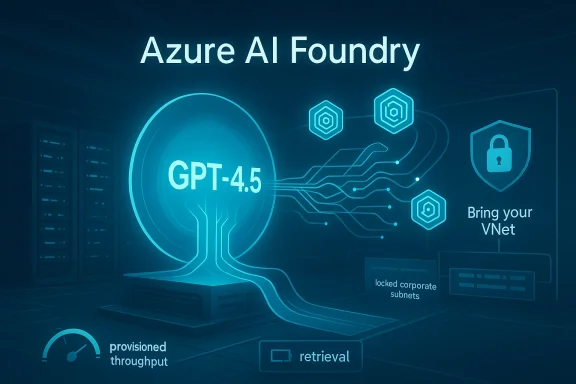 Overview
Microsoft framed the announcement as a move from AI experimentation to tangible business impact, and that framing matters. In practice, many enterprises have spent the last two years piloting generative AI in isolated workflows, only to run into concerns around latency, cost predictability, security boundaries, and observability. Azure AI Foundry’s latest changes are aimed directly at those blockers, not just at adding another model to a catalog. (azure.microsoft.com)The timing is also notable. By late February 2025, Microsoft had already expanded its model ecosystem beyond OpenAI with a growing lineup that included Phi, Stability AI, Cohere, and others. That breadth tells us Microsoft is no longer pitching Azure AI as a single-model story. Instead, it is positioning the platform as a model portfolio where customers can choose the best fit for a specific task, whether that task demands reasoning, retrieval, multimodal input, generation speed, or cost efficiency. (azure.microsoft.com)
There is another important subtext: Microsoft is emphasizing control layers as much as model quality. The announcement highlights Bring your VNet for Azure AI Agent Service, a capability designed to keep interactions, data processing, and API calls inside a customer’s virtual network. That is the sort of feature that rarely headlines consumer discussions, but it is exactly the sort of thing that can unlock enterprise adoption at scale. (azure.microsoft.com)
Why this release matters
The immediate effect is obvious: Azure customers get access to newer and more capable models. The deeper effect is strategic. By pairing premium frontier models like GPT-4.5 with smaller models such as Phi-4-mini and specialized tools like Cohere Rerank v3.5, Microsoft is making the case that AI deployment should be treated like an engineering portfolio, not a one-size-fits-all purchase. (azure.microsoft.com)- Microsoft is broadening model choice rather than betting on a single flagship.
- The company is pushing enterprise governance alongside model access.
- New tooling is designed to reduce cost, latency, and operational friction.
- Agent capabilities are being wrapped in network and security controls.
GPT-4.5 as the centerpiece
Microsoft’s biggest headline is the preview of GPT-4.5 in Azure OpenAI Service and Azure AI Foundry. The company describes it as its “latest and strongest general-purpose model,” emphasizing a research-preview step that reflects advances in scaling pre- and post-training. That language is important because it places GPT-4.5 in the lineage of large-scale unsupervised learning rather than as a narrow, task-specific release. (azure.microsoft.com)Microsoft says GPT-4.5 improves the feel of interaction as much as the output quality. In the company’s own wording, it has a broader knowledge base, stronger alignment, and a more natural conversational style, which Microsoft says helps with coding, writing, and problem-solving. That makes GPT-4.5 sound less like a specialized reasoning engine and more like a versatile assistant that can act across business functions. (azure.microsoft.com)
The performance claims
Microsoft also highlighted numbers that will attract immediate attention from developers and procurement teams alike. In the blog, the company says GPT-4.5 showed a 37.1% hallucination rate versus 61.8% for GPT-4o and 62.5% accuracy versus 38.2% for GPT-4o in the cited comparison. Those are significant claims, although as always with preview models, the real-world outcome will depend on workload, prompting discipline, and deployment context. (azure.microsoft.com)That caveat matters because enterprise teams tend to overread benchmark-like claims. A model can look dramatically better in a controlled test and still be disappointing in a specialized domain where terminology, policy constraints, or multi-step workflows create complexity. Still, lower hallucination rates and stronger alignment are exactly the sort of improvements that can reduce manual review overhead in production systems. (azure.microsoft.com)
- Lower hallucinations can reduce compliance and support burden.
- Higher accuracy can improve trust in internal copilots.
- Stronger alignment helps with instruction-following in workflows.
- Natural interaction may matter most in customer-facing deployments.
Enterprise access and Copilot reach
Microsoft said enterprise customers could access GPT-4.5 in Azure AI Foundry starting the day of the announcement, and the model is also available in GitHub Copilot Chat for Copilot Enterprise users. That dual placement is important because it extends the model beyond infrastructure buyers and into the daily workflow of developers. In other words, Microsoft is not merely selling model access; it is also embedding the model in the tools where work already happens. (azure.microsoft.com)That integration strategy is one of Microsoft’s strongest competitive advantages. If a model is available both in the cloud platform and in productivity or developer tooling, adoption friction drops dramatically. It also increases the odds that enterprises will standardize on Microsoft’s AI stack rather than stitching together separate vendors for inference, orchestration, and end-user experiences. (azure.microsoft.com)
The broader model catalog strategy
The GPT-4.5 launch sits inside a much wider model catalog strategy. Microsoft says its library now surpasses 1,800 offerings, and the February 2025 update showcases that breadth with Phi, Stability AI, Cohere, and GPT-4o variants all receiving attention. That matters because enterprise buyers increasingly want the freedom to match a model to a workload without changing platforms. (azure.microsoft.com)This is where Azure AI Foundry begins to look less like a single AI service and more like a managed operating environment. One team might want a model optimized for multimodal support. Another might need a cheaper, smaller model for classification or summarization. A third might need a ranking model that improves search quality in a retrieval pipeline. Microsoft is making the case that Azure should cover all of those use cases inside one governance perimeter. (azure.microsoft.com)
Phi-4 and the efficiency narrative
Microsoft’s Phi-4-multimodal and Phi-4-mini releases are central to that story. Phi-4-multimodal unifies text, speech, and vision for context-aware interactions, while Phi-4-mini is described as a 3.8 billion parameter model with a 128K-token context window and improved speed. Microsoft says Phi-4-mini can outperform larger models on coding and math tasks while delivering a 30% inference speed gain compared with prior models. (azure.microsoft.com)That matters because cost-efficient models are quickly becoming the workhorses of enterprise AI. Many businesses do not need a massive frontier model for every interaction. They need something fast, controllable, and cheap enough to deploy broadly across internal systems, kiosks, help desks, and workflow automation. The Phi family is Microsoft’s answer to that market reality. (azure.microsoft.com)
- Phi-4-multimodal targets richer input streams.
- Phi-4-mini emphasizes speed and compactness.
- Smaller models can lower inference costs.
- Efficiency is often the difference between prototype and production.
Stability AI and content generation
Microsoft also expanded its generative imaging story through Stability AI. The announcement highlights Stable Diffusion 3.5 Large, Stable Image Ultra, and Stable Image Core, each pitched as a way to accelerate marketing and product-visual workflows. The message is clear: Azure AI Foundry is not only for conversational intelligence, but also for visual content creation, product imagery, and design support. (azure.microsoft.com)This is strategically important for Microsoft because image generation remains a high-value business category. Marketing teams want speed and consistency. E-commerce teams want photorealistic product assets. Creative teams want brand-safe output. By offering these models in the same platform as text and speech models, Microsoft is building a more complete AI production stack. (azure.microsoft.com)
Cohere and retrieval quality
The inclusion of Cohere Rerank v3.5 is easy to overlook, but it is one of the most operationally meaningful parts of the release. Microsoft says the model improves search quality across keyword and vector search systems, supports more than 100 languages, and can surface relevant content without exact keyword matches. That makes it highly relevant for enterprise knowledge search, customer service, and retrieval-augmented generation pipelines. (azure.microsoft.com)In many real deployments, retrieval quality determines whether a chatbot feels intelligent or useless. A strong base model cannot compensate for poor grounding if the right documents are never surfaced. By adding a reranking layer with broad multilingual support, Microsoft is reinforcing the infrastructure needed for enterprise-grade assistants. (azure.microsoft.com)
Customization moves from optional to foundational
The customization story in this release is arguably just as important as the model additions. Microsoft is pushing distillation, reinforcement fine-tuning, and provisioned deployment as first-class tools, which indicates a broader shift from simply consuming models to actively shaping them for business use. That is a more mature enterprise posture and a more defensible one. (azure.microsoft.com)Distillation is especially significant because it creates a practical bridge between frontier capability and production economics. Microsoft says its code-first Stored Completions API and SDK can help smaller models inherit knowledge from larger ones such as GPT-4.5. In plain terms, that means organizations can use a larger model to teach a smaller one, then deploy the smaller model more cheaply and with lower latency. (azure.microsoft.com)
Distillation, but made operational
That approach is not new in concept, but Microsoft’s emphasis on a code-first workflow is important. Enterprises do not want theoretical machine learning concepts; they want repeatable tooling that fits their CI/CD pipeline, test harnesses, and deployment policies. If distillation becomes easier to operationalize, more teams will actually use it instead of treating it as an advanced research exercise. (azure.microsoft.com)The practical result is a better balance between quality and economics. A company might use GPT-4.5 to generate high-quality examples, then distill those behaviors into a smaller model tailored for a narrow workflow. That could be especially valuable in support automation, data extraction, and internal policy assistants, where cost and determinism matter. (azure.microsoft.com)
- Distillation can reduce cost per request.
- Smaller models can deliver better latency.
- Code-first tooling improves repeatability.
- The model lifecycle becomes easier to govern.
Reinforcement fine-tuning and reasoning
Microsoft also put reinforcement fine-tuning into private preview, describing it as a way to teach models new reasoning behaviors by rewarding correct logical paths and penalizing incorrect ones. That is a subtle but meaningful evolution because it suggests Microsoft wants enterprises to do more than format or tone customization. It wants them to shape the reasoning process itself. (azure.microsoft.com)That has obvious upside and obvious risk. If done well, it can improve task-specific reasoning in regulated workflows, planning systems, and multi-step decision trees. If done poorly, it can overfit the model to local patterns or create brittle behavior that looks smart in testing and fails in edge cases. As with all advanced tuning techniques, the operational guardrails matter as much as the math. (azure.microsoft.com)
Provisioned throughput and predictable economics
Another important addition is Provisioned Deployments for fine-tuned models, which Microsoft says will give customers predictable performance and costs through Provisioned Throughput Units alongside token-based billing. That is not flashy, but it is the kind of detail procurement teams care about when AI moves from experimentation into business-critical workloads. (azure.microsoft.com)Predictability is one of the biggest barriers to enterprise AI scaling. Uncapped usage-based costs can turn a promising assistant into a budget problem overnight. Provisioned capacity gives enterprises a way to plan around throughput, service levels, and spending with more confidence. That could be decisive for call centers, regulated industries, and high-volume internal automation. (azure.microsoft.com)
Secure agents become the enterprise wedge
The agent story in this announcement is a strong indicator of where Microsoft thinks the market is headed. Rather than focusing only on chat interfaces, Azure AI Foundry is moving toward secure automation, where agents perform multi-step tasks under enterprise controls. That is a different value proposition, and potentially a bigger one. (azure.microsoft.com)The most important feature here is Bring your VNet for Azure AI Agent Service. Microsoft says all AI agent interactions, data processing, and API calls can remain inside a customer’s own virtual network, avoiding exposure to the public internet. For many enterprises, that is not a luxury but a prerequisite. It addresses a central concern: if an agent is going to take actions on sensitive systems, where does the traffic go, and who can see it? (azure.microsoft.com)
Why network isolation matters
The significance of Bring your VNet is larger than the phrasing suggests. Enterprises often care less about whether an AI model is “smart enough” than about whether it can operate within existing security and compliance boundaries. If the data path is not compatible with a company’s trust model, the project stalls no matter how good the model is. (azure.microsoft.com)That makes this feature a commercialization enabler. It lowers the adoption barrier for industries such as finance, healthcare, manufacturing, and government, where network segmentation is not optional. It also lets Microsoft tell a compelling story about AI without sacrificing the language of security architecture. That is a rare combination in the market right now. (azure.microsoft.com)
- Keeps agent traffic inside the customer network.
- Supports more confident deployment in regulated sectors.
- Reduces exposure to the public internet.
- Makes agent rollouts easier to defend to security teams.
Fujitsu and the enterprise proof point
Microsoft pointed to Fujitsu as an early adopter, saying the company improved sales by 67% with a sales proposal creation agent while saving substantial time for customer engagement and strategy. As always with vendor examples, the precise business context matters, but the broader lesson is clear: Microsoft wants to show that agentic systems can produce measurable operational gains, not just demo-room novelty. (azure.microsoft.com)That kind of case study is valuable because it shifts the conversation from “Can this agent work?” to “What business process should this agent replace or augment?” If the answer is sales proposal generation, the value proposition becomes easier to understand in terms of labor savings, speed, and consistency. If the answer is broader workflow automation, the stakes become even higher. (azure.microsoft.com)
Magma and the multi-agent future
Microsoft’s Magma project, short for Multi-Agent Goal Management Architecture, suggests the company is thinking beyond single-agent assistants into orchestrated swarms of agents. Microsoft says the architecture can coordinate hundreds of AI agents in parallel and is available for experimentation in Azure AI Foundry Labs. That places it squarely in the experimental but strategically interesting category. (azure.microsoft.com)This is where the AI conversation starts to move from individual prompts to systems design. A single agent can assist with one task. A multi-agent architecture can potentially divide labor across planning, retrieval, verification, action execution, and exception handling. That may be the direction enterprise AI eventually takes, but it also multiplies complexity. (azure.microsoft.com)
Orchestration is the real hard problem
The challenge with multi-agent systems is not just coordination. It is state management, failure recovery, auditability, and the ability to prove which agent did what and why. In a consumer demo, parallel coordination looks magical. In enterprise production, it can look like a debugging nightmare unless observability and control are mature. (azure.microsoft.com)That makes Magma interesting as a signal rather than as an immediate product play. Microsoft is indicating that it sees value in agent orchestration at scale, but it is also wise to keep it in a labs environment. That gives the company room to experiment while customers learn what multi-agent workflows actually require. (azure.microsoft.com)
Competitive implications
The competitive stakes are substantial. Rival clouds and AI platforms are all racing to combine models, orchestration, search, and security. Microsoft’s advantage is that it can connect Foundry to Azure infrastructure, GitHub, Microsoft 365, and enterprise identity controls in a way few competitors can match. The more Microsoft can make agents secure by default, the harder it becomes for others to dislodge it in regulated accounts. (azure.microsoft.com)- Multi-agent systems could unlock complex workflows.
- They also increase operational complexity.
- Observability will determine whether these systems scale.
- Security and policy control will be critical adoption factors.
How Microsoft is reshaping the AI platform story
Taken together, the February 2025 Foundry announcement is not just about product additions. It is about Microsoft redefining what an enterprise AI platform should do. It should offer frontier models, small models, multimodal models, search ranking, fine-tuning, distillation, deployment controls, and network isolation in one place. That is a very Microsoft-shaped argument: breadth, integration, and operational credibility. (azure.microsoft.com)The platform strategy also helps Microsoft hedge. If a customer needs the absolute newest frontier capability, Microsoft can point to GPT-4.5. If the customer needs efficiency, it can point to Phi. If the customer needs retrieval quality, it can point to Cohere. If the customer needs secure automation, it can point to Agent Service and Bring your VNet. That diversity is a moat. (azure.microsoft.com)
Enterprise vs consumer impact
For enterprises, the most valuable part of the update is the combination of governance and economics. Fine-tuning, provisioned throughput, and secure network placement all reduce the friction of deploying AI in production. For consumers, the effect is more indirect but still meaningful, because many of these capabilities will surface through tools like GitHub Copilot and, eventually, Microsoft’s broader product ecosystem. (azure.microsoft.com)The distinction matters because enterprise AI often becomes consumer AI later. Features tested in Azure frequently become part of the everyday software stack through Microsoft 365, GitHub, and adjacent products. In that sense, enterprise investment in Foundry can shape the future of mainstream productivity software even if most users never touch Azure directly. (azure.microsoft.com)
Strengths and Opportunities
Microsoft’s Foundry update has several clear strengths. The company is pairing model diversity with operational controls, which is exactly what many enterprise AI buyers have been asking for. It is also making a persuasive case that AI value comes from the whole stack, not just from a single impressive model.- GPT-4.5 gives Microsoft a headline frontier model.
- Phi-4 reinforces the efficiency and cost-control story.
- Cohere Rerank v3.5 strengthens enterprise retrieval workflows.
- Bring your VNet addresses a major security objection.
- Distillation offers a path from high-end models to cheaper production systems.
- Provisioned deployments improve cost predictability.
- Magma hints at future multi-agent orchestration at scale.
Risks and Concerns
The same breadth that makes the platform compelling also introduces complexity. Enterprises may struggle to choose between overlapping models, tuning methods, and deployment patterns, especially if governance and observability are not mature enough. There is also the perennial risk that preview features sound more ready for production than they actually are.- Preview models can create expectation mismatch.
- Fine-tuning and reinforcement workflows can overfit to narrow tasks.
- Multi-agent systems can become hard to debug.
- More models mean more governance overhead.
- Savings claims may not generalize across all workloads.
- Security posture still depends on customer implementation discipline.
- Rapid feature expansion can make platform decisions feel unstable.
Looking Ahead
What happens next will depend on how quickly these capabilities move from announcement to repeatable production value. If Microsoft can turn GPT-4.5, distillation, secure agents, and provisioning controls into a straightforward enterprise workflow, Azure AI Foundry will look less like a feature bundle and more like the default operating layer for commercial AI. If not, the platform risks becoming a very broad catalog that still requires too much expert intervention. (azure.microsoft.com)The next phase will also reveal whether enterprises prefer Microsoft’s integrated approach or a more modular, vendor-diverse strategy. Some organizations will value the convenience and control of a unified stack. Others will remain cautious about deep dependence on any single cloud for models, orchestration, and governance. The answer may differ by industry, but the market direction is unmistakable: AI platforms are becoming infrastructure, not just software features. (azure.microsoft.com)
- Watch for broader regional availability of GPT-4.5.
- Watch for private preview to GA transitions in tuning and agent features.
- Watch how Magma evolves inside Foundry Labs.
- Watch whether enterprises adopt Bring your VNet as a standard pattern.
- Watch for more model catalog expansion across providers.
Source: HPCwire Microsoft Expands Azure AI Foundry with GPT-4.5, New Tools, and Enterprise AI Features - BigDATAwire
