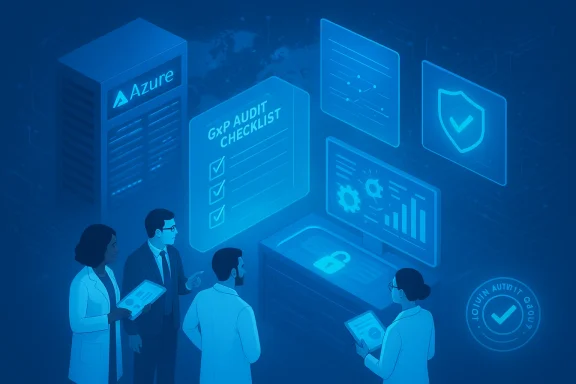
Microsoft Azure has cleared a major industry hurdle for regulated workloads by completing an independent, industry‑led GxP supplier audit conducted through the Joint Audit Group managed by Ingelheimer Kreis on February 19, 2026 — a development that materially changes the cloud risk calculus for life sciences organizations planning validated systems and AI initiatives in production.
Regulated industries — most notably pharmaceuticals, biotechnology, medical devices, and clinical research organizations — run under the umbrella term GxP: the collection of Good Practices that includes GMP (Good Manufacturing Practice), GCP (Good Clinical Practice), GLP (Good Laboratory Practice) and related regulations such as FDA 21 CFR Part 11 and EU Annex 11. Historically, those rules were written with on‑premises, tightly controlled computerized systems in mind. Moving core GxP workloads to public cloud platforms has therefore required careful vendor qualification, supplier audits, and exhaustive validation evidence.
Microsoft’s announcement reports that Azure participated in a Joint Audit Group (JAG) supplier audit, managed by the Ingelheimer Kreis (IK), using a GxP‑aligned scope and a spot‑check methodology. According to Microsoft’s communication, the audit team observed “strong organizational maturity, robust processes, and effective governance structures,” and judged Microsoft’s controls, transparency, and operational rigor to be aligned with the expectations of industry auditors and GxP stakeholders.
This is not merely a Microsoft marketing milestone; it is a structural shift for life sciences procurement. Multi‑sponsor, coalition audits by manufacturer consortia are explicitly intended to reduce duplicate vendor assessments, create shared assurance artifacts, and accelerate supplier enablement so regulated companies can move validated workloads to modern cloud platforms with fewer bespoke audits.
Key considerations when applying AI in GxP contexts include:
However, the audit is a tool — not a cure‑all. Regulated organizations must still perform their own validation, maintain clear shared‑responsibility governance, and ensure that every use of cloud services is justified by documented risk assessments and acceptance criteria.
Action plan for regulated IT, compliance, and QA teams:
Source: Microsoft Microsoft Azure achieves GxP milestone, reinforcing trust for regulated workloads - Microsoft Industry Blogs
 Background / Overview
Regulated industries — most notably pharmaceuticals, biotechnology, medical devices, and clinical research organizations — run under the umbrella term GxP: the collection of Good Practices that includes GMP (Good Manufacturing Practice), GCP (Good Clinical Practice), GLP (Good Laboratory Practice) and related regulations such as FDA 21 CFR Part 11 and EU Annex 11. Historically, those rules were written with on‑premises, tightly controlled computerized systems in mind. Moving core GxP workloads to public cloud platforms has therefore required careful vendor qualification, supplier audits, and exhaustive validation evidence.Microsoft’s announcement reports that Azure participated in a Joint Audit Group (JAG) supplier audit, managed by the Ingelheimer Kreis (IK), using a GxP‑aligned scope and a spot‑check methodology. According to Microsoft’s communication, the audit team observed “strong organizational maturity, robust processes, and effective governance structures,” and judged Microsoft’s controls, transparency, and operational rigor to be aligned with the expectations of industry auditors and GxP stakeholders.
This is not merely a Microsoft marketing milestone; it is a structural shift for life sciences procurement. Multi‑sponsor, coalition audits by manufacturer consortia are explicitly intended to reduce duplicate vendor assessments, create shared assurance artifacts, and accelerate supplier enablement so regulated companies can move validated workloads to modern cloud platforms with fewer bespoke audits.
Why this matters: practical and strategic implications
The announcement matters for three distinct but connected reasons.- Operational friction: Historically, life sciences firms spent significant time and money auditing cloud suppliers, sometimes repeating the same evidence requests across dozens of SaaS and IaaS providers. A joint audit model reduces that duplication and lowers the procurement friction that has slowed cloud adoption for validated systems.
- Validation confidence: While regulators expect the regulated company to validate its computerized systems, an independent, industry‑led supplier audit provides external evidence that the cloud provider’s underlying controls, change management, and operational practices meet the expected baseline. That external assurance can reduce the scope and cost of a customer’s own qualification/validation activities.
- AI and scale: The cloud is the default platform for modern AI and large‑scale data processing. The life sciences industry is wrestling with how to apply AI responsibly in regulated processes — from clinical document summarization to drug discovery pipelines and manufacturing process optimization. Strong third‑party assurance for the cloud stack lowers a material barrier to applying AI at scale in regulated contexts.
What the audit covered — and what it did not
The audit was described as GxP‑aligned and spot‑check based, with sessions that examined governance, security, software engineering, and operational processes relevant to GxP use. This is an important distinction.What was included
- Governance and organizational maturity: oversight, leadership commitment, responsibilities, and oversight models.
- Security and compliance controls: access management, monitoring, incident response, and evidence trails.
- Software engineering and change control: development lifecycle controls, release practices, and how evergreen updates are managed.
- Operational controls: backup/restore, incident management, capacity and availability processes that affect data integrity and availability.
What was out of scope or inherently limited
- A spot‑check approach does not equate to an exhaustive system‑level validation of every Azure service or region. The audit reflects the information Microsoft presented within the agreed scope and the sampling the auditors chose.
- There is no single, standardized “GxP certification” applicable to cloud providers. Regulators typically expect the regulated firm to demonstrate that their computerized systems (and supplier selection) meet GxP expectations — meaning the customer still retains the responsibility to qualify and validate their systems on top of the cloud platform.
- The audit does not replace customer‑level activities such as system categorization, validation plans, test protocols (IQ/OQ/PQ), or the documentation regulators may request during an inspection of a sponsor’s processes.
Independent verification vs. regulatory reality: a careful balance
The distinction between supplier assurance and customer validation is a recurring theme. A supplier audit gives purchasers a higher degree of confidence about the underlying controls and operational rigour. However, in regulated investigations or inspections, auditors will still expect the regulated organization to show:- That it selected a competent supplier (supplier qualification).
- That the computerized system has been validated for its intended use, including documented test evidence.
- Clear assignment and execution of responsibilities in the shared‑responsibility model.
- Traceability between requirements, developer and operational changes, and release artifacts.
Strengths identified — why life sciences should take notice
Microsoft and the audit report highlight several strengths that make Azure a more practical home for regulated workloads.- Operational maturity and governance: A centralized compliance program and executive oversight reduce the risk of governance gaps when scaling regulated workloads globally.
- Change management transparency: Azure’s evergreen update model is a double‑edged sword for validation, but strong change control and documented procedures — if demonstrable — can make continuous updates compatible with validated systems.
- Security posture and tooling: Native tooling such as policy enforcement, identity controls, centralized logging, and threat detection supports compliance and forensic readiness.
- Data residency and sovereignty capabilities: Built‑in region controls, sovereign cloud options, and contractual assurances help address jurisdictional requirements and regulator expectations about where regulated data resides.
- Scale & availability: Mature global operations and redundancy reduce the operational risk of downtime that could impact regulated manufacturing or clinical workflows.
Key risks, caveats, and governance gaps to watch
A balanced assessment must flag practical and regulatory risks so organizations don’t assume audit = compliance.- Spot‑check limitations: Because the audit used a spot‑check approach, it cannot be taken as a proof point for every Azure service or configuration. Customers must verify the specific services they plan to use.
- No “GxP certification” for cloud providers: Regulatory frameworks do not offer a universal stamp that transfers validation responsibility from the customer to the vendor. Organizations should avoid language that implies full transfer of validation obligations.
- Evergreen updates vs. validated baselines: Continuous platform updates require robust supplier communication, rapid impact assessment, and well‑defined processes for applying vendor changes to validated systems without invalidating customer evidence.
- Shared‑responsibility misunderstandings: Misaligned expectations between cloud provider and customer about what is “managed” vs. “customer responsibility” are a recurring audit finding. Clear contractual and operational demarcation is essential.
- Evidence depth for inspections: Regulatory bodies expect auditable evidence, and while supplier audits provide useful artifacts, regulators may still request detailed documentation showing how the regulated company ensured traceability, integrity, and testing for their specific use case.
- Sovereignty and cross‑border data flow: Depending on the use case, additional contracts, data processing agreements, or sovereign cloud deployments may be required to meet local laws — technical controls alone are not always sufficient.
Practical checklist for regulated organizations evaluating Azure after the audit
If you manage GxP systems, here’s a practical checklist to translate this announcement into procurement, validation, and operational action.- Confirm the audit artifacts available to you:
- Request the exact scope, date, and sampling methodology used by the Joint Audit Group.
- Obtain redacted audit findings and management responses where available.
- Map Azure services to your system inventory:
- For each computerized system, list the Azure services used and map responsibility (provider vs. customer) for each GxP control.
- Update your supplier qualification package:
- Incorporate the JAG/IK audit artifacts into your vendor evaluation, but maintain your site‑specific qualification evidence.
- Revisit change‑control and release management:
- Define a rapid impact assessment workflow for vendor updates and establish acceptance criteria for applying platform changes to validated systems.
- Strengthen logging, monitoring, and incident response:
- Ensure continuous, immutable logging for GxP data and define forensic and retention policies aligned to inspection expectations.
- Validate end‑to‑end data integrity:
- Test data flows, audit trails, and backup/restore procedures as part of IQ/OQ/PQ to demonstrate ALCOA‑C (Attributable, Legible, Contemporaneous, Original, Accurate — Complete).
- Contractual protections and data residency:
- Reconfirm data residency clauses, subprocessors, breach notification timelines, and audit rights in your supplier contracts.
- Run a risk‑based impact assessment:
- Use risk tiers to decide whether a service requires additional evidence or architectural mitigations (e.g., private networking, dedicated tenancy, confidential computing).
Recommended Azure controls and tools to include in your validation strategy
Azure provides a broad set of features and tools you can (and should) leverage when building validated systems. Consider these building blocks as part of your validation and compliance architecture:- Identity and access management: centralized identity provider, role‑based access control (RBAC), conditional access policies, and privileged identity management.
- Network isolation: virtual networks, private endpoints, service endpoints, and ExpressRoute for private connectivity.
- Data protection: encryption at rest and in transit, key management through HSMs and customer‑managed keys, and Confidential Computing for sensitive model or data handling.
- Monitoring and auditability: centralized logging with long‑term retention, immutable logs, and tamper‑evident storage for audit trails.
- Compliance posture management: continuous posture assessment tools, compliance manager templates, and policy-as‑code to enforce guardrails.
- Threat detection: integrated threat detection and endpoint protections for managed services and VMs.
- Backup and recovery: documented backup plans, frequent restore tests, and retention aligned with regulatory requirements.
How the Joint Audit Group model shifts procurement and audit economics
The Joint Audit Group approach — where a consortium of manufacturers coordinates and funds supplier audits — is explicitly designed to reduce repetitive supplier assessments and to produce shared evidence that members can rely on. Practically, that translates into:- Faster procurement cycles for high‑value cloud platforms.
- Lowered audit cost per member by sharing the expense of a rigorous third‑party review.
- More consistent audit artifacts and expectations across buyers in the same regulated sector.
- A common set of management responses and CAPAs that can be tracked collaboratively.
Governance playbook: questions to ask your cloud provider and internal stakeholders
To operationalize the audit findings and close the loop with regulators, use this concise set of governance questions:- To the provider:
- What was the exact scope of the JAG/IK audit and which controls were sampled?
- Can you provide redacted audit artifacts and your CAPA (corrective and preventive actions) plan?
- How are platform changes communicated, and what is the SLA for customer impact assessments?
- Which services are explicitly included in your compliance inheritance model, and how do you document them?
- How do you support customer evidence requests during regulator inspections?
- Internally:
- Which computerized systems do we plan to migrate or build on Azure, and what is their GxP categorization?
- What are the specific validation deliverables (IQ/OQ/PQ) we need to produce?
- Do our contracts and SOPs reflect the shared‑responsibility model and inspection support obligations?
- How will change management interact with vendor evergreen updates?
- Which mitigations (technical, contractual, procedural) are required for high‑risk systems?
A pragmatic outlook for AI and regulated innovation
One of the most consequential, long‑term impacts of reducing cloud procurement friction for regulated workloads is that it enables scaled, auditable AI work in the life sciences. Organizations can more confidently adopt cloud‑native ML pipelines, secure model training on sensitive datasets, and operate analytical platforms that accelerate R&D and manufacturing optimization — provided they treat the operational and regulatory constraints as first‑class design requirements.Key considerations when applying AI in GxP contexts include:
- Model provenance and version control as part of validation evidence.
- Data lineage and immutability for training sets used in regulated decision support.
- Human‑in‑the‑loop governance where AI outputs inform clinical or manufacturing decisions.
- Explainability and monitoring for model drift, with documented remedial processes.
Conclusion — what life sciences and regulated organizations should do next
Microsoft’s successful completion of an industry‑led GxP supplier audit through the Joint Audit Group managed by Ingelheimer Kreis is a meaningful enabler for cloud adoption in regulated industries. It reduces supplier evaluation overhead, provides industry‑level assurance about Azure’s controls, and makes the cloud a more viable platform for validated systems and AI workloads.However, the audit is a tool — not a cure‑all. Regulated organizations must still perform their own validation, maintain clear shared‑responsibility governance, and ensure that every use of cloud services is justified by documented risk assessments and acceptance criteria.
Action plan for regulated IT, compliance, and QA teams:
- Obtain the audit scope and artifacts and integrate them into your supplier qualification package.
- Map services to your systems and update validation plans to reflect Azure’s controls and your remaining responsibilities.
- Tighten contractual clauses for data residency, audit rights, and change notification around platform updates.
- Run a risk‑based pilot for one non‑critical validated system to exercise the supplier evidence flow, change management, and inspection readiness processes.
- Build cross‑functional KPIs (dev, ops, QA, compliance) that measure evidence readiness, time‑to‑restore, and change assessment latency.
Source: Microsoft Microsoft Azure achieves GxP milestone, reinforcing trust for regulated workloads - Microsoft Industry Blogs